
Emyria’s depression program delivers encouraging early results across first patient cohort
Emyria Limited (ASX: EMD) has reported encouraging early data from the first cohort of patients in its treatment-resistant depression (TRD) program, delivered through its national Empax Centre network. The findings mark the Company’s second major treatment program, extending its real-world model beyond the established, reimbursed Post Traumatic Stress Disorder (PTSD) program into a significant new patient group.
The results are being presented by Chief Scientific Officer Dr Michael Winlo at the 2026 International Mental Health Conference, Gold Coast (23 to 24 June 2026).
Across the first cohort of 10 patients, improvements were recorded across all four standard mental-health measures, with depression symptoms falling 6.8 points on average (from 16.8 to 10.0). The Company has framed these as early and exploratory data, not proof of effectiveness.
When big ASX news breaks, our subscribers know first
Inside the first-cohort results
Each of the 10 patients had a starting assessment and a follow-up at least three months after completing treatment. According to Emyria, patients showed clinically significant reductions in depression and trauma symptoms, alongside improvements in quality of life and daily functioning. Every change reported was statistically significant.
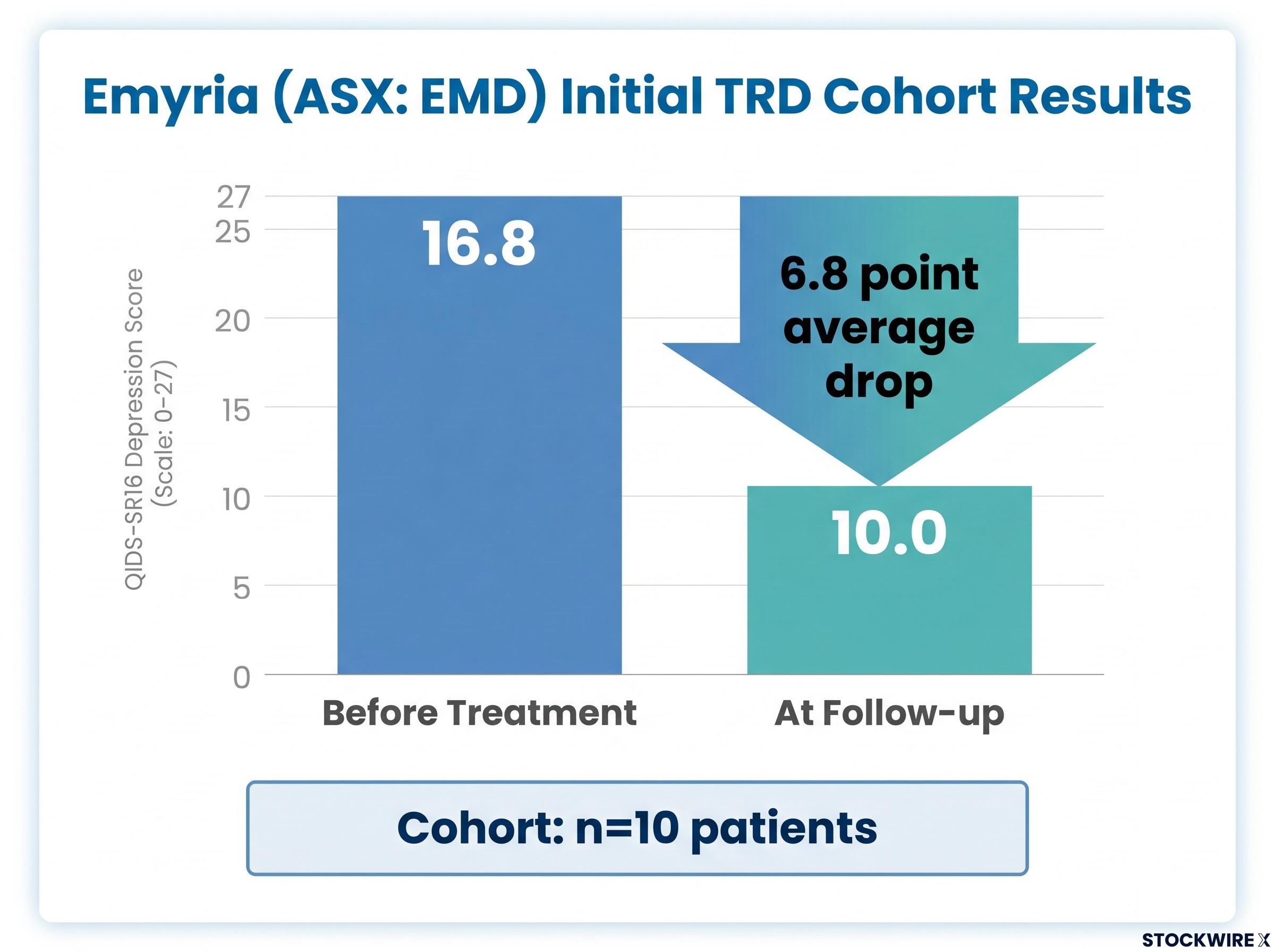
The headline measure relates to depression severity. Symptoms in this treatment-resistant group fell by 6.8 points on average, from 16.8 to 10.0 on the QIDS-SR16 scale, where a lower score indicates fewer symptoms. The Company describes this as a clinically significant improvement.
| Measure | Before Treatment | At Follow-up |
|---|---|---|
| Depression score (QIDS-SR16) | 16.8 | 10.0 |
| n=10; follow-up median 6.5 months (range 3.4 to 14.5 months); 2 to 3 dosings. Lower is better. Early and exploratory data, not proof of effectiveness. | ||
Dr Michael Winlo, Chief Scientific Officer
“Every patient in our first depression cohort analysed demonstrated significant improvements across depression and trauma symptoms, quality of life and everyday functioning. This is especially encouraging given these are individuals who were previously living with treatment-resistant depression, a major unmet need in mental health. This kind of real-world data helps improve our care models across both our TRD and PTSD programs. We look forward to sharing more as we scale.”

Understanding treatment-resistant depression and why it matters
Treatment-resistant depression refers to patients who do not respond adequately to standard treatments. According to Emyria, roughly one in three people with depression fall into this group, leaving a large population without effective options.
The TRD program follows the same real-world data collection approach used in Emyria’s established PTSD program, where PTSD remission outcomes showed 67% of treatment-resistant patients maintaining clinical remission at 12 months post-treatment, a benchmark that helped secure private health insurer participation across the network.
The QIDS-SR16 (Quick Inventory of Depressive Symptomatology, Self-Report) is a widely used questionnaire that measures the severity of depression symptoms. Scores range from 0 to 27, with a lower score meaning fewer symptoms.
The scale of the opportunity in Australia is substantial:
-
More than 2 million Australians experience depression
-
Around 1 in 3 do not respond to standard treatments
-
Approximately 600,000 patients are affected, representing a major unmet need
-
Mental health is among Australia’s largest contributors to burden of disease, second only to cancer
For investors, this underserved patient population frames both the clinical and commercial context for Emyria’s treatment model as it extends into a second indication.
A growing, funded national program
The operational footprint behind the depression program points to an expanding national presence. Emyria runs two treatment programs across a growing clinic network, with most patients supported by external health funding.
-
Two active programs (PTSD and TRD) delivered across four operational Empax clinics
-
A fifth clinic in NSW preparing to come online in Q3 2026, spanning Australia’s four largest states
-
Most patients are supported by private health insurance or other major health funders, an early indication of growing system support
On the regulatory side, in May 2026 the Therapeutic Goods Administration broadened its Authorised Prescriber pathway to widen the range of clinicians who can deliver these therapies. Emyria sees this as evidence of growing regulatory confidence in these programs.
What the results mean for investors, and what comes next
The TRD data offers an early signal that Emyria can extend its real-world treatment model to a new, large indication. That said, the Company has been explicit about the analysis’s limitations, which are central to interpreting the results responsibly.
Key caveats include:
-
A small group of only 10 patients, where one or two individuals can move the average
-
Only patients with follow-up information are included, an early subset of more than 20 patients currently in the program
-
Follow-up timing varied, ranging from 3 to 14 months after the end of treatment, so improvement is described at a typical point rather than a fixed time
Looking ahead, Emyria’s focus remains on clinic expansion, including the fifth site due in Q3 2026, and on generating further cohort data as the program scales. Management has noted that this real-world data feeds back into both the TRD and PTSD care models, supporting continued refinement of its approach as patient numbers grow.
For investors exploring how the growing clinic network generates revenue beyond direct patient treatment, our deep-dive into the Empax Global Partnership Program covers the capital-light sponsor-funded model in full, including the first commercial engagement with North American partner Psyence Group.
Don’t Miss the Next Healthcare Breakthrough on ASX
Big News Blast delivers FREE breaking ASX healthcare news directly to your inbox within minutes of release, with in-depth analysis already done. Join 20,000+ subscribers staying ahead of market-moving announcements the moment they drop. Click the “Free Alerts” button at StockWire X to start receiving real-time coverage across ASX healthcare and beyond.