
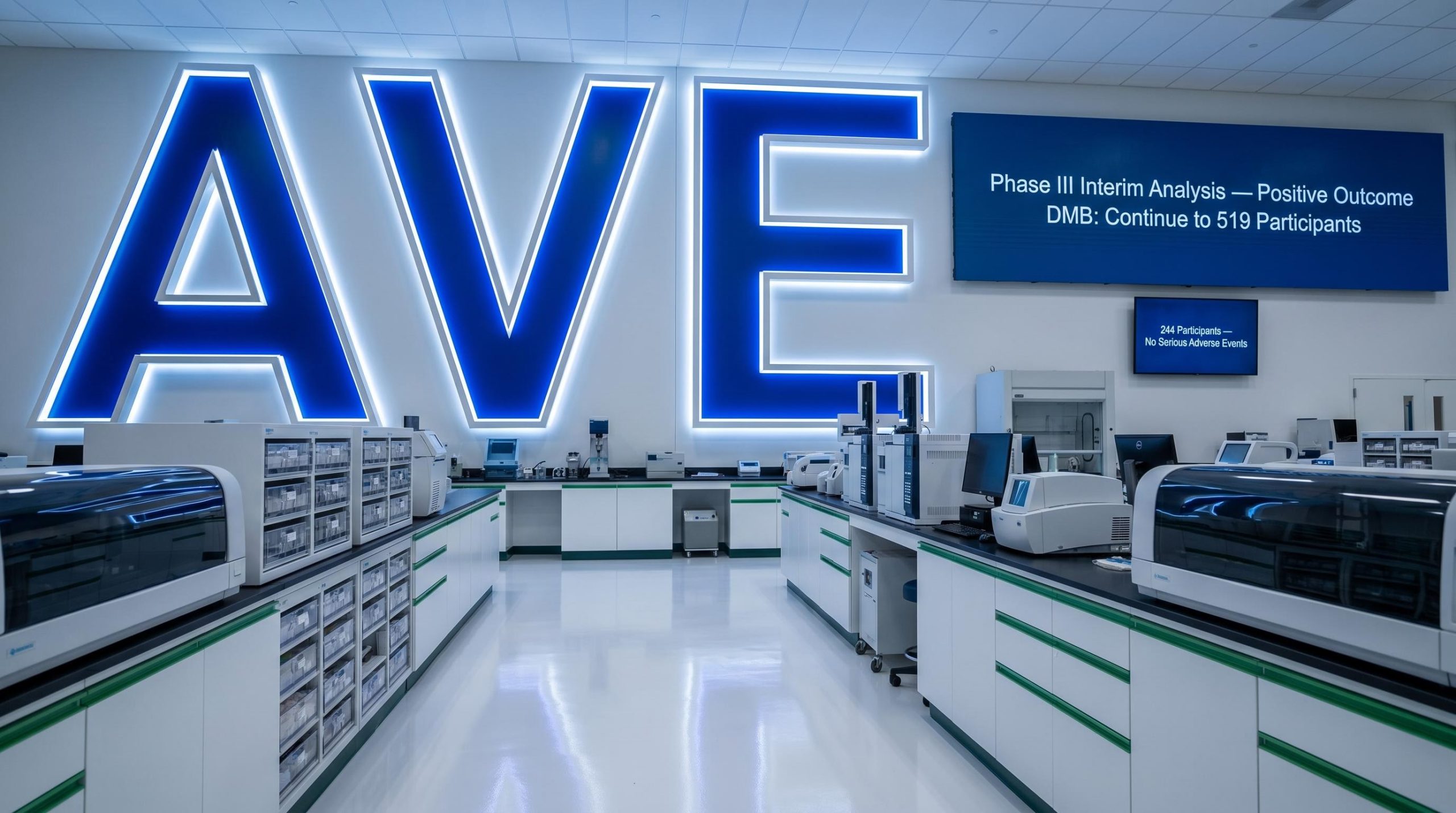
Avecho’s Phase III insomnia trial clears its first major hurdle
In its investor presentation detailing a positive Phase III interim analysis result, Avecho Biotechnology (ASX:AVE) outlined the outcome shareholders had been waiting on. An independent Data Monitoring Board (DMB) recommended the company’s CBD insomnia trial continue to 519 participants, the base-case positive result management had been targeting.
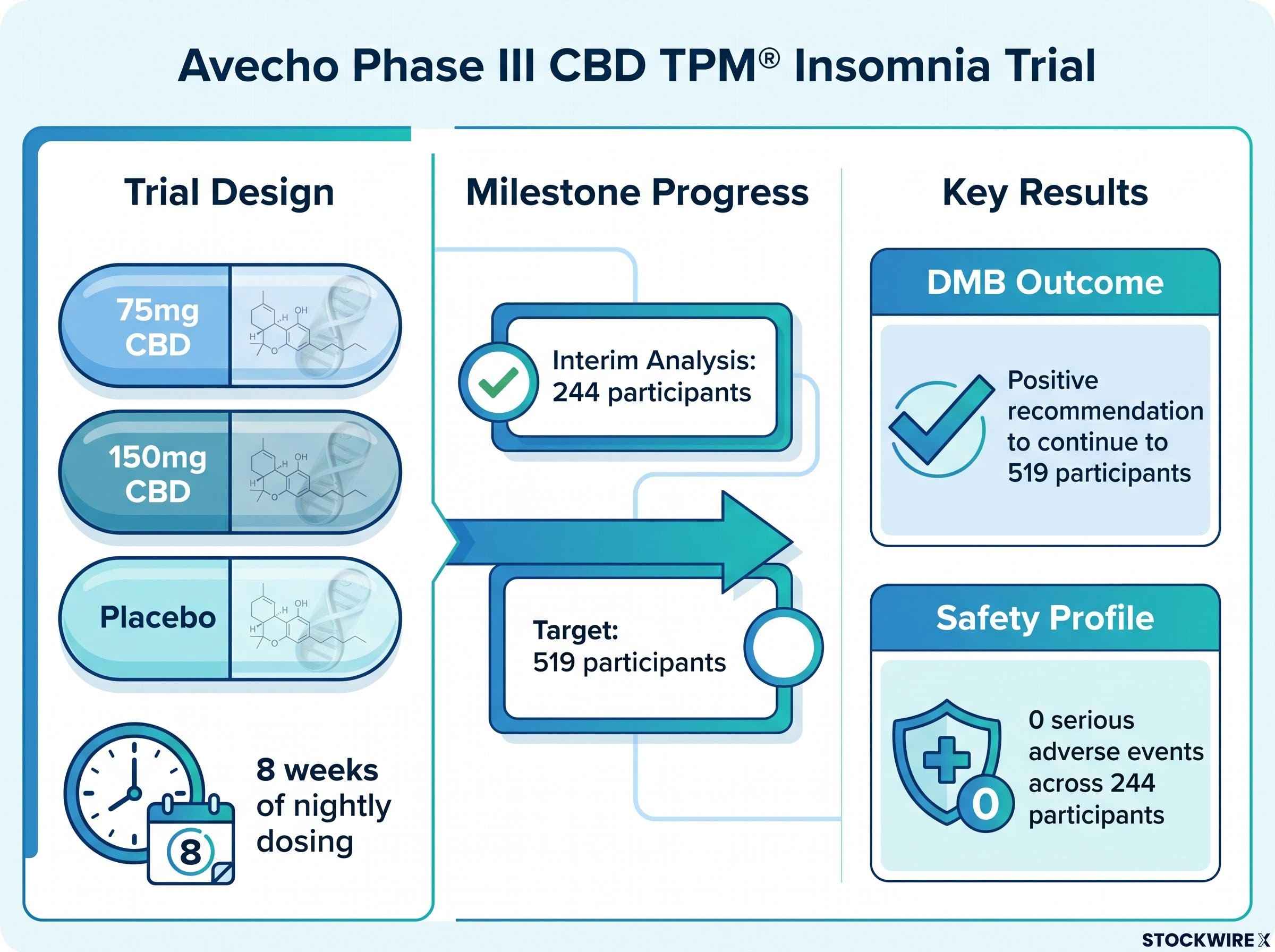
The recommendation followed an interim analysis of 244 participants, which showed a treatment effect on at least one of the trial’s two primary endpoints. Management framed the outcome as carrying dual significance: a positive efficacy signal alongside a clean safety profile.
The final pre-readout milestone was cleared in late May 2026, when all 244 participants completed their treatment phase and the dataset was handed to the independent board for unblinded analysis.
The study tests Avecho’s CBD TPM® capsule across three arms (75mg CBD, 150mg CBD and placebo) over 8 weeks of nightly dosing per participant. By clearing the interim review, the trial removes a key piece of binary risk and validates the assumptions underpinning the remaining patient cohort.
When big ASX news breaks, our subscribers know first
Inside the readout — what the DMB recommendation actually means
The DMB could have recommended one of three outcomes. The result landed on the base-case positive scenario, not an early efficacy stop and not futility.
-
Positive — continue to the second cohort at the confirmed sample size (the result delivered)
-
Positive — stop early for efficacy (an upside scenario management did not expect)
-
Negative — stop the trial for futility
The board is independent of Avecho and the trial investigators, and is the sole body with access to the unblinded interim data. Avecho, its investigators and patients all remained fully blinded throughout the process, consistent with best practice for pivotal placebo-controlled trials.
On efficacy, management highlighted that the DMB recommended continuation at the originally planned sample size rather than a larger one. According to the presentation, this signals that Avecho’s original assumptions on effect size and data variability are tracking at, or better than, expectation. Those original assumptions held that the product performs as well as approved insomnia drugs.
Management’s takeaway from the interim analysis was that, so far, the product’s performance appears in line with approved insomnia medications, with a safety profile described as competitive against existing therapies.
On safety, the presentation reported no serious adverse events across the 244 participants dosed at the two CBD doses during the interim analysis.
Why this trial was built to deliver a result
Insomnia refers to difficulty falling asleep or staying asleep. The condition affects an estimated 10–30% of Australians, yet management noted there is no approved over-the-counter (OTC) pharmaceutical product currently available in Australia for ongoing use.
That gap underpins the commercial logic. Since February 2021, Australia’s Schedule 3 OTC pathway has permitted low-dose CBD (≤150mg/day) to be sold pharmacist-only, but management noted that no product has yet met the efficacy bar required for Australian Register of Therapeutic Goods (ARTG) registration. A successful Phase III is the registration-enabling dataset.
The presentation outlined three design features built specifically to maximise the probability of a clinical signal:
-
Two independent primary endpoints (the Insomnia Severity Index, ISI, plus subjective sleep efficiency, sSE) — only one needs to succeed for trial success
-
Adaptive design interim analysis — allowing the required patient numbers to be recalibrated mid-study to ensure a conclusive result
-
Placebo-effect control mechanisms — designed to detect a genuine drug effect cleanly
The trial tests the 150mg maximum allowed OTC dose, applies a tight ISI ≥ 15 inclusion criterion, and was designed to FDA and EMA standards. Management described it as the largest CBD insomnia trial globally, designed to support a TGA submission on positive completion.
A large, underserved global market — and the licensing upside
Management led the commercial section with the company’s Australian commercial partner, Sandoz. The licensing terms presented comprise US$3M upfront, US$16M in milestones (US$19M total prior to commercial sales) and 14–19% tiered royalties. Australia is framed as the first territory in a broader global strategy.
The presentation positioned the global market context as follows.
| Metric | Figure | Detail | Relevance |
|---|---|---|---|
| Chronic insomnia | ~850M adults | 16.2% of global adults | Scale of need |
| Symptom prevalence | ~1 in 3 adults | At some point | Broad demand |
| Market by 2033 | ~US$9.5bn | from ~US$6.1bn (2025) | Growth runway |
| Market CAGR | ~6% | 2025–2033 | Sustained expansion |
Management framed the opportunity around three drivers:
-
A safety-driven gap, as benzodiazepines, Z-drugs and sedating antihistamines carry dependence, next-day impairment and overdose risk, shifting demand toward safer, non-scheduled options
-
An open Australian OTC pathway with no ARTG-registered product yet meeting the efficacy bar
-
First-mover potential with Sandoz as Australian commercial partner
The presentation also included indicative regional licensing multipliers (for example, USA 30x, Europe 20x, China 10x) relative to the Australian deal. These were presented as illustrative opportunity sizing only, not committed deals or guaranteed value. Management noted the Australian licensing agreement marks the first of potentially several agreements globally, with Australia small relative to international pharmaceutical markets. The company cited an Australian addressable market potential of >US$125M per annum and 9.5M Australians experiencing insomnia.
How the base case gets funded and what comes next
Management framed two questions shareholders would ask: how much, and how long. On funding, the stated priority is a pharmaceutical licensing deal for an ex-Australian territory, with upfront fees intended to fund Phase III completion. The company also reported a pro-forma cash position of $6.25M.
On execution, approximately 300 additional patients are required to complete the trial. The plan involves opening around 10 additional clinical sites (already identified), with recruitment expected to take approximately 12 months once those sites are engaged.
Running in parallel, management outlined TGA dossier construction with Sandoz, manufacturing scale-up funded from an earlier placement, further ex-Australia licensing conversations, and engagement with international regulators such as the FDA.
-
H2 2026: pursue multiple licensing deals; open additional trial sites and recommence dosing; engage overseas regulators; scale up manufacturing
-
2027: pursue further licensing; complete Phase III dosing to the final patient; finalise the TGA submission dossier; develop the product with partners in international territories
Management positioned this as a sequenced path to a registration-enabling dataset, with the cash position and licensing optionality framed as factors that could reduce dilution risk.
A de-risked investment case
Management closed by arguing that each part of the thesis has been independently validated at successive steps: preclinical work (TPM increased CBD absorption), the US Patent Office (product uniqueness), the TGA (trial design and submission strategy), Sandoz (commercial case), and now the interim analysis (evidence the product works for the indication).
The presentation summarised the de-risked case as follows:
-
Positive Phase III interim analysis — an efficacy and safety signal after 244 patients
-
Sandoz partnership, described as the world’s largest generics pharma
-
A clear TGA registration pathway via the Australian OTC route
-
Global licensing potential across multiple jurisdictions
-
Pro-forma cash of $6.25M to execute
Management’s framing was that the focus now shifts from whether the product will work toward what it could become.
For readers wanting fuller management commentary on these results, our detailed coverage of the June investor webinar captures CEO Dr Paul Gavin’s discussion of the interim analysis outcome, including the implications for the TGA submission timeline and ex-Australia licensing strategy.
Don’t Miss the Next ASX Healthcare Breakthrough
Big News Blast delivers FREE breaking ASX healthcare news directly to your inbox within minutes of release, complete with in-depth analysis. Join 20,000+ subscribers already staying ahead of the market. Click the “Free Alerts” button at StockWire X to get the next market-moving announcement the moment it drops.