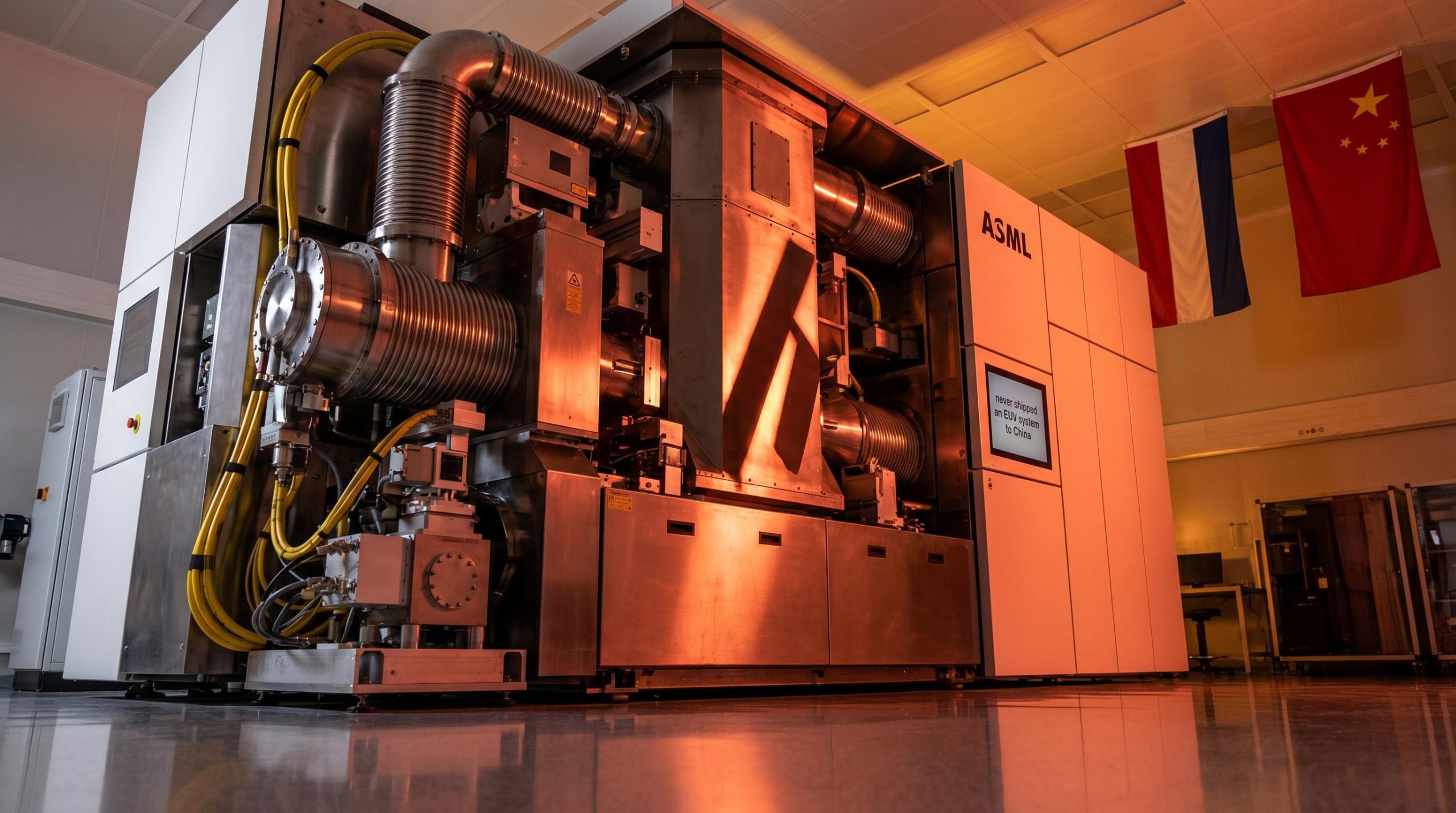
ASML, the Dutch company with an effective monopoly on the world’s most advanced chipmaking equipment, saw its shares fall in early European trading on 19 June 2026 after reports that U.S. Commerce Secretary Howard Lutnick personally raised concerns with ASML executives about an advanced extreme ultraviolet (EUV) system potentially reaching China. The allegation sits at the centre of the U.S.-China technology cold war, targeting a machine so critical to advanced semiconductor manufacturing that its movement across borders is one of the most closely watched issues in global trade policy. What follows explains what is actually alleged, why ASML’s response carries weight, what the regulatory risk channels look like for shareholders, and how investors should frame this episode relative to the company’s longer structural story.
What U.S. officials are actually alleging against ASML
Bloomberg News reported that U.S. government officials conveyed concerns to ASML’s leadership in a series of meetings about a possible illicit transfer of an EUV system to China, despite longstanding export bans on the technology. Commerce Secretary Howard Lutnick was named as the official who raised the matter directly with ASML executives.
The reporting characterises this as a concern expressed in private diplomatic and regulatory channels. It is not, as of 19 June 2026, a publicly announced formal investigation, charge, or enforcement action. Official U.S. government communications have not yet publicly confirmed a formal case.
ASML shares declined in early European trading on the news. The market reaction, however, may be running ahead of the confirmed facts, and investors should calibrate near-term risk against what has actually been established rather than what the headline implies.
When big ASX news breaks, our subscribers know first
ASML’s position and why its denial carries weight
ASML’s response has been categorical.
The company states it has never shipped an EUV system to China and that no such system is installed there.
This claim is not a reflexive corporate denial. It sits on years of verifiable export history. ASML has been barred from exporting EUV tools to China under Dutch and U.S.-aligned export rules for years, a restriction the company has publicly complied with throughout. Any EUV machine reaching China would most likely have arrived through secondary transfer, reverse engineering, or misuse by intermediaries rather than a direct ASML shipment.
That distinction matters legally, but it does not remove ASML from the regulatory spotlight. Even if the company did not directly violate any rule, a secondary transfer scenario involving one of its systems would still trigger compliance scrutiny, oversight demands, and potential conditions on future shipments. ASML’s exposure is not limited to what it shipped. It extends to what happened after.
What makes EUV machines the most consequential export-control target in the world
EUV (extreme ultraviolet lithography) machines are the tools used to manufacture the most advanced semiconductors powering AI, high-performance computing, and flagship smartphones. Without them, fabricating chips at the leading edge of transistor density is not commercially viable.
EUV lithography systems print transistor features by exposing silicon wafers to extreme ultraviolet light at wavelengths around 13.5 nanometres, a process so physically demanding that the machines require hundreds of bespoke subsystems and took decades of coordinated engineering investment to bring to commercial scale.
ASML is the sole commercial supplier of these systems worldwide, a position that makes it both strategically indispensable and a permanent target for geopolitical pressure.
Why ASML has no commercial rival in EUV
Decades of specialised development, deeply integrated supply chains, and cumulative engineering investment mean no competitor has reached commercial EUV scale. This monopoly is precisely why the technology sits at the centre of export-control policy: there is no alternative supplier to route around.
The U.S. pushed the Dutch government for years to deny export licences for EUV shipments to China, a campaign that succeeded and was later extended to tighten controls on other advanced lithography tools. The distinction between what ASML can and cannot sell to Chinese customers currently breaks down as follows:
The Dutch government export licence requirements for DUV systems, formalised through updated rules in September 2024, extended the licensing framework beyond EUV to cover higher-end deep ultraviolet tools, establishing the Netherlands as an active co-enforcer of the export-control regime rather than simply a jurisdiction responding to U.S. pressure.
- EUV systems: Banned from export to China under Dutch and U.S.-aligned controls. No shipments have been made.
- DUV (deep ultraviolet) systems: Currently permitted under existing rules, making China a significant but increasingly constrained market for ASML’s less advanced tools.

Any allegation involving EUV reaching China triggers immediate market and policy reactions because it strikes at the single most protected chokepoint in the global semiconductor supply chain.
The four risk channels investors need to understand
The risks facing ASML from this episode are not uniform. They differ in probability, trigger conditions, and potential impact. The table below maps the four channels investors should distinguish.
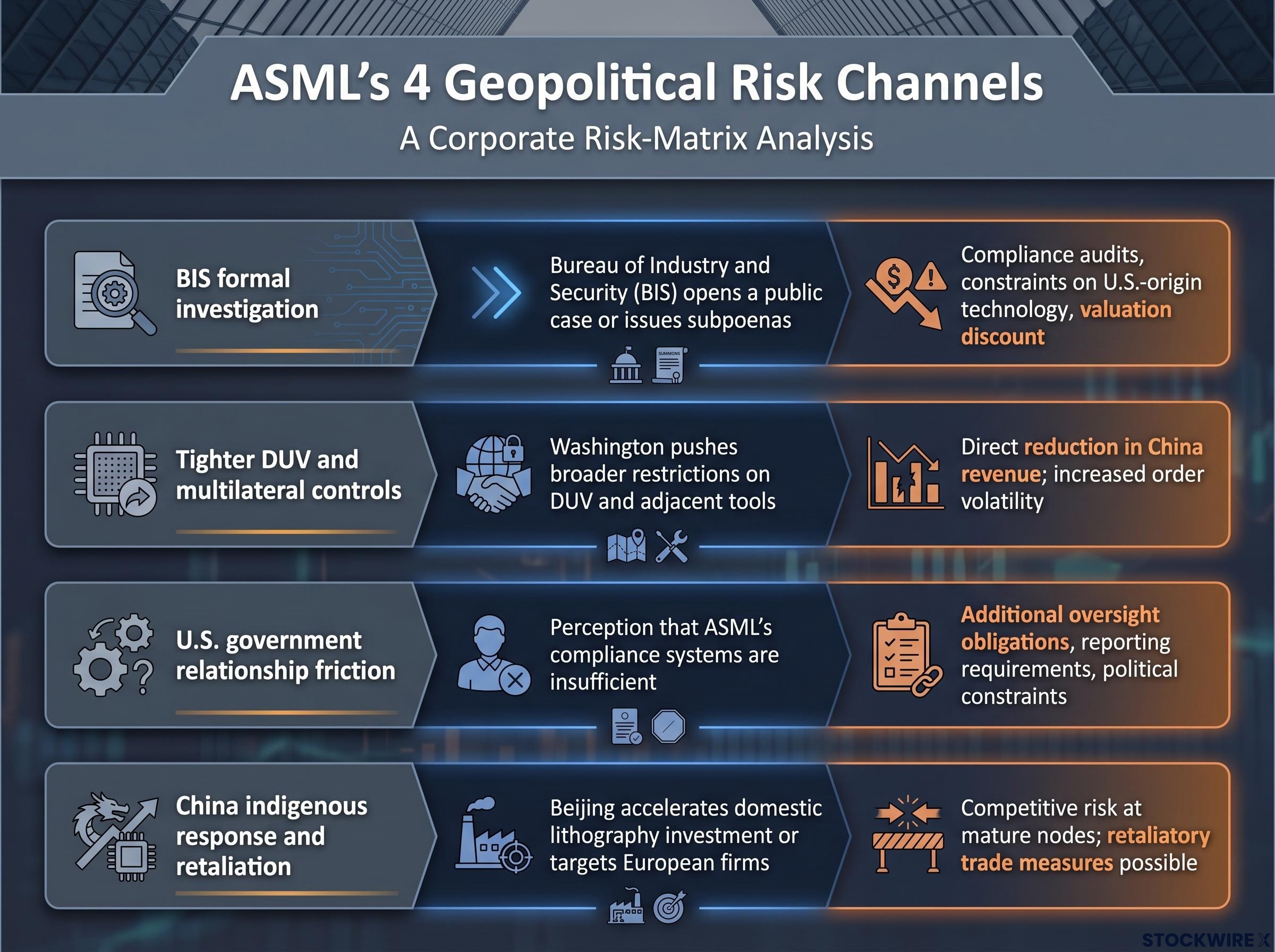
| Risk Channel | Trigger Condition | Investor Impact |
|---|---|---|
| BIS formal investigation | Bureau of Industry and Security (BIS) opens a public case or issues subpoenas | Compliance audits, potential constraints on U.S.-origin technology access, valuation discount |
| Tighter DUV and multilateral controls | Washington uses episode to push broader restrictions on DUV and adjacent tools | Direct reduction in China revenue; increased order volatility from Chinese customers |
| U.S. government relationship friction | Perception that ASML’s compliance systems are insufficient | Additional oversight obligations, reporting requirements, and political constraints on growth |
| China indigenous response and retaliation | Beijing accelerates domestic lithography investment or targets European firms | Long-term competitive risk at mature nodes; near-term retaliatory trade measures possible |
The regulatory exposure depends heavily on whether BIS opens a formal investigation and whether compliance gaps or secondary transfers are documented. Even without a proven violation, episodes like this are used in Washington to justify tightening controls on what ASML can sell to China, which would affect China revenue directly.
Tightening AI chip export rules has been a consistent direction of U.S. trade policy regardless of diplomatic cycles, with the Commerce Department closing a major loophole in May 2026 that allowed Chinese-headquartered entities to receive restricted processors through third-country subsidiaries, a move that signals the regulatory floor is shifting rather than holding steady.
BIS enforcement actions on semiconductor exports have set clear precedents for the scale of consequences companies face, including the $252 million penalty imposed on Applied Materials for illegally exporting semiconductor manufacturing equipment to China, a benchmark that shapes how investors should assess potential ASML liability if a formal case is opened.
China has been investing in indigenous lithography alternatives but remains behind EUV at commercial scale, meaning ASML’s tools remain necessary for many Chinese fabs at mature and mid-range nodes.
Three scenarios shaping how this story develops
- Base case: headline risk, limited structural change. No hard evidence surfaces of a direct ASML violation. The U.S. uses the episode to push for incremental tightening and stricter monitoring of China-bound shipments, particularly higher-end DUV tools. ASML continues to grow on non-China advanced-node demand while China sales become more regulated and volatile. The stock absorbs a risk-premium bump and news-driven volatility, but the long-term moat and demand story remain intact.
ASML’s valuation discount relative to U.S. semiconductor equipment peers has compressed from a historical premium of roughly 84% to approximately 6-15% as of mid-2026, a collapse that reflects geopolitical risk being priced into the multiple even as the underlying EUV monopoly has grown stronger over the same period.
- Adverse case: formal enforcement and tougher multilateral controls. A formal investigation is announced. Second-hand transfers or compliance gaps are documented. ASML faces penalties or new conditions on its use of U.S. technology, and the Netherlands and other allies tighten controls further on a wider range of tools. This scenario would mean a structurally lower China revenue contribution, a higher discount rate embedded in the valuation, and a more politically constrained growth path.
- Tail-risk case: extreme technology sanctions. The U.S. threatens to curtail ASML’s access to certain U.S.-origin components or software unless specific conditions are met.
This tail-risk scenario carries low probability but high impact. Disruption would extend well beyond ASML to U.S. chipmakers and allied fabrication facilities worldwide that depend on its tools, making it a costly escalation for all parties involved.
What to watch in the days and weeks ahead
The gap between a private regulatory concern and a formal enforcement action will close or widen based on a small number of observable signals. Investors should track:
- Official U.S. government communications. Any public statement or announcement from the Bureau of Industry and Security (BIS) would materially change the risk profile compared to the anonymous and background briefings reported so far. A formal case is a different category of event from a diplomatic conversation.
- Dutch government and EU signals. Whether The Hague or Brussels indicate they view this as a compliance problem or simply as heightened U.S. concern will shape the regulatory path. Coordinated allied action would amplify the impact; Dutch pushback would contain it.
- ASML disclosures and earnings commentary. Upcoming filings and calls should be monitored for any mention of investigations, export-licence changes, or updated China revenue guidance. What the company discloses voluntarily will indicate how seriously it views the regulatory risk.
- Sector moves in peer equipment companies. U.S. and Japanese lithography and process equipment makers often trade in sympathy on U.S.-China export news, creating both contagion risk and relative-value opportunities across the semiconductor equipment group.
ASML remains indispensable, but indispensability has a price
ASML’s monopoly position in EUV lithography is the foundation of its investment case and, simultaneously, the source of its recurring geopolitical exposure. The two cannot be separated. What has emerged so far is a headline and regulatory-risk shock, not yet a thesis-breaking event, but a reminder that the stock will always trade with a geopolitical risk premium attached.
The question now is whether this episode remains a concern raised in private meetings or escalates into formal enforcement. Investors have a framework to track that distinction, and the signposts are specific and observable.
Investors wanting to weigh the geopolitical risk premium against the structural growth arguments will find our deep-dive into ASML’s bull case, which examines the UBS price target rationale in detail, including revised EUV output projections for 2027 and the memory cycle extension thesis that sits at the centre of the most optimistic institutional view on the stock.
This article is for informational purposes only and should not be considered financial advice. Investors should conduct their own research and consult with financial professionals before making investment decisions.