
Why 68% of Australian CFD Traders Lose, and What 2027 Changes
51 mins ago

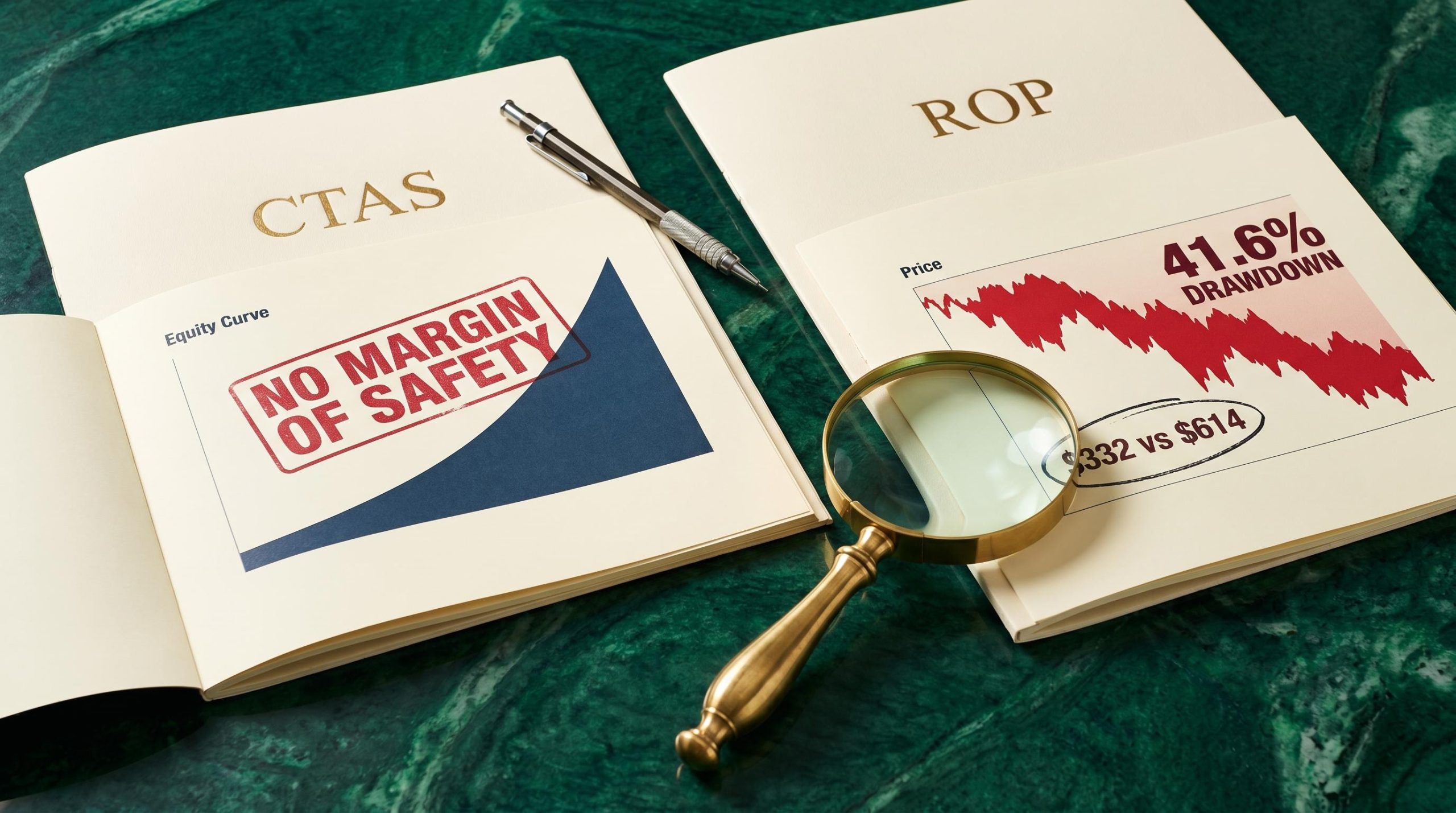
Two high-quality dividend growers sit side by side in many income-focused portfolios: Cintas Corporation and Roper Technologies. Both deliver consistent earnings growth, rising dividends, and the kind of competitive positioning that earns a permanent place on watchlists. But a discounted cash flow analysis of each company, conducted across multiple independent models as of mid-2026, produces two starkly different conclusions. One stock appears priced for its quality with no room to spare. The other, following a 41.6% drawdown, shows a valuation gap wide enough to warrant active diligence.
What follows is a side-by-side case study using both companies to demonstrate how DCF methodology reveals what price-to-earnings ratios and dividend yields alone cannot: whether a quality business is priced for a return, or simply priced for its reputation.
Dividend yield tells an investor what a company pays today. The P/E ratio tells them what the market charges per dollar of current earnings. Neither metric answers the question that matters most for a long-term holder: is today’s price rational given the cash this business is likely to generate over the next decade?
That is the question a discounted cash flow framework is designed to answer. The method works in three steps:
The output is a range of plausible intrinsic values, not a single number. For Cintas, four independent models produced estimates spanning from $126 to $218 per share. That range is wide, yet every model shared a directional conclusion: no wide margin of safety at recent prices. For Roper Technologies, independent models ranging from roughly 20% to 46% undervaluation all pointed the same way.
The margin of safety discipline requires more than identifying a discount to intrinsic value; it requires that the discount be wide enough to absorb model error, because the terminal value assumption alone typically drives 60-80% of a DCF model’s total implied output.
“DCF models don’t give you a price target. They give you a probability-weighted argument about whether today’s price is rational.”
The convergence or divergence of multiple models is the signal worth paying attention to. A single model’s precision matters far less than whether several independent approaches agree on direction.
Cintas operates in a specialised, recurring-service niche that produces steady, predictable cash flows. Revenue and net income have risen consistently over multiple years. Financial statement quality ratings are positive across evaluated categories, and recent commentary from independent analysts frames the company as a “great business, demanding price.”
The dividend profile reinforces the quality case. Shareholder yield sits at approximately 2.5% when buybacks are included alongside the roughly 1% dividend yield. One detail that trips up chart-based analysis: Cintas transitioned from annual to quarterly dividend payments, creating a visual artifact on dividend charts that resembles a cut. It was a schedule change, not a reduction in payout.
The valuation picture is where the tension lives. Multiple independent DCF models have been applied to Cintas at recent prices near $177-$180, and the results span a wide band.
| Source | Estimated Fair Value | Implied Verdict |
|---|---|---|
| GuruFocus | ~$126 | Overvalued |
| Simply Wall St | ~$218 | Modest discount |
| Sahm Capital | ~$176 (6% discount) | Near fair value |
| 2-Stage FCFE Model | ~$158 | Overvalued |
No single model delivers a definitive overvaluation figure. But the directional consensus is clear: none of these frameworks presents a wide discount, and the two models suggesting near-fair-value rest on assumptions investors should interrogate carefully.
The practical implication is straightforward. A 15-20% pullback or several years of sustained earnings growth without further multiple expansion would likely be needed to create a clear margin of safety. Buyers at today’s price are paying for quality rather than getting a discount on it.

A 41.6% decline over twelve months is the kind of price action that forces a question: has something broken, or has sentiment overshot?
Roper Technologies operates primarily in vertical-market software, acquiring and running niche businesses with high recurring revenue and strong free cash flow characteristics. Multiple independent research sources have examined the drawdown and attribute it to broader software and AI-adjacent sector pressure rather than identified fundamental impairment. The business model, centred on acquiring sticky, cash-generative software platforms, appears structurally intact based on available data.
Value trap risk is the critical analytical challenge when interpreting a 41% drawdown: distinguishing a structurally declining business from a temporarily mispriced one requires more than a DCF gap, it requires a qualitative assessment of competitive position, balance sheet trajectory, and management capital allocation history.
The DCF picture is where the case sharpens. Unlike Cintas, where independent models diverge on magnitude but agree on direction (no bargain), Roper’s independent models converge on both direction and scale:

When multiple DCF models using different methodologies, different discount rates, and different projection horizons all reach the same directional conclusion, that convergence carries more weight than any single estimate’s precision.
Three conditions would need to hold for the bull case to play out:
Viewed separately, each company tells a self-contained story. Placed on the same table, the contrast becomes the lesson.
| Dimension | Cintas (CTAS) | Roper Technologies (ROP) |
|---|---|---|
| Business Quality | High; durable compounder | High; recurring-revenue software |
| Dividend Yield | ~1% | Low but rising |
| Shareholder Yield | ~2.5% (dividends + buybacks) | Negative debt paydown yield |
| DCF Verdict | Wide band; no margin of safety | 20-46% undervalued across models |
| P/E vs. History | Rich multiple | Near 10-year low |
The 12-month price change tells the rest of the story: Cintas has experienced a modest pullback, while Roper has declined approximately 41.6%. The primary risk for each company differs accordingly. Cintas carries valuation compression risk; buyers are exposed if earnings growth disappoints at a premium multiple. Roper carries balance sheet and acquisition integration risk; the discount only converts to returns if the business executes.
The Cintas and Roper comparison does not exist in a vacuum: US equity market valuation signals including the Buffett Indicator at 223.6% and compressed earnings yields relative to Treasury rates set the macro backdrop against which any individual DCF analysis must be read.
Neither company is being dismissed here. Cintas remains a high-quality compounder. The distinction is between “buy now” and “watchlist,” and DCF analysis is what separates the two.
Valuation and risk are not separate analytical exercises. The discount rate embedded in every DCF model is itself a risk expression: a riskier business demands a higher rate, which reduces the implied fair value. Understanding that relationship transforms risk from a vague warning into a pricing input.
The discount rate as a risk expression is not an abstract modelling choice: a business with fragile competitive positioning, customer concentration risk, or balance sheet leverage demands a higher rate than a durable compounder, and that higher rate directly compresses the implied intrinsic value output.
For Cintas, the risk is asymmetric at current multiples. The approximately 1% dividend yield offers limited income compensation during a wait, and a sustained period of multiple compression or a broader market decline would expose the premium. There is little cushion built into the price if earnings growth decelerates.
For Roper, the risk is different in character. The DCF discount is real across multiple models, but realising that discount requires the business to deliver on specific conditions. Before sizing a position, three questions deserve clear answers:
Each of these questions feeds directly back into the DCF thesis. A negative answer on debt accretion or acquisition quality would justify raising the discount rate, narrowing or eliminating the implied undervaluation.
The specific numbers for Cintas and Roper will shift as prices move and new earnings data arrives. The method does not expire.
Any dividend compounder an investor is evaluating can be run through the same three-step process:
For Cintas, the appropriate watchlist trigger remains a 15-20% pullback or several years of earnings growth that is not matched by further multiple expansion. For Roper, the appropriate action trigger is completing the balance-sheet and acquisition-quality diligence outlined above.
Model convergence, where multiple independent DCFs agree directionally, is a more reliable signal than any single model’s precision. DCF analysis should sit alongside qualitative assessment of business durability and management track record, not replace it. The combination is what produces durable investment decisions.
Damodaran’s DCF valuation framework establishes that no single model produces a definitive intrinsic value; instead, the method’s strength lies in forcing explicit assumptions about growth, risk, and capital returns that market prices often leave implicit.
“A great business at the wrong price is a watchlist item. A great business at the right price is a portfolio entry. DCF analysis is what tells you which one you are looking at.”
Both Cintas and Roper Technologies are high-quality dividend growers with proven track records. DCF analysis reveals they are not both at the same point in the investment cycle for new buyers.
Cintas belongs on a watchlist with a clear price threshold for re-evaluation. Roper warrants active diligence given the convergence of multiple independent models, with position sizing contingent on completing balance-sheet and acquisition-quality checks.
DCF methodology is not a crystal ball. But when multiple independent models, built on different assumptions by different providers, agree directionally, that agreement is one of the more reliable signals available to retail investors building a dividend portfolio. The practical next step: build a DCF range for any dividend compounder under consideration, using at least two independent models, and pay attention not to the precise number but to whether the models converge or diverge.
This article is for informational purposes only and should not be considered financial advice. Investors should conduct their own research and consult with financial professionals before making investment decisions. Past performance does not guarantee future results. Financial projections are subject to market conditions and various risk factors.
Discounted cash flow analysis estimates a company's intrinsic value by projecting future free cash flows and converting them to present-value terms using a required rate of return. Dividend investors use it to determine whether today's price reflects a genuine discount or simply the market's admiration for a quality business.
Multiple independent DCF models for Cintas at prices near $177-$180 show no meaningful margin of safety, with fair value estimates ranging from $126 to $218 per share. Roper Technologies, following a 41.6% drawdown, shows 20-46% undervaluation across independent models, with a forward P/E near its 10-year historical low.
Model convergence means that multiple independent DCF frameworks using different discount rates, methodologies, and projection horizons all reach the same directional conclusion about a stock's valuation. Convergence carries more analytical weight than any single model's precise output, because it reduces the chance that the result is an artefact of one set of assumptions.
A DCF discount alone does not confirm an investment opportunity; investors must also evaluate whether the drawdown reflects fundamental impairment, whether debt growth is accretive to per-share value, and whether recent acquisitions show stable or improving margins. For Roper Technologies specifically, the article identifies balance sheet trajectory and acquisition integration quality as the key diligence items before sizing a position.
Investors should run at least two independent DCF estimates for any dividend compounder under consideration, assess whether those models converge or diverge directionally, and then classify each stock as act now, watchlist with a specific price trigger, or avoid until the business case changes. The method applies to any dividend grower, not just Cintas or Roper Technologies.