


AI may prove one of the most consequential technologies in a generation. The companies building its foundations, however, could end up earning less from it than airlines earn from flying. That is the provocation at the centre of a research note published on 15 June 2026 by BCA Research Chief Global Strategist Peter Berezin, arriving at a moment when AI capital expenditure commitments have reached historic scale and per-token pricing is sliding. The timing sharpens the warning. What follows is a structured analytical lens for evaluating AI investment risks across the value chain, grounded in Berezin’s specific framework: where the airline analogy holds, where it breaks down, and what early signals investors can track in real time.
The airline analogy and why Berezin reached for it
Berezin’s comparison is not casual. Airlines are capital-intensive businesses that sell a commoditised product, and most passengers default to price when choosing between carriers. Those two characteristics, extreme capex and interchangeable output, are what make the analogy precise rather than decorative.
The mechanism connecting it to AI model providers is the absence of social lock-in. Berezin draws a distinction that deserves quoting directly.
A platform like Instagram is used largely because others use it. That is a network effect. A model like ChatGPT is used because it is good. If something better or cheaper arrives, users switch.
That single observation reframes the competitive position of standalone model providers. There is no social graph binding users to a specific large language model. There is no content library they would lose by leaving. The switching cost is functionally zero.
BCA’s 15 June 2026 note goes further, describing first-mover advantage in AI infrastructure as a “false premise.” Being first to build does not confer lasting pricing power if the product commoditises. Token prices had declined in the weeks preceding the note, with cost-sensitive users migrating away from premium frontier models. The pattern Berezin identified is not hypothetical; it is already visible.
When big ASX news breaks, our subscribers know first
What the AI stack actually looks like and where the analogy breaks
The airline comparison is a precise instrument, but it cuts some layers of the AI value chain cleanly and leaves others untouched. Investors who apply it too broadly risk misclassifying defensible businesses as structurally challenged, or assuming hyperscaler bundling protects every AI investment regardless of economics.
| AI Stack Layer | Example Categories | Airline Analogy Strength | Key Moat Source | BCA Risk Assessment |
|---|---|---|---|---|
| Infrastructure (chips, data centres) | Semiconductor designers, fabricators | Moderate | Economies of scale, IP | Capital-intensive but scale advantages persist |
| Foundation model providers | Standalone API model vendors | Strong | Weak; output is interchangeable | Most exposed to commoditisation |
| Cloud and platform bundlers | Hyperscalers with integrated services | Weak | Migration costs, security, bundling | Volume offsets unit price compression |
| Application and workflow layer | Enterprise software with embedded AI | Very weak | Network effects, proprietary data, integration | Structurally defensible economics |
Where the airline comparison holds
At the foundation model layer, the parallels are direct. Capital intensity is enormous. The output, a response to a prompt, is increasingly interchangeable to cost-conscious buyers. BCA has repeatedly warned that this layer faces overbuild-cycle dynamics, drawing explicit parallels to telecom fibre and dot-com infrastructure spending where the underlying technology proved valuable but early investors bore severe losses.
Where the airline comparison fails
Airlines face large, inescapable marginal costs: fuel, crew, landing fees. AI inference costs, by contrast, can fall sharply as hardware and models improve. Software-like scalability means a trained model can serve orders of magnitude more queries without proportional cost increases.
BCA itself stresses that durable AI profits will accrue to companies with economies of scale, network effects, and proprietary technology. A dominant enterprise platform that weaves AI into mission-critical workflows and holds proprietary behavioural data has moat sources that airlines simply do not possess. The analogy, correctly applied, is a scalpel for the model layer, not a verdict on the entire stack.
Enterprise software pricing regimes are shifting faster than valuations reflect: AI-native entrants are undercutting incumbent SaaS costs by 80-90% through consumption-based models, and concrete enterprise case studies show companies cutting analytical software headcount from 20 seats to 3, a dynamic that reinforces why the application layer’s moat depends on workflow depth and proprietary data rather than seat counts or brand recognition.
Falling token prices as a real-time stress test for the monetisation thesis
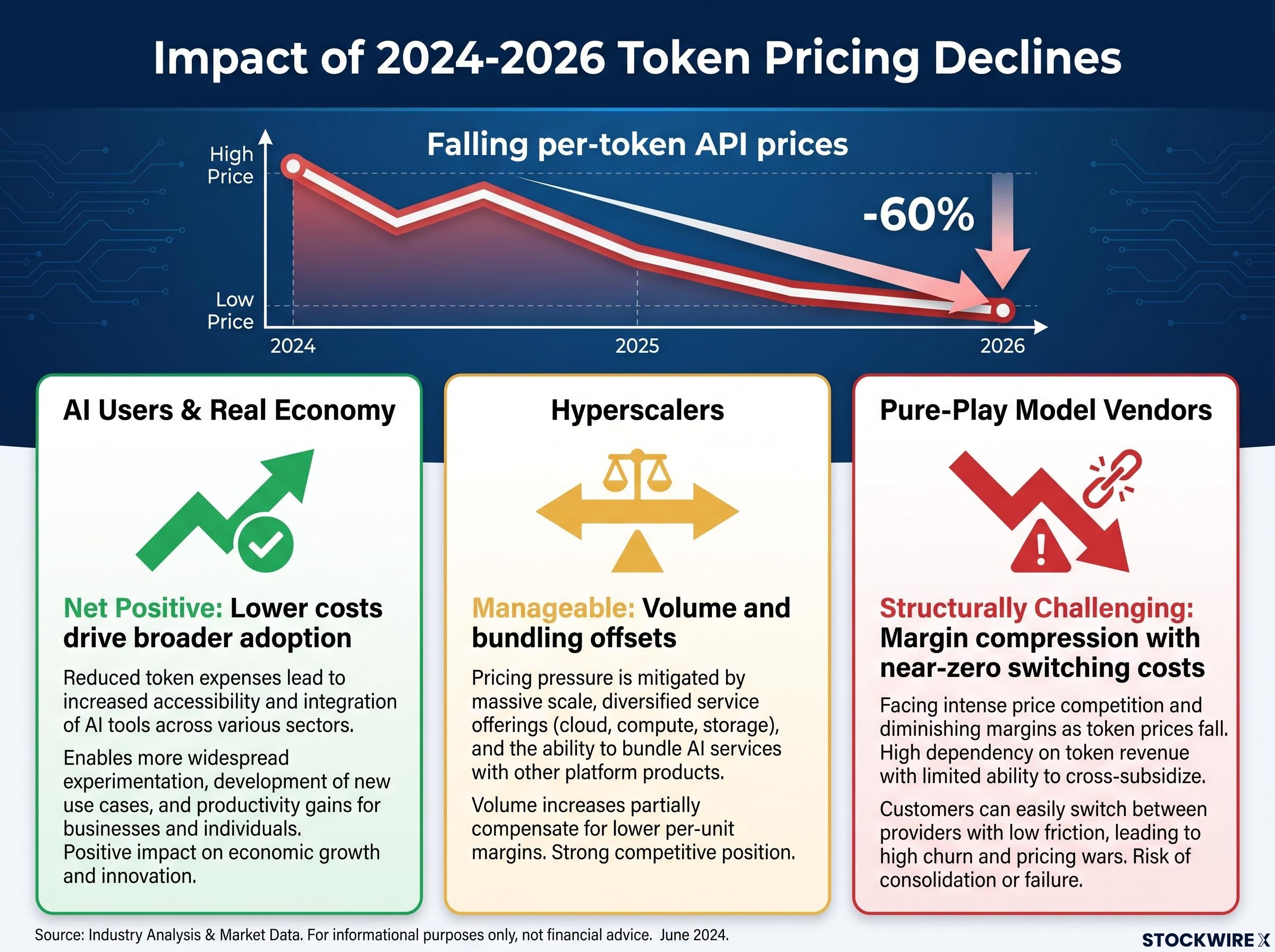
Token pricing is not an abstraction. It is a publicly observable data series, and Berezin has identified it as an early warning indicator of monetisation pressure in the 15 June 2026 note. The pattern through 2024-2026 tells the story empirically: major providers have repeatedly cut API prices, and open-weight models have steadily eroded the pricing premium that closed models once commanded.
The mechanism is straightforward. As per-token prices fall, the revenue curve flattens while the capex curve remains steep. The widening gap between the two is where investor impatience accumulates.
What falling token prices mean, however, depends entirely on where an investor sits:
- AI users and the real economy: Net positive. Lower costs drive broader adoption, more AI embedded in workflows, and real productivity gains.
- Hyperscalers with volume and bundling offsets: Manageable. Cloud storage and bandwidth followed a similar trajectory; unit prices fell, but volume and value-added services sustained returns.
- Pure-play undifferentiated model vendors: Structurally challenging. Falling unit prices combined with near-zero switching costs compress margins with no obvious offset.
Berezin warned specifically that a continuation of the token pricing slide could reignite investor concern about the monetisation of large AI capital expenditures.
The AI business model fragility Berezin identifies is already visible in concrete corporate structures: Oracle’s record $638 billion backlog rests nearly half on a single OpenAI contract whose implied $60 billion annual compute obligation requires OpenAI’s current revenue to more than double, a counterparty dependency that Moody’s has flagged as a material risk and that open-source benchmark convergence makes structurally harder to sustain.
That warning gives investors a concrete surveillance tool. Token price trends do not require proprietary research access to track; they are visible in public API pricing pages and competitive benchmarking data.
The Metaverse Moment risk and what history says about capex cycles
BCA’s “Metaverse Moment” is not a prediction that AI technology fails. It is a named framework for a specific type of valuation event: the point at which investors punish companies for escalating capex before cash flows catch up, regardless of the underlying technology’s long-run utility.
The dot-com and fibre parallel
The pattern has repeated across multiple infrastructure cycles. Telecom fibre buildouts in the late 1990s created genuine long-term economic value, yet early infrastructure investors absorbed catastrophic equity losses as valuations compressed years before utilisation caught up. BCA invokes these parallels deliberately, noting that the AI capex cycle, like all other capex cycles, will “end in tears.”
The metaverse-adjacent investment wave offered a more recent echo. Narrative outran monetisation, sentiment reversed, and companies that had committed billions saw sharp multiple contraction without the technology itself being disproven.
Why AI capex is particularly exposed to this dynamic
The scale of current AI infrastructure spending is historically unusual. BCA has observed that the AI boom has exerted less tangible real-economy impact than widely assumed, creating a gap between narrative and evidence that investor impatience could widen into a valuation event.
The conditions that BCA implies must align for a Metaverse Moment to materialise follow a specific sequence:
- High capex commitments relative to current profits
- Slowing or absent evidence of cash flow scaling from AI investments
- Investor impatience catalysed by a visible trigger, such as continued token price declines
An AI company can be right about long-run economics and still suffer severe multiple contraction if its capex trajectory runs ahead of demonstrable cash flow.
For investors who want to pressure-test the Metaverse Moment thesis against multiple independent analytical lenses, our deep-dive into AI capex bubble frameworks examines how the Minsky financing stage model, Kindleberger’s speculative cycle, Sharma’s four O’s, and the Shiller CAPE ratio at 40.11 each reach different verdicts on whether current AI infrastructure spending has crossed into genuinely dangerous speculative territory.
How to position across the AI value stack using BCA’s framework
BCA’s analysis translates into four investor-facing questions, each designed to interrogate a specific risk dimension rather than treat “AI exposure” as a monolithic category.
| Question | What to Look For | Red Flag Signal | Green Flag Signal |
|---|---|---|---|
| Durability of differentiation | Network effects, proprietary data, workflow integration | Standalone API with no switching costs | Deep integration into mission-critical enterprise workflows |
| Capex payback vs. Metaverse Moment timing | Ratio of AI capex to current AI-attributed revenue | Escalating capex with no visible cash flow inflection | Demonstrable revenue scaling alongside spend |
| Position in the AI stack | Layer-specific risk profile | Undifferentiated model provision layer | Application layer with proprietary data and network effects |
| Scenario humility | Range of outcomes considered in valuation | Single high-conviction point forecast | Explicit scenario analysis across bull and bear cases |
BCA’s analysis identifies three moat sources as the locus of durable AI profits:
Economic moat ratings provide a systematic way to operationalise the distinctions BCA’s framework implies: Morningstar’s mid-2026 analysis assigns wide moat status to Nvidia and Broadcom on the basis of CUDA switching costs and custom silicon lock-in respectively, while flagging Micron and Ciena as overvalued on thematic AI association alone, a classification that maps cleanly onto the foundation model layer versus infrastructure layer split Berezin draws.
- Economies of scale that compress costs below what smaller competitors can match
- Network effects that increase the product’s value as more users or data flow through the system
- Proprietary technology and data that competitors cannot easily replicate
McKinsey’s analysis of AI and network effects finds that capabilities embedded into core enterprise systems, combined with proprietary data feedback loops, generate switching costs that compound over time, precisely the moat dynamics BCA identifies as separating structurally defensible application-layer businesses from commoditised model providers.
Berezin has also acknowledged that BCA’s own MacroQuant model may be poorly suited to the current environment, described in the context of rapid policy shifts and potential structural breaks. If AI constitutes a genuine structural break from historical norms, the historical correlations underpinning quantitative macro frameworks may no longer serve as dependable predictive guides. That admission argues for scenario analysis over high-conviction point forecasts.
What investing in the next AI cycle demands
The airline analogy is not a verdict on AI’s future. It is a structural filter, and the question it poses is the one BCA has been building toward across months of research.
The question for investors is not whether AI is transformative. It is whether the companies building AI’s model layer will capture the value that transformation creates.
BCA’s position is that AI may drive significant productivity improvements and real income growth while the main equity beneficiaries are not today’s undifferentiated model providers. That is not a contradiction; it is a historical pattern that has played out across every major infrastructure cycle.
The conditions under which investors should have higher confidence in AI equity returns are specific: strong moats from network effects or proprietary data, deep workflow integration that raises switching costs, and capex profiles that are disciplined relative to demonstrable cash flow. Where those conditions are absent, the airline analogy applies with full force.
Token prices remain the canary Berezin has identified. If they continue declining without a volume or margin offset from bundled services, the warning has a clear empirical test. Investors who internalise this framework not as a prediction but as a filter will be better positioned to distinguish companies building durable economic franchises from those accumulating the conditions for a Metaverse Moment.
This article is for informational purposes only and should not be considered financial advice. Investors should conduct their own research and consult with financial professionals before making investment decisions. Past performance does not guarantee future results. Financial projections are subject to market conditions and various risk factors.






