
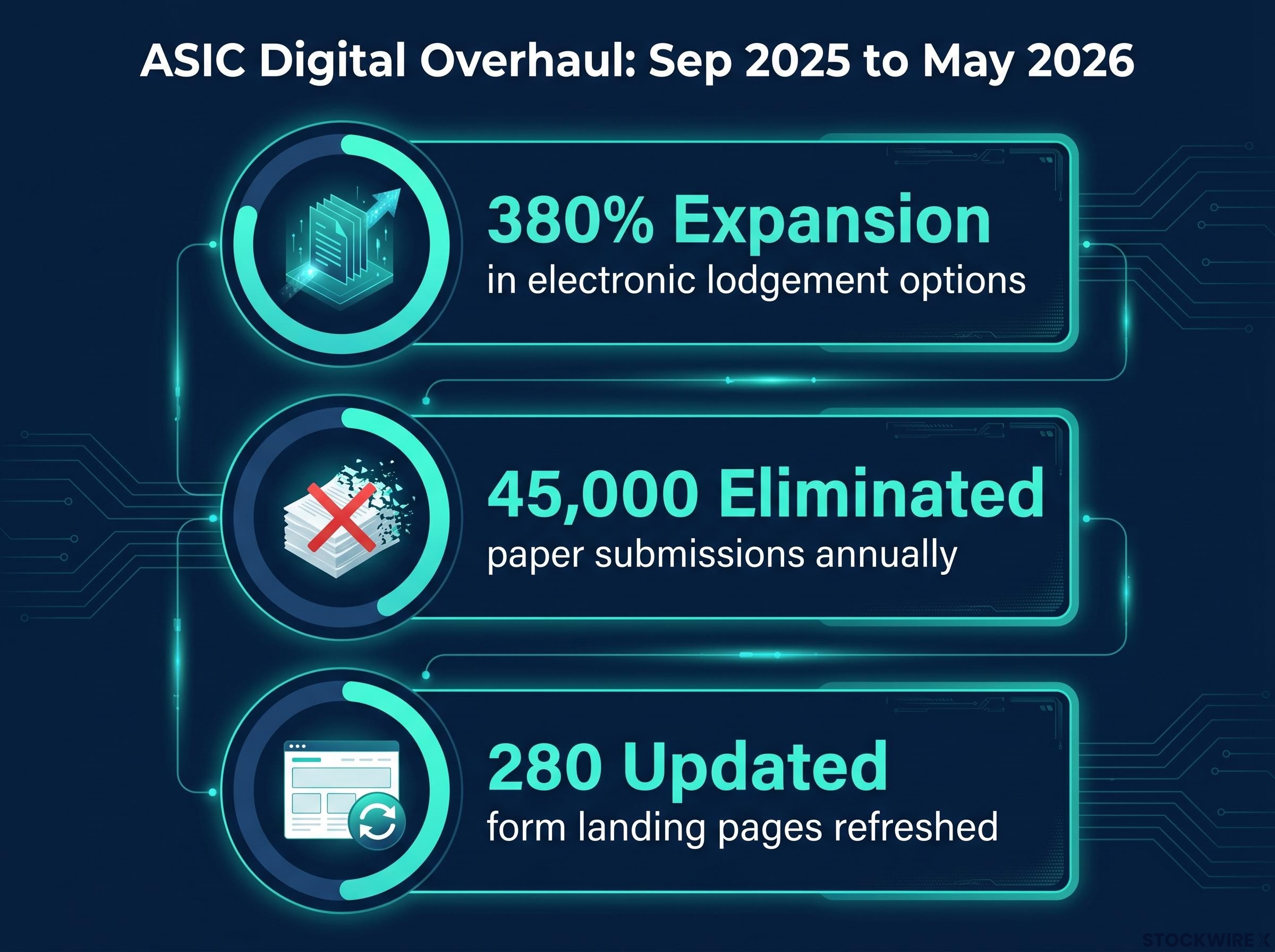
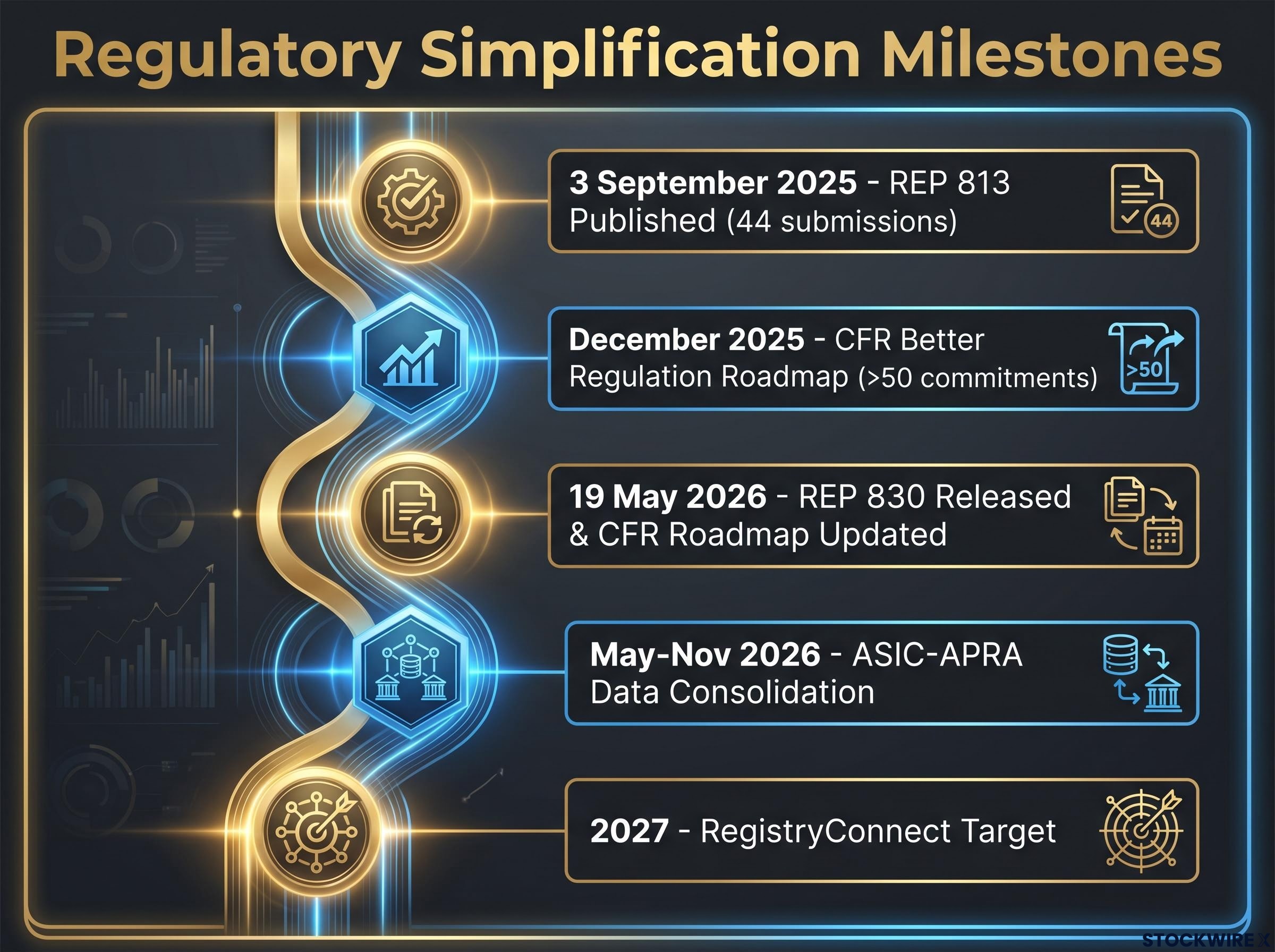
ASIC eliminated 45,000 paper-based submissions per year and expanded electronic lodgement options by 380% in less than nine months. Those are not aspirational targets from a consultation paper. They are delivered outcomes, documented in ASIC’s second regulatory simplification progress report, REP 830, released on 19 May 2026. The report follows REP 813, published on 3 September 2025, which drew 44 industry submissions and set the agenda for a programme that has since moved from consultation to measurable execution. This analysis examines what has actually changed across ASIC’s regulatory simplification workstreams, what remains incomplete, and what the forward agenda means for businesses and investors operating within the regulator’s perimeter.
Why ASIC is treating compliance complexity as an economic problem, not a paperwork issue
Regulatory simplification is not new language for ASIC. What has changed is the framing. ASIC Chair Joe Longo has positioned the programme not as an exercise in administrative tidying, but as an economic argument about Australia’s competitiveness as a destination for investment and commerce.
“Regulatory complexity creates cost burdens, inhibits innovation, introduces unnecessary obstacles, and can lead to worse outcomes for consumers.” — Joe Longo, ASIC Chair, media release 26-100MR (19 May 2026)
That statement carries a dual mandate. One side faces regulated entities: reduce the cost and confusion of compliance. The other faces consumers and investors: maintain protections that make Australian markets trustworthy. REP 813 set the agenda in September 2025. REP 830 is the accountability document, measuring what the regulator has delivered against its own commitments.
ASIC’s REP 830 progress report documents the transition from consultation to execution across each simplification workstream, providing the primary accountability record against which the commitments made in REP 813 are being measured.
The distinction matters for how reform is resourced and prioritised. When simplification is framed as a productivity issue rather than a bureaucratic one, it attracts attention from Treasury and the Council of Financial Regulators, not just ASIC’s internal operations team. That is precisely what has happened.
ASIC’s willingness to deploy assertive regulatory intervention when voluntary engagement fails was demonstrated most clearly in the ASX inquiry report published 2 April 2026, where the regulator escalated to a formal panel inquiry only after exhausting expert reviews, enforcement actions, and licence conditions against the exchange’s governance and risk management failures.
When big ASX news breaks, our subscribers know first
The digital overhaul by the numbers: what 380% actually looks like in practice
Between September 2025 and May 2026, ASIC delivered three categories of operational change that affect how regulated entities interact with the regulator on a daily basis.
The 380% expansion in electronic lodgement options eliminated an estimated 45,000 paper-based submissions annually. Approximately 280 form landing pages on ASIC’s website were updated to improve access to compliance information and filing pathways.
| Metric | Status at REP 813 (September 2025) | Status at REP 830 (May 2026) |
|---|---|---|
| Electronic lodgement options | Baseline established | 380% expansion delivered |
| Paper submissions eliminated annually | Target identified | Approximately 45,000 removed |
| Form landing pages updated | Review commenced | Approximately 280 pages refreshed |
For compliance managers and finance teams at smaller regulated entities, the shift is practical. Paper-based lodgement carried processing delays, higher error rates, and the administrative burden of physical document handling. The updated form landing pages represent a less visible but structurally important change: ASIC’s website is being repositioned as a functional compliance tool rather than a static document repository.
How compliance roadmaps reduce the obligations guessing game for smaller regulated entities
A sector-based regulatory roadmap is a structured summary of obligations relevant to a specific type of regulated entity. It differs from ASIC’s general-purpose guidance in one critical respect: it is organised around who the reader is, not around which legislative instrument applies.
ASIC developed these roadmaps in direct response to feedback gathered after REP 813. Smaller operators, particularly those without dedicated compliance teams, reported difficulty identifying which rules applied to their specific operations. The result was inadvertent non-compliance driven by information overload rather than wilful disregard.
REP 830 identifies two initial target groups:
- Small company directors, who face a range of continuous disclosure, financial reporting, and governance obligations
- Financial advice businesses, which operate under layered licensing, conduct, and education requirements
- Simplified legislative instruments, which were also revised during this period to improve readability for regulated entities broadly
For a small company director or a financial advice principal, the practical effect is a reduction in the research overhead of determining what applies to them. The roadmap does not change the law. It changes how quickly a compliance-constrained operator can find the obligations that matter to their business.
The compliance cost of missing obligations is not theoretical: ASIC’s financial reporting enforcement programme resulted in $1.17 million in court-imposed fines against three ASX-listed companies in March 2026, following a December 2025 surveillance sweep that found 151 of 217 reviewed companies allegedly non-compliant for FY23 and/or FY24.
The harder work: coordinating with APRA and the broader regulator network
The digital and guidance improvements documented in REP 830 were delivered through decisions ASIC could make on its own. The next phase of simplification requires something harder: coordination between regulators with overlapping jurisdictions, different data systems, and distinct institutional cultures.
ASIC and APRA: targeting insurance and superannuation overlap
ASIC and the Australian Prudential Regulation Authority (APRA) are jointly targeting overlapping data collection obligations in the insurance and superannuation sectors. For a superannuation trustee or insurer regulated by both bodies, duplicated data requests represent a compliance cost that is significant but often invisible in aggregate reporting. The two regulators have committed to reducing these inconsistencies over the six-month period from May 2026, placing the next accountability window at approximately November 2026.
The coordination challenge between ASIC and APRA extends beyond data duplication: APRA supervisory expectations were reset by a formal 30 April 2026 letter that applied heavier interpretive weight to existing prudential standards, including CPS 234, meaning entities regulated by both authorities must now satisfy two converging and rapidly evolving compliance frameworks simultaneously.
The CFR Better Regulation Roadmap and its 50-plus commitments
The bilateral ASIC-APRA effort sits within a broader framework. The Council of Financial Regulators (CFR) published its Better Regulation Roadmap in December 2025 and updated it in May 2026. The roadmap incorporates over 50 commitments drawn from the Economic Reform Roundtable, spanning data consolidation, regulatory overlap reduction, and government law reform support.
ASIC’s simplification programme feeds into this roadmap but does not control it. Where progress depends on inter-agency agreement, legislative change, or shared technology platforms, the timeline is inherently less certain than ASIC’s internally controlled digital programme.
RegistryConnect and the 2027 horizon: infrastructure investment with delivery uncertainty
RegistryConnect is ASIC’s multi-year programme to stabilise and upgrade its business registers, funded in the 2025-26 Budget. The programme predates REP 830, but the progress report provides an updated status on its trajectory toward a 2027 delivery target for streamlined company registration services.
ASIC’s RegistryConnect programme page sets out the full scope of the business registers uplift, confirming the government’s 2025-26 Budget funding commitment and the key deliverables targeted for the 2027 horizon, including director identification number integration and expanded digital transaction capabilities.
The programme’s scope includes:
- Removing director home addresses from online company extracts (a privacy measure already underway)
- Planning links to director identification numbers
- Expanding digital transaction capabilities for company registration
- Stabilising existing registry infrastructure to support higher digital volumes
Reports indicate total programme investment of approximately $361.5 million, with roughly $288.4 million allocated to digital components, though these figures have not been independently confirmed against primary budget documents. Delivery confidence has been described as medium-high in the Major Digital Projects Report 2026, though this rating also awaits independent verification.
For company directors, registered agents, and businesses that interact with ASIC’s registry systems, RegistryConnect’s delivery would represent the most structurally significant change in the simplification programme. The 2027 target and reported confidence rating suggest meaningful progress, but multi-year technology programmes of this scale carry execution risk that compliance teams should factor into their forward planning.
A more navigable regulatory environment is taking shape, but the distance to travel is still significant
REP 830 documents progress across three distinct levels. Operational improvements (digital lodgement, website updates) are delivered. Guidance-based reforms (sector roadmaps, simplified legislative instruments) are in place for their initial target groups. Structural changes (ASIC-APRA data consolidation, RegistryConnect) remain in progress with longer time horizons and higher execution uncertainty.
Key milestones for readers to monitor:
- REP 830 released May 2026: current accountability baseline
- CFR Better Regulation Roadmap updated May 2026: broadest cross-regulator commitment framework
- ASIC-APRA data consolidation focus period: May to November 2026
- RegistryConnect delivery target: 2027
ASIC has stated its commitment to open industry consultation on initiative selection, suggesting that the feedback loop established through REP 813’s 44 submissions will continue to shape priorities. For businesses and investors assessing Australia’s regulatory environment, REP 830 provides evidence that simplification is being systematically pursued rather than rhetorically promised. The forward agenda gives compliance teams a concrete set of milestones to track over the next 12-18 months, with the clearest test arriving when the cross-regulator workstreams report their first outcomes later this year.
The simplification programme operates against a backdrop where ASIC is also building out purpose-built licensing frameworks for new asset classes: the Corporations Amendment (Digital Assets Framework) Act 2026, which received Royal Assent on 8 April 2026, introduced dedicated licensing categories for digital asset platforms and tokenised custody platforms, adding a new layer of regulated entity obligations that will itself require structured compliance guidance.
This article is for informational purposes only and should not be considered financial advice. Investors should conduct their own research and consult with financial professionals before making investment decisions.