
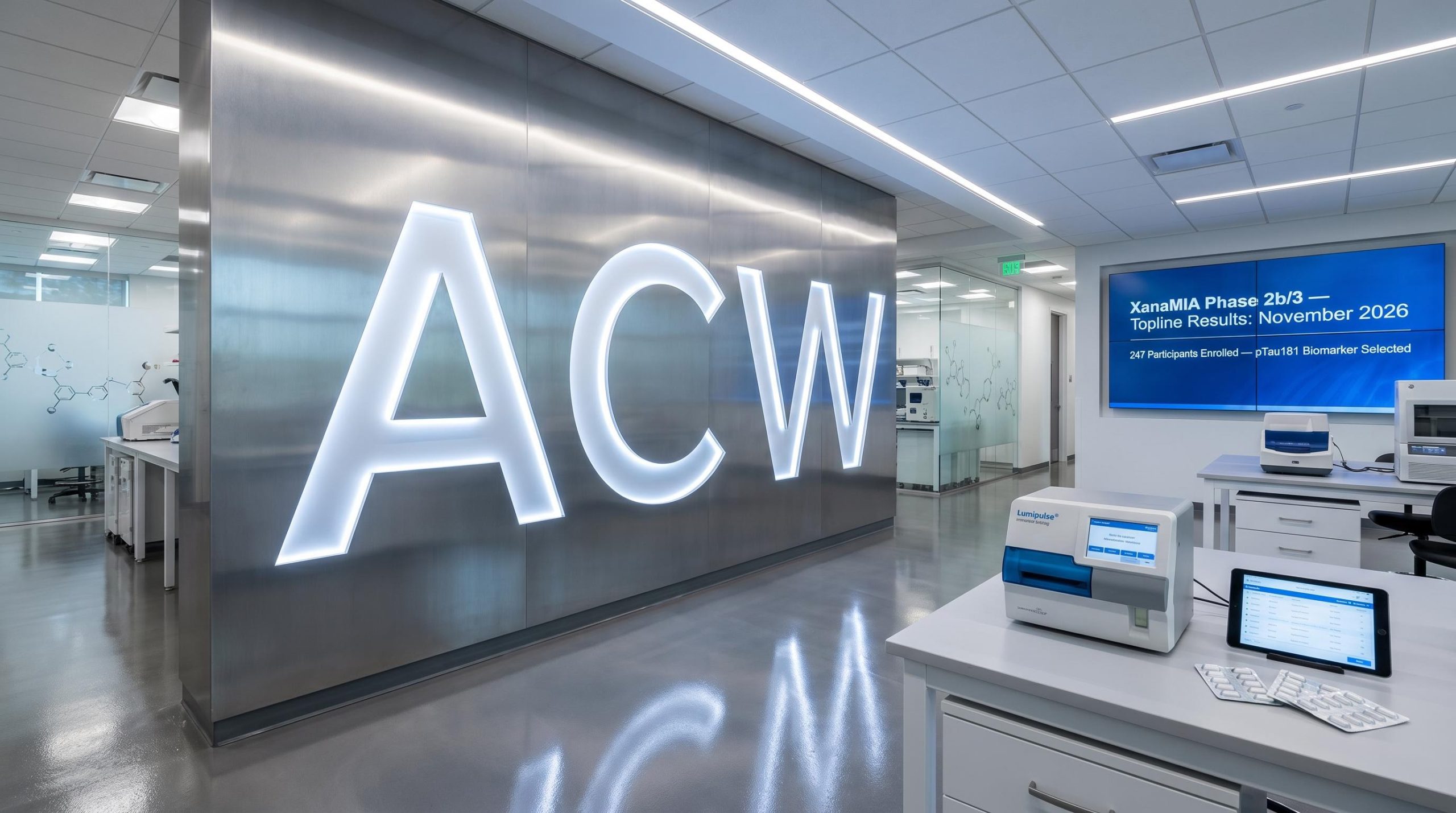
Actinogen takes XanaMIA screening data to national dementia forum ahead of November readout
Actinogen Medical (ASX: ACW) presented an academic poster at the Australian Dementia Network’s Australian Dementia Research Forum (ADRF) in Sydney on 1 June 2026, covering screening efficiency and baseline population characteristics from the fully enrolled XanaMIA phase 2b/3 trial of Xanamem® (emestedastat) in mild to moderate Alzheimer’s disease. The presentation offers investors their first detailed look at the enrolled patient cohort, with topline final results expected November 2026.
When big ASX news breaks, our subscribers know first
What the XanaMIA poster revealed
A trial built on a smarter patient selection strategy
The XanaMIA trial is now fully closed to recruitment, with 247 participants randomised 1:1 to either emestedastat 10mg or placebo over 36 weeks. A defining feature of the trial design is its reliance on elevated plasma pTau181 as the qualifying biomarker, measured using the Lumipulse® assay, with a minimum threshold of ≥1.6 pg/mL.
This approach replaces more complex and costly methods such as amyloid brain scans or cerebrospinal fluid biomarkers. The mean baseline pTau181 level across enrolled participants was 2.55 pg/mL (range 1.6 to 18.6 pg/mL), confirming a cohort with meaningfully elevated biomarker levels at entry.
The rationale for this selection strategy is clinical. Elevated pTau181 identifies patients with a more progressive disease course, which increases the trial’s statistical power to detect a treatment effect for Xanamem® over 36 weeks. This design also replicates the patient population from the phase 2 study (Taylor et al. 2024), where pTau181-elevated Alzheimer’s disease patients treated with Xanamem® 10mg showed slower CDR-SB decline (mean 0.36) versus placebo (mean 0.98; Cohen’s d=0.41).
Two-stage screening cut costs by 43%
Rather than requiring all interested participants to complete a full screening visit, the XanaMIA trial used a brief pre-screening visit to check pTau181 levels first, reserving the full screening visit only for those who qualified. The result: 819 full screening visits were saved, with 610 participants excluded at pre-screening due to low pTau181 levels.
This two-stage process delivered an estimated 42.9% reduction in screening costs compared to a single-visit approach, a meaningful indicator of cost discipline that other trial designers are observing closely.
The enrolled population reflects a typical mild-to-moderate AD cohort:
- 247 participants randomised 1:1 (emestedastat 10mg vs placebo)
- Mean age 74.5 years (range 50–91)
- 51% male / 49% female
- 44.9% enrolled in Australia, 55.1% in the US
- Mean MMSE score 21.8; mean CDR-SB 4.3
- 66.1% carried at least one APOE ε4 allele (e3/e4: 49.2%; e4/e4: 16.9%)
- Mean baseline pTau181: 2.55 pg/mL
| Characteristic | Value | Range / SD | Clinical Benchmark | Significance |
|---|---|---|---|---|
| Mean age (years) | 74.5 | SD 8.0; range 50–91 | Typical mild-to-moderate AD range | Consistent with target population |
| Sex distribution | 51% male / 49% female | 126 male; 121 female | Broadly balanced | Reduces sex-related confounders |
| Mean MMSE score | 21.8 | SD 3.25 | Mild-to-moderate AD: 18–26 | Confirms enrolled disease stage |
| Mean CDR-SB | 4.3 | SD 1.95 | Typical mild-to-moderate AD range | Primary endpoint baseline anchor |
| Mean pTau181 (pg/mL) | 2.55 | SD 1.33; range 1.60–18.6 | Qualifying threshold ≥1.6 pg/mL | Confirms biomarker-positive cohort |
Understanding Xanamem’s mechanism and why cortisol matters in Alzheimer’s
Xanamem® (emestedastat) is an oral, selective inhibitor of 11β-HSD1, the enzyme responsible for cortisol synthesis inside brain cells. Critically, the compound reduces cortisol within the brain without disrupting the adrenal glands’ systemic cortisol production, which is essential for normal body function.
Cortisol is commonly known as the “stress hormone.” When chronically elevated inside the brain, it is toxic to neurons and is associated with neurodegeneration, harm to brain cells, and cognitive decline, particularly in the hippocampus and frontal cortex — regions directly implicated in Alzheimer’s disease progression.
Xanamem® is administered as a once-daily oral pill, a practical delivery advantage over infusion-based therapies currently on the market. The compound has been studied in more than 500 volunteers and patients across eight clinical trials and carries a promising safety profile. Results from the XanaCIDD phase 2 depression trial, reported in August 2024, demonstrated clinically and statistically significant benefits on depressive symptoms, providing further validation of the cortisol-control mechanism at the Xanamem® 10mg oral daily dose.
The path to November — what investors should watch for
Topline final results from the XanaMIA trial are expected November 2026. The trial has already passed an independent Data Monitoring Committee (DMC) safety and efficacy futility review, a meaningful de-risking milestone that indicates the trial was not stopped early for futility or safety concerns.
The XanaMIA-OLE (open-label extension), which commenced March 2026, offers all participants up to 25 months of active Xanamem® 10mg. This extension signals confidence in the compound’s long-term safety profile and will continue to generate supporting data.
The primary endpoint is change from baseline to Week 36 in CDR-SB (Clinical Dementia Rating scale – Sum of Boxes). Key secondary endpoints include a digital cognitive test battery (CTB) assessing global cognition, the Amsterdam Instrumental Activities of Daily Living (Ai-ADL), and plasma biomarkers of Alzheimer’s disease (pTau181, pTau217) and neurodegeneration (NfL, GFAP).
Note: No CEO quote was included in the ASX announcement text. This section should be confirmed with the Actinogen IR team before publication if a management quote is required.
Key milestones investors should track:
- November 2026 — XanaMIA topline results
- Ongoing — XanaMIA-OLE safety and efficacy data accumulation
- 1 June 2026 — ADRF poster publicly presenting baseline and screening methodology now on record
Don’t Miss the Next ASX Healthcare Breakthrough
Big News Blast delivers FREE breaking ASX healthcare news to your inbox within minutes of release, complete with in-depth analysis. Join 20,000+ subscribers already staying ahead of the market on critical announcements. Click the “Free Alerts” button at Big News Blast to get the next market-moving healthcare update the moment it drops.