
Independent DSMB recommends Entropy Neurodynamics progress TRP-8803 trial to Cohort 2
Entropy Neurodynamics has received clearance from its independent Data Safety Monitoring Board (DSMB) to progress its Phase 2 trial evaluating IV-infused psilocin (TRP-8803) in Binge Eating Disorder patients to Cohort 2, following a favourable safety review of Cohort 1 data. The DSMB recommended progression without any protocol modifications, confirming a favourable safety and tolerability profile across all six dosed participants. Cohort 2 is fully recruited and ready to commence dosing.
The independent endorsement represents a significant de-risking milestone for Entropy’s TRP-8803 programme, validating the clinical feasibility of delivering controlled psychedelic therapy via intravenous psilocin administration. The trial enrolled 12 patients across two cohorts of six, with each participant receiving two administrations of TRP-8803 delivered 14 days apart in conjunction with supportive therapy. Cohort 1 dosing was completed on 2 June 2026.
The DSMB’s recommendation provides external medical validation that the Company’s IV psilocin platform is progressing as intended, strengthening confidence in the programme’s trajectory ahead of topline Cohort 1 efficacy results expected in early July 2026.
When big ASX news breaks, our subscribers know first
Clean safety profile across all Cohort 1 participants
All six Cohort 1 participants completed both dosing sessions with no serious or unexpected adverse reactions reported. The DSMB review confirmed a favourable safety and tolerability outcome, with the majority of adverse reactions assessed as mild or moderate.
The safety data included:
- No SARs (Serious Adverse Reactions)
- No SUSARs (Suspected Unexpected Serious Adverse Reactions)
- No discontinuations due to safety events
- Majority of adverse reactions mild or moderate
- One Grade 3 event — consistent with known psilocin pharmacology, managed per protocol
The absence of serious or unexpected adverse reactions across all dosed participants strengthens the safety case for TRP-8803 and supports continued clinical advancement. The single Grade 3 adverse event aligned with the established pharmacological profile of psilocin and was managed within the study protocol, indicating no unexpected safety signals.
What is a DSMB and why does this recommendation matter?
A Data Safety Monitoring Board is an independent committee of medical and scientific experts who review safety data during clinical trials. The DSMB operates separately from the company conducting the trial, providing unbiased oversight of participant safety and study conduct.
The DSMB’s core responsibilities include:
- Assess participant safety
- Evaluate adverse events
- Recommend whether a study should continue, pause or be modified
- Ensure the trial is conducted ethically and safely
Independent third-party validation carries significant weight that internal company assessments cannot provide. When a DSMB recommends progression without protocol modifications, it signals genuine confidence in the observed safety profile based on expert medical review of the underlying data. For investors, this external endorsement de-risks the clinical programme and confirms that the trial execution aligns with regulatory and ethical standards.
The DSMB’s clearance to proceed removes a key gating factor in the trial timeline and supports the Company’s planned cadence of clinical readouts through 2026.
60-minute infusion regimen endorsed for Cohort 2
The DSMB selected the 60-minute infusion regimen for Cohort 2 from three protocol-defined dosing options. This shorter infusion duration differs substantially from the approach used in Cohort 1 and carries important commercial and operational implications for TRP-8803’s development pathway.
| Cohort | Loading Dose | Maintenance Dose | Total Infusion Time |
|---|---|---|---|
| Cohort 1 | 20 minutes | 120 minutes | 140 minutes |
| Cohort 2 | 20 minutes | 40 minutes | 60 minutes |
The DSMB’s recommendation reflects its assessment that Cohort 1 dosing was well tolerated, produced predictable infusion characteristics, and delivered a high-intensity psychedelic experience without safety findings requiring extension of the planned dosing duration.
A clinically viable 60-minute treatment session is substantially more practical and scalable than the multi-hour sessions required by oral psilocybin, which typically run 8–10 hours. The condensed therapeutic window reduces clinic resource requirements, improves patient throughput, and addresses a critical operational barrier to commercial adoption of psychedelic-assisted therapy. This supports the commercial case for TRP-8803 as a precision-controlled alternative to oral psilocybin formulations.
Cohort 2 will further characterise the safety, feasibility and pharmacokinetic profile of TRP-8803 at this clinically relevant infusion duration, generating data to assess whether the shorter regimen produces comparable efficacy to the extended Cohort 1 protocol.
How TRP-8803 differs from oral psilocybin treatments
Oral psilocybin presents inherent limitations that create operational bottlenecks for clinical delivery and scalability challenges for commercial adoption. The compound’s slow and variable onset, unpredictable exposure levels, and extended session duration of 8–10 hours impose significant resource demands on treatment facilities and limit patient throughput.
Once oral psilocybin is swallowed, clinicians have no ability to adjust or reverse the dose, regardless of the patient’s response. This lack of control creates risk in vulnerable patient populations and complicates protocol adherence in clinical trials.
TRP-8803’s intravenous delivery model addresses these barriers directly through:
- 15-minute onset — rapid initiation of the psychedelic state compared to slow, variable onset with oral administration
- 1–2 hour therapeutic window — condensed treatment duration versus extended 8–10 hour sessions
- Precise control of blood levels — reproducible exposure profiles across patients
- Adjustability and reversibility during dosing — real-time titration based on patient response
The precision-controlled nature of IV psilocin administration creates a fundamentally different clinical experience. Clinicians can monitor blood levels in real time, adjust infusion rates to modulate depth of the psychedelic state, and halt administration if safety concerns arise. This level of control is impossible with oral psilocybin once the drug is metabolised.
The operational efficiency gains are material. A 60-minute TRP-8803 session allows treatment facilities to increase daily patient capacity while maintaining the therapeutic benefits of psilocybin exposure. This scalability advantage directly addresses one of the primary commercial barriers facing psychedelic medicine.
Upcoming catalysts and trial timeline
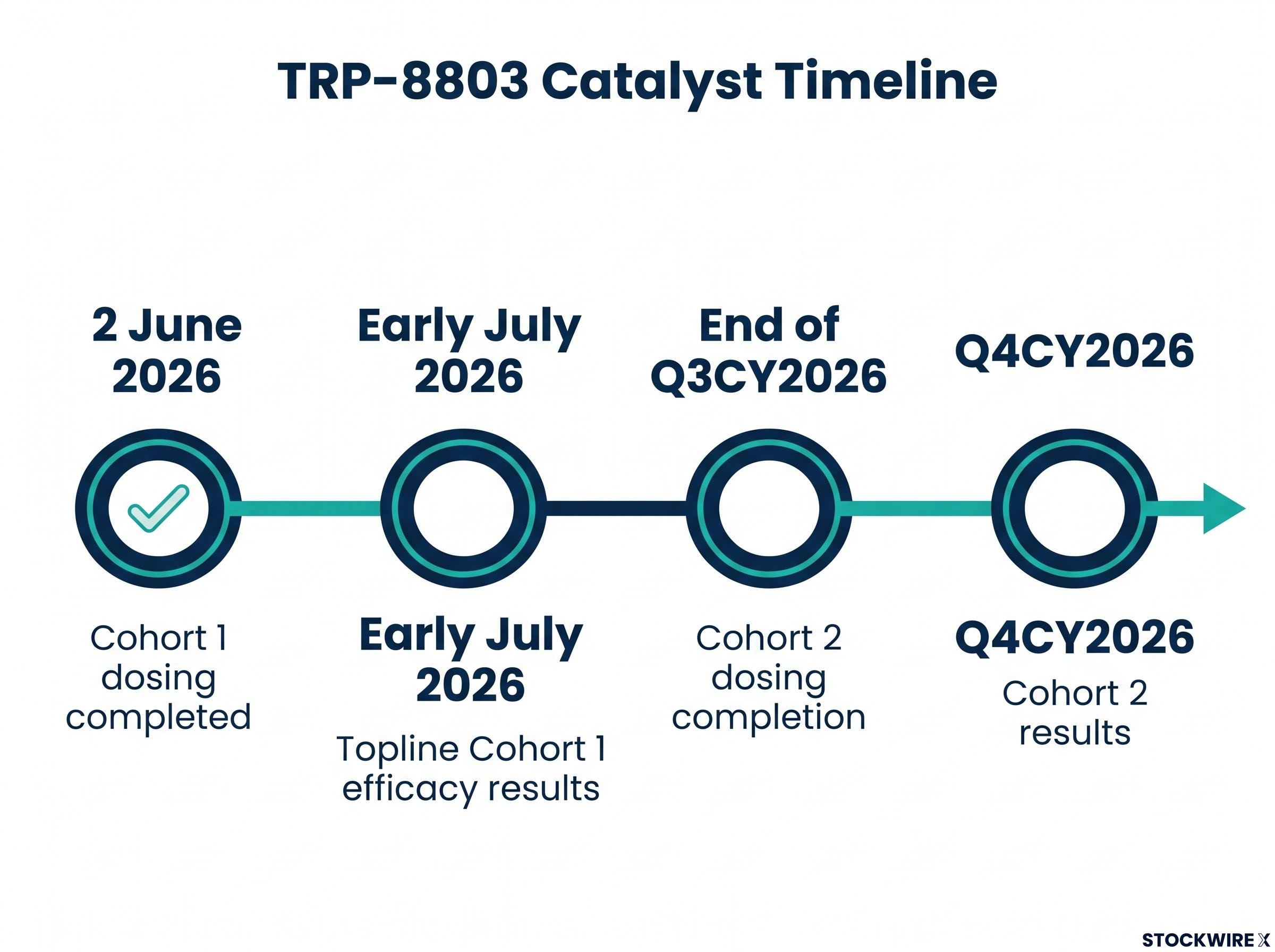
Entropy has established a cadence of near-term clinical readouts that provide multiple inflection points for investors to assess programme progress. The Company expects to release topline Cohort 1 efficacy results in early July 2026, representing the first look at clinical outcomes from the world’s first IV-psilocin study in Binge Eating Disorder.
Key milestones include:
- Topline Cohort 1 efficacy results: Early July 2026
- Cohort 2 dosing completion: End of Q3CY2026
- Cohort 2 results: Q4CY2026
The July 2026 efficacy data will mark a significant inflection point for the programme, providing the first clinical validation of whether TRP-8803’s controlled delivery model translates into measurable therapeutic outcomes in BED patients. The trial represents a novel approach to treating a disorder with limited pharmacological options and substantial unmet medical need.
The early clinical signals from TRP-8803 have exceeded investigator expectations, with the first enrolled patient’s four-week post-treatment assessment showing meaningful reductions in binge eating severity, anxiety, and depression alongside improvements in emotional regulation.
Cohort 2 dosing completion at the end of Q3CY2026 positions the Company to deliver results in Q4CY2026, maintaining momentum through the second half of the year. The staggered cohort structure ensures a steady flow of data releases rather than a single binary readout, allowing investors to track programme evolution across multiple data points.
Jason Carroll, CEO
“The DSMB’s recommendation to progress to Cohort 2 without any protocol changes is an important milestone for the TRP-8803 programme and provides independent validation of the favourable safety profile observed in Cohort 1.”
Management’s framing aligns with the independent DSMB assessment, confirming that internal observations of the safety profile matched the conclusions reached by external medical experts. This consistency between company perspective and third-party validation strengthens confidence in programme execution and data integrity.
Carroll highlighted that all six participants completed both dosing sessions with no serious or unexpected adverse reactions, reinforcing the potential of intravenous psilocin to deliver a controlled and reproducible psychedelic experience in a clinical setting. The DSMB’s endorsement of the planned 60-minute infusion regimen reflects confidence in both the tolerability and operational feasibility of the approach.
Strategic positioning in precision psychedelic medicine
The DSMB milestone extends beyond a single trial readout — it validates the underlying IV psilocin platform that Entropy intends to deploy across multiple psychiatric and functional disorders. The Company has previously conducted Phase 2a trials using oral psilocybin in Binge Eating Disorder, Irritable Bowel Syndrome and Fibromyalgia, demonstrating clinical benefits of psychedelic therapy across diverse indications.
The IV psilocin platform across multiple indications has already produced striking signals, including a reported 75% response rate in treatment-resistant IBS patients, a result described by researchers from Massachusetts General Hospital and Columbia University as the strongest clinical signal ever recorded in IBS drug development.
TRP-8803 represents the evolution of that clinical foundation into a precision-controlled delivery system designed to address the operational and commercial limitations of oral psilocybin. The platform’s potential spans multiple therapeutic areas where psychedelic therapy has shown promise but where practical barriers to implementation remain.
Entropy’s continued development of TRP-8803 across multiple indications positions the Company as a leader in precision-controlled psychedelic medicine. The favourable safety profile confirmed by the DSMB supports expansion of the clinical platform into additional patient populations and strengthens the Company’s engagement with regulators and potential partners.
Progress toward a scalable, commercially viable psychedelic therapeutic model requires both clinical validation and operational feasibility. The 60-minute infusion regimen endorsed by the DSMB addresses the scalability constraint, whilst the clean safety profile across all dosed participants confirms the clinical viability of the approach. This combination of safety, efficacy potential, and operational practicality forms the foundation for a differentiated commercial proposition in the emerging psychedelic medicine sector.
Interested in Entropy’s Precision Psychedelic Platform?
The DSMB’s independent endorsement of TRP-8803’s safety profile marks a significant de-risking event for Entropy’s IV psilocin programme, with topline Cohort 1 efficacy results expected in early July 2026. The 60-minute infusion regimen offers a scalable alternative to oral psilocybin’s 8–10 hour sessions, addressing a critical commercial barrier in psychedelic-assisted therapy.
To access the full clinical data, regulatory updates and upcoming trial milestones, visit the Entropy Neurodynamics investor centre. Stay informed on how this precision-controlled platform is progressing across multiple psychiatric indications.