
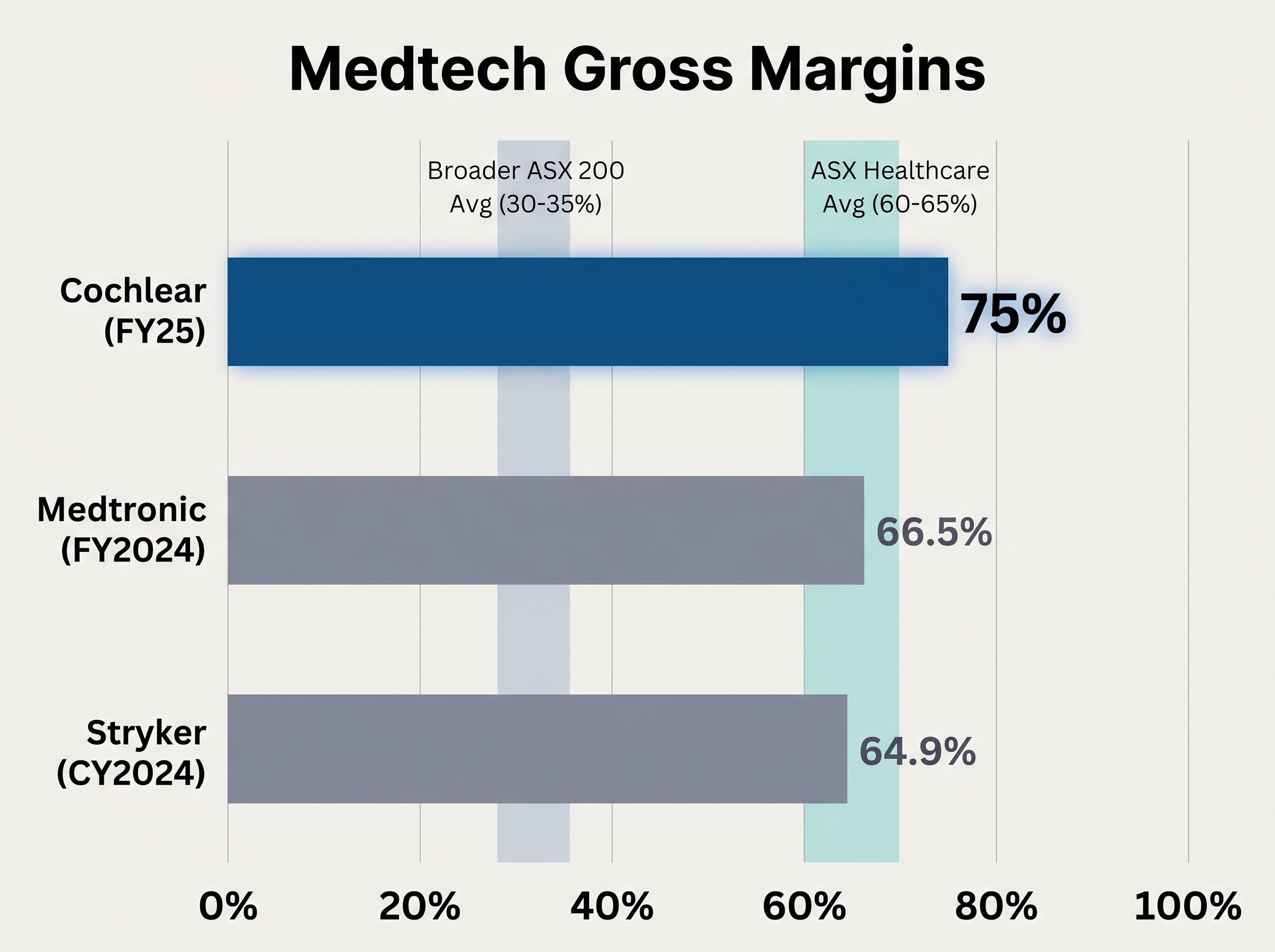
Cochlear Ltd generated a gross margin of approximately 75% in FY25, placing it above the ASX healthcare sector average and most global medtech peers. A high gross margin, however, does not tell a retail investor whether the stock is cheap, expensive, or worth researching further.
Australian retail investors are increasingly drawn to ASX healthcare and medtech names as long-term compounders. Yet the metrics that matter for a medical device business differ meaningfully from those used to assess banks, miners, or retailers. Without a structured analytical framework, it is easy to confuse a high-quality business with a well-priced investment.
Gross margin, ROE, and revenue CAGR are three of the five fundamental analysis metrics that form the core of any structured equity assessment; the others, earnings per share and the P/E ratio, connect company quality to the market price investors are being asked to pay.
This guide uses Cochlear’s publicly reported financials as a practical teaching case, walking through five metrics that reveal a medical device company’s fundamental profile: gross margin, revenue compound annual growth rate (CAGR), return on equity (ROE), net debt positioning, and the step that separates company quality from share price valuation.
Why medical device stocks need their own analytical lens
A bank earns a spread on deposits. A miner sells a commodity at a price it cannot control. A medical device company does neither. Its economics are shaped by a different set of forces, and applying a generic stock-analysis checklist will produce the wrong answers.
Medical device businesses share several defining characteristics:
- Recurring revenue streams from device upgrades, consumables, and services, not just one-off product sales
- Regulatory barriers that restrict new competitors from entering the market without years of clinical evidence and approvals
- High R&D intensity, with ongoing investment required to maintain clinical leadership and product refresh cycles
- Structurally high gross margins, reflecting pricing power in specialised clinical niches
- Long device replacement cycles, creating multi-year revenue visibility once a patient is fitted
Cochlear illustrates this directly. The company generates recurring revenue through sound processor upgrades and services, not just initial implant sales, a business model characteristic that distinguishes it from most ASX-listed industrials.
The financial contrast is stark. According to Goldman Sachs Australia (December 2024), the ASX healthcare sector (excluding biotech) carries average gross margins of approximately 60-65%, compared with roughly 30-35% for the broader ASX 200. That gap reflects the pricing power and cost structures unique to healthcare businesses.
The metrics that follow from the business model
Each business model characteristic maps to a specific financial metric. Pricing power shows up in gross margin. Durability of demand appears in revenue CAGR. Capital efficiency is captured by ROE. Financial resilience lives in the balance sheet. The sections that follow take each in turn.
When big ASX news breaks, our subscribers know first
Gross margin: the single most revealing number in medtech
Gross margin measures how much revenue remains after subtracting the direct cost of producing a product. The formula is straightforward: revenue minus cost of goods sold, divided by revenue, expressed as a percentage. It captures pricing power and production efficiency before operating costs such as R&D, sales, and administration are considered.
Cochlear reported a gross margin of 74.9% in FY24 and 75% in FY25. That stability, within a tenth of a percentage point across two full fiscal years, signals consistent pricing discipline and cost control. The figure becomes more informative when placed alongside peers.
| Company | Gross Margin | Period |
|---|---|---|
| Cochlear | 74.9% / 75% | FY24 / FY25 |
| Medtronic | 66.5% | FY2024 |
| Stryker | 64.9% | CY2024 |
| CSL | 59.5% | FY24 |
| ResMed | 55.6% / 58.2% | FY24 / Q2 FY25 (non-GAAP) |
| ASX Healthcare Avg. | ~60-65% | FY24 |
Cochlear’s approximately 75% gross margin sits materially above the ASX healthcare sector average of 60-65% and above every listed global peer in this comparison. For a retail investor screening medtech names, this is the fastest single indicator of underlying pricing power.
A gross margin at this level implies Cochlear retains significant capacity to invest in R&D, absorb cost pressure from foreign exchange movements or supply chain disruption, and protect profitability during periods of softer implant procedure volumes. It is, in effect, a measure of the business’s room to manoeuvre.
Revenue CAGR: separating structural growth from a single good year
A single year of strong revenue growth can reflect a favourable currency tailwind, a one-off product launch, or a post-pandemic recovery in procedure volumes. None of those signals durability. A three-year compound annual growth rate strips out the noise.
Cochlear reported revenue of A$2,236 million in FY24, representing 15% growth in constant currency terms. In FY25, revenue rose to A$2,356 million, a more modest 4% in reported terms (3% constant currency). The three-year revenue CAGR is estimated at approximately 14.3%, though this figure has not been independently confirmed.
That moderation from FY24 to FY25 warrants context. Services revenue softened in the first half as the company invested in its cloud platform, and procedure volume growth normalised after the strong post-COVID recovery in prior years. The question for investors is whether the long-term demand drivers remain intact.
What drives long-term hearing implant demand
The structural case rests on several factors that operate independently of any single year’s results:
The WHO World Hearing Report provides the primary epidemiological basis for hearing loss prevalence estimates, documenting that over 1.5 billion people globally live with some degree of hearing loss and projecting that number will rise to 2.5 billion by 2050 without intervention.
- Ageing populations globally, with the World Health Organisation estimating over 1.5 billion people live with some degree of hearing loss
- Low penetration rates in developing markets, where access to cochlear implant surgery remains limited
- Reimbursement expansion, including a March 2024 adjustment to U.S. Medicare rules that better supports sound processor upgrades for eligible patients
- Product refresh cycles, with FDA and CE Mark approvals for next-generation processors and implant systems in 2024 creating upgrade pathways for existing patients
These demand drivers extend well beyond a single reporting period. For a stock trading on a premium multiple, sustained double-digit CAGR is part of the justification for paying above the market average.
Return on equity and balance sheet health: what the numbers say about capital discipline
Return on equity (ROE) measures how much net profit a company generates relative to the equity shareholders have invested. The formula is net profit divided by shareholders’ equity. A high ROE signals that management is generating strong returns without requiring disproportionate capital.
Cochlear reported ROE of 19.9% in FY24. Placed against peers, the figure sits comfortably in the upper range of both the ASX healthcare sector and global medtech comparisons.
| Company | ROE | Period |
|---|---|---|
| ResMed | ~23% (Morningstar est.) | TTM |
| Stryker | 21.5% | CY2024 |
| Cochlear | 19.9% | FY24 |
| CSL | 13.8% | FY24 |
| Medtronic | 11.2% | FY2024 |
| ASX Healthcare Avg. | ~15-20% | FY24 |
ROE becomes more meaningful when read alongside the balance sheet. Net debt is calculated as total borrowings minus cash. A negative figure means the company holds more cash than debt, a position of financial strength.
Cochlear held a net cash position of approximately A$270 million as at FY24, with a debt-to-equity ratio of just 13.2%. A net cash balance sheet for a growth-oriented medtech carries three practical implications:
- R&D funding flexibility, allowing continued investment in next-generation products without reliance on debt markets
- Foreign exchange resilience, providing a buffer against currency volatility (the company reports in Australian dollars but earns revenue globally)
- Dividend and capital return optionality, giving management room to return capital to shareholders without compromising growth investment
Together, a 19.9% ROE and a net cash balance sheet tell a capital quality story: strong returns generated without excessive leverage.
The quality factor characteristics that define companies like Cochlear, high ROE, low leverage, and stable earnings, are not just useful for individual stock analysis; in the current macro environment, these same attributes are driving institutional interest in quality-screened ASX ETFs as a way to remain invested while managing downside risk in a potentially overvalued broader market.
The valuation step: why a great business is not always a great buy at any price
Every metric examined so far assesses company quality. Gross margin, revenue CAGR, ROE, and balance sheet strength reveal what kind of business an investor is looking at. None of them reveal whether the current share price fairly reflects that quality.
This distinction is the most consequential conceptual shift in any analytical framework.
Valuation multiples provide a bridge between quality assessment and price assessment. For ASX medtech, the two most commonly referenced are the price-to-earnings (P/E) ratio and enterprise value to earnings before interest, tax, depreciation, and amortisation (EV/EBITDA). P/E compares the share price to annual earnings per share. EV/EBITDA compares the total enterprise value (market capitalisation plus net debt) to operating earnings.
According to Livewire Markets (February 2026), quality defensive healthcare names with high ROE and visible growth have historically traded on 25-30x earnings on the ASX. By early 2026, those multiples had compressed to closer to approximately 18x. Morgan Stanley commentary (September 2024) placed large-cap ASX medtech EV/EBITDA through the cycle at approximately 15-20x. The ASX healthcare sector has typically traded at a 20-40% premium to the broader market P/E.
Cochlear’s share price illustrates why the valuation step matters. Through 24 May 2026, the stock had declined approximately 62.63% year-to-date. The underlying business continued to generate a 75% gross margin, near-20% ROE, and a net cash balance sheet. The decline reflects a repricing of the multiple the market was willing to pay, not a collapse in business fundamentals.
The ASX healthcare sector de-rating over the five years to mid-2026 was driven primarily by the unwinding of COVID-era valuation distortions rather than any collapse in earnings, with institutional investors including AustralianSuper and Hostplus characterising the compression as a reset opportunity for global earners rather than a structural impairment.
A business can score well on all five metrics in this framework and still be overvalued at a given moment. Quality and price are separate questions.
The practical sequence for any investor evaluating an ASX medtech name is:
- Assess company quality using the metrics covered in this guide (gross margin, CAGR, ROE, balance sheet)
- Check the current multiple against historical and sector ranges for P/E and EV/EBITDA
- Form a view on whether the premium is justified by the company’s growth outlook and capital efficiency
Past performance does not guarantee future results. Financial projections are subject to market conditions and various risk factors.
How to apply this framework to other ASX medtech names
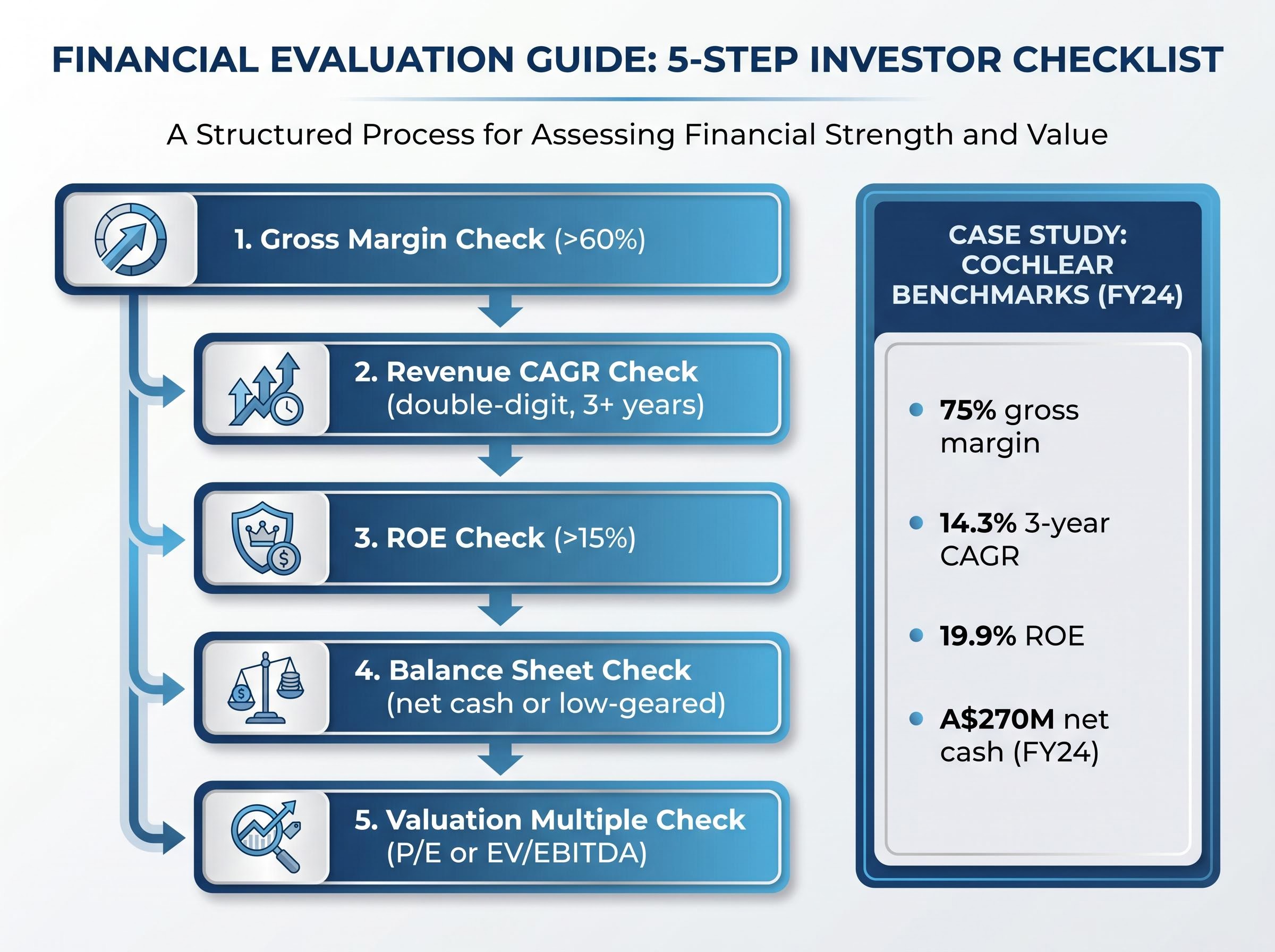
The framework taught through Cochlear’s financials is designed to be reusable. Applied as a sequential checklist, the five steps are:
- Gross margin check: Is the company’s gross margin above 60%? Where does it sit relative to ASX healthcare peers?
- Revenue CAGR check: Has the business compounded revenue at a double-digit rate over three or more years? Are the demand drivers structural or cyclical?
- ROE check: Does ROE exceed 15%? Is it achieved without excessive leverage?
- Balance sheet check: Is the company net cash or low-geared? Does it have financial flexibility to fund R&D and absorb volatility?
- Valuation multiple check: Where does the current P/E or EV/EBITDA sit relative to historical and sector ranges? Is the premium justified?
For smaller or earlier-stage ASX medtech names, such as Polynovo or Nanosonics, the framework requires modification. According to Bell Potter commentary (via Livewire, May 2024), P/E is often uninformative during the scaling phase. EV/sales and EV/EBITDA trajectory become more relevant metrics until free cash flow turns positive and ROE exceeds approximately 15%. Cochlear’s estimated market share of around 48% in global cochlear implants (an unverified estimate that should be cross-checked) is an example of the oligopoly characteristic that supports premium multiples for established players, a feature most smaller names have yet to achieve.
For further reading on applying these concepts independently:
- ASX Investor Update (August 2024): covers how to read healthcare income statements, R&D risk, and multi-year trend analysis
- Livewire Markets (June 2024): explains healthcare margins, moats, and the difference between device, pharma, and pathology business models
- Morningstar Australia (May 2024): covers economic moats, valuation approaches (DCF, P/E, EV/EBITDA), and when each is most appropriate
The distinction that separates informed investors from the rest
Cochlear’s financials offer a high-quality benchmark that retail investors can use to calibrate what “good” looks like in ASX medtech: a 75% gross margin, an estimated 14.3% three-year revenue CAGR, 19.9% ROE, and a net cash balance sheet. These are the markers of a structurally sound business.
The analytical process, however, does not end at quality assessment. The same framework applied across multiple names and over multiple reporting periods builds genuine sector literacy rather than a one-time opinion on a single stock.
As a practical exercise, consider applying this five-step checklist to one other ASX healthcare name. The gap between the quality the numbers reveal and the price the market currently assigns may be where the most useful insight sits.
Investors wanting to build a more complete toolkit beyond P/E and EV/EBITDA will find our full explainer on ASX share valuation methods, which walks through P/S ratios, discounted cash flow, EV/EBITDA, and the dividend discount model in a structured five-step sequence with worked examples drawn from listed ASX companies.
This article is for informational purposes only and should not be considered financial advice. Investors should conduct their own research and consult with financial professionals before making investment decisions.