A single ASX-listed ETF now holds more than AUD 46 billion in Australian investor money. It tracks over 1,200 companies across 23 developed economies, and its growth over the past two years has outpaced every other international equity fund listed in Australia. That fund is Vanguard’s MSCI Index International Shares ETF, traded under the ticker VGS, and its trajectory reflects a structural shift in how Australian investors are building portfolios. The ASX’s heavy concentration in banks and mining companies leaves domestic-only portfolios exposed to a narrow slice of the global economy, a gap that record flows into broad international ETFs are now filling. This article explains what VGS holds, how it works, what it costs relative to alternatives, and why advisers and analysts are positioning it as a core long-term holding for Australian investors.
Why the ASX leaves Australian investors exposed to a narrow market
Most Australian investors carry a tilt they have never chosen deliberately. The ASX is structurally dominated by financials and resources; the major banks and large mining companies account for a disproportionate share of the index’s total weight. That concentration means an investor holding only ASX equities has limited access to sectors that drive much of global equity market growth.
VGS’s portfolio, by contrast, allocates approximately 24.8% to Information Technology and approximately 11.8% to Health Care, two sectors with minimal representation on the domestic exchange. Consumer Discretionary and Industrials each carry meaningful weight in the fund that the ASX cannot replicate.
The sectors most underrepresented on the ASX, and most accessible through a global index fund, include:
- Technology: Global software, semiconductor, and cloud infrastructure companies with no ASX-listed equivalents at comparable scale.
- Health Care: Large-cap pharmaceutical and medical device firms headquartered primarily in the US and Europe.
- Consumer Discretionary: International retail, automotive, and luxury goods companies absent from Australian equity markets.
- Industrials: Aerospace, logistics, and advanced manufacturing firms concentrated in the US, Europe, and Japan.
This gap has a behavioural dimension. “Home bias,” the tendency for investors to over-allocate to their domestic market, is well-documented among Australian retail investors, partly reinforced by the franking credit system that rewards domestic dividend income. Recognising the structural cost of that bias is the first step toward addressing it.
The cost of home bias is measurable: over the 10 years to June 2025, the ASX delivered annualised returns of 11.1% including franking credits, compared to 12.5% for the MSCI World and 15.5% for the S&P 500, with Morningstar data confirming that franking credits alone do not close the gap for growth-oriented investors in the accumulation phase.
Graham Hand, Editorial Director at Firstlinks (Morningstar), has described low-cost global ETFs as “the new default core holding” for self-directed investors, including SMSF members.
When big ASX news breaks, our subscribers know first
What VGS actually holds: the index, the markets, and the sectors
The headline figure, approximately 1,265-1,275 securities as at April 2026, is where the story starts, not where it ends. VGS tracks the MSCI World ex-Australia Index, a rules-based, market-capitalisation-weighted index covering large and mid-cap companies across developed markets. Australia is excluded by design, on the basis that investors already hold domestic exposure separately.
Vanguard implements the index through direct shareholding in the underlying companies rather than through derivatives or synthetic replication. Each unit of VGS represents a proportional claim on the actual shares held in the fund.
Geographic spread across developed economies
The United States accounts for approximately 69-73% of the fund, a weighting that reflects the actual size of US equity markets relative to other developed economies rather than an active allocation decision. Market-capitalisation weighting means VGS automatically mirrors where global equity value sits.
The MSCI World ex Australia Index methodology uses a rules-based, market-capitalisation weighting approach that captures large and mid-cap representation across 23 developed markets, which means country and sector weights shift automatically as market values change rather than through any active allocation decision by the fund manager.
Beyond the US, meaningful secondary exposures include Japan at approximately 6.2%, the United Kingdom at approximately 4.0%, France at approximately 3.5%, Switzerland at approximately 3.3%, Germany at approximately 2.9%, and Canada at approximately 3.3%. Aggregated, developed European markets represent a high-teens percentage of the fund.
Sector composition and what it adds to an ASX portfolio
The sectors most heavily weighted in VGS are precisely those most underrepresented on the ASX. Information Technology leads at approximately 24.8%, followed by Financials at approximately 14.0%, Health Care at approximately 11.8%, and Consumer Discretionary at approximately 10.5%. The top individual holdings, large-cap US technology companies, are unavailable to investors through ASX-listed equities.
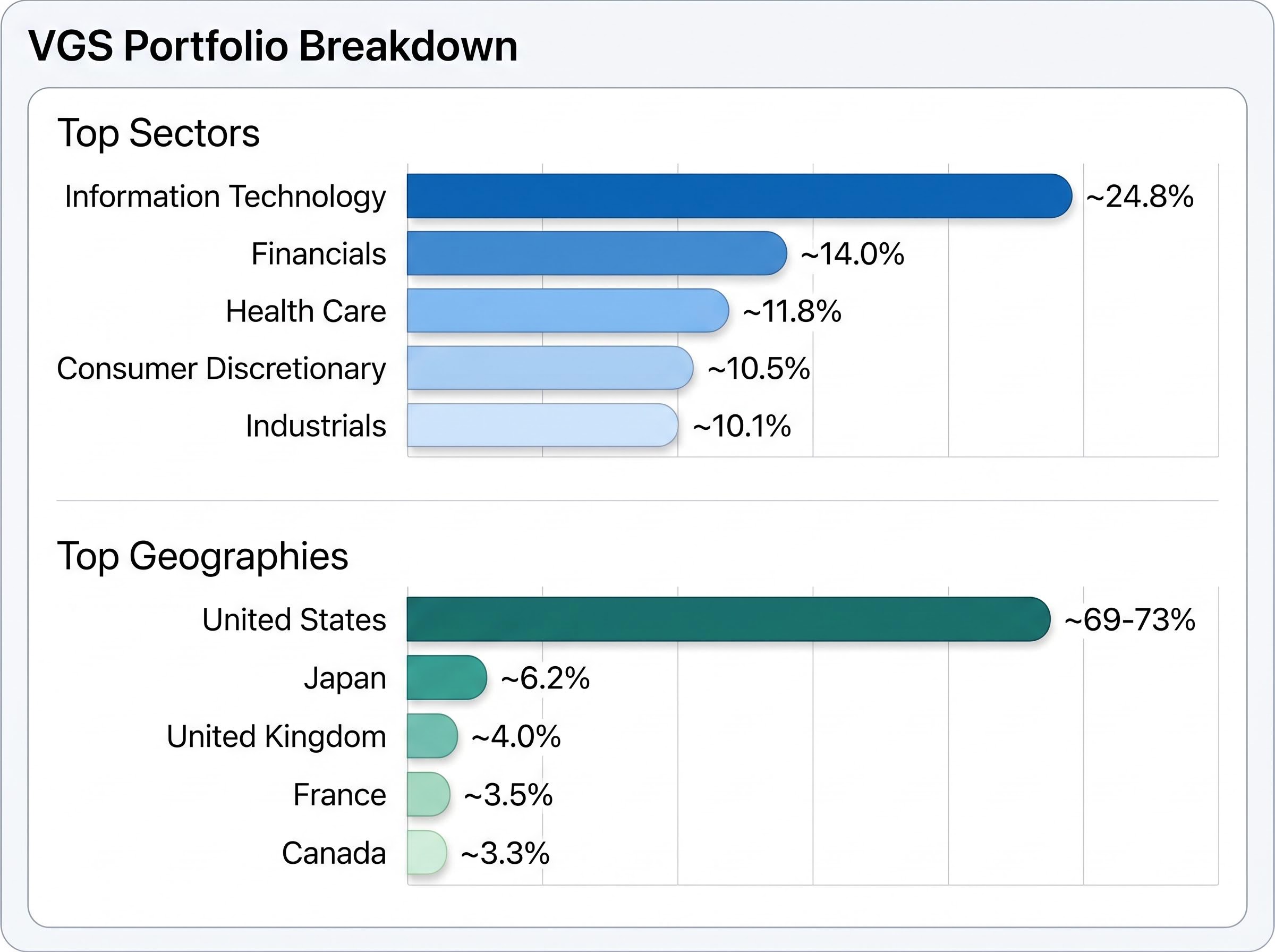
| Country | Weight | Sector | Weight |
|---|---|---|---|
| United States | ~69-73% | Information Technology | ~24.8% |
| Japan | ~6.2% | Financials | ~14.0% |
| United Kingdom | ~4.0% | Health Care | ~11.8% |
| France | ~3.5% | Consumer Discretionary | ~10.5% |
| Canada | ~3.3% | Industrials | ~10.1% |
How VGS works as a fund: structure, currency, and tax treatment
Understanding what VGS holds is one thing. Understanding how owning it actually works, how the units trade, what happens with currency, and how the tax treatment differs from domestic shares, is what moves an investor from research to action.
VGS is listed on the ASX and trades in Australian dollars. Investors buy and sell units through any standard Australian brokerage account, the same way they would purchase shares in a domestic company. There is no need to open a foreign brokerage account or handle foreign currency transactions directly.
The key structural facts:
- ASX-listed: Trades on the Australian Securities Exchange under the ticker VGS.
- Unhedged: Australian dollar returns include the effect of currency movements between the AUD and the underlying currencies (primarily USD, EUR, GBP, JPY). Currency fluctuations are a source of both risk and potential return.
- AUD-denominated: All transactions, distributions, and reporting are in Australian dollars.
- No franking credits: Distributions are typically a mix of income and realised gains, with no franking credits attached given the international holdings. Relevant foreign income tax offsets may apply.
The fund’s management expense ratio sits at 0.18% per annum as reported by Vanguard for April-May 2026. Funds under management have reached approximately AUD 46.85 billion as at 30 April 2026, making it one of the largest ETFs on the ASX by any measure.
Anthony Macdonald, writing in the Australian Financial Review’s Chanticleer column in February 2026, described VGS as “a plain-vanilla, institutional-grade tool that gives mum-and-dad investors the same broad global exposure that big super funds have.”
How VGS compares to other broad international ETFs on the ASX
Several broad international equity ETFs compete for the same allocation in Australian portfolios. The differences between them are not about quality but about mandate: what each fund includes, what it screens out, and how much it charges for the exposure.
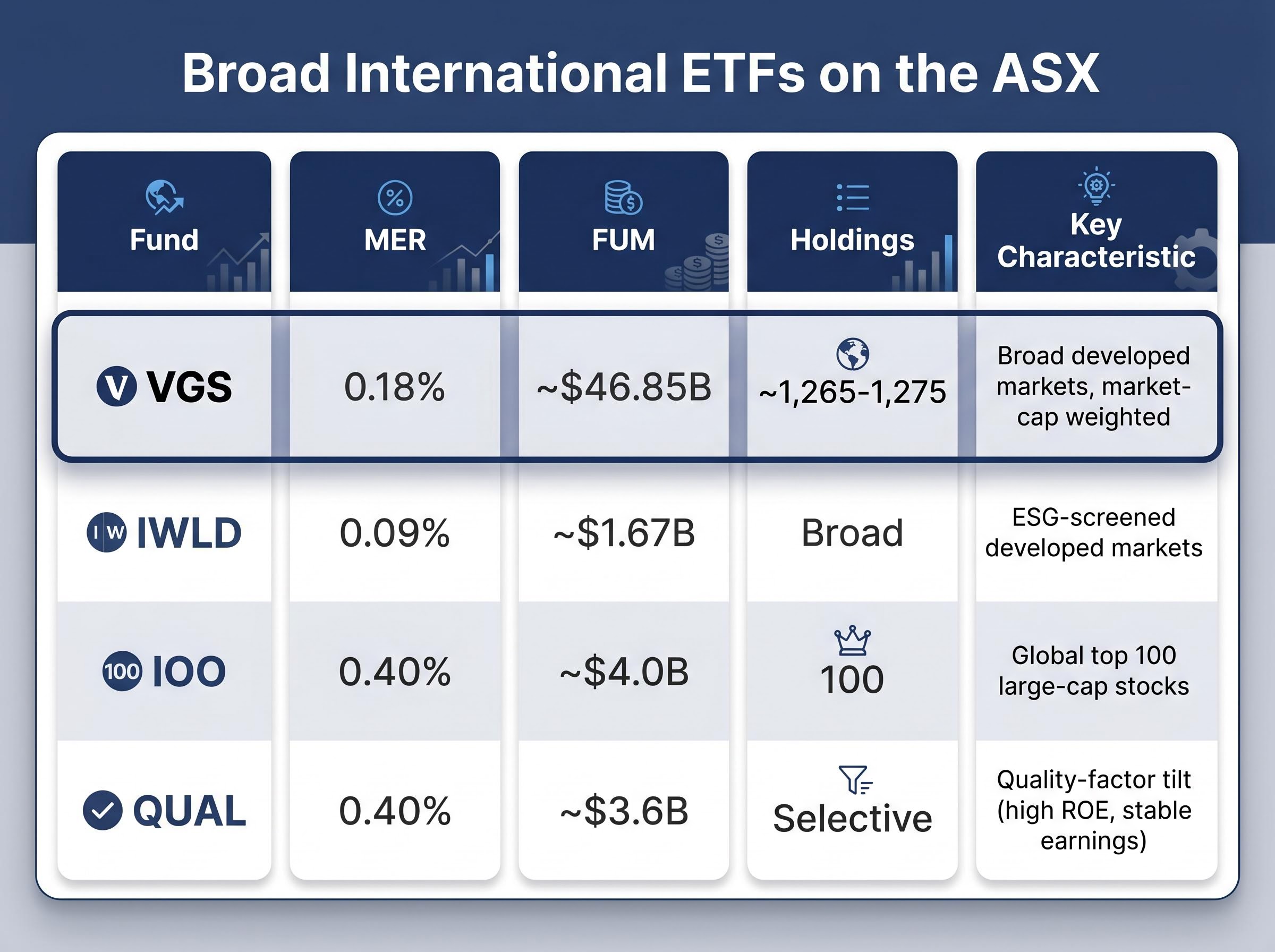
| Fund | MER | FUM | Holdings | Key Characteristic |
|---|---|---|---|---|
| VGS | 0.18% | ~$46.85B | ~1,265-1,275 | Broad developed markets, market-cap weighted |
| IWLD | 0.09% | ~$1.67B | Broad | ESG-screened developed markets |
| IOO | 0.40% | ~$4.0B | 100 | Global top 100 large-cap stocks |
| QUAL | 0.40% | ~$3.6B | Selective | Quality-factor tilt (high ROE, stable earnings) |
IWLD offers a lower MER at 0.09%, but that headline fee comes with an ESG screening overlay. The fund excludes companies that fail certain environmental, social, and governance criteria, which means the investor is accepting a values-based filter alongside the market exposure. Whether that filter aligns with an individual’s preferences is a personal assessment.
VGS sits in the mid-range on cost but leads the category significantly on FUM, a reflection of both its longer track record among Australian investors and the depth of secondary market liquidity available on the ASX.
The core trade-offs in summary:
- VGS: Pure market-cap exposure across developed markets, no ESG or factor overlay.
- IWLD: Lower fee, but ESG screening excludes certain companies the investor may wish to assess independently.
- IOO / QUAL: Higher fees with narrower or factor-tilted mandates, concentrating exposure in fewer holdings or specific quality characteristics.
The investor demand behind VGS: flows, SMSF adoption, and the home-bias shift
The capital flowing into VGS is not speculative enthusiasm. It is a measurable reallocation by Australian investors who are consciously reducing their domestic concentration.
In the 12 months to 31 December 2024, Australian-domiciled global equity ETFs attracted net inflows of approximately AUD 11 billion, outpacing flows into Australian equity ETFs, according to Morningstar Australia. VGS itself recorded over AUD 537 million in inflows in March 2026 alone, according to Vanguard Australia.
SMSF trustees and self-directed retail investors are consistently cited as the most active adopters. The shift is not happening in isolation; it is being actively recommended by professional investors and advisers across the industry.
- James Gerrish, Portfolio Manager at Shaw and Partners, has recommended allocating “at least one-third of equities” to global funds for balanced portfolios, describing a world index ETF as “an efficient way for Australian investors to get access to technology, healthcare and consumer brands that barely exist on the ASX.”
- Scott Phillips, Chief Investment Officer at Motley Fool Australia, notes that VGS “spreads risk across thousands of companies in the US, Europe and Japan, reducing overexposure to any one sector or country.”
- Tim Mackay, Principal at Quantum Financial, has endorsed VGS as a core holding, observing that “for clients with heavy franking-credit exposure, a global index ETF is often the simplest way to diversify sector risk.”
- Elio D’Amato, equities strategist, has stated: “You can’t build a genuine global portfolio on the ASX alone; you need vehicles like VGS to access global leaders.”
Damien Klassen, Head of Investments at Nucleus Wealth, has noted that broad international ETFs tracking MSCI World ex-Australia allow investors to “reduce country, currency and sector concentration risk in a single trade.”
The consistency of this commentary, from independent advisers, fund managers, and financial media, points to a structural shift in Australian portfolio construction rather than a cyclical preference.
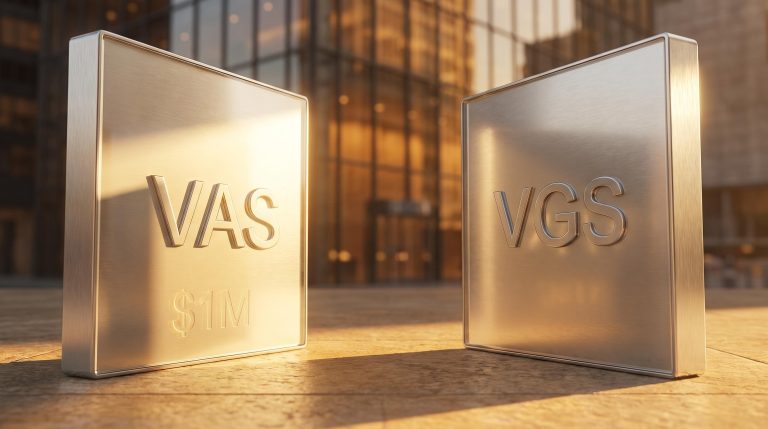
The return divergence between domestic and international ETFs reached its widest point in recent memory over the 12 months to May 2026, with IVV returning approximately 32% against VAS’s 10.59%, a gap driven in part by the RBA’s rate hiking cycle directly pressuring the bank-heavy composition of the domestic index at the same time as US equity markets recovered.
Is VGS a fit for your portfolio? What long-term investors should weigh
The data and adviser commentary make a strong case for VGS as a diversification tool. That does not mean the fund is without trade-offs, and investors benefit from weighing three specific considerations before committing capital.
- US concentration: With approximately 69-73% of the fund allocated to US equities, VGS is heavily correlated to US market performance. Investors seeking genuinely diversified global exposure should recognise this tilt and assess whether their overall portfolio, including other holdings, achieves the balance they intend.
- Investment horizon: Multiple commentators, including Scott Phillips of Motley Fool Australia writing in June 2025, frame VGS as a holding suited to investors with a 10-plus-year time horizon. Shorter-term holders are more exposed to currency fluctuation cycles and equity market drawdowns that tend to smooth over longer periods.
- Emerging markets gap: VGS tracks developed markets only. China, India, Brazil, and other emerging economies are outside the MSCI World ex-Australia index and therefore absent from the fund. Investors seeking total global market coverage should consider this gap.
Emerging market exposure via ASX-listed ETFs returned between 9% and 16% year-to-date through mid-May 2026, a period during which the ASX 200 declined approximately 2.5%, illustrating both the diversification benefit and the distinct risk profile that investors accept when extending beyond the developed-market universe VGS covers.
What VGS does not cover
Australia is explicitly excluded from the index by design. The assumption is that Australian investors already hold domestic equities separately, making VGS a complement rather than a replacement for ASX holdings.
Emerging markets are similarly absent. The MSCI World ex-Australia index covers developed economies only. Investors who want exposure to higher-growth emerging market equities may consider pairing VGS with a dedicated emerging markets fund, though any such decision warrants independent research and professional advice.
A straightforward tool for a genuinely complex problem
The ASX’s structural concentration in financials and resources means most Australian investors are under-diversified by default. VGS addresses that gap with a single, ASX-accessible fund: broad developed-market coverage across approximately 1,265-1,275 holdings, a management expense ratio of 0.18%, and approximately AUD 46.85 billion in funds under management reflecting a decade-long track record of attracting both institutional and retail capital.
The fund is not a speculative position on global markets. It is a structural portfolio complement to domestic holdings, and it is being used as such by SMSF trustees, self-directed investors, and financial advisers across Australia.
Investors considering VGS should verify current product details, including the latest factsheet and product disclosure statement, directly with Vanguard Australia or consult a licensed financial adviser before investing.
This article is for informational purposes only and should not be considered financial advice. Investors should conduct their own research and consult with financial professionals before making investment decisions.