
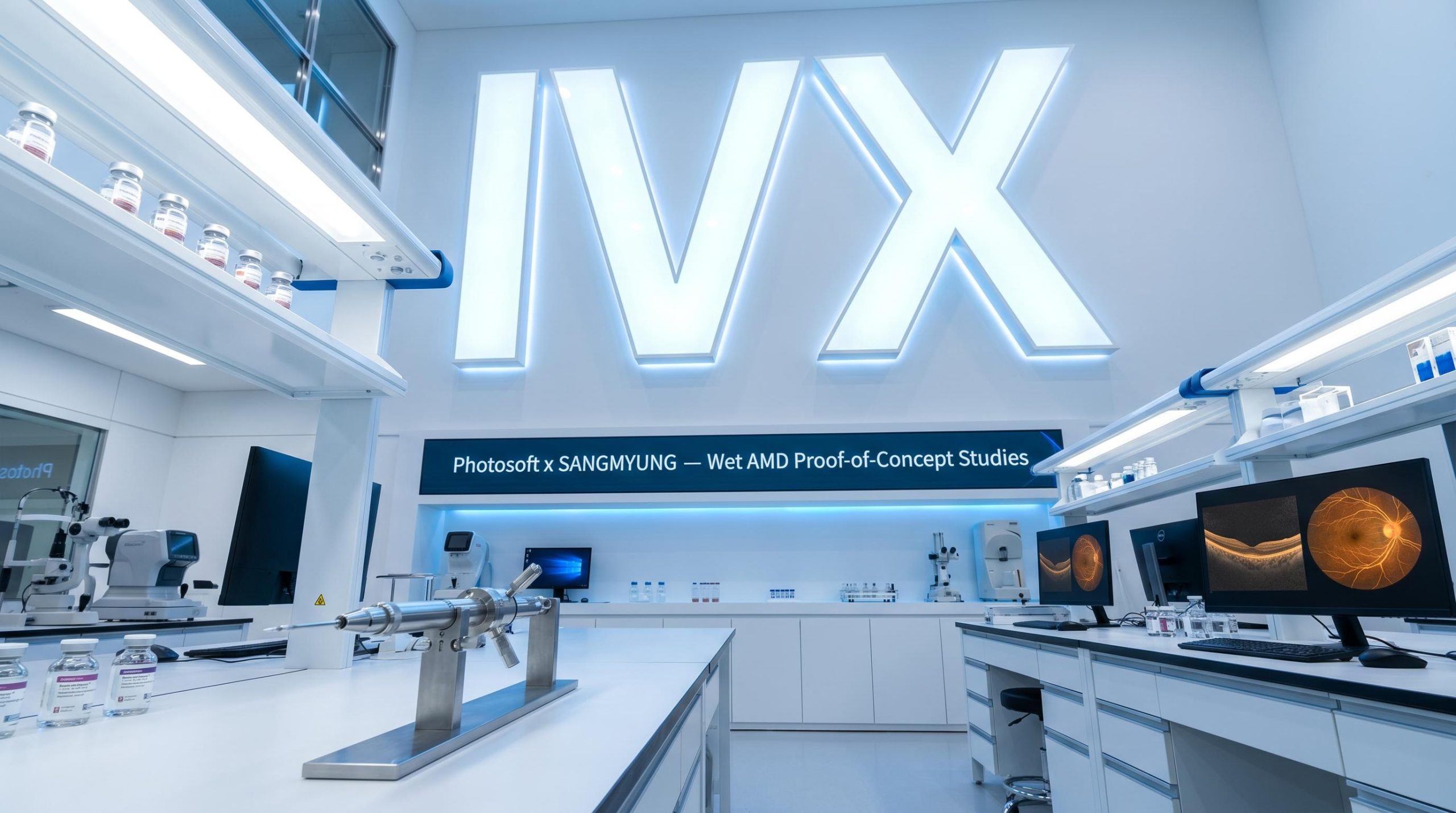
Invion’s Photosoft technology enters ophthalmology with funded wet AMD partnership
Invion Limited (ASX: IVX) has signed its first collaboration agreement in the ophthalmology space, partnering with SANGMYUNG Innovation Co., Ltd., a South Korean ophthalmic drug delivery company that spun off from Hanlim Pharmaceutical in 2022, to evaluate the Photosoft platform technology for the treatment of wet age-related macular degeneration (wet AMD) and other retinal vascular diseases.
Under the deal structure, SANGMYUNG will fund and conduct proof-of-concept preclinical efficacy studies using select Photosoft compounds drawn from Invion’s library of over 300 unique Photosoft photosensitisers. Invion supplies the Photosoft compounds and light devices, while retaining all rights to the Photosoft intellectual property (IP), including any new IP generated through the studies.
Prof Thian Chew, Executive Chair and CEO, Invion
“As part of our strategy to expand our Photosoft platform through strategic partnerships, our collaboration with SANGMYUNG extends our technology into ophthalmology, where there remains a clear need for new treatment options.”
When big ASX news breaks, our subscribers know first
Why wet AMD represents a compelling and urgent opportunity
The scale of the problem
Wet AMD is a serious disease characterised by abnormal blood vessel growth at the back of the eye, which can damage the macula and lead to rapid central vision loss. Age-related macular degeneration (AMD) affects roughly 1 in 8 people aged 60 and older and is the most common cause of irreversible blindness in older people in developed countries.
Despite accounting for only ~10% of all AMD cases, wet AMD is responsible for 90% of legal blindness, underscoring the severity of the condition relative to its prevalence.
Key market figures from the announcement:
- Global wet AMD market valued at approximately US$10.6 billion in 2025
- Projected to reach approximately US$16.7 billion by 2032
- Compound annual growth rate (CAGR) of 6.7%, driven by ageing demographics and expanded access to new therapies
The gap Photosoft could fill
Anti-vascular endothelial growth factor (anti-VEGF) therapy is the current standard of care for wet AMD, but meaningful gaps in efficacy remain. 20–40% of patients may not respond to anti-VEGF therapy, and up to 50% of those who do respond may develop resistance within a year.
There is currently only one FDA-approved photodynamic therapy (PDT) for wet AMD, verteporfin, which is used as a secondary treatment or in combination with anti-VEGF. Beyond its limitations as an early-generation PDT, a global verteporfin shortage exists due to challenges around its chemistry and manufacturing.
Photosoft is being evaluated as a potential next-generation alternative to address these limitations. It is important to note that this programme remains at the preclinical stage.
| Feature | Anti-VEGF / Verteporfin | Photosoft (Under Investigation) |
|---|---|---|
| Patient non-response rate | 20–40% may not respond to anti-VEGF | Being evaluated as an alternative for non-responders |
| Resistance development | Up to 50% of responders may develop resistance within a year | Resistance profile under preclinical investigation |
| Global supply availability | Global verteporfin shortage due to manufacturing challenges | Drawn from a library of 300+ unique photosensitisers |
| Generation of therapy | First-generation PDT (verteporfin) or biologics (anti-VEGF) | Next-generation PDT platform |
Note: Photosoft data reflects preclinical investigation only. Clinical efficacy and safety have not yet been established.
What is photodynamic therapy, and what makes Photosoft different?
Photodynamic therapy (PDT) is a treatment approach that uses non-toxic photosensitiser compounds activated by light to selectively target and destroy disease-causing cells. Because the photosensitiser is only activated when exposed to a specific wavelength of light, the approach aims to minimise damage to surrounding healthy tissue.
In the context of wet AMD, the disease is driven by abnormal blood vessel growth at the back of the eye. A precisely targeted PDT approach could address this mechanism with minimal systemic side effects compared to existing therapies.
Photosoft is Invion’s next-generation PDT platform, with applications being explored across cancers, atherosclerosis, and infectious diseases. The ophthalmology collaboration with SANGMYUNG represents a new application of the platform in a high-value disease area.
SANGMYUNG’s proprietary suprachoroidal delivery device is central to the partnership’s rationale. The device administers drugs directly to the suprachoroidal space (SCS) of the eye, enabling higher drug concentrations, increased bioavailability, and prolonged duration of action. This targeted delivery mechanism is considered synergistic with Photosoft’s mechanism of action, as precise placement could enhance the photosensitiser’s therapeutic effect while limiting off-target exposure.
Mr Jinha Park, CEO, SANGMYUNG Innovation
“Our proprietary suprachoroidal delivery device is designed to place therapies precisely where they are needed. However, even the best delivery technology cannot overcome the fundamental limitations of current wet AMD drugs, which still leave many patients with inadequate or diminishing responses.”
What comes next, and what investors should watch
The immediate path forward involves SANGMYUNG undertaking and funding proof-of-concept preclinical efficacy studies using select Photosoft compounds. Invion retains full IP rights throughout this process, including any new IP generated.
Should preclinical results prove promising, both parties may discuss a broader development collaboration, including further preclinical studies, regulatory planning, and potential clinical development pathways.
Investors should monitor the following progression:
- Completion of proof-of-concept preclinical studies, funded by SANGMYUNG
- Data readout and assessment against wet AMD efficacy endpoints
- Potential expansion to a broader development collaboration, encompassing further preclinical work, regulatory planning, and clinical development pathways
The partnership was facilitated with support from the Victorian Government through the Global Victoria programme, as well as Austrade in South Korea, which made the introduction to Hanlim and SANGMYUNG. This government-supported pathway adds a layer of institutional credibility to the connection.
For the Photosoft platform more broadly, this agreement signals continued progress in Invion’s strategy of expanding its technology into new disease areas through externally funded partnerships, with the IP position preserved throughout.
Don’t Miss the Next Healthcare Breakthrough on the ASX
Big News Blast delivers FREE breaking ASX healthcare news directly to your inbox within minutes of release, complete with in-depth analysis. Join 20,000+ subscribers already staying ahead of the market. Click the “Free Alerts” button at Big News Blast to get the next market-moving healthcare announcement the moment it drops.