On 17 May 2026, WTI crude futures crossed $101 and the 10-year Treasury yield pushed to 4.60%, yet the strategists at Alpine Macro were already designing the trade for what happens after the U.S.-Iran standoff breaks. Markets are caught in a split-screen moment: equity indices are falling, energy stocks are rallying, and bond yields are spiking on inflation fears tied to elevated crude prices. The question is not whether this tension persists indefinitely but how investors position for the rotation that follows a resolution, whichever form it takes.
What follows is an examination of Alpine Macro’s recommended barbell investment strategy, the mechanism by which falling oil prices could simultaneously improve AI sector economics and lift traditional cyclical industries, and the equity rotation investors should be monitoring before year-end 2026.
Why the U.S.-Iran standoff is holding markets in suspension
The market data from 17 May 2026 tells a story of an equity market pulled in two directions at once:
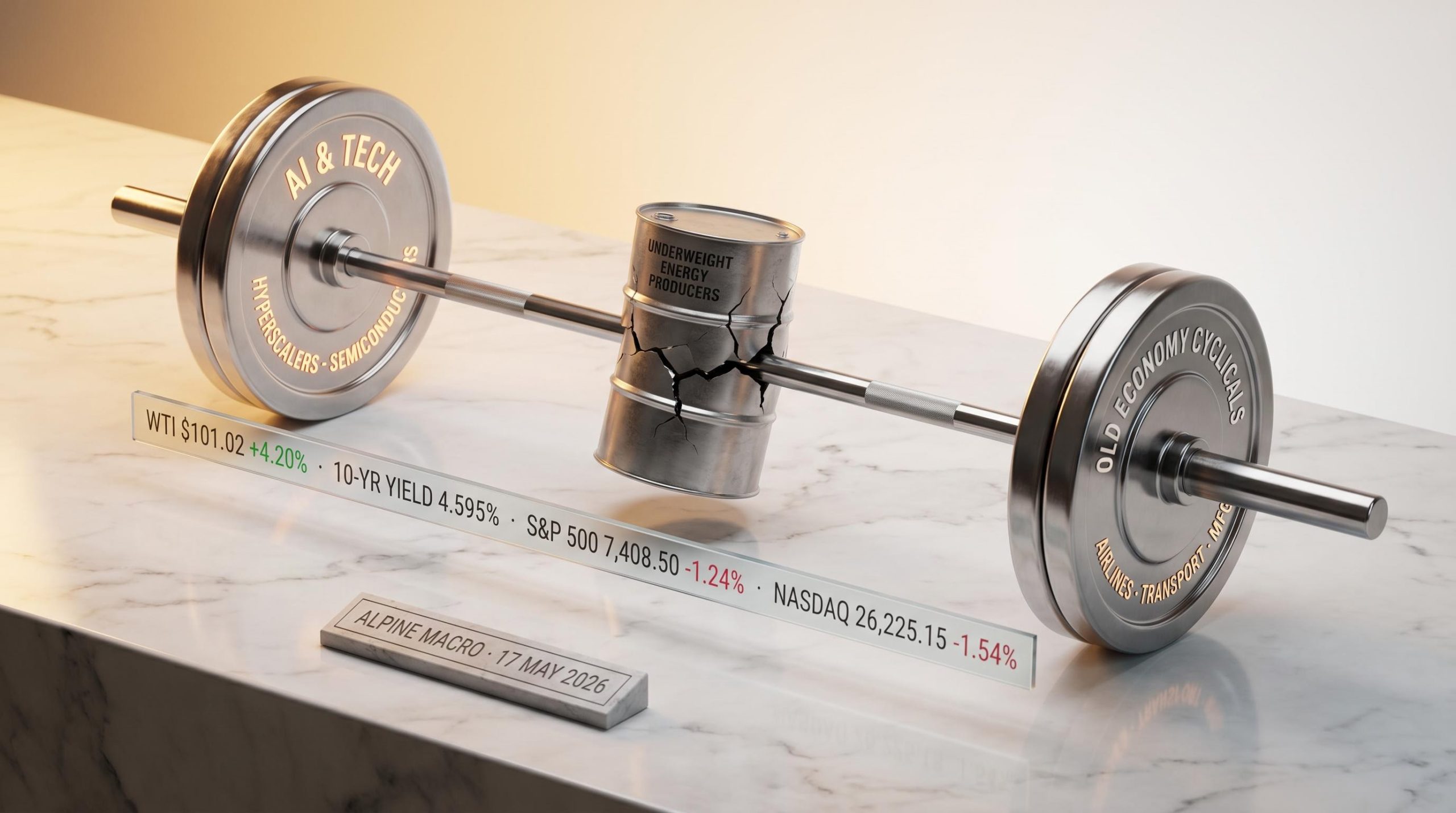
- WTI Crude: $101.02, up $4.25 (+4.20%)
- Brent Crude: $109.26, up $3.54 (+3.35%)
- U.S. 10-Year Treasury yield: 4.595%, up 13.6 basis points
- S&P 500: 7,408.50, down 1.24%; NASDAQ: 26,225.15, down 1.54%; VIX: 18.43
- S&P 500 Energy sector: up +2.32% on the same session
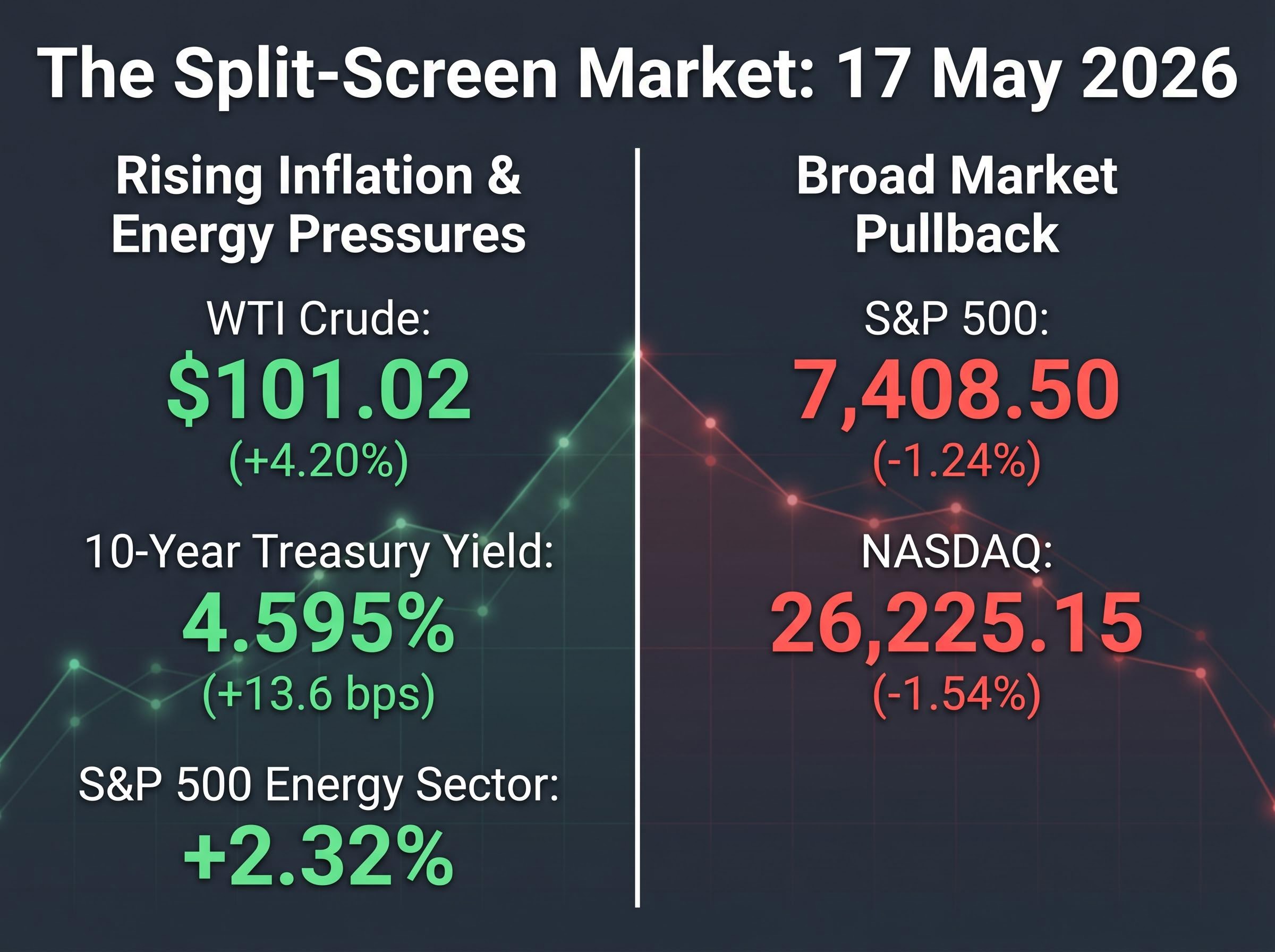
The divergence between a falling broad market and a rising energy sector is not a contradiction. It is the market pricing two distinct scenarios simultaneously. Equities are absorbing the drag of higher input costs across most sectors, while energy producers capture the upside of a sustained crude price spike. Bond markets, meanwhile, are repricing inflation risk: the 13.6 basis point jump in the 10-year yield reflects fixed-income investors adjusting to the possibility that energy-driven inflation persists longer than expected.
The Hormuz oil risk premium has proved stickier than headline ceasefire signals suggest, with the IEA projecting a two-year supply chain recovery timeline even under a best-case resolution, meaning the decompression Alpine Macro anticipates over a 3-6 month window may still leave elevated volatility in energy markets through the end of 2026.
Alpine Macro’s Chief Geopolitical Strategist Dan Alamariu places equal 50% odds on a peace agreement within 1-2 weeks versus a resumption of military strikes.
That 50/50 framework is what makes the current moment a setup rather than a resolution. Both outcomes produce sharp, directionally opposed rotations across sectors, and Alpine Macro’s barbell is designed to position for the one the firm believes is more likely to pay off.
When big ASX news breaks, our subscribers know first
What a barbell investment strategy actually means
The concept borrows its name from the gym. A barbell concentrates weight at two ends with a thin bar connecting them. In portfolio construction, the principle is the same: concentrate exposure at two extremes of the risk or sector spectrum and hold little or nothing in the middle.
The logic is not hedging in the conventional sense. Both ends of the barbell should be capable of generating positive returns, but under different scenarios. If one end outperforms because of a specific macro development, the other end should not collapse; it should hold value or benefit from a separate, concurrent driver.
This is not a niche tactic. BlackRock, Goldman Sachs, J.P. Morgan, Morgan Stanley, and Amundi have all advocated forms of barbell positioning pairing AI and technology growth with value and cyclical sectors as a structural approach for the 2024-2026 period. The institutional consensus reflects a market regime where AI momentum and commodity-driven inflation can coexist, making a single-sector bet riskier than a dual-exposure framework.
How Alpine Macro’s version of the trade is structured
Alpine Macro’s specific formulation identifies three positions:
- Long: AI and technology winners (hyperscalers, semiconductors)
- Long: Old Economy cyclicals (energy-intensive sectors including airlines, transportation, and manufacturing)
- Underweight or short: Energy producers (integrated oil majors, exploration and production companies)
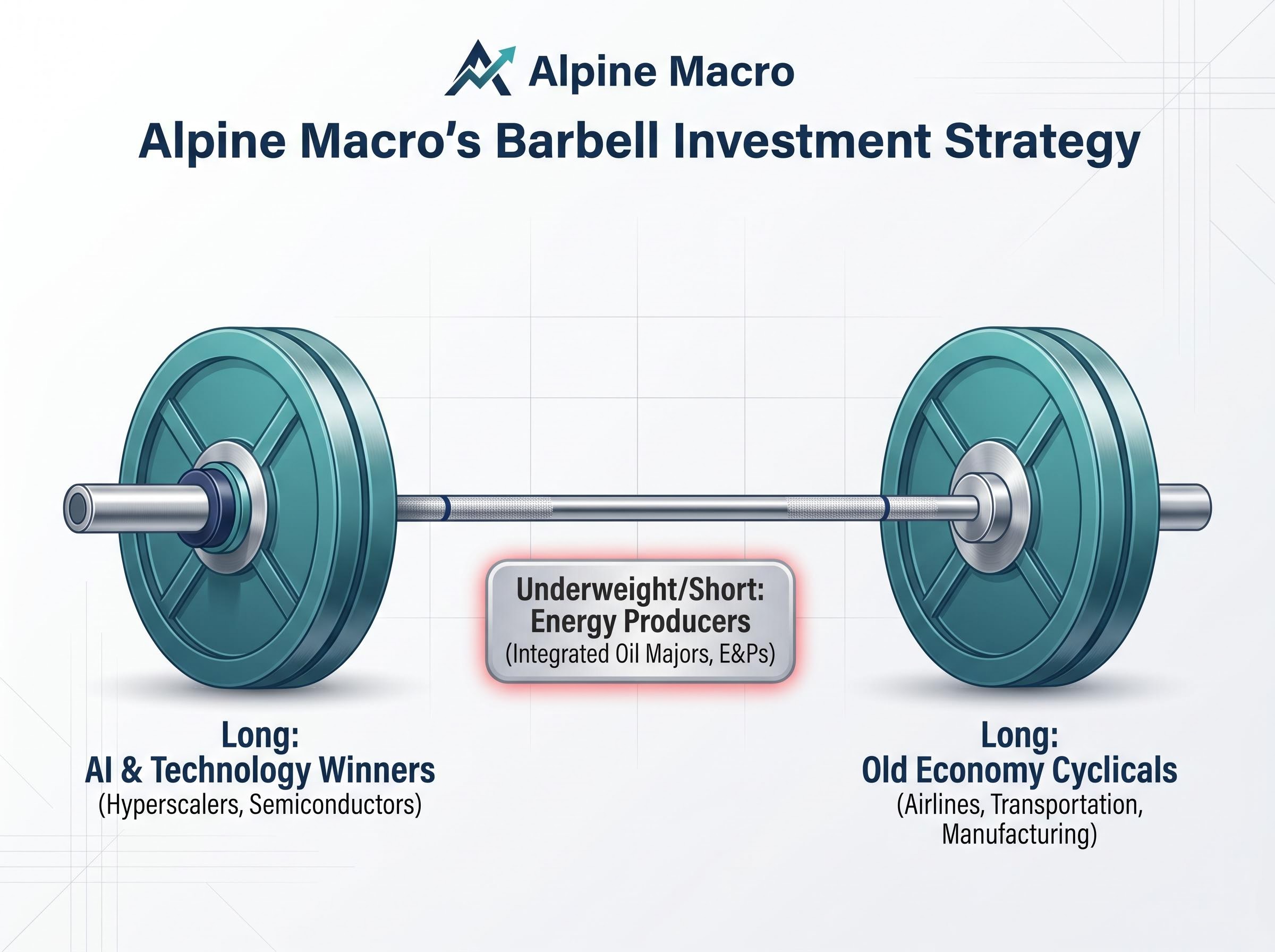
This is not a random pairing. It is a deliberate bet on oil price directionality: if crude falls from current levels, the two long positions benefit through distinct mechanisms, while the underweight position in energy producers limits exposure to the sector most vulnerable to declining oil revenue.
How falling crude prices feed the AI investment engine
The link between oil prices and AI profitability is not intuitive, and it does not run in a straight line. Crude oil does not power data centres directly. The connection moves through three steps:
- Oil price declines feed through to natural gas and wholesale power markets. In the U.S., natural gas is the marginal fuel for electricity generation in many regions, and gas prices are partially correlated with broader energy market conditions. Natural gas futures traded at $2.96 on 17 May 2026.
- Lower wholesale power prices reduce the operating cost burden for AI data centres. According to McKinsey, electricity constitutes up to 25-40% of total data-centre operating expenditure, with AI workloads pushing that share higher. For GPU-intensive facilities, power may represent the single largest operating cost.
- Cheaper power improves the internal rate of return on AI infrastructure projects, supporting more aggressive hyperscaler capital expenditure. As Bloomberg has reported, hyperscalers’ returns on AI investments are “highly sensitive to electricity prices,” and cheaper power “improves the IRR of AI infrastructure projects.”
AI infrastructure power costs are increasingly the variable that determines which hyperscaler projects move from approved to shovel-ready, with Wall Street projecting $530-700 billion in global data centre IT spending through 2026 and data centres forecast to consume 9% of US domestic electricity by 2030, up from 4% in 2023.
Bloomberg has described power as potentially “the single largest operating cost” for GPU-rich data centres. Cheaper power, in this framing, does not merely save money; it changes which projects get approved.
The International Energy Agency’s “Electricity 2024” report projected that data-centre, AI, and crypto demand could reach up to 4% of global electricity demand by 2026. At that scale, even modest shifts in power pricing alter the economics of hundreds of billions of dollars in planned infrastructure spending.
Alpine Macro’s framing aligns with this mechanism: declining energy costs “would support continued momentum in AI-related sectors.” The trade logic is not speculative; it follows a well-documented cost chain from fuel markets to electricity markets to data-centre economics.
The other side of the barbell: energy consumers take over from energy producers
The rotation from energy producers to energy consumers during periods of falling oil prices is not a forecast. It is a pattern with a track record.
J.P. Morgan research from October 2024 documented that the 2014-2015 and 2020 oil price declines produced “underperformance of energy producers and outperformance of transport, airlines, and net-energy-consuming manufacturing.” Goldman Sachs equity research from November 2024 estimated that a 10% sustained drop in oil could boost airline and chemicals earnings by several percentage points while cutting energy-sector earnings.
The S&P 500 Energy sector’s +2.32% gain on 17 May 2026 illustrates the elevated starting point: energy producers are currently benefiting from geopolitical premium in crude pricing. Alpine Macro’s thesis is that this premium reverses once the diplomatic situation resolves.
| Sector Category | Representative Equities | Expected Impact of Oil Price Decline | Historical Precedent |
|---|---|---|---|
| Energy Producers | Integrated majors, E&Ps | Earnings compression, equity underperformance | 2014-2015, 2020 oil declines |
| Energy-Intensive Industrials | Airlines, transportation, manufacturers | Margin expansion, equity outperformance | 2014-2015, 2020 oil declines |
| AI and Technology | Hyperscalers, semiconductors | Lower power costs, improved infrastructure IRR | Structural (2024-2026 data-centre build-out cycle) |
| Broad Market (S&P 500) | Index-level | Net positive (lower input costs across sectors) | Post-oil-decline rallies in 2015, 2020 |
What the Hormuz Strait reopening would mean for oil supply
Alpine Macro views the current blockade as structurally unsustainable. Any diplomatic resolution is expected to include the reopening of the Strait of Hormuz, and the firm projects oil price normalisation over a 3-6 month window from May 2026. Alpine Macro anticipates that “relative performance between energy-producing equities and energy-consuming equities is expected to shift materially before year-end” 2026.
The risks that could break the trade before it pays off
The barbell is a probability-weighted position, not a certainty. Two distinct failure modes could invalidate the thesis.
- Geopolitical escalation: Resumed military strikes would keep oil elevated and energy producers outperforming, inverting the trade. Alpine Macro’s own 50/50 probability assessment underscores that this is not a low-probability tail risk but a coin flip.
- Federal Reserve policy independence from headline energy moves: A fall in oil does not automatically translate into rate cuts that would further boost the AI and growth leg of the barbell.
- Elevated valuation starting point: Following a strong Q1 2026 earnings season, the S&P 500 at 7,408.50 and the NASDAQ at 26,225.15 already price significant optimism, creating a higher bar for the trade’s upside to materialise quickly.
Bond market stress is real. The 10-year Treasury yield at 4.595% and the 30-year at 5.128% on 17 May 2026 reflect how much damage a sustained oil-driven inflation episode could inflict on fixed-income portfolios. The VIX at 18.43, up 6.78% on the session, confirms elevated uncertainty across asset classes.
Why the Fed will not automatically follow oil prices down
The Federal Reserve’s inflation mandate focuses on core CPI, not headline readings that include volatile energy prices. Fed Board staff research (FEDS Notes) has documented the declining pass-through of energy price shocks to core inflation compared to the 1970s. Falling oil may help headline CPI but has limited impact on the core metrics that actually drive policy decisions.
Core CPI dynamics explain why the Federal Reserve under Chair Kevin Warsh is unlikely to treat a crude oil decline as a policy pivot signal: core inflation reached 2.8% in April 2026, well above the 2% target, and the newly confirmed hawkish Fed leadership has flagged the prospect of accelerated quantitative tightening that would steepen the yield curve independently of any move in headline energy prices.
Alpine Macro’s own assessment reinforces this distinction: “the primary risks threatening bonds are seen as originating from policy decisions rather than from underlying macroeconomic conditions.” For the barbell’s AI leg to receive a rate-cut tailwind, core inflation would need to decline on its own terms, not merely because petrol prices fell.
A 3-6 month window investors should be watching closely
Alpine Macro projects that both bond and equity prices could move “considerably higher within 3-6 months” if the peace scenario materialises. The firm anticipates a Hormuz Strait deal within one to two months of May 2026, with oil price normalisation and sector rotation unfolding over the subsequent quarter.
The four sequential signposts that would confirm the thesis:
- Diplomatic breakthrough or Strait of Hormuz reopening announcement
- WTI crude declining toward pre-conflict baseline levels
- Energy sector equity underperformance relative to industrials and technology
- Bond yield stabilisation as inflation expectations moderate
One additional variable sharpens the timeline. U.S. midterm elections on 3 November 2026 create political incentive for the administration to pursue lower energy prices, reducing the probability of reactive fiscal stimulus that could complicate the macro picture. Lower fuel costs ahead of an election cycle are politically valuable, which may increase the likelihood of a diplomatic resolution.
The barbell is not a passive hold. It is a positioning decision that requires active monitoring of both the geopolitical trigger and the energy-price response. Investors who understand the signposts and the failure modes are better equipped to act before the rotation becomes consensus.
The trade Alpine Macro is making is a bet on geopolitics as much as economics
The barbell’s appeal lies in its dual-scenario logic. If oil falls as projected, both AI and cyclicals benefit through distinct mechanisms: cheaper power for data centres and lower input costs for energy-intensive industries. If the conflict escalates, the portfolio’s energy-producer underweight is the primary vulnerability investors need to monitor.
Broad institutional consensus supports the structural pairing. BlackRock, Goldman Sachs, J.P. Morgan, Morgan Stanley, and Amundi have all endorsed versions of AI and technology growth paired with energy-intensive cyclicals as a positioning framework for the 2024-2026 period. Alpine Macro’s specific call, anchored to a live geopolitical catalyst, sits within that established analytical foundation.
The two leading indicators that will confirm or invalidate the thesis within the next one to two months are the Hormuz Strait diplomatic situation and the WTI price trajectory. Investors may wish to review their current energy sector exposure and assess whether their portfolio is positioned for an oil-down rotation, or inadvertently concentrated in the sectors most vulnerable to one.
For investors assessing how much unintentional technology exposure already exists in their portfolios before implementing the barbell, our dedicated guide to S&P 500 concentration risk examines how technology stocks accounted for roughly 85% of the index’s year-to-date gain as of 16 May 2026, the rebalancing thresholds Goldman Sachs and JPMorgan recommend, and why cap-weighted index funds mechanically compound sector overweights over time.
This article is for informational purposes only and should not be considered financial advice. Investors should conduct their own research and consult with financial professionals before making investment decisions. Forward-looking statements regarding oil prices, sector rotation, and diplomatic outcomes are speculative and subject to change based on market developments and geopolitical conditions.