
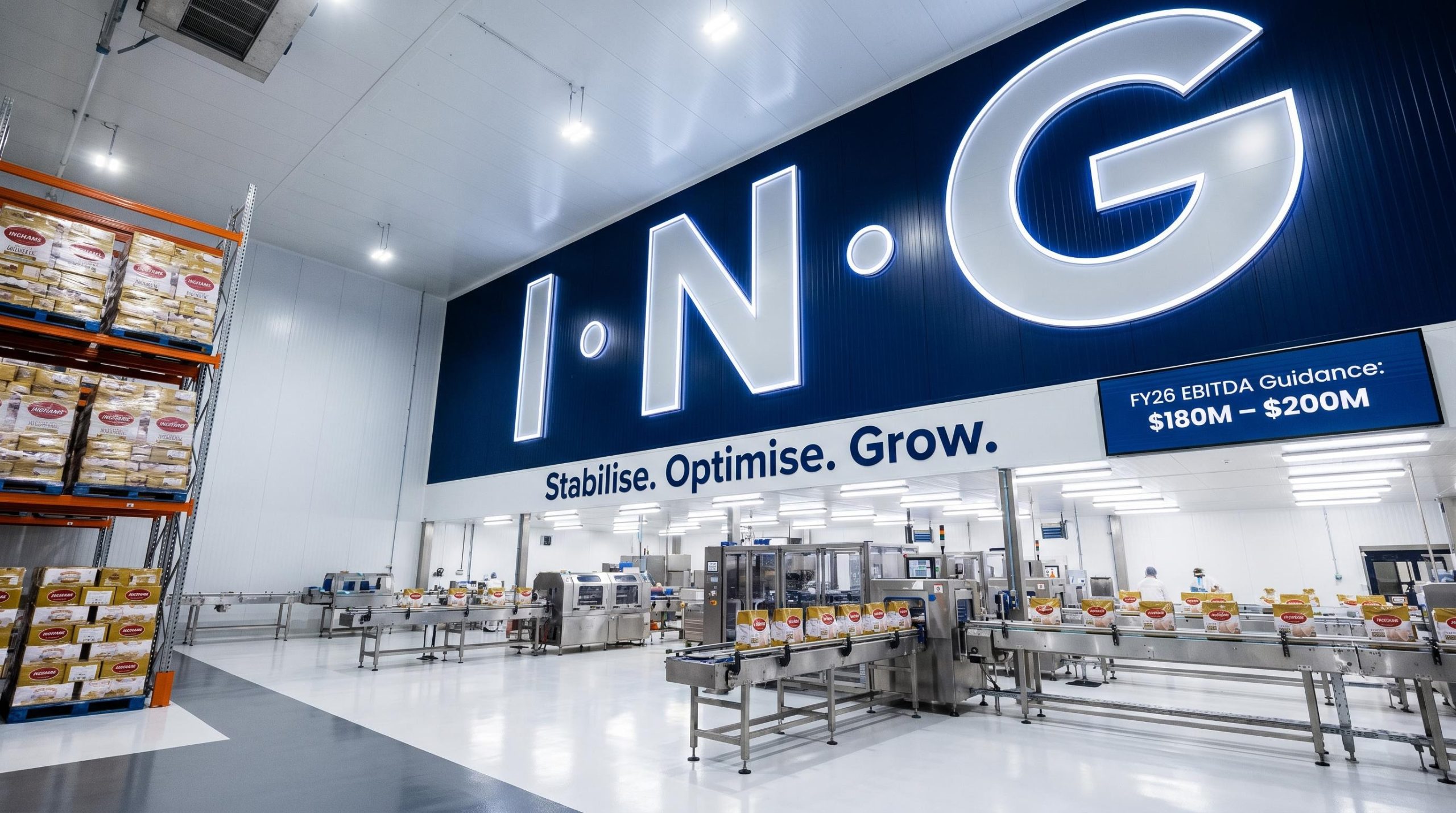
Inghams maps a clear three-phase strategy to lift earnings and returns at 2026 Investor Day
At its Investor Day held on 11 May 2026, Inghams Group (ASX: ING) presented a structured strategic roadmap to investors and analysts, led by CEO and Managing Director Ed Alexander and the full executive leadership team. The central thesis is a three-phase plan, Stabilise, Optimise, Grow, anchored by a deliberate shift towards maximising value per bird rather than pursuing volume-led expansion.
Management simultaneously reaffirmed FY26 Underlying EBITDA (pre AASB 16) guidance of $180.0 million to $200.0 million, alongside a trading update covering the first nine months of FY26. The framing was direct: past returns have not reflected the quality of the underlying asset base, and the primary constraint is operational execution, not demand.
When big ASX news breaks, our subscribers know first
The strategic shift — from volume to value per bird
A deliberate pivot in operating philosophy
Management outlined a fundamental change in how Inghams thinks about growth, moving from a volume-led, commodity-first model to a value-led approach centred on value per bird and return on invested capital. The presentation laid out this contrast explicitly across five dimensions:
| Traditional Approach | Inghams’ Approach |
|---|---|
| Volume-led | Value-led + volume growth |
| Cost-first | Customer + category + cost |
| Commodity | Differentiated |
| Capacity expansion | Capital discipline |
Management was unambiguous about the destination: “We expect to continue growing broadly in line with category growth — but with materially stronger earnings quality and returns.”
Three phases, three distinct jobs to be done
The presentation structured the strategic plan around three sequenced phases, each with a distinct mandate:
- Stabilise — fix execution on yield, labour and planning; restore consistency; reduce volatility
- Optimise — lift value per bird, improve mix, optimise network flows, expand margins
- Grow — expand into higher value products, scale the ingredients platform, build innovation-led growth
Management was explicit that stabilisation must come first, and growth capital will only be deployed after returns improve.
CEO and Managing Director Ed Alexander
“Stabilise first. Optimise second. Growth through disciplined expansion.”
What the numbers say — early stabilisation gains and the embedded earnings opportunity
Trading update reaffirms guidance amid cost headwinds
The FY26 trading update, covering the first nine months of the financial year, presented the following metrics:
- Group core poultry volumes up 1.1% versus the prior corresponding period (PCP); Australia +1.2%, New Zealand +0.5%
- Group core poultry net selling prices (NSP) up 1.1% versus PCP; Australia +1.4%, New Zealand (NZD terms) +2.7%
- FY26 Underlying EBITDA (pre AASB 16) guidance reaffirmed: $180.0 million to $200.0 million
- Revised capital expenditure guidance: approximately $80 million
Geopolitical developments in the Middle East have driven cost pressures across several input categories. Feed requirements for the remainder of FY26 are fully covered under the company’s 3–9 month forward procurement policy, though higher observed feed costs are expected in FY27. Diesel fuel cost increases, flowing through via transport provider fuel levies, are expected to carry a net FY26 impact in the range of $7–10 million after customer pricing actions and operational improvement initiatives. Packaging cost pressures are also beginning to emerge, with mitigation strategies being implemented. These headwinds are acknowledged but contained — the guidance reaffirmation signals management confidence in underlying execution.
Quantified earnings upside already embedded in the business
Management identified three major EBITDA uplift buckets, each with a defined timeline and quantum:
- Operational execution (yield, labour, planning, waste): more than $100 million EBITDA, phased over three years
- Customer and commercial strategy (mix, premium formats, pricing discipline): approximately $30 million EBITDA, phased over five years
- Planning and supply chain discipline: more than $30 million EBITDA, phased over three years
Two specific proof points presented at the Investor Day illustrate early momentum. Chicken processing yield improved from 60.8% (Week 1 FY26) to approximately 63.2% (Week 39), delivering an estimated ~$20 million annualised benefit. Across transport, labour, network and planning, $17.4 million in annualised savings have been delivered or are underway, with a further $3.1 million in future projects in the pipeline. Additionally, a reduction of approximately $25 million in frozen inventory has restored system balance and improved cash generation.
The key message management sought to land was direct: earnings recovery is within the company’s control and does not rely on external tailwinds.
New Zealand, innovation and the balance sheet — building the long-term platform
New Zealand on track for NZD $100 million EBITDA by 2030
Management presented New Zealand as a strategically distinct and attractive market, characterised by a rational four-player structure, a vertically integrated supply chain, and a geographically concentrated population base that creates meaningful logistics and service advantages. The EBITDA trajectory (pre-royalty, company data) illustrates consistent improvement:
- FY22: NZD $34.1 million
- FY23: NZD $37.0 million
- FY24: NZD $64.6 million
- FY25: NZD $73.0 million
- Target: NZD $100 million by 2030
Branded volume growth for FY26 year-to-date versus PCP reinforces the premiumisation trend: the Ingham’s brand grew +8.6%, Waitoa +15.1%, and Bostock Brothers +10.1%. The Te Aroha automation programme is delivering return on invested capital (ROIC) of more than 20% across major investments and a run-rate cost reduction of approximately $3–4 million.
Innovation and capital discipline complete the picture
On the innovation front, management outlined a $2.6 billion combined ANZ addressable market across three structurally growing demand pools: Convenience ($1.5 billion+, CAGR approximately 6–8%), Nutrition ($0.5 billion+, CAGR approximately 8–10%), and Experience ($0.6 billion+, CAGR approximately 7–9%). The Advanced Ingredients Facility represents a specific near-term opportunity, with incremental EBITDA of approximately $5 million on an $8.5 million investment in plate-freezing equipment and infrastructure.
On the balance sheet, management presented the following net debt trajectory as forward-looking company forecasts:
- FY26 forecast: $440–460 million
- FY27 forecast: $410–435 million
- FY28 forecast: $380–415 million
The target leverage range is 1.0–2.0x pre AASB 16. Management framed the declining net debt trajectory as a commitment to a strengthening balance sheet that preserves strategic flexibility, funded by earnings improvement, working capital discipline and capital expenditure restraint.
The overall investment thesis presented at the 2026 Investor Day rests on the convergence of several factors: a structurally attractive protein category, a deep integrated network spanning Australia and New Zealand, more than $130 million of identified EBITDA upside already embedded in the business, and a sequenced capital strategy designed to improve returns before scaling growth. Management’s confidence, as articulated throughout the presentation, is grounded in the view that the path to stronger earnings is operational, executable, and already underway.
Don’t Miss the Next Consumer Staples Breakout
Big News Blast delivers FREE breaking ASX news straight to your inbox within minutes of release, complete with in-depth analysis already done for you. Join 20,000+ investors who stay ahead of the market the moment announcements drop. Click the “Free Alerts” button at Big News Blast to start receiving alerts today.