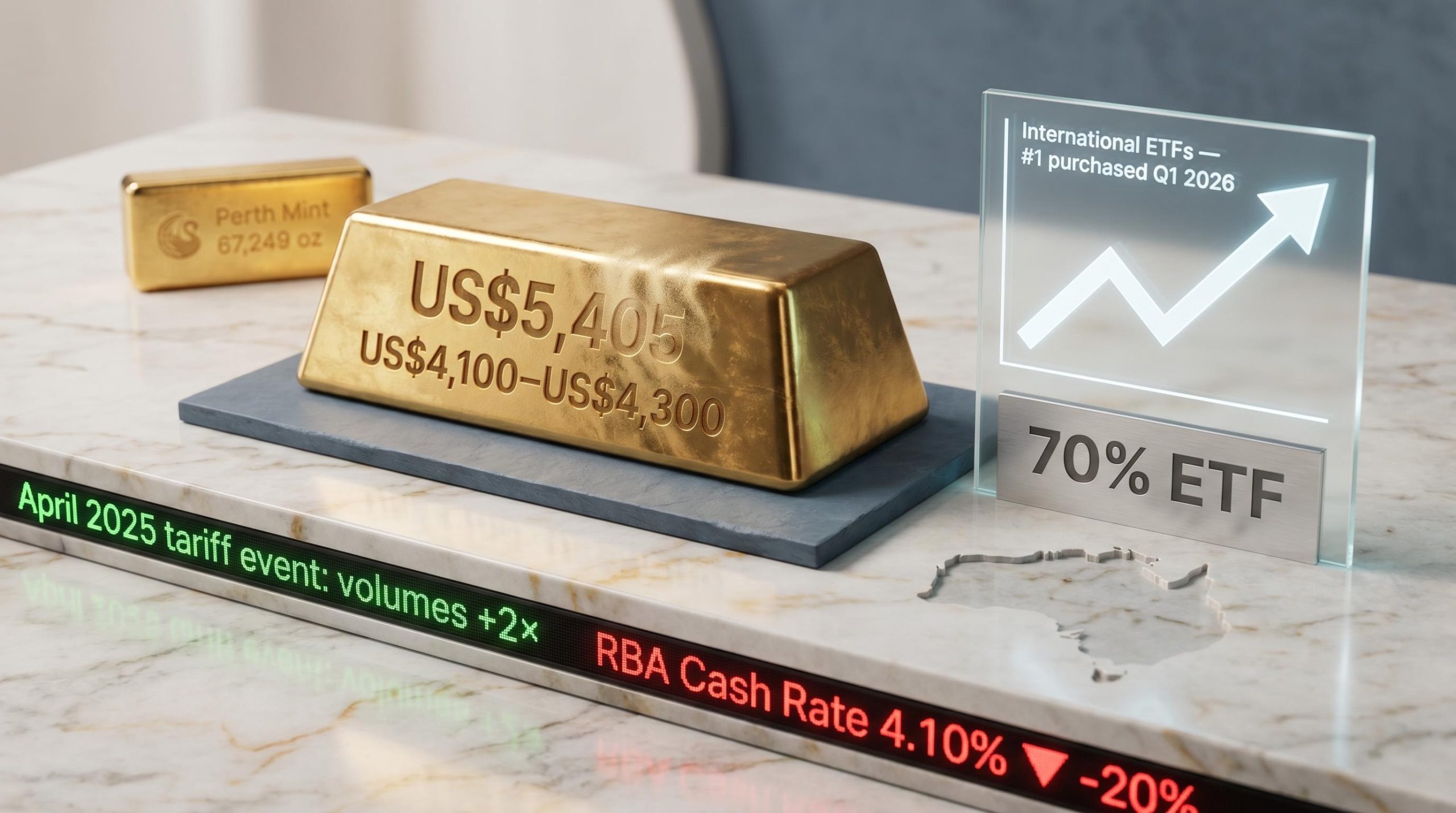
When the Reserve Bank of Australia lifted the cash rate by 25 basis points to 4.10% in March 2026, trading volumes on the Selfwealth by Syfe platform fell by more than 20% almost overnight. Months earlier, a US tariff announcement triggered the opposite reaction: volumes doubled in a single day. Two events, two opposing market responses, and one clear signal about how Australian retail investor trends are shifting beneath the surface.
The Selfwealth by Syfe Quarterly Investor Pulse for Q1 2026 captures a retail cohort that is faster, more globally connected, and more sensitive to macro signals than at any prior point. Against a backdrop of Australian inflation running at 4.09% (the highest in over two years), gold retreating from a January high of US$5,405 per ounce, and ASX reporting season delivering 5%-plus moves on roughly half of all results days, the data points to structural behavioural shifts rather than one-off reactions. This analysis examines two interlocking patterns: the acceleration of event-driven trading and the cooling of gold demand, and what both reveal about how Australian retail investors are managing portfolio risk in 2026.
How macroeconomic shocks became same-day trading events for Australian retail investors
The two data points sit in tension, and that tension is the point.
- April 2025, US tariff announcement: Trading volumes on the Selfwealth by Syfe platform doubled in a single session as investors rushed to reposition around the shock.
- March 2026, RBA rate hike to 4.10%: Trading activity on the same platform fell more than 20% as investors pulled back from a tightening environment they had not anticipated.
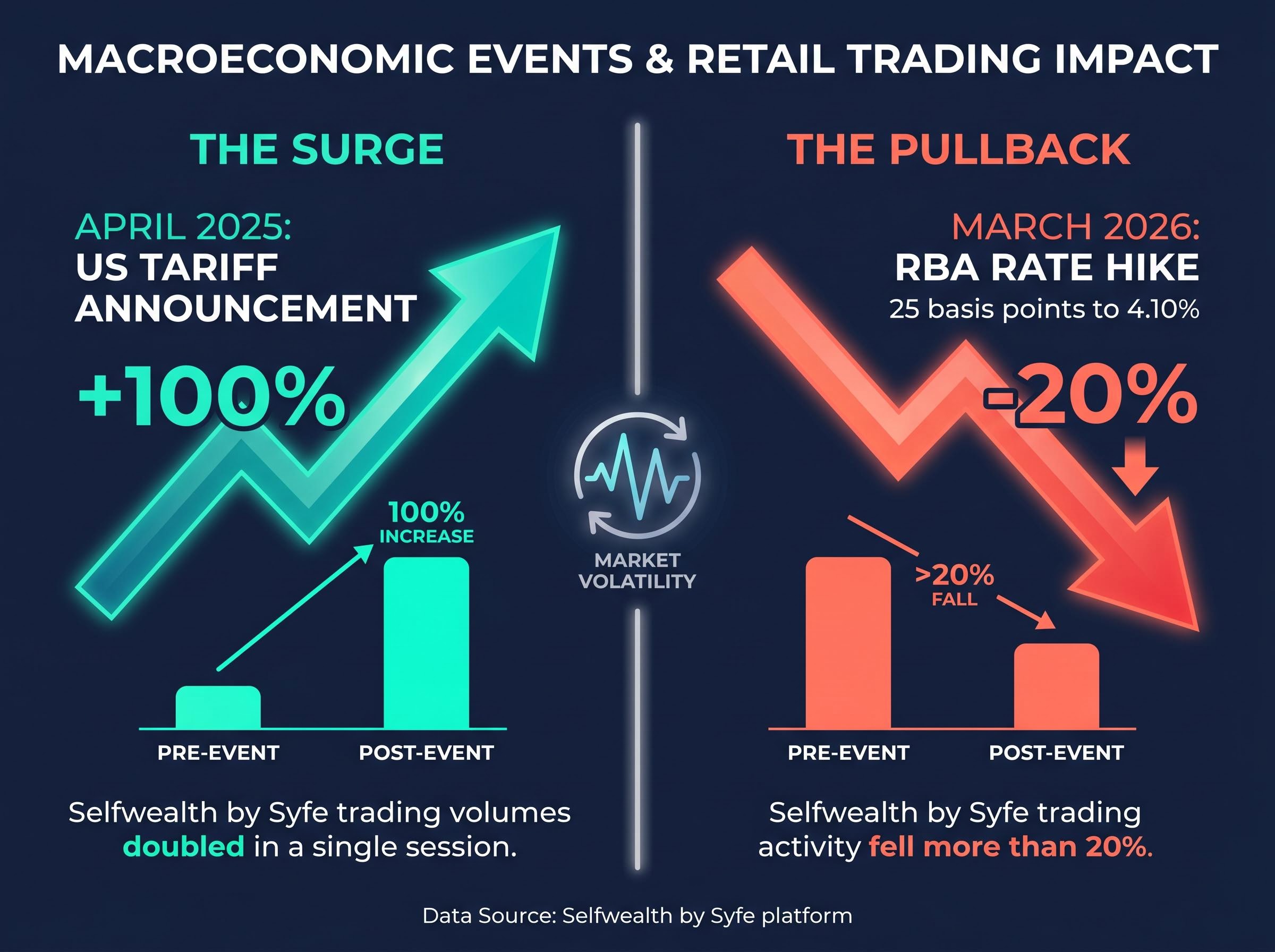
Trading volumes on the Selfwealth by Syfe platform doubled during the April 2025 US tariff announcement, one of the sharpest single-day retail trading surges recorded on the platform.
One event triggered aggressive buying. The other triggered withdrawal. The directional responses could not be more different. Yet both are expressions of the same structural change: Australian retail investors now move at the speed of the news cycle rather than the speed of traditional portfolio review.
The Selfwealth by Syfe data suggests macro developments price into retail behaviour almost immediately. Whether the impulse is to act or to freeze, the lag between event and response has compressed to hours, not days. With Australian inflation at 4.09% in Q1 2026 and the RBA’s rate path uncertain, that compression shows no sign of reversing.
The 4.09% headline CPI figure sitting behind Q1 2026 retail behaviour is itself a composite of competing forces; Australian inflation mechanics distinguish between demand-pull pressures the RBA can directly address through rate hikes and cost-push impulses driven by supply shocks, a distinction that explains why the March 2026 rate move surprised a retail cohort that had not priced in another tightening cycle.
When big ASX news breaks, our subscribers know first
What event-driven trading actually means for portfolio risk
The speed itself is neither good nor bad. Its consequences depend entirely on what drives the decision behind the trade.
When speed works against the investor
Rapid reaction to macro events can result in selling into volatility or chasing momentum, both of which compound underperformance over time. ASIC has taken notice. ASIC REP 735, published in 2026, found that retail investors are increasingly exposed to private credit and higher-risk products. The ASIC Key Issues Outlook 2026 flagged several concern areas:
- Increased retail investor exposure to private credit markets
- Growing retail access to higher-risk and more complex products
- Expanded retail participation in private markets with limited transparency
These findings suggest that retail speed has, in some cases, outpaced retail sophistication. When the reaction is reflexive rather than strategic, faster execution simply delivers worse decisions more efficiently.
The costs of reactive trading extend beyond missed entries and exits; ASIC REP 828 documented more than $458 million in losses by Australian retail CFD investors in FY 2024 alone, with 68% of participants recording losses, a figure that contextualises why regulators treated the Q1 2026 behavioural patterns as a systemic concern rather than an individual investor issue.
ASIC Report 820, published following a surveillance of both retail and wholesale private credit funds, identified inconsistent disclosure practices and governance deficiencies across the sector, adding regulatory weight to the concern that retail access to complex products has outpaced the frameworks designed to protect those investors.
The reporting season amplifier
Company-level event sensitivity compounded the problem in Q1 2026. According to CommSec, approximately 50% of ASX-listed companies moved 5% or more on results days during the quarter. That stock-level volatility layered on top of macro sensitivity created compounding reactivity: investors reacting to rate decisions and individual earnings surprises simultaneously, with each reinforcing the other.
ASX interest rate derivatives recorded record trading volumes in Q1 2026, a data point that confirms the event-driven pattern extended well beyond equities into more complex instruments.
A primer on safe-haven cycles: why gold demand surges and then fades
Safe-haven demand follows a recognisable cycle. Uncertainty drives capital into defensive assets such as gold. As confidence recovers, that capital rotates toward growth-oriented positions. The movement is not a rejection of gold’s value; it is a recalibration of how much protection the portfolio needs at that moment.
Perth Mint gold sales surged 131% in February 2026, reaching 67,249 ounces, driven by global uncertainty at the peak of the demand cycle.
The Q1 2026 gold data illustrates both halves of this cycle in compressed form.
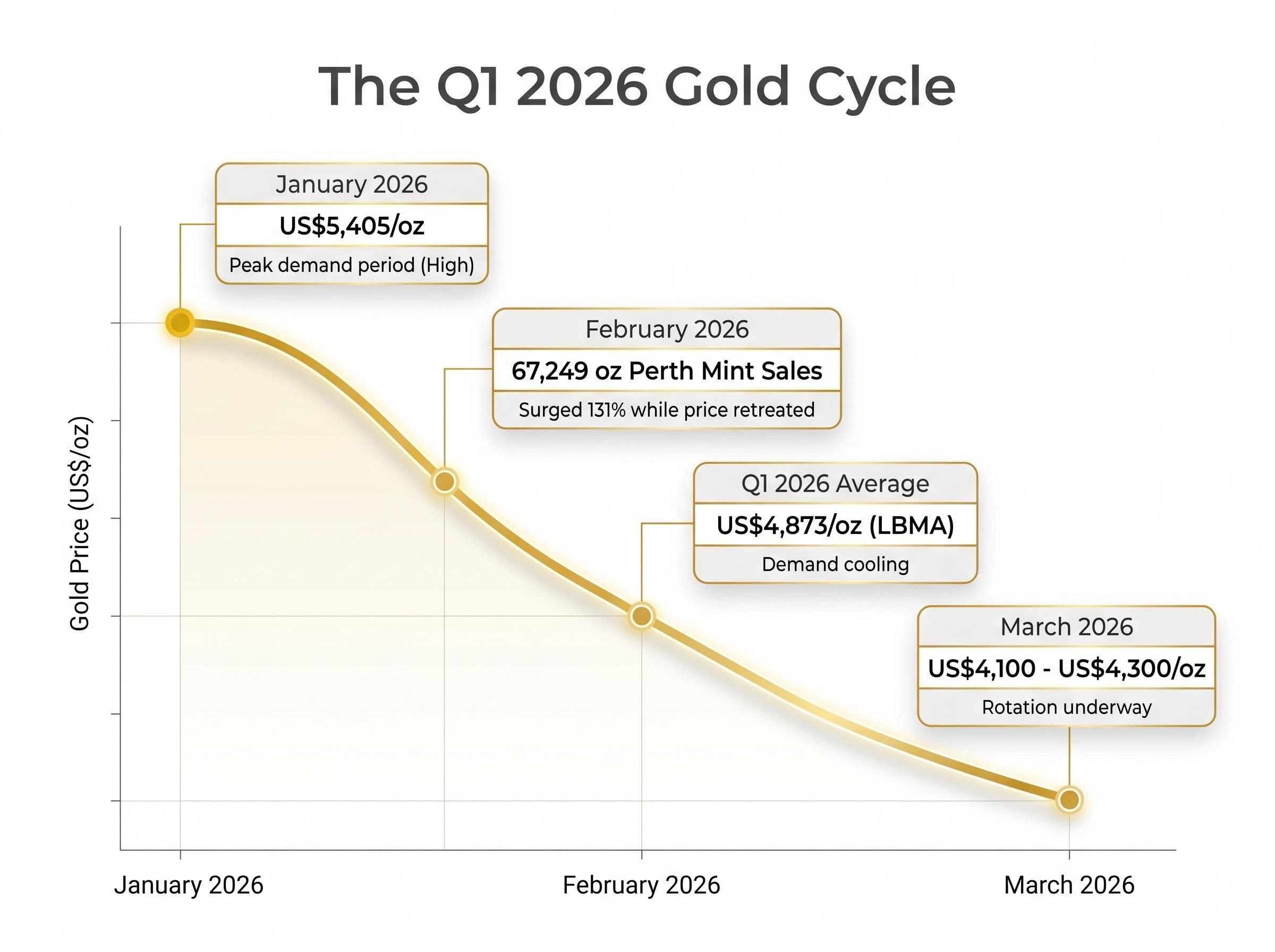
| Period | Gold Price (US$/oz) | Perth Mint Sales (oz) |
|---|---|---|
| January 2026 (high) | US$5,405 | Peak demand period |
| February 2026 | Retreating from highs | 67,249 (up 131%) |
| Q1 2026 average (LBMA) | US$4,873 | Demand cooling |
| March 2026 (range) | US$4,100-US$4,300 | Rotation underway |
The Perth Mint surge in February occurred after the January price peak, a lag consistent with retail investors buying into the safe-haven thesis just as institutional money was beginning to rotate out. By March, prices had corrected to the US$4,100-US$4,300 range, and the demand cycle had entered its cool-off phase.
Beyond the safe haven: tracing gold’s ebbing demand and capital rotation in Australian retail portfolios
The theoretical cycle played out in measurable platform data. Selfwealth by Syfe reported that gold buying activity fell below 70% of total gold-related trades by Q1 2026, marking a clear shift from the aggressive accumulation phase of earlier months.
The timing aligns with an improvement in investor sentiment identified by the platform. As confidence recovered, capital rotated toward risk assets rather than remaining parked in defensive positions.
Where the gold capital went
The destination assets tell a story of their own:
- Financial equities: nabtrade data shows retail investors heavily positioned in banks and miners, which together represent approximately 55% of ASX weighting
- International ETFs: These became the most purchased ETF category on the Selfwealth by Syfe platform in Q1 2026, surpassing domestic funds for the first time
- Growth-oriented positions: The S&P/ASX 200’s 3.7% rise in February 2026 provided a favourable environment for rotation into equities
Millennial investors, who allocate approximately 70% of their portfolios to ETFs according to Selfwealth by Syfe data, represent a generational driver of the international diversification trend. Their preference for ETF-based exposure, particularly international funds, helped accelerate the rotation away from gold into structured, diversified holdings.
The World Gold Council notes that gold retains strategic portfolio relevance for Australian investors despite the correction. The rotation is contextual, not permanent.
World Gold Council analysis of Australian gold allocation in 2026 supports the view that the Q1 correction reflects a contextual rotation rather than a structural exit, with the Council’s research identifying Australia’s macro environment as one that continues to justify a strategic gold position within diversified portfolios.
Generational patterns in a news-reactive market: are Australian retail investors actually more disciplined than the data suggests?
The event-driven narrative paints a picture of impulsive, reactive trading. The generational data complicates that picture considerably.
| Generation | ETF Allocation | Individual Equities |
|---|---|---|
| Gen Z | ~50% | ~50% |
| Millennials | ~70% | ~30% |
| Gen X | ~50% | ~50% |
| Baby Boomers | Increasing adoption | Continuing preference |
Millennial investors allocate approximately 70% of their portfolios to ETFs, according to Selfwealth by Syfe Q1 2026 data, the highest ETF weighting of any generational cohort on the platform.
Gen Z and Gen X both maintain approximately 50/50 splits between ETFs and individual equities. Baby Boomers are increasingly incorporating ETFs despite a continuing preference for individual stock selection. The cross-generational convergence is notable: age-cohort differences in structural portfolio approach are narrowing.
ETF portfolio construction across Australian generational cohorts is evolving rapidly, with total market assets estimated at $340-$350 billion as of April 2026 and Betashares forecasting growth above $500 billion by end-2028, a trajectory that reinforces why the cross-generational convergence visible in the Selfwealth by Syfe platform data reflects a structural market shift rather than a temporary positioning swing.
International ETFs surpassing domestic funds as the leading purchase category on the platform in Q1 2026 reinforces this discipline. Even in a fast-moving, news-reactive environment, Australian retail investors are maintaining diversified, structured portfolios rather than concentrating in speculative positions. Reactivity and discipline coexist within the same cohort. That is a feature of the current Australian retail investing environment, not a contradiction.
Speed, sensitivity, and structure: what Q1 2026 actually tells us about where Australian retail investing is heading
The event-driven trading acceleration and the gold rotation are two expressions of the same underlying driver: retail investors with faster information access and lower barriers to action are recalibrating portfolios more frequently than previous generations.
This behavioural shift is visible well beyond platform-level data. ASX interest rate derivatives recorded record trading volumes in Q1 2026. The ASIC Key Issues Outlook 2026 flagged retail complexity risk as a primary concern. Both signals confirm that regulators and exchanges are tracking the same patterns the platform data reveals.
Selfwealth by Syfe’s Q1 2026 Quarterly Investor Pulse identified event-driven reactivity as one of four structural behavioural shifts defining the current Australian retail investing environment.
The Selfwealth by Syfe Quarterly Investor Pulse identifies four structural shifts that defined Q1 2026:
- International ETF preference surpassing domestic ETF purchases
- Generational convergence in portfolio construction approaches
- Gold demand cooling as confidence recovered
- Event-driven reactivity compressing the gap between macro news and trading decisions
As digital platforms lower barriers further and macro volatility persists, the combination of speed and discipline observed in Q1 2026 will likely define Australian retail investing through the remainder of 2026 and beyond. The structural implication is straightforward: a more sophisticated but also more volatile retail market, where both outcomes intensify as information access continues to expand.
The informed investor’s takeaway from a quarter that rewrote the retail playbook
Q1 2026 was not a period of speculative excess. It was a period of structural transition, with Australian retail investors demonstrating both heightened macro sensitivity and underlying portfolio discipline simultaneously.
The question for individual investors is whether their own behaviour aligns with the disciplined side of that equation. Are gold exposure adjustments deliberate rotations or reactive sell-offs? Are event-driven trades part of a considered plan or a reflex triggered by a headline?
The Selfwealth by Syfe Quarterly Investor Pulse and ASIC REP 735 offer useful benchmarks for self-assessment against the behavioural patterns described here. Both are publicly accessible resources that provide context for evaluating where individual decision-making sits relative to broader market trends.
This article is for informational purposes only and should not be considered financial advice. Investors should conduct their own research and consult with financial professionals before making investment decisions. Past performance does not guarantee future results.