
Australian consumers are currently facing a persistent 4.6% headline inflation rate and the reality of a 4.1% Reserve Bank of Australia cash rate following the March 2026 hike. Global petroleum supply shocks have pushed domestic petrol prices through volatile swings, sitting at $1.51 per litre today after peaking at $2.30 last month. This widespread economic pressure means that investing during inflation is no longer a theoretical exercise, but a daily necessity for preserving capital.
What follows is a practical framework for diagnosing portfolio vulnerabilities in the current economic climate. The strategies outlined below identify both the direct risks to uninvested capital and the unique yield opportunities created by tight monetary policy. By understanding these macroeconomic forces, readers can systematically position their wealth to absorb the shocks of an elevated interest rate cycle.
Understanding the Mechanics of Wealth Erosion
The first step in wealth preservation requires shifting focus from abstract economic theory to the direct impact on daily purchasing power. Broad price increases are currently driven by two simultaneous forces: excessive consumer demand meeting constrained global supply chains. When more capital chases fewer available goods, the fundamental cost of living mathematically must rise.
This dynamic creates a compounding cycle that moves through every layer of the economy. Anticipated living cost increases drive worker compensation demands, which corporations subsequently pass back to retail buyers through higher prices. While mild price appreciation historically stimulates economic activity, excessive inflation actively degrades the real value of uninvested capital at an accelerating rate.
Passive cash holding effectively operates as a guaranteed loss strategy in the current environment. A capital reserve sitting in a zero-interest account loses nearly five percent of its purchasing utility over a twelve-month period. Economic research formalises this wealth destruction on a global scale.
“According to International Monetary Fund research, true economic output expansion typically decreases for each individual percentage point that price growth surpasses the baseline.”
Research within the IMF working paper on disinflation isolates this negative correlation, proving that uninvested capital consistently loses purchasing utility when inflation persists above baseline targets.
Readers must recognise this fundamental mechanism of wealth erosion before deploying capital. This foundational knowledge clarifies why inflation forces a choice between proactive asset allocation and the certain degradation of passive savings.
When big ASX news breaks, our subscribers know first
Central Bank Responses and the April 2026 Macro Landscape
Central bank interventions often feel unpredictable, but they represent a deliberate mechanical brake applied to an overheated economy. Authorities manipulate benchmark borrowing costs to regulate consumer demand and manage domestic price stability. The Reserve Bank of Australia raised the cash rate to 4.1% specifically to make capital more expensive, thereby forcing a slowdown in corporate expansion and retail spending.
Geopolitical petroleum supply disruption serves as the primary inflationary driver in the second quarter of 2026. Current Brent crude market estimates are fluctuating widely between $104.18 and $114.42 per barrel. However, market pricing indicates an expectation that this supply shock will remain transient rather than permanent.
The cascading effect of these elevated commodity prices is forcing economists to recalibrate global inflation expectations, as persistent energy costs threaten to offset the disinflationary benefits of stabilising supply chains.
This commodity-driven inflation is actively competing against powerful countervailing global deflationary forces. Assess your portfolio against these emerging downward price pressures:
Artificial intelligence advancements: Rapid automation is compressing corporate operational costs and reducing white-collar labour requirements. Moderating global wage increases: Developed nations are reporting a stabilisation in worker compensation growth following the post-pandemic surge. Trade diversion: Evolving supply chains are establishing cheaper manufacturing alternatives outside traditional hubs. Global housing inventory: Specific international markets are seeing increased residential supply, cooling global shelter inflation metrics.
Monetary policy decisions typically follow established economic models. According to some analyses, the Taylor Rule benchmark suggests authorities must elevate interest rates by approximately 1.5 percentage points for each single percentage point of surplus inflation. Understanding this ratio helps forecast future Reserve Bank actions rather than simply reacting to monthly announcements.
Historical Precedents and Market Expectations
Aggressive historical tightening provides a roadmap for how deeply central banks will intervene to restore stability. According to historical data, between 1980 and 1982, aggressive United States monetary tightening reduced domestic inflation from roughly 14% to 3%, though the required demand destruction pushed unemployment beyond 10%. Current market pricing indicators suggest modern central banks hope to achieve similar stability without triggering equivalent job losses.
Petroleum futures currently display a state of backwardation, which offers a clear signal regarding the geopolitical disruption. A backwardation occurs when immediate delivery expenses exceed long-term pricing contracts. This market structure indicates that commercial buyers expect the current supply disruption to resolve in the near term, pricing future stability into later contracts.
Evaluating Asset Class Resilience on the ASX
A common assumption during tightening cycles is that all equities suffer uniformly, but the Australian market reveals distinct sector divergence. The broader market demonstrated this resilience by tracking approximately flat for the week of 20-24 April 2026. Analysing this divergence highlights specific sectors that possess natural resistance to inflationary pressures.
Financial reporting and recent Australian market commentary validate this trend, noting that softer core inflation data has helped domestic equities stabilize despite pressure on traditional mining sectors.
Elevated global oil prices provide immediate fundamental support for domestic energy producers on the local index. Santos and Woodside Energy have both benefited from the volatile commodity pricing environment. Santos, in particular, has captured value through stronger production outputs at its Barossa project.
Institutional capital is actively hiding in specific defensive and thematic allocations while rotating away from vulnerable industries. Capital flows indicate a clear preference for thematic investments in defence technology, rare earths, and Asian technology markets. Sector performance on the ASX broadly separates into three distinct categories:
Energy and Utilities: These entities demonstrate near-term market support owing to rising global oil prices and the ability to pass costs directly to consumers. Technology and Financials: These sectors show fundamental growth driven by digital infrastructure investment and active trading revenues, extending earnings expectations into 2027. * Pressured Sectors: Consumer-facing industries and residential property sectors face mounting operational pressures as discretionary spending contracts.
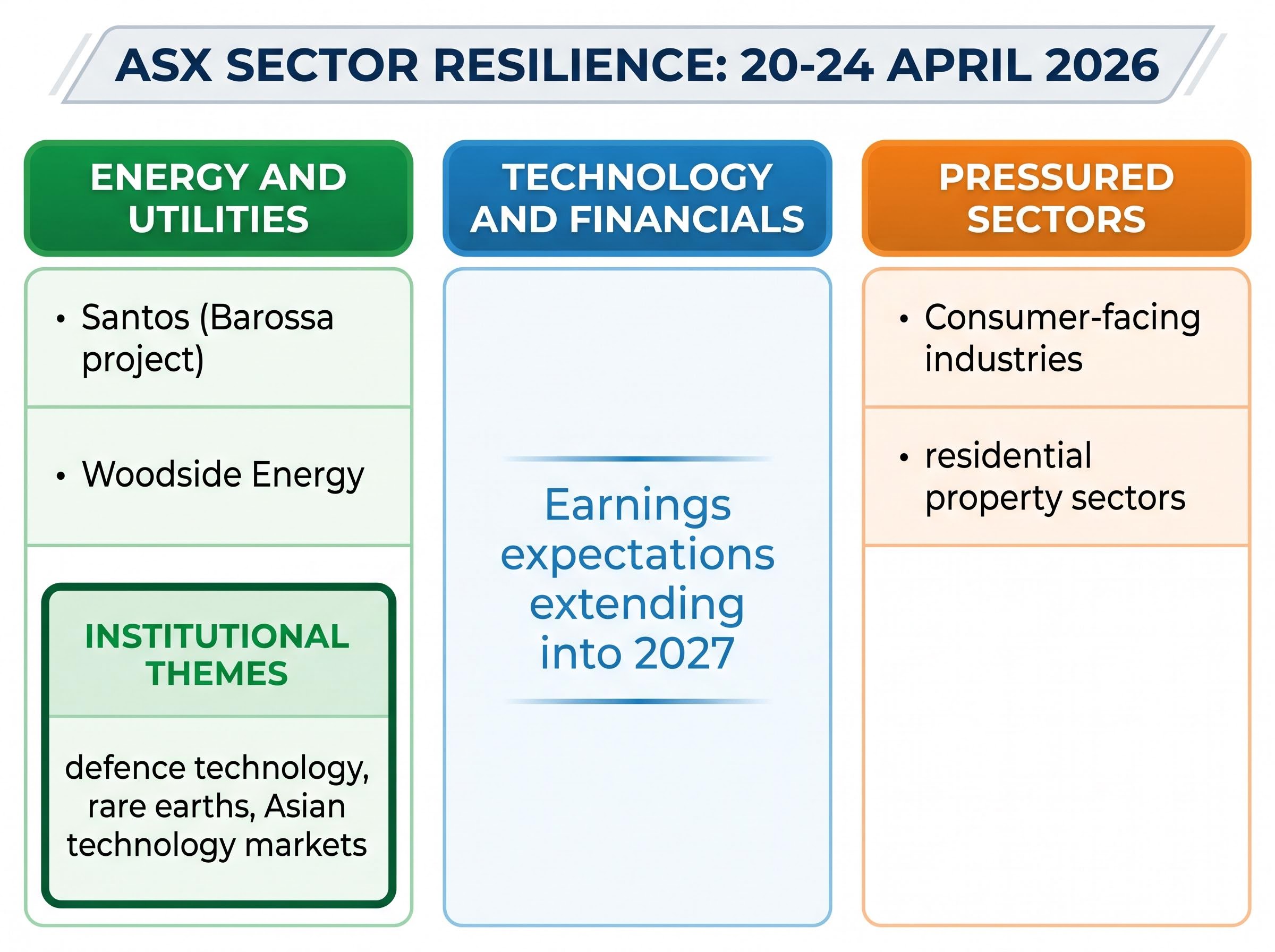
By tracking these divergent performance categories, investors can observe where institutional capital positions itself during monetary tightening. This data provides actionable domestic equity observation for rebalancing vulnerable portfolios.
Securing Elevated Yields in Fixed Income
The current macroeconomic climate provides a rare, quantifiable opportunity for guaranteed returns through fixed income vehicles. Traditional defensive equity assets are temporarily underperforming as borrowing costs compress corporate margins. Conversely, government bonds and cash equivalents are offering highly competitive yields that rival historical equity returns.
High interest rates should not be viewed solely as a borrowing penalty, but rather as an offensive wealth generation tool. The Australian 3-year government bond yield closed at 4.68% for the week ending 24 April 2026. Longer duration instruments show even stronger returns, with the 10-year government bond yield sitting at 5.02% as of late April 2026.
This environment allows defensive investors to lock in high yields while the Reserve Bank cash rate remains at its peak. The specific returns available in the domestic fixed income market provide direct tools to outpace the 4.6% headline inflation rate without absorbing equity market volatility.
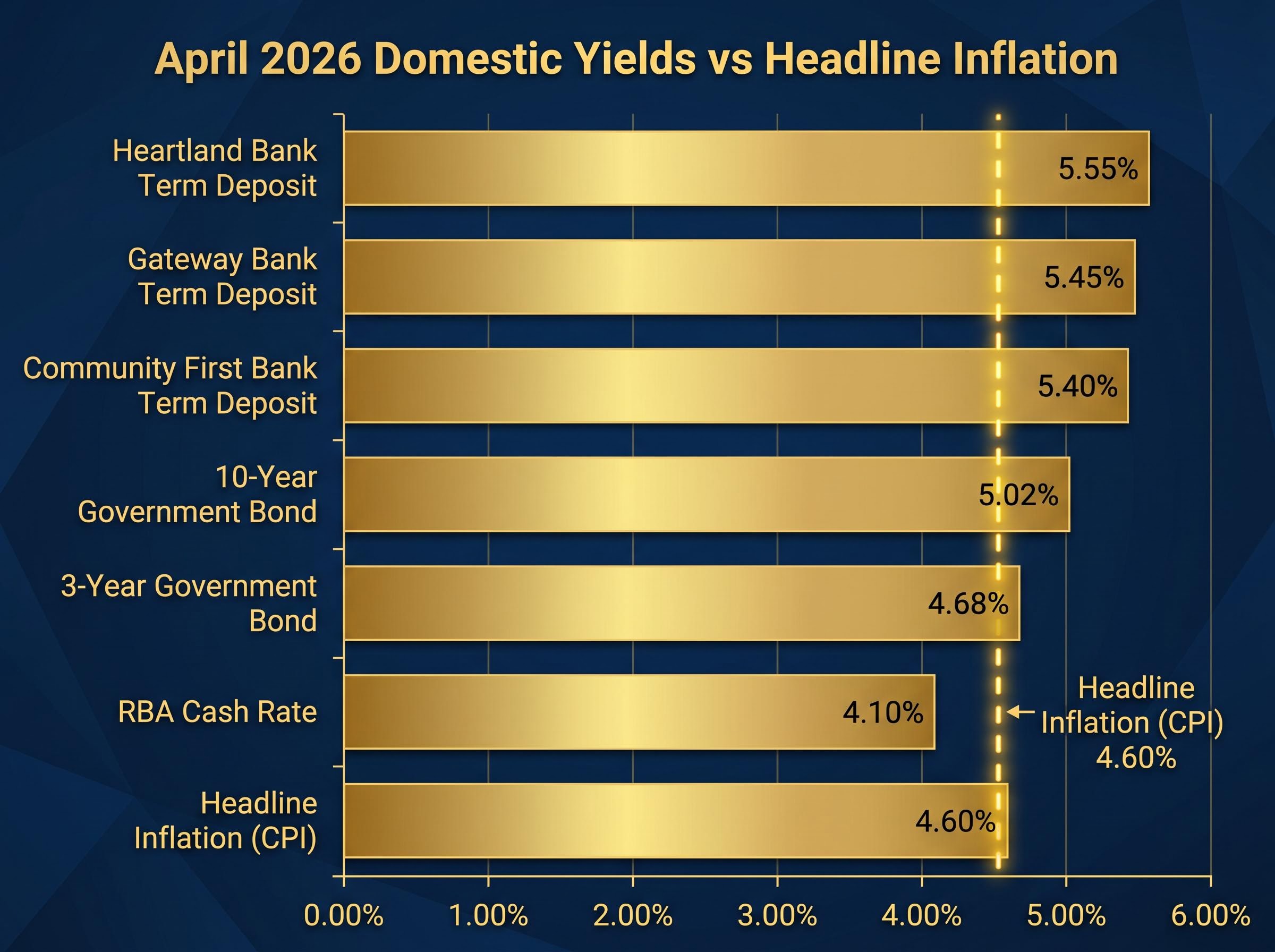
| Economic Indicator / Asset | Current Rate / Yield (April 2026) |
|---|---|
| Headline Inflation (CPI) | 4.60% |
| Reserve Bank Cash Rate | 4.10% |
| 10-Year Government Bond | 5.02% |
| Heartland Bank Term Deposit | 5.55% |
| Gateway Bank Term Deposit | 5.45% |
| Community First Bank Term Deposit | 5.40% |
The data highlights a distinct structural advantage for cash allocation. Top-tier bank term deposit rates are yielding above 5%, presenting a mathematically sound strategy for risk-averse capital deployment.
The growing demand for these defensive yields has also driven institutional investment into term deposit platforms that aggregate competitive rates across multiple authorised deposit-taking institutions.
Practical Capital Allocation Strategies for Volatile Markets
Translating macroeconomic analysis into practical execution requires systematic deployment tactics. Current guidance from wealth management platforms advocates for disciplined capital allocation to navigate market unpredictability. Establish a clear sense of control over your portfolio by replacing emotional reactions with scheduled investment intervals.
Consistent deployment intervals allow investors to capture undervalued assets during inevitable market dips without attempting to time the absolute bottom. Maintaining broad international equity exposure ensures the portfolio captures growth in regions operating under different monetary cycles. Implement the following systematic steps to restructure an exposed portfolio:
- Evaluate existing cash positions to determine what percentage is actively losing value to the 4.6% inflation rate.
- Schedule automated investment deposits at regular intervals to smooth out acquisition costs across volatile trading weeks.
- Allocate a defined percentage of defensive capital into high-yield term deposits or government bonds to secure guaranteed returns above 5%.
- Maintain highly liquid capital reserves in elevated interest accounts to deploy quickly when strategic equity opportunities arise.
- Rebalance equity exposure toward resilient sectors like energy producers and digital infrastructure while monitoring global thematic funds.
Investors targeting the energy sector are increasingly noting how smaller operators are successfully raising gas exploration capital to capitalise on Australia’s ongoing supply constraints and secure near-term drilling programs.
This pragmatic roadmap removes the paralysis of economic uncertainty. Executing these specific steps ensures capital is positioned defensively against inflation while retaining the flexibility to capitalise on market dislocations.
Preserving Wealth Through the Current Economic Cycle
Proactive portfolio management is an absolute necessity in an environment where inflation actively erodes passive cash holdings. While central bank interventions and commodity shocks create immediate market volatility, they simultaneously produce highly predictable yield opportunities in government bonds and term deposits. Navigating this cycle requires treating elevated interest rates as a strategic tool rather than a macroeconomic hurdle.
Review your current asset allocation against the resilient ASX sectors and fixed income strategies discussed throughout this framework. Past performance does not guarantee future results, and financial projections are subject to rapidly shifting market conditions and geopolitical risk factors.
This article is for informational purposes only and should not be considered financial advice. Investors should conduct their own research and consult with financial professionals before making investment decisions.