
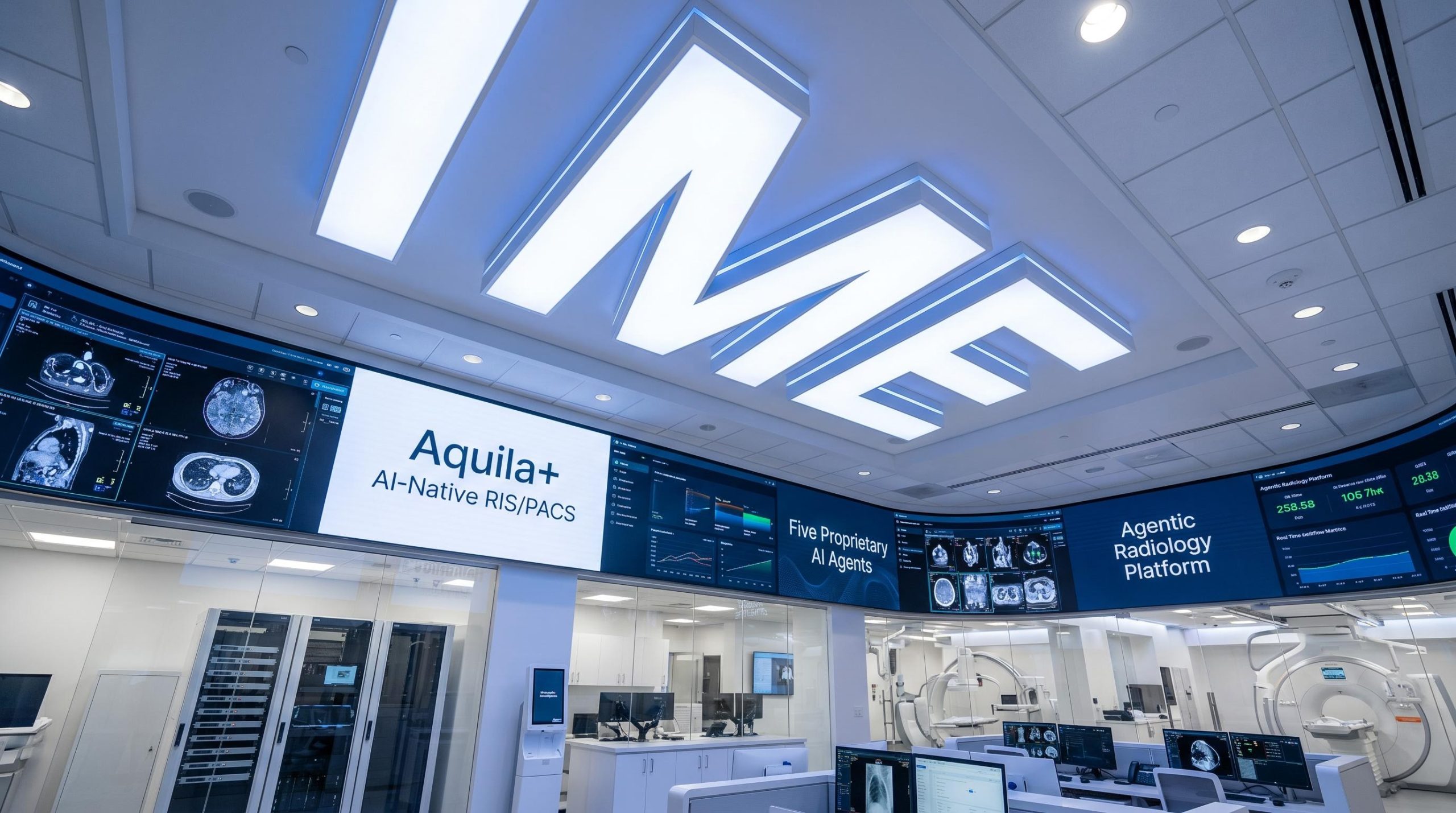
IMEXHS embeds five AI agents across Aquila+ platform
IMEXHS Limited (ASX: IME) has launched an agentic AI platform for radiology with five proprietary AI agents embedded directly into Aquila+, its next-generation RIS/PACS platform. Two agents are live across the client base, one is in final testing, and two are in active development — execution that is ahead of schedule. Aquila+ is commercially live at eight sites. The agents are proprietary intellectual property owned by IMEXHS, not third-party integrations.
The rollout marks a shift in execution strategy. Rather than bolt AI capabilities onto individual workflow steps, IMEXHS has embedded autonomous software agents across the entire diagnostic imaging process — from scheduling through to final report delivery. The platform is AI-native: designed around agent architecture rather than retrofitted.
Proprietary IP ownership and ahead-of-schedule delivery signal execution capability and defensible competitive positioning in a market where most vendors offer piecemeal AI tools layered onto legacy systems.
When big ASX news breaks, our subscribers know first
What is agentic AI in radiology?
Agentic AI refers to autonomous software agents that operate in the background, completing tasks without human intervention. Traditional AI tools perform single functions requiring manual triggering — for example, flagging an abnormality in an X-ray after a radiologist uploads the image. Agentic AI operates differently. It monitors workflows continuously, makes decisions based on real-time data, and executes tasks independently.
The IMEXHS approach embeds agents across the entire workflow rather than at isolated steps. The platform was designed around AI agents from the outset, creating architectural differentiation rather than incremental feature addition. This represents workflow-wide integration, not a point solution.
For investors, this matters because the architecture creates structural advantages. Agentic systems that automate operational tasks across multiple steps build deeper client dependency than single-function tools. The value proposition scales with the number of agents deployed.

The five agents and what they automate
| Agent | Function | Status | Key Benefit | Projected Impact |
|---|---|---|---|---|
| Intelligent Appointment Scheduling | Reads medical orders and insurance authorisations, applies institutional scheduling rules, books appointments automatically | In active development | Reduces administrative burden | Up to 80% reduction in call-centre staffing, 50-60% reduction in patient wait times |
| Intelligent Study Prioritisation | Analyses clinical data, assigns study priority using self-learning medical dictionary | Final testing | Critical cases surface faster | Reduces critical study delays and medico-legal exposure |
| Intelligent Auto-Distribution | Evaluates radiologist workload in real time, dynamically assigns and reassigns studies | Live across client base | Balances caseloads platform-wide | Prevents queue build-up, improves SLA compliance |
| Study Non-Attendance Alerts | Monitors reading queue, flags cases at risk of exceeding SLA thresholds | Live across all clients | Platform-wide visibility of at-risk studies | Reduces overlooked cases, creates adoption pathway to Auto-Distribution |
| RV Mentor | AI co-pilot for radiologist at point of reading | Partially live, in development | Contextual queries, quality checks, image analysis support | Near-term roadmap includes pre-report generation, auto-correction, translation |
Two revenue-generating agents are already deployed across the entire client base, demonstrating a monetisation pathway. Agent 4 explicitly creates cross-sell optionality into Agent 3, enabling land-and-expand dynamics within existing accounts.
Why the radiology industry needs workflow automation now
Diagnostic imaging demand is rising at an accelerating rate while the radiologist workforce cannot keep pace. Bottlenecks concentrate in operational tasks surrounding the radiologist: scheduling patients, triaging urgent cases, distributing workload across reading teams, monitoring service level agreements. These are the points where delay, error, and cost accumulate.
The prevailing industry response has been to layer single-point AI tools onto legacy workflows. A vendor might offer AI to detect lung nodules, another to segment brain lesions, a third to flag critical findings. Each tool performs a discrete function, often requiring manual triggering or review. The result is incremental improvement rather than structural change.
IMEXHS has taken a different approach. Rather than adding AI to isolated steps, the company built agents that operate across the workflow itself, resolving operational tasks autonomously. The system monitors scheduling demand, assigns priorities based on clinical urgency, distributes cases dynamically to balance radiologist workload, and flags at-risk studies before SLA breaches occur. The agents function continuously in the background without requiring human oversight for routine decisions.
For investors, this positions IMEXHS to capture market share from legacy vendors offering piecemeal solutions. The structural approach addresses the operational bottleneck, not just the diagnostic task.
The structural advantages for clients
The agentic architecture delivers four value propositions:
- Operational efficiency — automating work currently requiring human operators at scale, reducing call-centre staffing requirements and administrative overhead.
- Clinical safety — reduced SLA breach risk and medico-legal exposure through continuous monitoring and automated prioritisation of critical cases.
- Medical productivity — increased radiologist output without proportional headcount growth, as agents handle distribution, triage, and queue management.
- Scalable unit economics — volume growth without proportional cost growth, as the platform handles rising case volumes without requiring additional administrative staff.
These translate directly to client ROI, supporting pricing power and retention. A client deploying multiple agents experiences compounding benefits across workflow efficiency, clinical risk mitigation, and cost structure.
Strategic moat and cross-sell architecture
The agentic architecture creates a structural moat by deepening client dependency on Aquila+ with each additional agent deployed. A client using only the Auto-Distribution agent gains workload balancing. Adding the Study Non-Attendance Alerts agent creates platform-wide visibility of at-risk cases. Adopting RV Mentor brings AI assistance directly into the radiologist’s workspace. Each layer increases the platform’s operational value and raises switching costs.
Cross-sell pathways exist within the current customer base. The announcement explicitly notes that Agent 4 (Study Non-Attendance Alerts) creates a natural adoption pathway into Agent 3 (Intelligent Auto-Distribution), as clients move from monitoring at-risk studies to automating their distribution. This land-and-expand dynamic represents lower customer acquisition cost growth and higher lifetime value potential compared to acquiring new logos.
Dr Germán Arango, Co-Founder and CEO
“The defining story of the quarter is product. Our entire strategy has pivoted towards an AI-native, agentic platform for radiological workflow management – and execution against that vision is well ahead of schedule. This is a new chapter for the Company and, we believe, for the industry.”
Land-and-expand dynamics reduce the cost of revenue growth. Rather than pursuing new customers to hit volume targets, IMEXHS can deploy additional agents across its existing eight-site base, extracting incremental revenue from relationships already established.
What comes next
The RV Mentor agent has a defined near-term roadmap: native workspace integration, automatic pre-report generation by study type, auto-correction and translation of reports, and study-to-report correlation validation. These features extend the agent’s capability from support tool to co-pilot, automating portions of the reporting workflow itself.
A video demonstrating agent functionality will be released on the company website and shared with prospective clients. All five agents are proprietary IMEXHS intellectual property, developed and owned by the company. This removes third-party licensing risk and preserves margin control.
The development pipeline provides visibility on near-term product expansion. With two agents live, one in final testing, and two in active development, the company has a staged rollout that can be matched to client adoption capacity and technical validation milestones.
Want the Next Healthcare Tech Breakout in Your Inbox?
Join 20,000+ investors receiving FREE real-time ASX alerts the moment healthcare and tech news breaks. Big News Blast delivers breaking announcements plus in-depth analysis straight to your inbox within minutes of release. Click the “Free Alerts” button to get ahead of the market.