
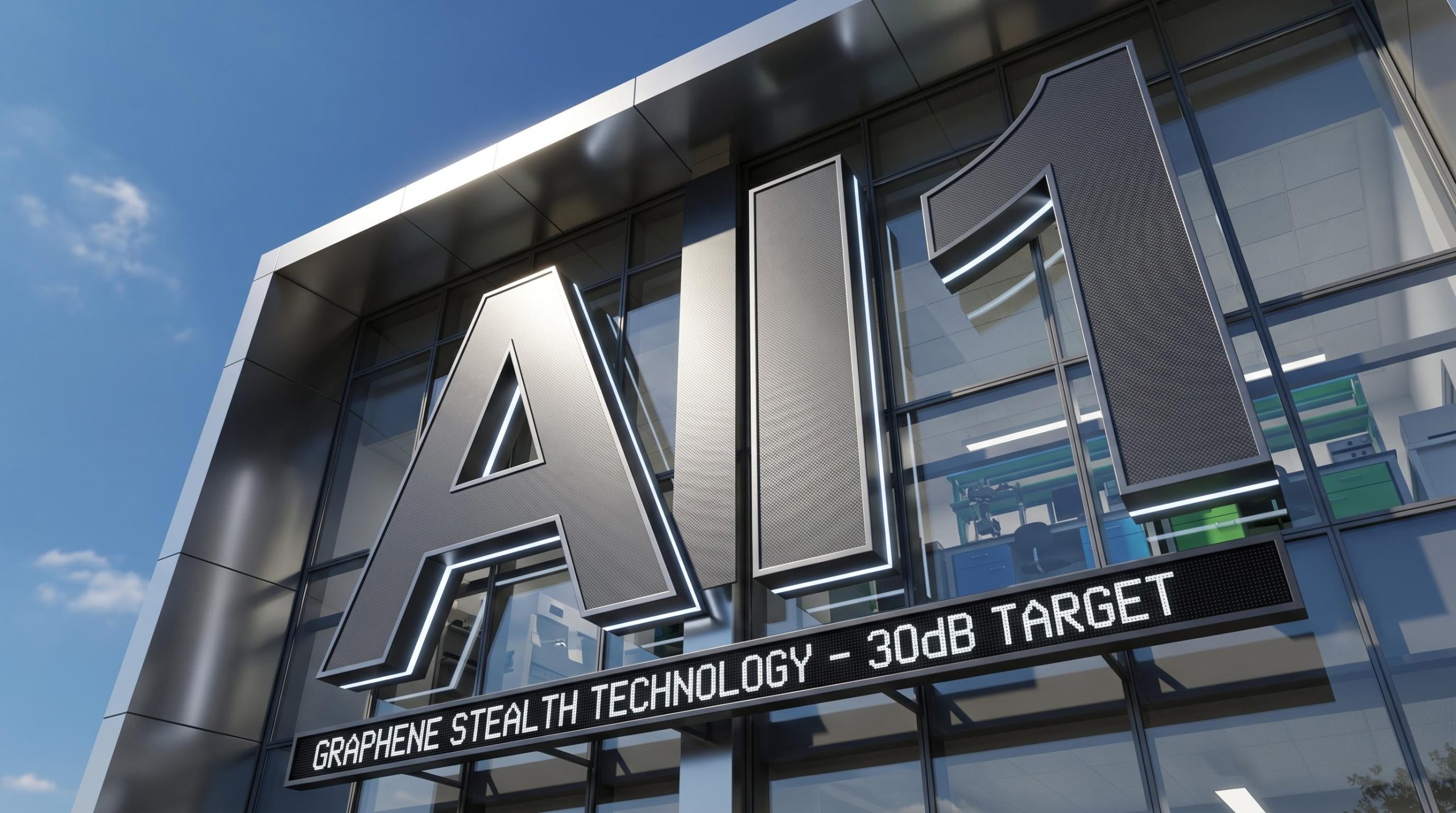
Adisyn has secured exclusive, worldwide commercialisation rights for graphene-based radar signature reduction technology, marking a significant transition from research to structured commercial development. The company’s subsidiary, 2D Radar Absorbers Ltd, has executed a binding Licence and Research Agreement with Ramot, Tel Aviv University’s technology transfer company.
Adisyn secures exclusive worldwide rights to graphene stealth technology
The agreement replaces a previously announced option arrangement and establishes long-term access to current intellectual property and its future development, defined economic terms, and a clear pathway to commercialisation. Under the binding Licence and Research Agreement, Adisyn holds exclusive commercial rights across the defined field for Ramot’s IP.
Tel Aviv University is globally recognised for its leadership in advanced materials and applied physics. Ramot’s responsibility for commercialising breakthrough technologies provides Adisyn with access to world-class research capability and commercialisation expertise.
The timing is strategically relevant. The announcement comes at a period of increasing global focus on radar signature management, driven by rapid expansion of UAV deployment, Loitering Munitions, and growing sophistication of detection systems across defence and aerospace sectors.
This shifts Adisyn from research-stage optionality to defined commercial rights with long-term IP access and a clear pathway to monetisation.
When big ASX news breaks, our subscribers know first
How graphene-based radar absorption works
The technology integrates graphene and other 2D materials into composite materials to reduce radar detectability by absorbing and dissipating electromagnetic signals. For investors unfamiliar with the technical metrics, a decibel (dB) reduction in radar reflection represents an exponential decrease in how visible an object appears to radar systems.
Laboratory testing has demonstrated approximately 20dB reduction in radar reflection, equivalent to a ~100x reduction in radar return. Ongoing development is targeting ~30dB, which represents a ~1,000x reduction. At these levels, radar visibility can be materially reduced, particularly for UAV platforms, potentially reducing detection range and response time in operational environments.
The technology progression follows a clear development path:
- Current performance: ~20dB reduction achieved in controlled laboratory testing
- Development target: ~30dB reduction through ongoing optimisation
- Next phase: Validation across relevant radar frequencies and real-world environments
Unlike traditional materials, graphene-enhanced composites combine structural performance with inherent radar absorption, removing the need for additional coatings. This dual benefit enables lightweight, stealth-enabled designs, representing a potential step-change compared to existing solutions, which typically require trade-offs between weight, strength, and radar performance.
The structural advantage could differentiate Adisyn’s offering in a market where competitors typically sacrifice one attribute for another. To date, testing has been conducted under controlled laboratory conditions, with current and future work focused on validating performance across relevant radar frequencies and real-world environments.
Structured 12-month development programme with Tel Aviv University
The agreement includes a 12-month funded research programme with Tel Aviv University, led by Professor Pavel Ginzburg in radar physics. The programme is expected to cost less than AU$100k, representing a capital-efficient research commitment with defined milestones for investors to track progress.
| Phase | Activity | Duration | Key Focus |
|---|---|---|---|
| Research | Electromagnetic testing of “building blocks” for optimal combinations | 2 months | IP protection plan including patent filings |
| Development | Building prototypes for components (propellers, drone body parts) | 4 months | Optimal combinations for weight, cost, mechanical properties |
| Integration | Integrating components into existing drones and testing | 6 months | Suitability, performance, impact on other systems |
The programme will focus on improving radar absorption performance, manufacturability, and scalability, supporting progression towards commercial deployment and real-world validation. The phased approach provides clear decision points, with each stage building on validated results from the previous phase.
Sub-$100k development cost for a 12-month programme represents capital-efficient R&D with defined milestones for investors to track progress.
Commercial model and economic framework
Subject to the results of the programme, Adisyn intends to commercialise the technology through three primary pathways:
- Establishing production capacity jointly with a large industrial manufacturer to provide components incorporating the technology to UAV manufacturers
- Strategic partnerships with UAV manufacturers and defence primes
- Integrating the company’s technologies into international transactions carried out by the Israeli Ministry of Defence
Target customers include UAV manufacturers, defence contractors, and advanced materials suppliers seeking to integrate radar-absorbing capabilities into next-generation platforms.
The agreement establishes a clear economic framework. Adisyn will receive a 4% royalty on net sales, whilst Ramot receives a 19% equity interest in 2D Radar Absorbers Ltd, aligning both parties to long-term commercial success.
The royalty model provides scalable, high-margin exposure without Adisyn needing to build manufacturing capability. The structure leverages third-party manufacturing and distribution without the need for capital-intensive production infrastructure. Ramot’s 19% equity stake aligns the university’s commercial incentive with Adisyn’s success.
Market opportunity and strategic positioning
The global market for radar-absorbing and stealth materials is expanding rapidly, representing a multi-billion dollar opportunity across aerospace and defence applications. Growth drivers include increasing UAV deployment, Loitering Munitions, and defence modernisation programmes.
The radar initiative complements Adisyn’s core semiconductor graphene programme. This demonstrates broader commercial potential of its graphene technology platform beyond the company’s primary focus on Atomic Layer Deposition (ALD) processes for semiconductor applications.
The radar initiative creates a second revenue pathway alongside the core semiconductor programme, diversifying Adisyn’s commercial optionality within its graphene expertise.
Management commentary and next steps
Adisyn Managing Director Arye Kohavi emphasised the significance of transitioning from research to commercial development:
Arye Kohavi, Managing Director
“This agreement represents a critical step in transitioning our radar technology from research into commercial development. We have already demonstrated strong proof-of-concept results, and now, with exclusive global rights and a structured programme in place, we are focused on advancing this technology towards real-world applications. We believe this has the potential to become a meaningful value driver alongside our core semiconductor programme.”
The company has outlined defined next steps to advance the technology towards commercialisation:
- Commencement of TAU research programme
- Teaming with a large industrial manufacturer
- Establishing an advisory board with expertise in radars and drones
- Further technical validation and real-world testing
- Engagement with defence and aerospace partners
- Progression of commercial and partnership discussions
Initial commercial engagement is expected to progress alongside the current development programme, with early-stage licensing opportunities anticipated as key technical milestones are achieved.
Want the Next Defence Tech Breakthrough in Your Inbox?
Join 20,000+ investors receiving FREE breaking ASX news delivered within minutes of release, complete with in-depth analysis. Click the “Free Alerts” button at StockWire X to get real-time alerts on Defence, Technology, and other non-resource sectors the moment market-moving announcements break.