

Adisyn has received firm commitments to raise A$14 million at A$0.0675 per share, with settlement expected 29 April 2026. The placement was cornerstoned by Regal Funds Management, managing over A$20 billion in assets, and Meitav, Israel’s largest investment house with approximately A$190 billion in assets under management serving over one million clients.
Adisyn launches A$14 million graphene technology placement
The capital raise will issue approximately 207.4 million new fully paid ordinary shares under the company’s existing placement capacity pursuant to ASX Listing Rules 7.1 and 7.1a. The issue price represents a 10% discount to the last closing price of A$0.07 on 21 April 2026, and a 5.78% discount to the 15-day volume-weighted average price.
Chairman Kevin Crofton and Non-Executive Director Dominic O’Hanlon have committed to subscribe for a combined $200,000, subject to shareholder approval at a general meeting expected in June 2026.
The institutional backing from Regal and Meitav, both sophisticated investors with deep expertise in technology and defence sectors, provides validation of Adisyn’s dual-platform commercial pathway. Regal Funds Management is one of Australia’s most active institutional investors, whilst Meitav represents the largest investment house in Israel with substantial exposure to technology commercialisation.
When big ASX news breaks, our subscribers know first
Two breakthrough milestones triggered the capital raise
The placement follows two significant technical and commercial announcements in the days immediately prior, demonstrating progress across both of Adisyn’s core graphene programmes.
Graphene semiconductor breakthrough (20 April 2026)
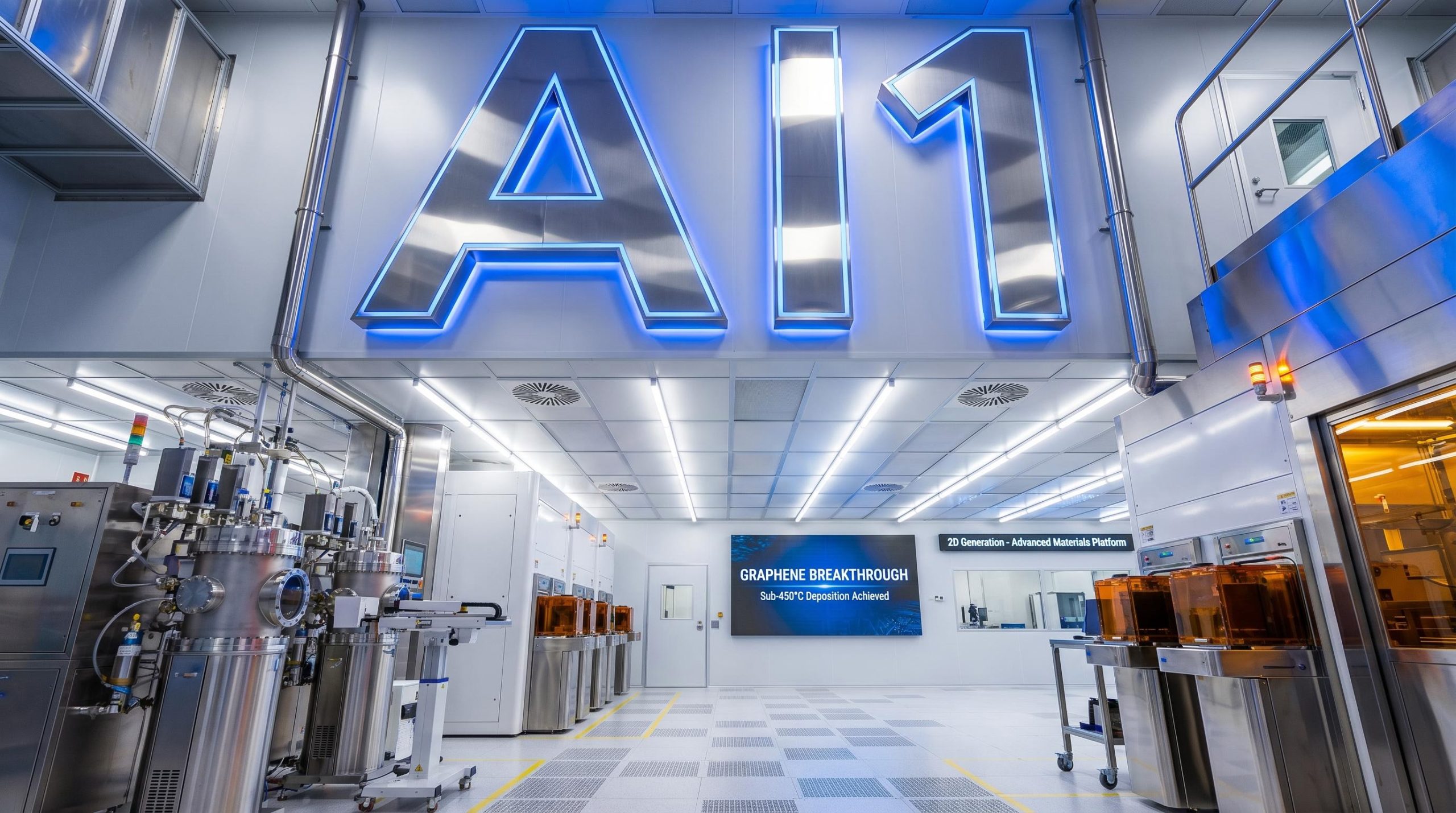
On 20 April 2026, wholly-owned subsidiary 2D Generation successfully deposited a continuous graphene layer on a 1cm² coupon at temperatures well below the semiconductor industry’s thermal ceiling of approximately 450°C using an industrial Atomic Layer Deposition (ALD) system. This result simultaneously achieves three criteria the semiconductor industry has been unable to combine: use of an industrial ALD system, operation within semiconductor-compatible temperatures, and formation of a continuous graphene layer.
Copper interconnects, the wiring that connects billions of transistors in advanced chips, have become one of the most significant bottlenecks constraining semiconductor performance, energy efficiency and further scaling. Graphene has long been identified as a potential solution to these interconnect limitations, but integrating graphene formation within existing semiconductor fabrication environments has remained elusive due to the high temperatures typically required for graphene synthesis.
The demonstration positions Adisyn to enter the industry collaboration and commercial engagement phase, targeting global semiconductor leaders. The company is now progressing toward film optimisation, repeatability testing and scale-up to wafer-level formats.
Kevin Crofton, Chairman
“The interconnect is now one of the key constraints in semiconductor performance. If you can solve that, you’re solving a problem the entire industry is focused on.”
Stealth drone technology licence secured (22 April 2026)
On 22 April 2026, subsidiary 2D Radar Absorbers Ltd executed a binding Licence and Research Agreement with Ramot, the technology transfer company of Tel Aviv University, securing exclusive worldwide rights to commercialise graphene-based radar absorption technology.
Laboratory testing has demonstrated approximately 20dB radar absorption, equivalent to a 100-fold reduction in radar return signal. Ongoing optimisation is targeting approximately 30dB reduction, which would equate to a 1,000-fold decrease. At that level of reduction, a standard 1m² drone radar signature becomes equivalent in detectability to a butterfly.
Unlike conventional radar-absorbing materials applied as coatings, graphene-enhanced composites combine structural strength with inherent stealth properties. This removes the need for additional coatings and enables lightweight, high-performance unmanned aerial vehicle designs where weight and structural integrity are critical performance parameters.
The agreement includes a structured 12-month research programme funded by Adisyn, with costs expected to be less than A$100,000.
Arye Kohavi, Managing Director
“We have already demonstrated strong proof-of-concept results, and now, with exclusive global rights and a structured program in place, we are focused on advancing this technology towards real-world applications.”
What is Atomic Layer Deposition and why does it matter for graphene?
Atomic Layer Deposition is a manufacturing technique that deposits material one atomic layer at a time, enabling precise control over film thickness and uniformity. The process is widely used in semiconductor fabrication for depositing ultra-thin films with high conformality across complex three-dimensional structures.
Graphene has long been identified as a potential solution to copper interconnect limitations in advanced semiconductor nodes, offering superior electrical conductivity and thermal properties. However, integrating graphene formation within existing semiconductor fabrication environments has remained elusive because traditional graphene synthesis methods require temperatures in excess of 1,000°C, far above the thermal budget available in modern chip manufacturing.
Semiconductor manufacturing cannot tolerate high-temperature processes without damaging existing chip structures, particularly the delicate transistor architectures and dielectric materials already present on the wafer. Achieving graphene formation within the industry’s thermal ceiling of approximately 450°C unlocks the potential for integration into existing production lines without requiring fundamental changes to fabrication workflows.
This is the technical hurdle that has prevented graphene commercialisation in semiconductors for over a decade. Demonstrating that continuous graphene layer formation can occur at semiconductor-compatible temperatures using industrial ALD equipment moves the technology from laboratory curiosity toward commercial viability.
Two markets, one graphene platform
Adisyn is positioning itself as an emerging graphene technology platform with leverage to two large, structurally growing markets. Progress in either semiconductor or defence applications provides optionality and multiple pathways to value creation.
| Market | Size/Forecast | Adisyn’s Angle |
|---|---|---|
| Semiconductors | Global market forecast to reach ~US$1 trillion by 2030 | Advanced interconnect solutions critical as industry pushes below 2nm nodes; AI demand accelerating need for high-performance chips |
| Defence/Autonomous Systems | Global military drone market forecast to grow from US$20.7 billion (2026) to US$66.5 billion by 2035 | Graphene composites address lightweight radar-absorbing material demand for drones, loitering munitions and unmanned platforms |
The semiconductor market opportunity is driven by the industry’s ongoing push to sub-2nm process nodes, where conventional copper interconnects are reaching fundamental performance limits. As transistor density increases and chip architectures become more complex, interconnect resistance and capacitance increasingly dominate overall chip performance and power consumption. Advanced interconnect solutions are no longer a marginal optimisation but a requirement for continued scaling.
The defence and autonomous systems market is characterised by accelerating proliferation of unmanned platforms across modern military operations. The stealth materials opportunity extends beyond traditional UAVs to loitering munitions, autonomous swarms and reconnaissance platforms where radar signature management is increasingly mission-critical. Graphene-based composites that integrate structural and stealth properties in a single material system address limitations inherent in coating-based approaches.
Use of proceeds and key dates
Proceeds from the placement will be applied to the advancement of graphene technology programmes, business development initiatives, working capital and costs of the offer. Sandton Capital Advisory, which led the placement, will receive a management fee of 6% of gross proceeds raised.
The deployment of capital toward commercial milestones and technology development, rather than general corporate overhead, positions the company to accelerate both semiconductor and defence programmes. The relatively tight timeline to settlement signals institutional conviction in the near-term commercial pathway.
Key dates for the placement are as follows:
- Placement announced and Company resumes trading on ASX: Thursday, 23 April 2026
- Settlement of New Shares via DVP: Wednesday, 29 April 2026
- Allotment of New Shares: Thursday, 30 April 2026
- General Meeting for approval of director participation: ~June 2026
The new shares will rank equally with existing fully paid ordinary shares on issue from the allotment date.
Want the Next Tech Breakthrough in Your Inbox?
Join 20,000+ investors receiving FREE breaking ASX news within minutes of release, complete with in-depth analysis. StockWire X delivers tech sector alerts the moment market-moving announcements drop—click the “Free Alerts” button to stay ahead on emerging opportunities before the market reacts.