
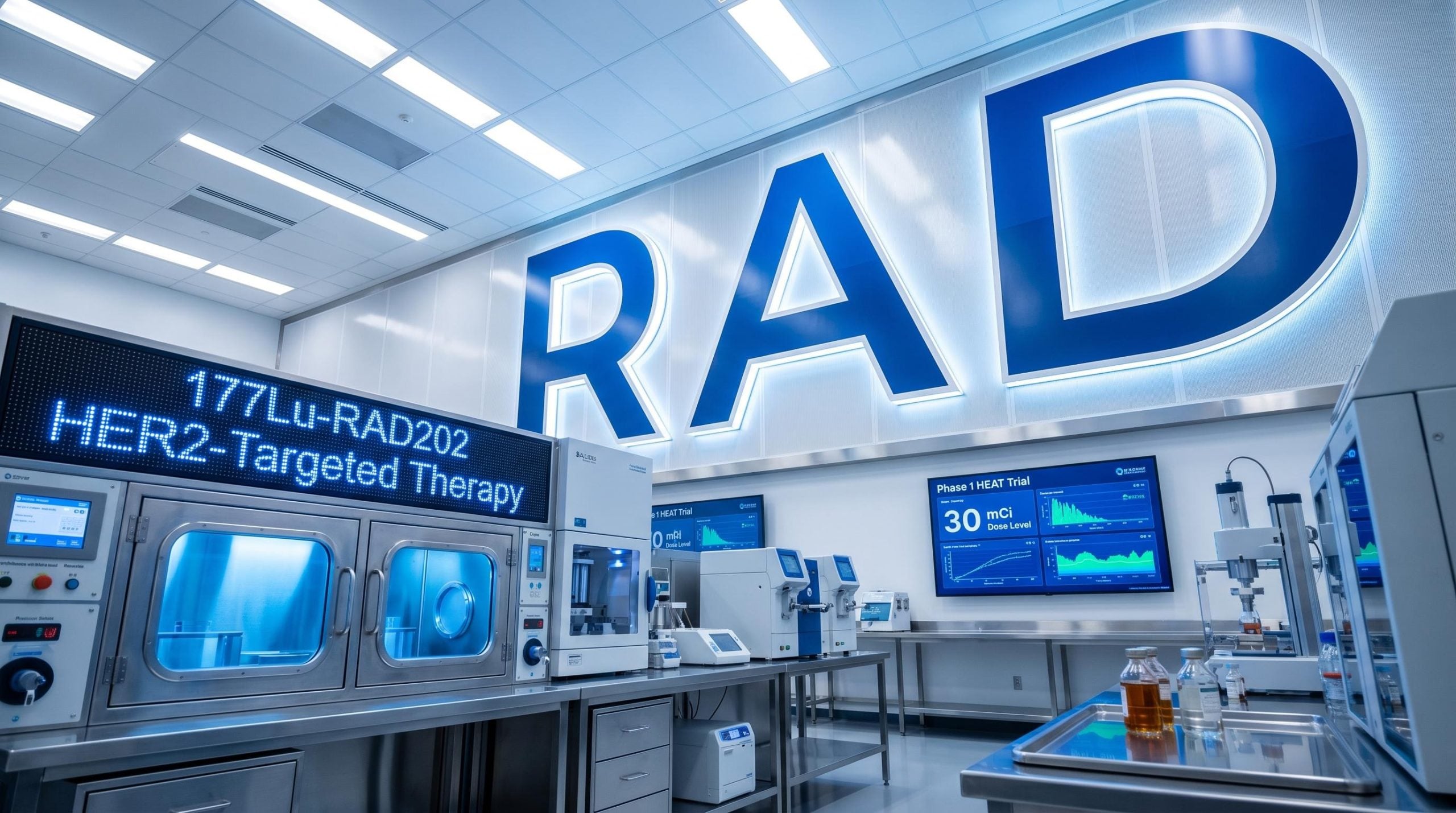
Radiopharm Theranostics reports promising early safety and tumour uptake in first-in-human HER2 trial
Radiopharm Theranostics has presented initial clinical findings from its Phase 0/1 HEAT trial evaluating 177Lu-RAD202, a first-in-class HER2-targeted radiopharmaceutical therapy, at the American Association for Cancer Research (AACR) Annual Meeting 2026 in San Diego (April 17–22, 2026). The data showed encouraging tumour uptake and a favourable safety profile in heavily pre-treated patients with advanced HER2-positive breast and urothelial cancers dosed at the lowest level of 30 mCi.
The first-in-human results represent a significant de-risking milestone for the clinical programme. Three patients in the initial cohort experienced no dose-limiting toxicities, and the Data Safety and Monitoring Committee (DSMC) has approved advancement to the third cohort at 130 mCi dosing. This progression toward potentially therapeutic dose levels validates the platform’s clinical viability and supports further evaluation of 177Lu-RAD202’s antitumour potential in a patient population with substantial unmet medical need.
When big ASX news breaks, our subscribers know first
What the HEAT trial data revealed
The AACR poster presentation highlighted four key clinical findings from the initial lowest-dose cohort:
- Meaningful tumour uptake of 177Lu-RAD202 was observed at 30 mCi, particularly in breast cancer lesions
- The therapy was generally well tolerated in all three treated patients, with predominantly Grade 1–2 treatment-emergent adverse events
- No dose-limiting toxicities or treatment discontinuations due to adverse events were observed
- Organ-level absorbed radiation doses were within expected and clinically acceptable ranges, supporting continued dose escalation
The safety profile and dosimetry data provide critical support for advancing to higher dose levels where therapeutic activity is anticipated. Tumour uptake was notably strong in breast cancer lesions, suggesting effective targeting in this indication.
Dr Dimitris Voliotis, Chief Medical Officer
“These first-in-human results represent an important early milestone for our HER2-targeted radiopharmaceutical program. In a heavily pre-treated patient population with significant unmet need, 177Lu-RAD202 demonstrated encouraging tumor uptake and a favorable safety profile at the lowest dose level. Importantly, the observed dosimetry supports continued dose escalation, which was recently approved by the Data Safety and Monitoring Committee (DSMC) to advance to the third cohort at 130 mCi dosing. We look forward to further evaluating the therapeutic potential of this novel approach and expect to see signs of antitumor activity at higher, more therapeutic dose levels.”
Understanding radiopharmaceutical therapy for HER2-positive cancers
A radiopharmaceutical therapy is a drug that delivers targeted radiation directly to cancer cells. 177Lu-RAD202 uses a single-domain antibody (sdAb) to seek out HER2-expressing tumours, then delivers cytotoxic radiation via Lutetium-177, a beta-emitting isotope.
The sdAb format offers distinct advantages over conventional monoclonal antibodies. Its smaller molecular size enables deep tumour penetration and rapid clearance from the body, potentially reducing radiation exposure to healthy tissue. The Lutetium-177 component generates a bystander effect, where emitted radiation can kill nearby cancer cells even if they do not express high levels of HER2. This mechanism may prove particularly valuable in heterogeneous tumours where HER2 expression varies across different regions.
HER2 is a validated oncology target with proven commercial success, exemplified by therapies such as Herceptin. A first-in-class radiopharmaceutical approach could address patients who have progressed on existing HER2 therapies, representing a significant unmet need in advanced breast and urothelial cancers. Radiopharmaceuticals combine the targeting precision of antibody-based therapies with the cytotoxic potency of radiation therapy.
The HEAT trial design and pathway to Phase 2
The HEAT trial (HER2-Antibody Therapy with Lutetium-177; NCT06824155) is a first-in-human, open-label, multicenter study evaluating 177Lu-RAD202 in patients with HER2-positive locally-advanced or metastatic solid tumours. The integrated Phase 0/1 design allows the company to assess both biodistribution characteristics and dose escalation safety within a single protocol.
Phase 0 evaluated biodistribution, pharmacokinetics, and radiation dosimetry using an imaging dose. Phase 1 consists of multiple-dose escalation to assess safety, tolerability, tumour targeting, and to determine the recommended Phase 2 dose. The DSMC approval on 8 April 2026 to advance to the third cohort at 130 mCi represents significant progress toward identifying therapeutic dose levels where antitumour activity is expected to emerge.
| Trial Phase | Objective | Status | Key Milestone |
|---|---|---|---|
| Phase 0 | Biodistribution, PK, dosimetry | Complete | Imaging dose evaluated |
| Phase 1 – Cohort 1 | Safety at 30 mCi | Complete | 3 patients dosed |
| Phase 1 – Cohort 2 | Safety at intermediate dose | Complete | DSMC approved escalation |
| Phase 1 – Cohort 3 | Safety at 130 mCi | Enrolling | DSMC approved April 2026 |
Radiopharm’s broader clinical pipeline and strategic position
The HEAT trial represents one component of Radiopharm’s diversified clinical-stage pipeline, which includes one Phase 2 and five Phase 1 trials across lung, breast, prostate, and brain cancers. The company’s platform spans peptides, small molecules, and monoclonal antibodies, providing multiple pathways to address different tumour biology and patient populations.
Radiopharm maintains a dual-listing on the ASX (RAD) and NASDAQ (RADX), providing access to both Australian and US capital markets. Prior diagnostic studies have established clinical proof-of-concept for RAD202, with published research (Zhao et al, 2021 and 2024) demonstrating positive safety and biodistribution in HER2-positive breast cancer patients. This earlier validation supported the progression to therapeutic development in the current HEAT trial.
Positive early data from the HEAT trial supports the broader platform thesis and could attract partnership interest in the HER2 asset. Radiopharmaceutical therapies are emerging as a distinct modality in oncology, with recent regulatory approvals and commercial success in other cancer types validating the therapeutic approach.
Next steps and catalysts
Upcoming milestones include:
- Cohort 3 dosing at 130 mCi (currently underway)
- Additional safety and efficacy data expected as dose escalation continues through subsequent cohorts
- Determination of recommended Phase 2 dose following completion of dose escalation
Management has stated they expect to see signs of antitumour activity at higher, more therapeutic dose levels. Each successful dose escalation cohort de-risks the programme and moves closer to demonstrating clinical efficacy, the key value inflection point for oncology assets. The progression from imaging doses through to therapeutic doses represents a critical pathway for validating 177Lu-RAD202’s potential to address unmet needs in HER2-positive cancers.
Want the Next Biotech Breakthrough in Your Inbox?
Join 20,000+ investors receiving FREE ASX healthcare and biotech news within minutes of release, complete with expert analysis. Click the “Free Alerts” button at Big News Blast to get market-moving announcements delivered straight to your inbox the moment they break.