S&P 500 Hits 7,000 Milestone as Iran Ceasefire Eases Tensions

Key Takeaways
- The S&P 500 closed above 7,000 for the first time in history on 15 April 2026, reaching an intraday high of 7,008 and trading at 7,041.28 as of 18 April.
- Geopolitical de-escalation, including a U.S.-Iran ceasefire and a 10-day Israel-Lebanon ceasefire announced by President Trump on 17 April, removed a significant risk premium from equity valuations.
- S&P 500 profit growth is projected to reach 15.5% in 2026, with strong Q1 earnings from Bank of America and Morgan Stanley providing fundamental justification for the new price levels.
- Broad sector participation across both technology and cyclical stocks, combined with the VIX dropping below 18 to a seven-week low, signals a healthier and more durable rally foundation.
- Bitcoin trading at $76,800 and capital rotating out of safe-haven assets confirm risk-on sentiment extending beyond equities as geopolitical stability improves.
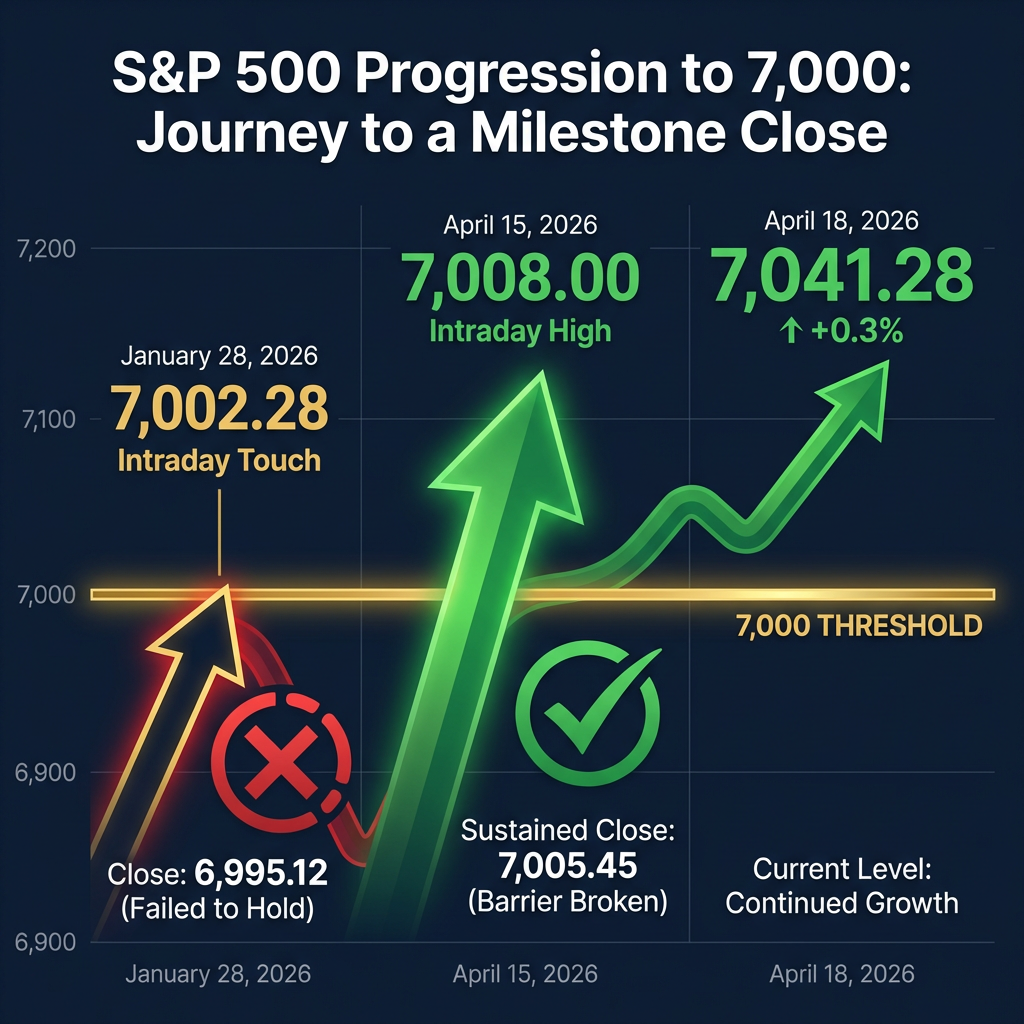
The S&P 500 closed above 7,000 for the first time in history on 15 April 2026, reaching an intraday high of 7,008. The milestone marks a decisive breakthrough after the index briefly touched 7,002.28 intraday on 28 January 2026 without sustaining a close above the threshold.
As of 18 April, the index trades at 7,041.28, up 0.3%. The Dow Jones Industrial Average stands at 48,578.72 (up 0.2%), while the NASDAQ Composite reached 24,102.70 (up 0.4%), reflecting broad-based strength across U.S. equity markets. The VIX volatility index dropped below 18, reaching a seven-week low and signalling reduced volatility expectations.
The 15 April close represents the true breakthrough moment analysts recognise as the milestone. Whilst the 28 January intraday touch demonstrated potential, the failure to close above 7,000 on that date meant the level remained a psychological barrier until this month’s sustained move higher.
Why 7,000 Matters: Understanding Market Milestones
Round-number thresholds like 7,000 serve as psychological barriers where investors collectively pause to reassess valuations and market conditions. Breaking through such levels decisively signals improved confidence across market participants. This explains why analysts distinguish between intraday touches and sustained closes when evaluating milestone significance.
The NBER research on round-number price barriers demonstrates how psychological thresholds influence collective investor behaviour and trading patterns at major milestones.
The S&P U.S. Indices Methodology defines how closing prices are calculated and why sustained closes above round-number thresholds carry greater technical significance than intraday peaks.
Market professionals describe this move as a “confidence rally” and “market re-rating”. This characterisation suggests investors are fundamentally reassessing what U.S. equities are worth based on improved geopolitical and economic conditions. The re-rating reflects more than momentum trading, indicating a broader shift in how the market values corporate America at current growth trajectories.
The decisive close above 7,000 represents the culmination of a remarkable recovery from the geopolitical turmoil that dominated markets in February and March 2026, demonstrating how markets dismissed an 8% geopolitical shock through a combination of resilient earnings and improving risk conditions.
When big ASX news breaks, our subscribers know first
Geopolitical De-Escalation Removes Risk Premium
A U.S.-Iran ceasefire cooled tensions and reduced uncertainty in global markets and energy sectors. This development contributed directly to improved investor sentiment and increased risk appetite, removing what analysts had termed a “geopolitical discount” on equity valuations.
The geopolitical de-escalation that catalyzed this milestone began with the Iran Strait reopening and its immediate market impact, which removed the primary supply disruption risk that had weighed on investor sentiment throughout March 2026.
President Trump announced a 10-day ceasefire between Israel and Lebanon on 17 April, with weekend negotiations planned to pursue a lasting resolution. This announcement effectively removed remaining geopolitical risk premium that had weighed on market sentiment in preceding weeks.
Brent crude fell approximately 10% towards $95 per barrel from a peak near $100 as Strait of Hormuz disruption concerns subsided. Capital rotated out of safe-haven assets including gold and defensive equity positions, flowing back into growth and technology sectors as geopolitical stability improved.
Corporate Earnings Provide Fundamental Support
Strong Q1 2026 corporate earnings provided fundamental support for the rally, demonstrating this advance rests on more than sentiment alone. The financial sector delivered particularly robust results, with Bank of America and Morgan Stanley reporting resilient quarterly earnings despite regional geopolitical instability that had created uncertainty in preceding months.
S&P 500 profit growth is projected to reach 15.5% in 2026. This double-digit earnings expansion provides fundamental justification for higher equity valuations, distinguishing the current rally from speculative excess driven purely by momentum or liquidity factors.
Strong fundamentals combined with improved geopolitical conditions explain why analysts characterise this move as a “re-rating” rather than speculation. The underlying corporate profitability supports the new price levels, suggesting the 7,000 threshold may prove durable if earnings trajectories hold.
The next major ASX story will hit our subscribers first
Sector Leadership Shows Broad-Based Rally
Large-cap technology stocks continue providing momentum and leadership, reflected in the NASDAQ Composite reaching 24,102.70 with a 0.4% gain. This outpaced the broader S&P 500, indicating continued investor appetite for growth-oriented technology names driving innovation and revenue expansion.
Cyclical stocks are also benefiting from the improved economic outlook and reduced geopolitical risks. This dual leadership from both technology and cyclicals indicates broad-based market strength rather than narrow concentration in a handful of mega-cap names.
Market strategists generally view broad sector participation as a healthier sign than rallies driven by limited stock leadership. This composition suggests stronger market foundations for the 7,000 level to hold, reducing vulnerability to sharp reversals if sentiment in any single sector deteriorates.
What the 7,000 Milestone Means for Investors
The VIX dropping below 18 to a seven-week low indicates reduced volatility expectations amongst options traders and institutional investors. Bitcoin trading at $76,800 with a 2.5% gain reflects risk-on sentiment extending beyond equities into alternative assets. These signals suggest genuine confidence rather than cautious positioning or defensive hedging.
As the VIX reaches seven-week lows, investors who navigated the recent turbulence successfully employed proven strategies for investing during market volatility that remain relevant even as conditions stabilize and new opportunities emerge at higher price levels.
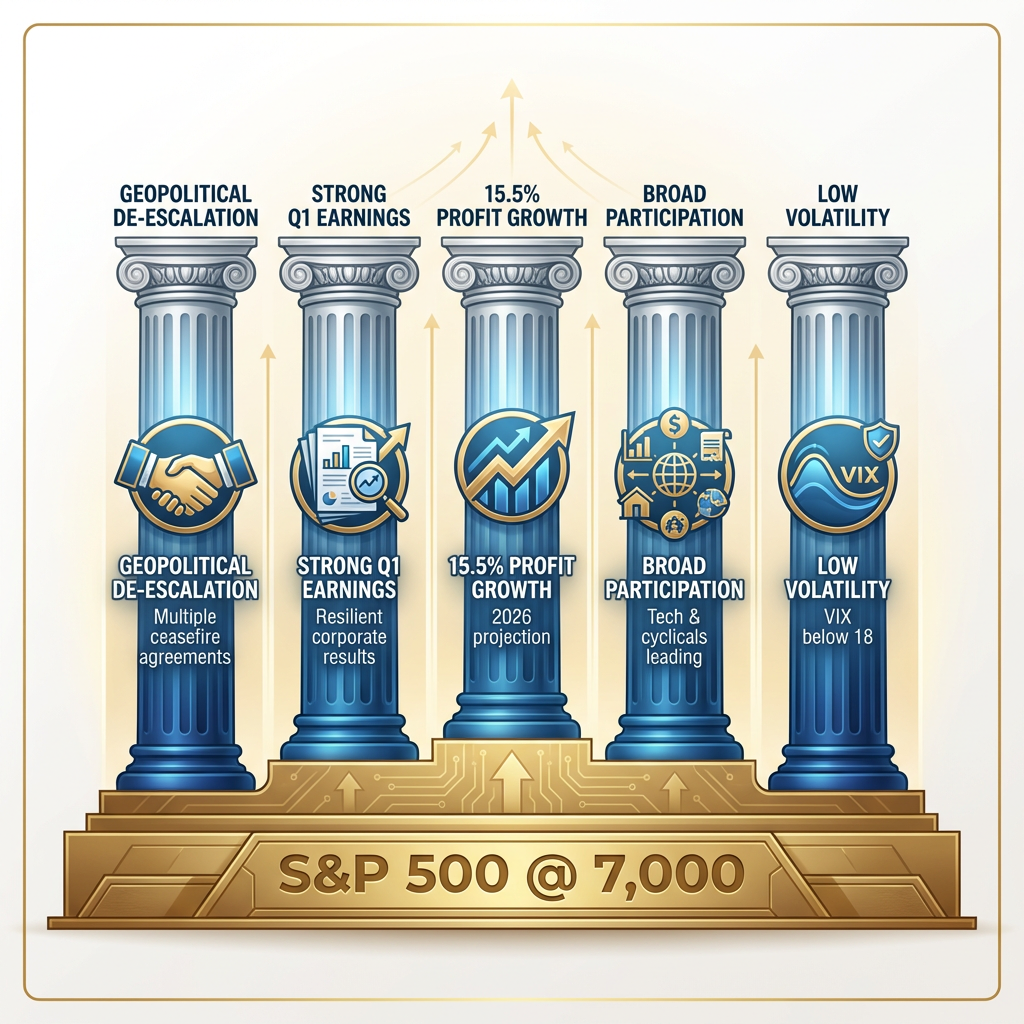
Key factors supporting the rally include:
- Multiple ceasefire agreements reducing geopolitical risk premium on equity valuations
- Strong Q1 earnings demonstrating corporate health across sectors, particularly financials
- 15.5% profit growth projection for 2026 providing fundamental justification for higher prices
- Broad sector participation across technology and cyclicals suggesting rally durability
- Declining volatility indicating sustained market confidence and reduced hedging demand
Weekend negotiations on the Israel-Lebanon ceasefire will be closely monitored for progress towards a lasting resolution. Continued earnings releases will test whether corporate results sustain current valuation levels. The 7,000 milestone reflects improved conditions, but investors should monitor these developments for confirmation that the supportive backdrop remains intact.
This article is for informational purposes only and should not be considered financial advice. Investors should conduct their own research and consult with financial professionals before making investment decisions.
Frequently Asked Questions
When did the S&P 500 first close above 7,000?
The S&P 500 closed above 7,000 for the first time in history on 15 April 2026, reaching an intraday high of 7,008. Although the index briefly touched 7,002.28 intraday on 28 January 2026, it failed to sustain a close above the level at that time.
Why does the S&P 500 closing above 7,000 matter to investors?
Round-number thresholds like 7,000 act as psychological barriers where investors collectively reassess valuations; a sustained close above the level signals genuine confidence and a market re-rating rather than a temporary intraday spike.
What drove the S&P 500 above 7,000?
The rally was driven by a combination of geopolitical de-escalation including a U.S.-Iran ceasefire and an Israel-Lebanon ceasefire announcement, strong Q1 2026 corporate earnings from major financials, and a projected 15.5% S&P 500 profit growth for 2026.
Which sectors are leading the S&P 500 rally above 7,000?
Both large-cap technology stocks and cyclical stocks are providing dual leadership, with the NASDAQ Composite gaining 0.4% to 24,102.70, indicating broad-based market strength rather than narrow concentration in a handful of names.
What should investors watch now that the S&P 500 has crossed 7,000?
Investors should monitor progress in weekend Israel-Lebanon ceasefire negotiations, continued Q1 earnings releases to confirm corporate health, and the VIX volatility index, which has dropped below 18 to a seven-week low, for signs that the supportive backdrop remains intact.