
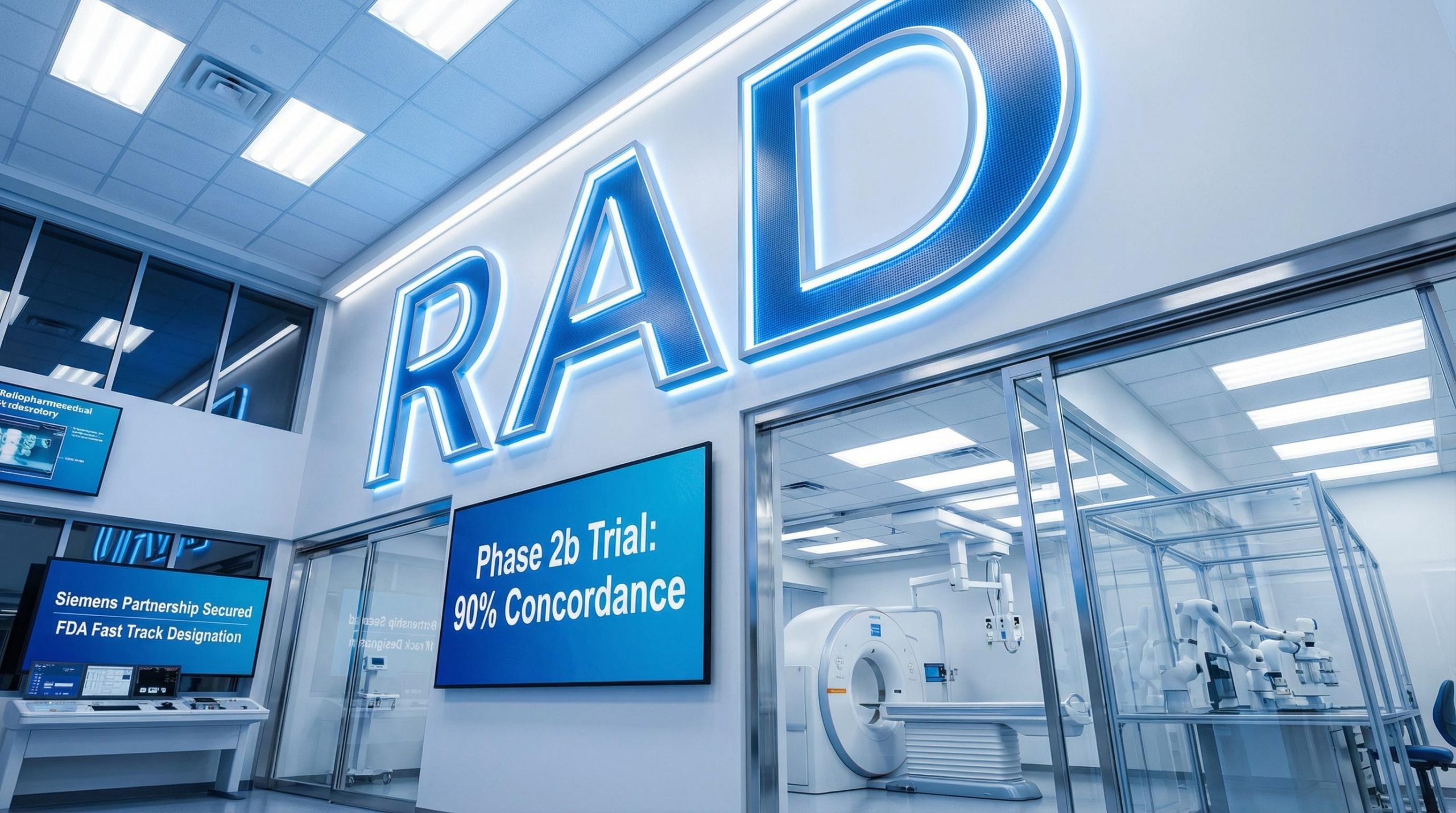
Radiopharm secures Siemens supply deal as RAD101 Phase 2b data hits 90% concordance
Radiopharm Theranostics (ASX: RAD) has announced a clinical supply agreement with Siemens Healthineers for its RAD101 diagnostic imaging agent, coinciding with positive interim Phase 2b trial data showing 90% concordance between PET imaging and MRI in brain metastases patients. The partnership positions the company to initiate a Phase 3 registrational trial following topline data readout expected in H1 2026.
The dual announcement addresses both clinical validation and supply chain de-risking ahead of the pivotal trial. RAD101 is designed to distinguish recurrent brain metastases from treatment effects, a diagnostic challenge affecting more than 300,000 people annually in the United States. The therapy holds FDA Fast Track Designation, supporting an expedited development pathway.
Siemens Healthineers will manufacture and distribute Fluorine-18-labelled RAD101 doses across its national network of U.S. radiopharmacies. The partnership signals manufacturing feasibility at commercial scale and provides logistical infrastructure for multi-centre trial execution.
When big ASX news breaks, our subscribers know first
What is RAD101 and why does it matter for brain metastases diagnosis?
RAD101 is a diagnostic imaging agent targeting fatty acid synthase (FASN), a metabolic enzyme overexpressed in cancer cells. The molecule is radiolabelled with Fluorine-18 to enable positron emission tomography (PET) scanning, which detects metabolic activity in tumours.
The clinical problem RAD101 addresses centres on diagnostic ambiguity. When oncologists review MRI scans of patients previously treated for brain metastases, distinguishing between recurrent tumour growth and treatment-related tissue changes is often unclear. This uncertainty can delay treatment decisions or lead to unnecessary interventions.
Key aspects of RAD101’s diagnostic approach:
- FASN targeting: Fatty acid synthase is a metabolic enzyme highly active in cancer cells but less active in normal brain tissue, providing a molecular target for selective tumour imaging.
- PET imaging complement: RAD101 PET scans provide metabolic information that MRI cannot capture. Where MRI shows tissue changes, PET imaging with RAD101 can confirm whether those changes represent active tumour metabolism.
- Treatment decision support: Clearer differentiation between recurrence and treatment effects allows oncologists to escalate therapy when needed or avoid overtreatment when inflammation rather than cancer is present.
The addressable patient population is substantial. Brain metastases occur when cancer from other organs spreads to the brain, commonly from lung, breast, and melanoma primaries. Current imaging protocols rely heavily on MRI, which has limitations in post-treatment settings where tissue scarring and inflammation can mimic tumour appearance.
For investors, diagnostic precision tools in oncology command premium positioning within clinical workflows. Products that reduce diagnostic uncertainty support better patient outcomes and can generate durable revenue streams through repeat imaging protocols across treatment cycles.
Phase 2b interim results show selective tumour uptake
The second interim analysis of the Phase 2b trial enrolled 20 patients and evaluated RAD101’s ability to match MRI findings in suspected recurrent brain metastases. Results demonstrated significant and selective tumour uptake, with images confirming metabolic activity in brain metastases compared to equivocal MRI findings.
The primary endpoint measured concordance between RAD101 PET imaging and MRI. 18 of 20 patients achieved concordance, representing a 90% success rate. This outcome supports the hypothesis that RAD101 adds diagnostic value beyond standard MRI protocols.
Secondary objectives assessed sensitivity and specificity, requiring longer-term follow-up data or biopsy confirmation to validate diagnostic accuracy. The first five patients with evaluable six-month follow-up data or biopsy results showed a positive trend for both metrics, indicating RAD101 correctly identified tumour presence and absence.
| Metric | Result |
|---|---|
| Patients dosed | 20 |
| Concordance with MRI (Primary Endpoint) | 90% (18/20) |
| Tumour uptake | Significant and selective |
| Sensitivity/Specificity trend (Secondary) | Positive (n=5 evaluable) |
Riccardo Canevari, CEO and Managing Director
“We have made considerable progress advancing RAD101 through the clinic, and the second interim analysis showed 90% (18/20) of the patients dosed with RAD101 achieved concordance between PET imaging and MRI (the primary endpoint). The results showed significant and selective tumor uptake in the brain metastases. Images confirm metabolic activity in brain metastases compared to equivocal MRI findings.”
The interim data strengthens the rationale for advancing to Phase 3. Strong primary endpoint performance reduces execution risk for the registrational trial, whilst early secondary data adds confidence in diagnostic utility. Investors should note that full topline data readout in H1 2026 will provide a more complete assessment of sensitivity and specificity across the entire patient cohort.
Siemens partnership secures U.S. supply for Phase 3
Under the clinical supply agreement, Siemens Healthineers will manufacture and distribute Fluorine-18-labelled RAD101 doses to support the Phase 3 registrational trial in the United States. Siemens brings established credentials as a leader in PET imaging solutions, operating a large national network of radiopharmacies across multiple U.S. markets.
The partnership addresses a critical operational requirement. Fluorine-18 has a short half-life, decaying rapidly after production. This necessitates a distributed manufacturing model where doses are produced at multiple sites and delivered quickly to clinical trial centres. Siemens’ existing radiopharmacy infrastructure is designed for this workflow, supporting timely dose delivery to patients enrolled across geographically dispersed trial sites.
Manufacturing partnerships with established radiopharmaceutical players reduce execution risk for clinical-stage biotechnology companies. Siemens’ track record in PET imaging and commercial-scale production signals that RAD101’s manufacturing process is feasible beyond early-phase trial settings.
Barry Scott, Head of Radiopharma, Siemens Healthineers
“As the leader in PET imaging solutions, we are pleased to partner with Radiopharm Theranostics to provide our reliable and specialized manufacturing capabilities. With our large national network of radiopharmacies in the U.S., we are uniquely qualified and well-equipped to deliver RAD101 as well as other novel PET biomarkers to assist in the fight against challenging diseases such as brain metastases.”
For investors, the partnership provides visibility into Radiopharm’s commercialisation strategy. Supply chain de-risking ahead of pivotal trials demonstrates proactive planning and reduces the probability of manufacturing-related delays. Siemens’ involvement also positions RAD101 for efficient multi-centre trial logistics, supporting faster patient recruitment and data readout timelines.
Upcoming catalysts and pathway to registration
The development timeline centres on three near-term milestones. Phase 2b topline data readout is expected in the first half of 2026, providing full efficacy and safety data across the trial population. This readout will inform final Phase 3 trial design and regulatory discussions with the FDA.
Following topline data, Radiopharm plans to initiate the Phase 3 registrational trial. The study will be multi-centre and global in scope, with Siemens supporting U.S. supply logistics. FDA Fast Track Designation supports an expedited review pathway, potentially accelerating regulatory approval timelines if Phase 3 trial results meet primary endpoints.
Near-term milestones:
- Phase 2b topline data readout in H1 2026
- Phase 3 registrational trial initiation following topline readout
- Multi-centre global trial execution supported by Siemens supply infrastructure
Radiopharm’s broader pipeline includes one Phase 2 trial and five Phase 1 trials across solid tumour cancers, including lung, breast, and brain metastases. The company’s platform spans peptides, small molecules, and monoclonal antibodies, providing multiple shots on goal within the radiopharmaceutical sector.
Riccardo Canevari, CEO and Managing Director
“This partnership marks a milestone for Radiopharm, as we bring RAD101 closer to improving diagnostic precision for brain metastases. This partnership ensures our supply of 18F-labeled RAD101 in the U.S. for the initiation of the multi-center global Phase 3 registrational trial following our readout of topline data in the Phase 2b trial in the first half of 2026.”
The catalyst pathway is well-defined, with concrete timelines and regulatory support mechanisms in place. Fast Track Designation may accelerate time to market if Phase 3 results replicate interim Phase 2b performance. Investors should monitor the H1 2026 topline readout as the primary near-term catalyst, with Phase 3 initiation dependent on those results meeting regulatory thresholds for advancement.
Don’t Miss the Next Biotech Breakthrough
Join 20,000+ investors getting FREE breaking ASX healthcare news delivered to your inbox within minutes of release, complete with expert analysis. Click the “Free Alerts” button at StockWire X to receive real-time alerts the moment market-moving biotech announcements drop.