
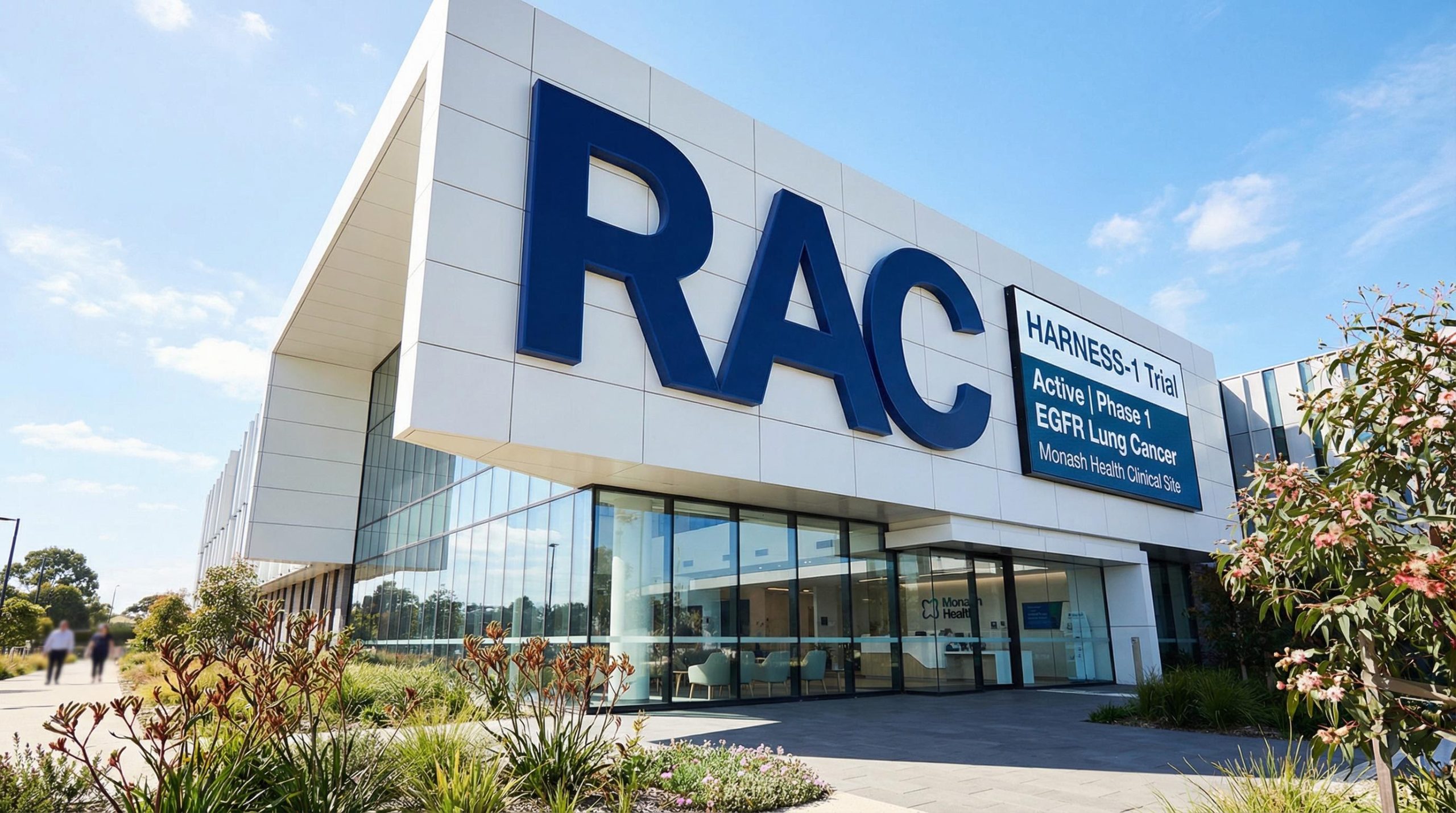
Racura recruits first patient to HARNESS-1 lung cancer trial
Racura Oncology (ASX: RAC) has recruited the first patient to its Phase 1 HARNESS-1 trial, marking a significant de-risking milestone for the clinical-stage biotech. The trial will assess the safety, tolerability and pharmacokinetics of RC220 (E,E-bisantrene) in combination with osimertinib in patients with EGFR-mutant non-small cell lung cancer. The first participant was consented by Principal Investigator Associate Professor Surein Arulananda and his team at Monash Health (Clayton, Victoria).
The company has indicated that four additional clinical trial sites are expected to be activated in the coming months, signalling momentum in trial expansion and patient recruitment capacity. The trial is registered under ACTRN12626000325303.
Dr Daniel Tillett, CEO and Managing Director
“The enrolment of the first patient to the HARNESS-1 trial is a significant milestone for Racura. We are grateful to A/Prof Surein Arulananda and his clinical team at Monash Health for working diligently with us to activate the trial and recruit the study’s first participant. We wish to thank all the patients and their families for their willingness to participate in our clinician trials.”
For clinical-stage companies, reaching patient recruitment represents a material operational milestone. It confirms trial activation, regulatory clearance, and the company’s ability to execute on its clinical development strategy. Multi-site expansion strengthens recruitment timelines and supports broader data generation.
When big ASX news breaks, our subscribers know first
Why EGFR resistance in lung cancer is a major unmet need
EGFR-mutant non-small cell lung cancer occurs when specific mutations in the epidermal growth factor receptor drive cancer cell growth. Tyrosine kinase inhibitors such as osimertinib (marketed as Tagrisso by AstraZeneca) block this pathway and represent the standard of care for these patients.
However, all patients treated with osimertinib eventually develop resistance, meaning the cancer learns to bypass the drug’s effects and begins progressing again. Currently, there is no approved therapy to prevent or delay this resistance, leaving patients with limited options once progression occurs.
RC220 is being trialled in combination with osimertinib to address this gap. The aim is to prevent or delay the emergence of resistance rather than treating progression after it has occurred. This positions RC220 as a potential first-line companion therapy rather than a salvage treatment.
Associate Professor Surein Arulananda, Principal Investigator
“Resistance to standard of care TKIs in NSCLC is a very significant issue. All patients with this devastating disease will face this issue which currently has no solution. This study is a very important one and will give us evidence related to the safety and efficacy of RC220 in this clinical area.”
EGFR mutations occur in approximately 10% to 15% of NSCLC patients in Western populations, with higher prevalence in Asian populations. Successfully preventing or delaying resistance could represent a commercially significant development in lung cancer treatment.

How the HARNESS-1 trial works
The HARNESS-1 trial is a multi-centre, Phase 1a/b study using circulating tumour DNA (ctDNA) to screen and enrol EGFRm NSCLC patients receiving osimertinib. The trial commences with a ctDNA screening stage, followed by dose escalation of RC220 when patients show evidence of disease progression.
Patients will receive intravenous infusion of RC220 on Day 1 of a 21-day cycle in combination with osimertinib. The trial employs an accelerated trial design (ATD) for initial cohorts, intended to balance safety evaluation with the objective of reaching clinically active doses quickly. Once the ATD stage is complete, participants will be enrolled into a Bayesian Optimal Interval (BOIN) dose escalation study, using larger patient cohorts to identify the maximum tolerated dose (MTD) of RC220.
Treatment continues until patients achieve disease control or complete one year of treatment, experience disease progression, develop unacceptable toxicity, or withdraw consent.
| Stage | Design | Patient Numbers | Objective |
|---|---|---|---|
| Phase 1a (ATD) | Single-patient cohorts | Starting cohort | Safety evaluation, reach active doses quickly |
| Phase 1a (BOIN) | Bayesian dose escalation | 12 to 40 patients total | Identify maximum tolerated dose |
| Phase 1b | Double-blind, randomised | 40 patients | Compare two RC220 dose levels with osimertinib |
Once the MTD is determined, all accumulated safety and pharmacokinetic data will be analysed before initiating the Phase 1b stage. In this expansion phase, 40 participants will be randomised to one of two RC220 dose levels in combination with osimertinib. Patients will be monitored for safety and pharmacokinetics, alongside secondary endpoints including progression-free survival, overall survival, changes in ctDNA levels, and changes in cancer-specific mutations.
The Bayesian design aligns with the US FDA’s Project Optimus initiative, which aims to optimise dose selection by balancing efficacy and side effects in cancer treatments. This adaptive approach allows clinicians to identify the optimal dose more efficiently than traditional dose-escalation methods, potentially improving the probability of success in later-stage trials.
Racura’s broader clinical pipeline
RC220 across multiple oncology indications
HARNESS-1 forms part of Racura’s broader clinical development strategy for RC220, which spans multiple oncology indications. The company is advancing:
- Phase 3 programme: Acute myeloid leukaemia (AML)
- Phase 1a/b: HARNESS-1 trial in EGFRm NSCLC (first patient now recruited)
- Phase 1a/b: Combination programme with doxorubicin targeting cardioprotection in solid tumours
- Intellectual property: 20 years of composition of matter patent protection over (E,E)-bisantrene
RC220’s lead asset, (E,E)-bisantrene, is a small molecule anticancer agent that functions primarily via G4-DNA and RNA binding, leading to silencing of MYC, an important cancer growth regulator. The compound has demonstrated therapeutic activity in cancer patients with a well-characterised safety profile.
The multi-indication pipeline provides Racura with several potential value-creation pathways. The Phase 3 programme in AML represents the most advanced clinical validation of RC220’s mechanism, while the NSCLC and cardioprotection programmes target distinct commercial opportunities.
Racura has stated it is actively exploring partnerships, licence agreements, or a commercial merger and acquisition to accelerate access to RC220 for patients globally. Such corporate development activity could represent near-term value inflection points independent of clinical data readouts.
What comes next for Racura
The company has outlined several near-term catalysts expected to drive clinical and operational momentum:
- Activation of four additional HARNESS-1 clinical trial sites
- Continued patient recruitment and dose escalation through Phase 1a
- Safety and pharmacokinetic data analysis ahead of Phase 1b initiation
- Partnership and licensing discussions ongoing
The activation of additional trial sites will materially accelerate recruitment timelines, allowing Racura to progress through dose escalation more rapidly. The Bayesian design requires sufficient patient numbers to identify the optimal dose, so recruitment velocity directly impacts the timeline to Phase 1b and subsequent data readouts.
The company’s active exploration of partnerships and licensing opportunities indicates potential value-creation events beyond organic clinical development. For investors, this dual-track strategy (internal development alongside corporate development discussions) provides multiple pathways to value realisation.
Racura’s progress in activating the HARNESS-1 trial, recruiting the first patient, and expanding to additional sites demonstrates operational execution in a high-value therapeutic area with significant unmet need. The trial’s innovative ctDNA screening approach and Bayesian dose optimisation methodology align with contemporary regulatory expectations and may support more efficient clinical development timelines.
Stay Ahead on Breakthrough Biotech News
Join 20,000+ investors receiving FREE breaking ASX healthcare announcements within minutes of release, complete with in-depth analysis. Get market-moving biotech news delivered straight to your inbox before the market reacts—click the “Free Alerts” button at Big News Blast to start receiving real-time alerts.