
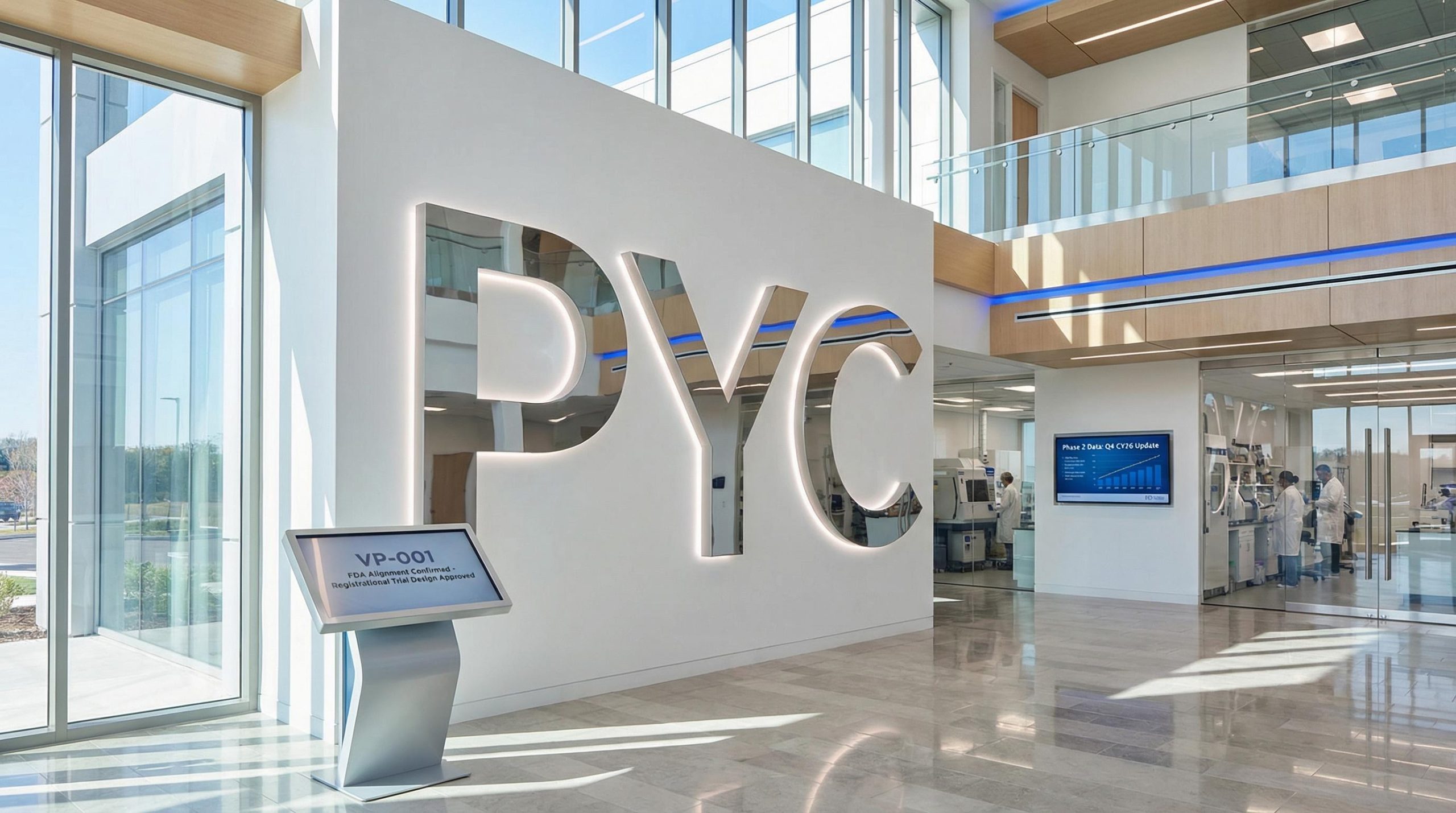
FDA greenlights registrational pathway for potential first RP11 treatment
PYC Therapeutics (ASX: PYC) has secured FDA agreement on the framework for VP-001’s registrational trial design, a critical milestone in the drug candidate’s pathway to market. The PYC Therapeutics VP-001 FDA alignment follows a Type D meeting with the US Food and Drug Administration, confirming key elements of the pivotal study intended to support a New Drug Application for Retinitis Pigmentosa type 11 (RP11). VP-001 has the potential to become the first approved treatment option for patients with this blinding eye disease.
The FDA confirmed agreement on the primary endpoint: mean change from baseline in Low Luminance Visual Acuity (LLVA) at month 36, requiring a ≥15 letter mean difference in favour of VP-001 versus sham control. The regulator previously confirmed in June 2025 that a single registrational trial is capable of supporting a New Drug Application for VP-001, streamlining the pathway to potential approval.
This regulatory alignment removes a major uncertainty for investors evaluating VP-001’s commercial potential. Agreement on trial design, endpoints, and evidentiary requirements de-risks the development pathway and provides clarity on what success looks like.
When big ASX news breaks, our subscribers know first
What the FDA agreement covers
The Type D meeting confirmed five critical elements of the registrational study design, providing a clear roadmap for the pivotal trial.
| Trial Element | FDA-Agreed Specification |
|---|---|
| Primary Endpoint | Mean change from baseline in LLVA at month 36 (≥15 letter mean difference versus sham) |
| Key Secondary Endpoints (Ranked Hierarchy) | 1) Proportion achieving ≥10-letter improvement from baseline at month 36 2) Proportion losing ≥10 letters from baseline at month 36 |
| Other Secondary Endpoints | Mean change in pre-specified transitional zone macular sensitivity at month 36; rate of ellipsoid zone area change over time; rate of change in LLVA over time; rate of change in pre-specified transitional zone macular sensitivity over time |
| Sham Control Arm | Inclusion confirmed |
| Natural History Data | Company’s natural history study data can be incorporated alongside sham control data in NDA submission |
The hierarchy of endpoints provides regulatory clarity on how efficacy will be evaluated. The primary endpoint focuses on improving vision in low-light conditions, a clinically meaningful outcome for RP11 patients whose photoreceptors progressively degenerate. The key secondary endpoints capture both improvement and prevention of deterioration, addressing the dual objectives of restoring function and halting disease progression.
The ability to use natural history study data alongside the sham control arm strengthens the evidentiary package without requiring a larger trial. This approach allows PYC Therapeutics (ASX: PYC) to leverage its existing natural history dataset to aid interpretation of treatment effects, potentially reducing sample size requirements and accelerating timelines.
Special Protocol Assessment option available
The FDA highlighted the Special Protocol Assessment (SPA) procedure as an optional mechanism available to PYC to align on the final details of the proposed registrational trial. An SPA would lock in agreement on the study protocol and statistical analysis plan, providing additional regulatory certainty before trial initiation.
This represents an additional de-risking tool available to the company. While not mandatory, pursuing an SPA would formally bind the FDA to the agreed trial design, reducing the risk of regulatory challenges during the New Drug Application review process.
Understanding FDA Type D meetings and registrational trials
For investors new to biotech regulatory pathways, understanding the significance of this PYC Therapeutics VP-001 FDA alignment requires familiarity with several key concepts.
A Type D meeting is a formal FDA meeting specifically designed to discuss the design of pivotal trials intended to support marketing applications. These meetings allow sponsors to align with regulators on critical trial design elements before committing significant capital to late-stage development. Agreement at this stage reduces the risk of costly protocol amendments or failed regulatory submissions later.
A registrational trial (also called a pivotal trial) is the definitive study intended to generate the primary evidence supporting drug approval. For VP-001, this represents the final clinical hurdle before a potential New Drug Application submission. The data from this trial will form the basis of PYC’s case for regulatory approval.
A New Drug Application is the formal submission to the FDA seeking approval to market a drug in the United States. It contains all clinical, preclinical, manufacturing, and regulatory data demonstrating that the drug is safe and effective for its intended use. FDA approval of an NDA allows commercial sale of the therapy.
Low Luminance Visual Acuity measures a patient’s ability to see in low-light conditions, such as at dusk or in dimly lit environments. For RP11 patients, whose photoreceptors (light-sensing cells in the retina) progressively degenerate, this metric captures a clinically meaningful aspect of visual function that directly affects quality of life.
Investors should recognise that this meeting represents a critical checkpoint in VP-001’s development. FDA agreement on trial design, endpoints, and data requirements provides the regulatory certainty needed to progress confidently into the pivotal stage of development.
VP-001’s path forward and key catalysts
The PYC Therapeutics VP-001 FDA alignment sets the stage for several near-term catalysts that will shape the investment thesis.
The upcoming milestones include:
- Q4 CY26: Long-term Phase 2 data update expected, including patients with more than 12 months continuous VP-001 exposure
- Post-data review: Finalisation of registrational study design incorporating Phase 2 outcomes and FDA feedback
- Optional SPA submission: PYC may pursue Special Protocol Assessment to lock in protocol details with FDA
The Q4 CY26 data readout represents the next major value inflection point. This update will include patients who have received VP-001 for over a year, providing critical evidence on the durability of the treatment effect observed in earlier data. Positive long-term results would validate VP-001’s ability to maintain or improve vision over extended treatment periods, a key question for investors evaluating the therapy’s commercial potential.
The data will inform final decisions on the registrational study design, potentially refining elements such as dosing regimen, patient selection criteria, or assessment schedules. Combined with the FDA feedback received in the Type D meeting, this dataset will allow PYC to optimise the pivotal trial protocol before initiation.
The totality of evidence standard
The FDA confirmed an important nuance in how VP-001’s efficacy will ultimately be evaluated. While the primary endpoint sets a 15-letter threshold, the regulator stated that failure to meet this specific threshold would not automatically preclude approval if the “totality of evidence” supported the risk-benefit profile of the investigational drug candidate.
This signals regulatory flexibility in the assessment process. Rather than a binary pass/fail on the primary endpoint, the FDA will consider the full data package, including secondary endpoints, safety data, natural history comparisons, and the unmet medical need in RP11. For a disease with no approved treatments, the regulatory bar may accommodate evidence of meaningful clinical benefit even if it falls short of the pre-specified threshold.
This reduces binary risk around the primary endpoint. Investors should understand that VP-001’s approvability will be determined by the weight of evidence across multiple endpoints, not a single statistical hurdle.
Investment thesis
The PYC Therapeutics VP-001 FDA alignment represents a significant value inflection point for the company. VP-001 targets RP11, an orphan indication affecting a small patient population with no approved treatment options. The regulatory clarity achieved in this Type D meeting de-risks the pathway to market on three critical dimensions.
First, the FDA previously confirmed that a single registrational trial is capable of supporting a New Drug Application. This contrasts with many regulatory programmes that require two pivotal studies, materially reducing development costs and timelines.
Second, agreement on endpoints and their hierarchy eliminates a major source of regulatory uncertainty. PYC now has a defined roadmap for demonstrating efficacy, with clear success criteria and a ranked structure for evaluating outcomes.
Third, FDA acceptance of natural history data alongside sham control data strengthens the evidentiary package without requiring a larger trial. This approach leverages existing data to provide context for treatment effects, potentially reducing sample size requirements.
PYC Therapeutics (ASX: PYC) currently has three clinical-stage programmes targeting monogenic diseases with its proprietary RNA therapy platform. VP-001, which addresses the underlying genetic cause of RP11, represents the most advanced programme with the clearest regulatory pathway.
Strategic Significance
The company’s ability to secure FDA alignment on a single-trial pathway for a potential first-in-class therapy positions VP-001 as a high-value asset within PYC’s pipeline. With regulatory design locked in and long-term Phase 2 data expected in Q4 CY26, investors have clear visibility on the next validation checkpoint before the pivotal stage commitment.
The upcoming Phase 2 data update will be critical for validating VP-001’s durability and refining the investment case. Positive results demonstrating sustained or improving visual acuity in patients with more than 12 months exposure would de-risk the registrational study and support progression with confidence. The clarity on endpoints and data requirements achieved through this FDA engagement reduces execution risk and provides a defined framework for evaluating success.
Don’t Miss the Next Biotech Breakthrough
Join 20,000+ investors receiving FREE breaking ASX news within minutes of release, complete with in-depth analysis. Big News Blast delivers real-time alerts the moment market-moving announcements hit—click the “Free Alerts” button to stay ahead on healthcare and biotech developments.