

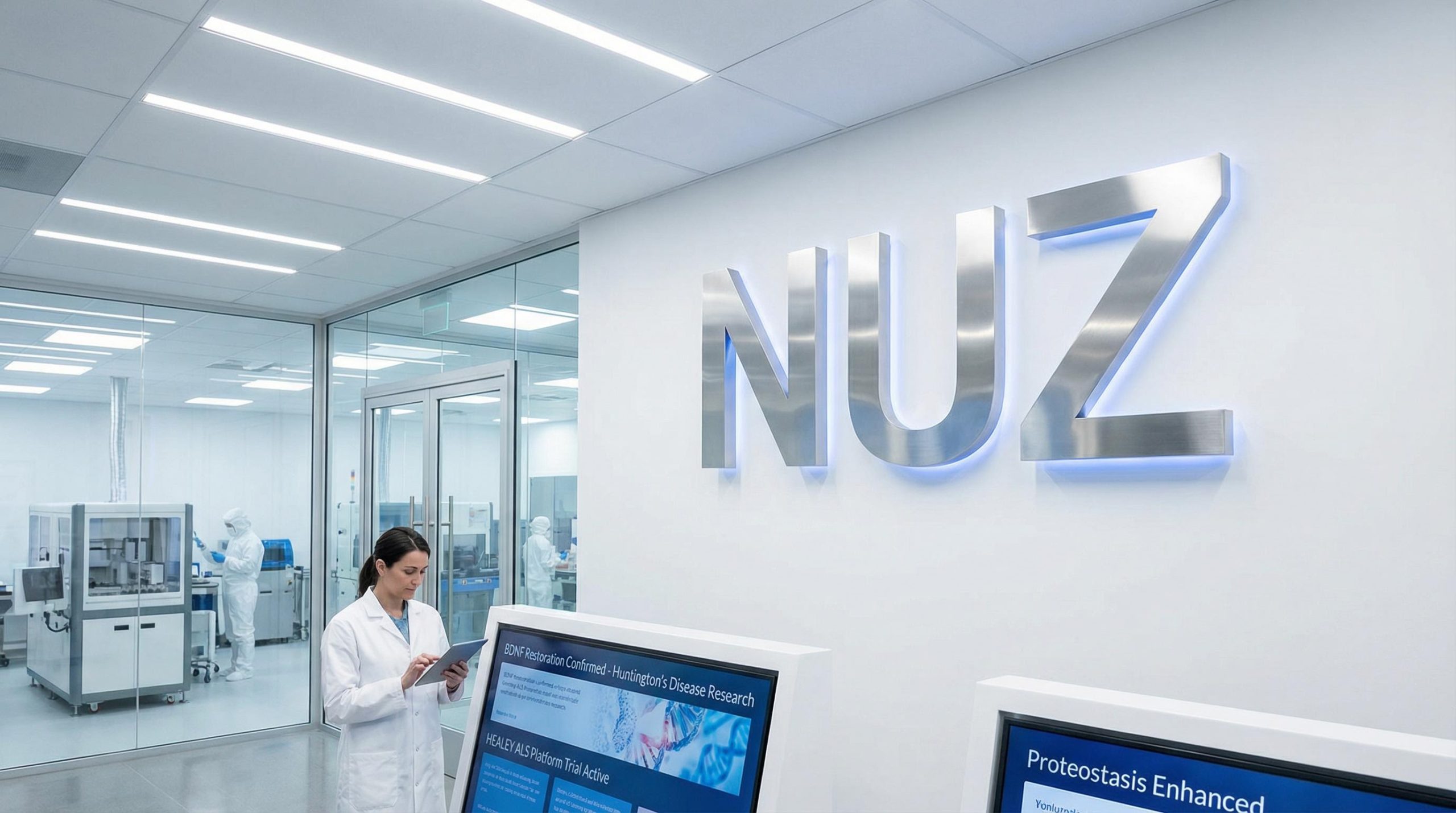
Neurizon expands Huntington’s disease evidence with new NUZ-001 preclinical data
Neurizon Therapeutics (ASX: NUZ) has presented new preclinical data showing its lead drug candidate NUZ-001 demonstrates activity in Huntington’s disease models through a dual mechanism. The data, presented at the 2026 American Society for Experimental NeuroTherapeutics (ASENT) Annual Meeting in Bethesda, Maryland, expands the therapeutic potential of NUZ-001 beyond amyotrophic lateral sclerosis (ALS), where the compound is currently being evaluated in the HEALEY ALS Platform Trial.
The findings show NUZ-001 and its active metabolite NUZ-001 Sulfone enhance protein clearance pathways and restore brain-derived neurotrophic factor (BDNF) under disease-relevant stress conditions. For investors, this data suggests pipeline optionality, with a single clinical-stage asset demonstrating activity across multiple neurodegenerative pathways and indications. The announcement signals progress in building a translational evidence base that could support future clinical development decisions for Huntington’s disease.
When big ASX news breaks, our subscribers know first
What is Huntington’s disease and why does it matter for drug development?
Huntington’s disease is a fatal neurodegenerative disorder caused by a mutation in the HTT gene. This mutation produces a toxic form of the huntingtin protein that damages neurons over time. Unlike many neurodegenerative conditions, Huntington’s disease is caused by a single known genetic defect, making it an attractive target for therapeutic intervention.
The disease drives neurodegeneration through two connected pathways. First, the mutant huntingtin protein misfolds and forms toxic clumps that overwhelm the cell’s natural protein clearance systems. Second, affected neurons experience reduced levels of BDNF, a protein essential for neuronal survival, particularly in brain regions controlling movement and cognition.
Developing effective treatments for Huntington’s disease has proven challenging because therapies need to address both protein accumulation and neuronal support mechanisms. Success in this indication would address a significant unmet medical need, with limited approved treatment options currently available. The dual pathogenic mechanism also means a drug capable of targeting both pathways may offer advantages over single-mechanism approaches.
Three key findings strengthen the NUZ-001 Huntington’s disease case
Drug exposure and metabolite activity confirmed
Preclinical studies in zebrafish models demonstrated both NUZ-001 and its metabolite NUZ-001 Sulfone are readily taken up following treatment. Both compounds demonstrated biological activity in vivo, measured through HPLC analysis. The findings indicate NUZ-001 Sulfone is pharmacologically active and may contribute to the overall therapeutic effect observed with NUZ-001.
BDNF restoration is disease-specific
The restorative effects of NUZ-001 and NUZ-001 Sulfone on BDNF levels occurred selectively in HTT knockdown conditions. Importantly, these effects were not observed in wild-type animals. This disease-dependent activity suggests a stress-adaptive, pathology-specific mechanism rather than nonspecific upregulation of neurotrophic signalling. The selectivity is consistent with targeted therapeutic activity under disease-relevant conditions.
Enhanced protein clearance in human HD neurons
New cellular data generated in human induced pluripotent stem cell (iPSC)-derived Huntington’s disease neurons carrying a 50 CAG repeat expansion demonstrated reduced p62 immunoreactivity following treatment with both compounds. This reduction is consistent with enhanced autophagic flux, indicating activation of protein clearance pathways that help remove toxic protein aggregates.
| Finding | Model Used | Observed Effect | Significance |
|---|---|---|---|
| Drug exposure & metabolite activity | Zebrafish larvae | Both NUZ-001 and NUZ-001 Sulfone readily taken up; biological activity demonstrated in vivo | Confirms target engagement and metabolite contribution to therapeutic effect |
| Disease-dependent BDNF restoration | Zebrafish with approximately 30% HTT knockdown | BDNF levels restored only in HTT knockdown conditions; no effect in wild-type animals | Indicates pathology-specific mechanism rather than nonspecific upregulation |
| Enhanced protein clearance | Human iPSC-derived HD neurons (50 CAG repeats) | Reduced p62 immunoreactivity consistent with enhanced autophagic flux | Demonstrates activation of protein clearance pathways in human disease-relevant cells |
Dual mechanism positions NUZ-001 across neurodegeneration
The preclinical data presented at ASENT 2026 supports a dual mechanistic framework involving enhanced proteostasis and restored neurotrophic support under disease-relevant stress conditions. This framework applies across the models tested, including human iPSC-derived neurons and zebrafish with HTT reduction. Notably, both NUZ-001 and NUZ-001 Sulfone demonstrated comparable effects across the measured outcomes.
NUZ-001 is currently being evaluated for the treatment of ALS in the HEALEY ALS Platform Trial. Ongoing preclinical studies are evaluating the compound’s activity in additional Huntington’s disease models to further define its translational potential across neurodegenerative disorders characterised by impaired protein homeostasis. A drug candidate demonstrating activity across multiple neurodegenerative pathways may have broader applicability than compounds targeting a single mechanism.
The announcement notes that protective effects were observed selectively under conditions of HTT reduction, consistent with a stress-adaptive mechanism of action rather than constitutive pathway activation. This selectivity may carry implications for safety and tolerability in clinical development, though further validation in mammalian models is required.
Next steps for Neurizon’s Huntington’s disease programme
Neurizon is continuing preclinical evaluation of NUZ-001 to strengthen the translational evidence base supporting potential clinical development in Huntington’s disease. Ongoing studies include:
- Additional human iPSC-derived HD model studies to validate findings across different genetic backgrounds
- Rodent HD model evaluation to assess activity in mammalian systems
- Continued mechanistic characterisation to define the molecular pathways underlying observed effects
These studies are positioned to expand the translational validation of NUZ-001 in Huntington’s disease models and support mechanistic understanding. Continued preclinical progress builds the evidence base that could inform future clinical development decisions for the Huntington’s disease indication, pending successful completion of these validation studies.
Want the Next Biotech Breakthrough in Your Inbox?
Join 20,000+ investors getting FREE ASX healthcare alerts delivered within minutes of release, complete with in-depth analysis. Click the “Free Alerts” button at Big News Blast to receive breaking biotech news the moment it hits the market.