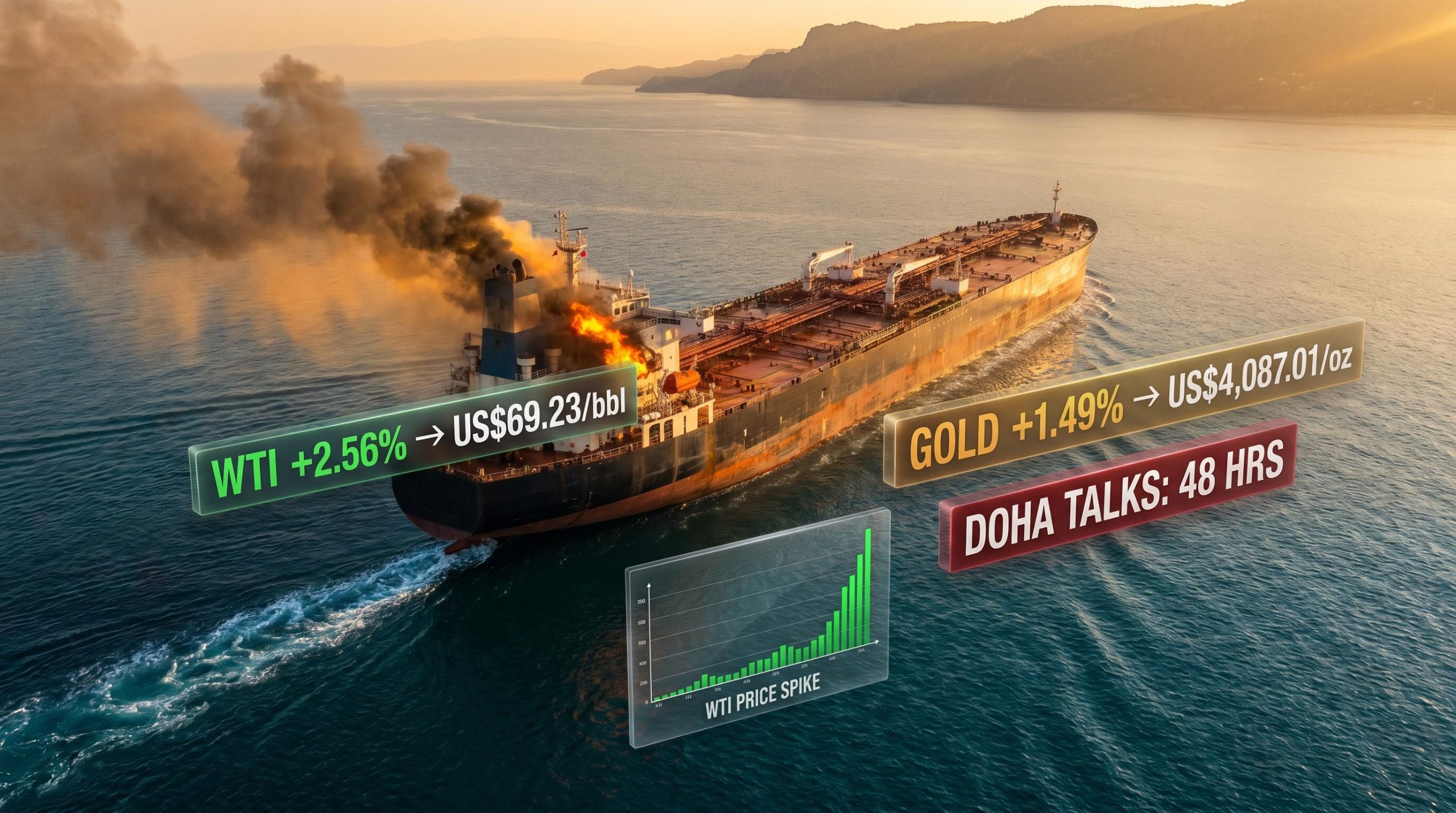
Iranian drones struck two commercial vessels transiting the Strait of Hormuz this weekend, hitting the cargo ship Ever Lovely and the oil tanker Kiku while both carried real cargoes through the world’s most consequential oil chokepoint. Oil markets opened Monday morning pricing the consequences.
A ceasefire is nominally in place. Both Washington and Tehran are sending representatives to Doha for talks on Wednesday. But the weekend’s events have transformed the Strait of Hormuz from a theoretical vulnerability into a demonstrated one, with US strikes on Iranian coastal military assets and Iranian retaliatory fire on American installations in Bahrain and Kuwait marking the sharpest exchange since the 60-day memorandum of understanding (MoU), a temporary diplomatic framework intended to prevent exactly this kind of escalation.
Everything that moves in markets this week will be read through a single lens: the 48-hour window before those Doha talks begin. Here is a clear picture of what the market is already pricing, what Wednesday’s meeting will either confirm or upend, and which signals are worth watching before the weekend.
From abstract risk to live conflict: what happened over the weekend
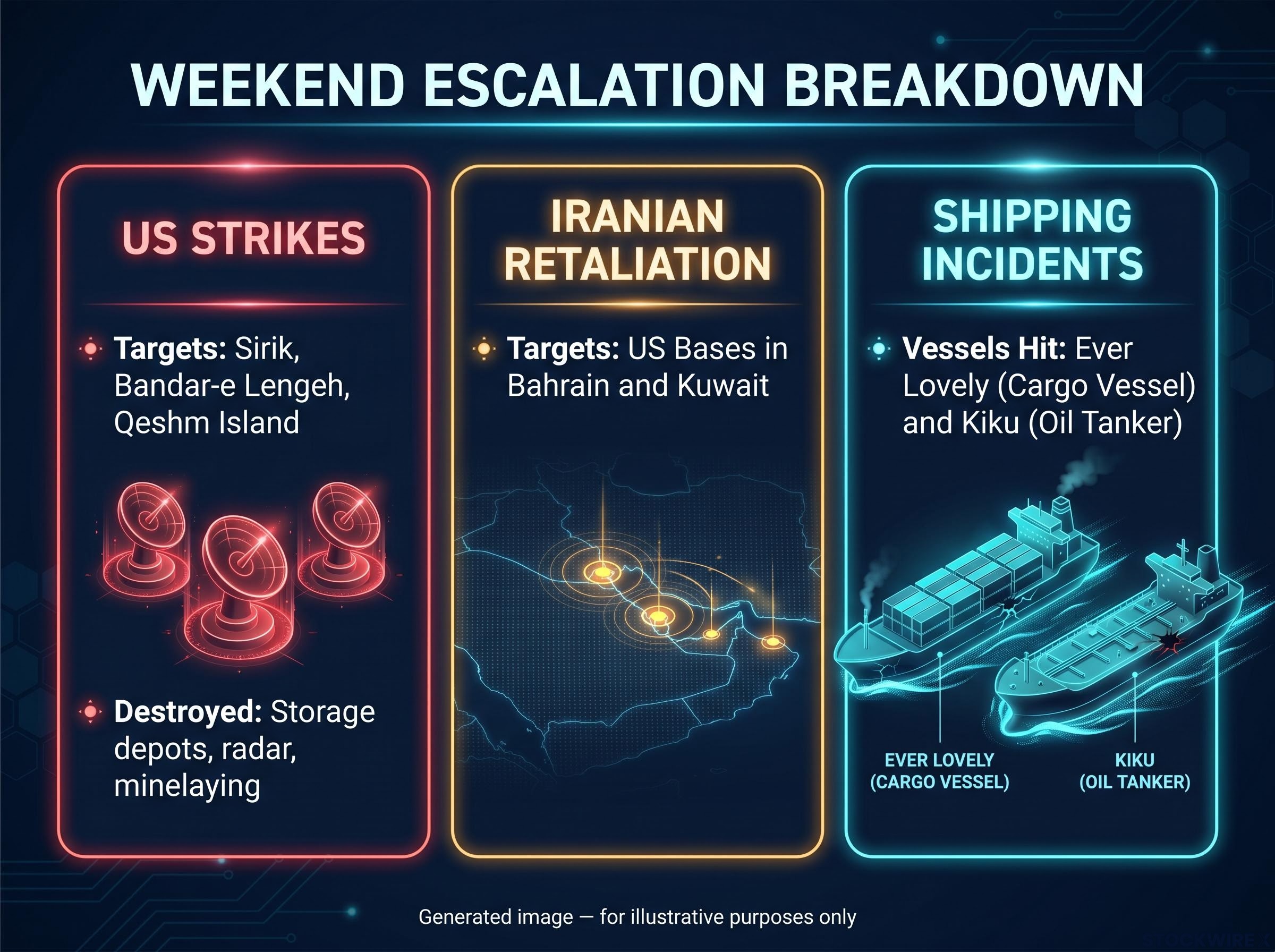
American forces targeted Iranian military infrastructure across three locations on Iran’s southern coastline: Sirik, Bandar-e Lengeh, and Qeshm Island. Washington targeted specific capability categories designed to threaten maritime traffic:
- US strikes: Storage depots for missiles and drones, radar installations and surveillance systems along the coast, and facilities supporting minelaying operations in waters near the strait
- Iranian retaliation: Coordinated missile and drone strikes against American bases in Bahrain and Kuwait, marking the most severe Iranian response since the 60-day MoU came into force
- Shipping incidents: Iranian one-way attack drones hit the cargo vessel Ever Lovely outbound through the strait and caused damage to the oil tanker Kiku while it was in transit
- Regional escalation: Israeli forces carried out fresh strikes in southern Lebanon, resulting in at least one death, coming just a day after a provisional ceasefire arrangement with Beirut had been announced
The target categories matter. Destroying minelaying capabilities and coastal radar is not a symbolic gesture. It is a direct attempt to degrade Iran’s ability to control which ships pass through the strait, and on what terms. The vessel names matter too. The market is no longer pricing a hypothetical scenario. It is pricing drone strikes on identified ships carrying real cargoes.
When big ASX news breaks, our subscribers know first
Why the Strait of Hormuz is the world’s most consequential maritime chokepoint
The Strait of Hormuz sits at the mouth of the Persian Gulf, a narrow passage that cannot be bypassed without adding enormous cost and time to shipping routes. Its significance is not symbolic. It is structural.
Roughly one-fifth to one-quarter of all global seaborne oil passes through the Strait of Hormuz, making it a single point of failure for the world’s energy supply chain.
That same passage carries a disproportionate share of global liquefied natural gas (LNG) exports, particularly from Qatar. Iran has previously fired on or harassed commercial vessels transiting the strait and has asserted control over which lanes are acceptable for passage. The pattern is well documented; the weekend’s attacks are the latest and most aggressive iteration.
What disruption to Qatar’s LNG exports would mean for Europe
Since Russian pipeline gas flows to Europe were curtailed, Qatari LNG has become a supply backbone for European energy security. Even marginal doubts about uninterrupted Qatari loadings can translate quickly into higher European gas price volatility.
This is why the Doha talks carry dual significance. They bear simultaneously on the US-Iran military situation and on the continuity of Qatar’s LNG export operations. War-risk insurance premia for tankers transiting the strait have already risen, and this is the mechanism that affects energy consumers globally: higher insurance costs raise delivered prices for oil and LNG even when physical flow is uninterrupted. Corporate input costs and household energy bills feel the effect before any formal blockade occurs.
How markets are reading the risk: a split verdict across asset classes
Monday’s market data does not tell a single story. It tells several, and the divergences between asset classes reveal more than any individual price move.
| Asset | Direction | Move | Market Signal |
|---|---|---|---|
| WTI crude | Up | +2.56% to US$69.23/bbl | Geopolitical risk premium applied, but not full-disruption pricing |
| Gold | Up | +1.49% to US$4,087.01/oz | Active safe-haven demand; institutions hedging against breakdown |
| Gold Miners ETF | Up | +1.76% to 77.0 | Miners tracking gold strength; sustained hedging flows |
| Silver Miners ETF | Up | +1.73% to 78.42 | Precious metals complex moving in lockstep with gold |
| Energy sector ETF | Down | -0.41% | Equity investors doubt durability of crude spike |
| Copper | Down | -0.79% to US$6.10 | Growth-anxiety barometer weakening |
| Copper Miners ETF | Down | -0.39% | Industrial metals sentiment softening |
| Uranium ETF | Down | -0.75% | Broader energy-transition complex under pressure |
| Steel ETF | Down | -1.89% | Cyclical weakness reflecting macro growth concerns |
| Strategic Metals ETF | Down | -3.00% | Capex-sensitive assets pricing geopolitical drag |
| Lithium and Battery Tech ETF | Down | -3.21% | Sharpest sell-off; transition metals absorbing growth fears |
The most counterintuitive signal in Monday’s data: crude rose 2.56% while the energy sector ETF fell 0.41%. Equity investors are pricing the oil spike as temporary and operationally complicated, not structural. For that view to shift, the market would need evidence that physical disruption is lasting, not just that geopolitical rhetoric is elevated.
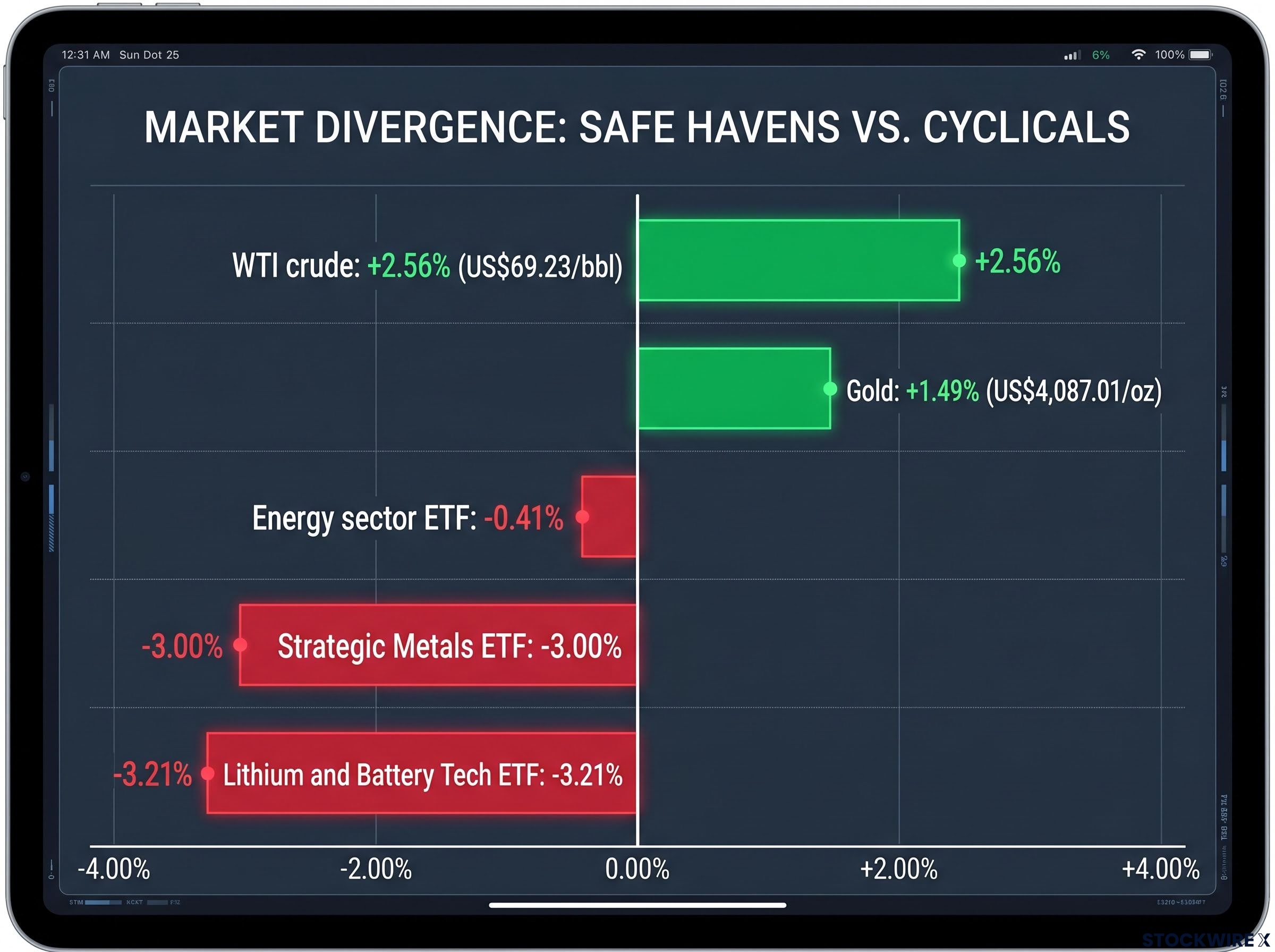
The weakness across copper, lithium, steel, and strategic metals is a separate signal entirely. These assets are functioning as a growth-anxiety barometer, pricing the probability that renewed Middle East risk weighs on global investment and industrial activity. Tracking crude alone misses half the picture.
Wednesday’s Doha talks: the binary that defines the next move
Both US and Iranian representatives are travelling to Doha under the 60-day MoU framework. Wednesday’s meeting is not background diplomacy. It is a market-moving event with two clearly defined outcomes, each carrying specific asset-price consequences.
| Scenario | Market Implications |
|---|---|
| Talks succeed: constructive recommitment to MoU, potentially including explicit shipping-lane guarantees | Weekend risk premium in crude deflates toward pre-escalation levels; tanker insurance pressure eases; gold pulls back as hedge demand fades; implied volatility compresses |
| Talks fail: delayed, downgraded, or acrimonious meeting | WTI could push toward US$75-80 as markets begin pricing more durable supply disruption; gold and gold miners extend gains; volatility spikes across energy-linked indices |
Gold and gold miners’ strength ahead of Wednesday is itself a signal. Large investors are still adding geopolitical hedges, not reducing them. That tells you the institutional consensus is not yet confident in de-escalation.
If you hold energy equities, crude futures, or commodities exposure, Wednesday is a dates-in-the-diary event. The meeting’s outcome could materially reprice positions within hours of becoming clear.
Five signals to watch before and during the Qatar meeting
Rather than waiting for Wednesday’s result in a vacuum, five monitorable signals will indicate which direction the binary is leaning in real time:
- Doha meeting diplomatic tone: Whether the meeting proceeds on schedule with senior representation and whether any framework includes explicit shipping-lane guarantees. Format and seniority matter as much as statements.
- Further attacks on commercial shipping: Any additional drone, missile, or warning-shot incidents in or near the strait, including AIS tracking pattern changes and insurance advisory updates, would signal that Tehran is using maritime risk as leverage even while talks are pending.
- Israeli strikes in Lebanon or Syria: Israel has already resumed Lebanon strikes concurrent with this crisis. A widening conflict theatre could force Iranian proxy responses and raise pressure on Washington, complicating the diplomatic track.
- US political signalling: White House, Pentagon, and State Department language on what constitutes a ceasefire violation, particularly any shift toward threats targeting Iranian export infrastructure, would be read as bullish for crude and volatility.
- Gold and implied volatility behaviour: Continued gold strength into Wednesday indicates ongoing institutional hedging. A gold pullback signals growing confidence in temporary de-escalation.
Gold is the cleanest geopolitical indicator available before Wednesday. It carries no operational exposure to specific shipping routes or sanctions regimes. Its direction into the talks will tell you where large capital is positioning.
Each of these signals carries directional weight. A shift in any one of them tells you something specific about which way the binary is leaning, giving you time to consider adjustments before a major repricing occurs.
What the next 48 hours change, and what they do not
The market read as of Monday morning is internally consistent once you see the layers. Crude and gold are pricing elevated but still containable risk. Cyclicals and transition metals are pricing macro growth anxiety. Both things can be true simultaneously.
The energy equities versus crude divergence remains the signal to watch for a shift in market conviction. If equity investors begin closing the gap by buying energy stocks, it signals growing belief that the oil move is structural rather than transient. That gap has not closed yet.
Three positioning themes matter most heading into Wednesday:
- Crude asymmetry around diplomacy headlines: The failed-talks scenario (WTI toward US$75-80) carries more absolute dollar upside than the successful-talks scenario carries downside, making directional bets particularly sensitive to headline risk
- Energy equities versus crude divergence: The gap between rising crude and falling energy stocks is the market’s way of saying “prove it.” Closing that gap is the signal that institutional conviction has shifted
- Gold as a geopolitical hedge: Gold’s lack of operational exposure to shipping routes makes it a more straightforward hedge on further escalation than crude itself, and its downside case (successful de-escalation) correlates with the downside case for crude longs
The binary nature of Wednesday means both upside and downside volatility remain live. Position sizing and optionality, particularly through limited-risk option structures around crude and related indices, matter more than directional conviction right now.
Wednesday does not end this story either way. A successful meeting compresses near-term risk but does not eliminate the structural vulnerability of a chokepoint that carries a quarter of the world’s seaborne oil. A failed meeting opens a new chapter entirely. The Strait of Hormuz’s vulnerability predates this weekend and will outlast the Doha talks regardless of result.
This article is for informational purposes only and should not be considered financial advice. Investors should conduct their own research and consult with financial professionals before making investment decisions. Past performance does not guarantee future results. These statements are speculative and subject to change based on market developments and geopolitical conditions.