
Domino’s Falls 9.6% to 52-Week Low After Q1 Miss on All Metrics
15 hrs ago


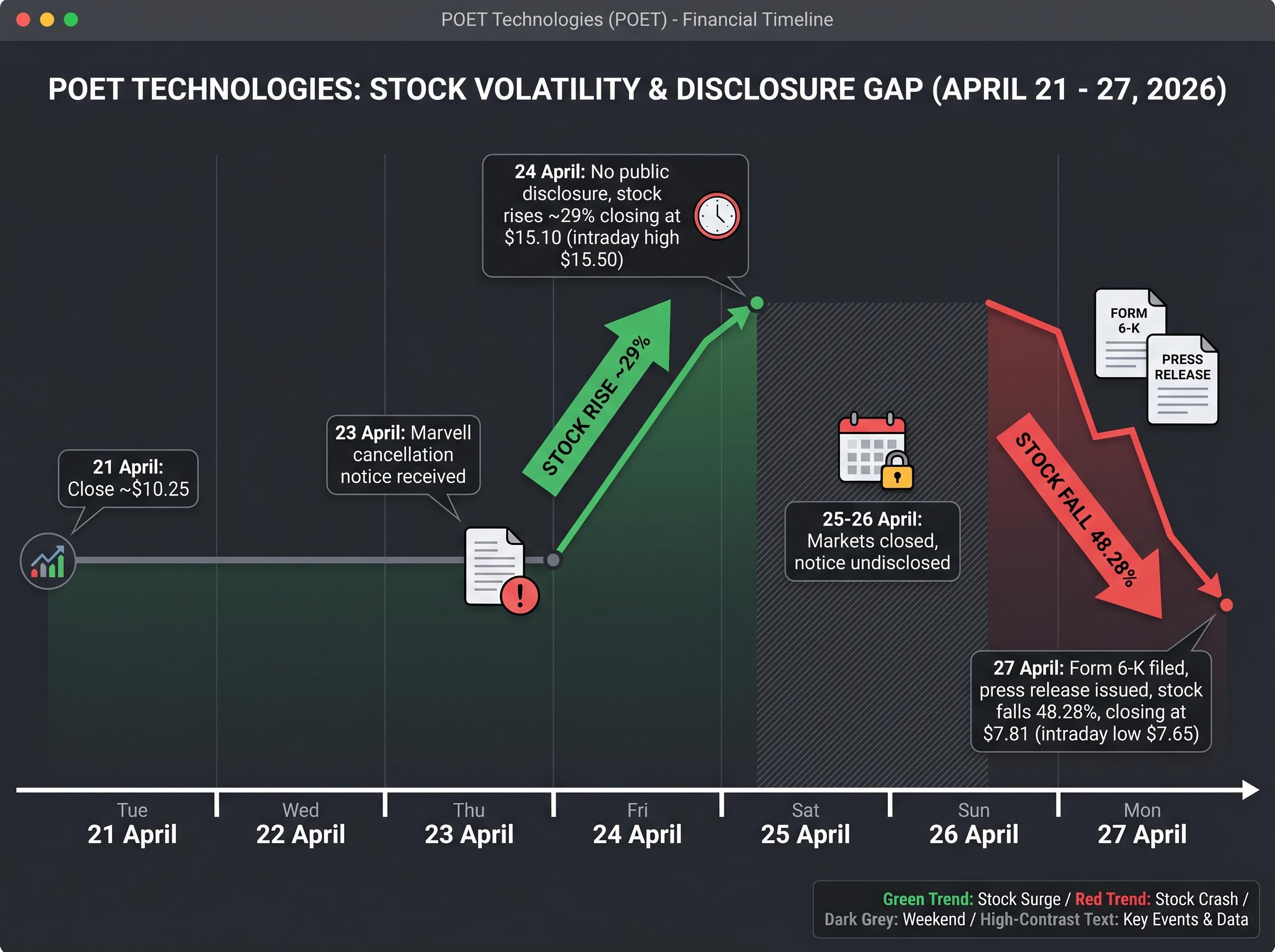
POET Technologies shares fell 48.28% on 27 April 2026, the steepest single-day decline in the company’s recorded stock history, erasing nearly half its market value in a session that opened with retail investors already trapped on the wrong side of the trade. The collapse followed a weekend disclosure that Marvell Technology had cancelled all purchase orders tied to its Celestial AI acquisition, citing alleged confidentiality violations by POET. The cancellation notice arrived at POET on Thursday 23 April, yet no public disclosure was made until Monday 27 April, a gap that allowed the stock to surge 29% on Friday with the information still withheld. What follows is a full account of the crash, the cancellation mechanics, the disclosure controversy, what business remains for POET, and the analyst warnings that preceded the collapse.
The numbers told the story before any explanation arrived. POET opened Monday’s session in freefall and never recovered, closing at $7.81 after trading as low as $7.65 intraday.
Dow Jones Market Data confirmed the 48.28% single-day decline as the largest in POET’s recorded history, with comparable lows reaching back to 2011.
The crash erased a rally that had made POET one of the most watched names in AI-adjacent hardware. From its 21 April close of approximately $10.25 to its 24 April close of $15.10, the stock had gained roughly 47.3%, peaking at an intraday high of $15.50. Some calculations placed the broader preceding surge at approximately 108% from an earlier base the same week.
Key price data from the crash:
For investors tracking AI infrastructure names, the velocity matters as much as the headline figure. The loss was amplified by the rally that preceded it, and that rally occurred while material negative information had already been received internally by the company.
POET confirmed in its 27 April disclosure that one commercial relationship survived the Marvell cancellation. A separate, unidentified customer holds an active purchase order valued at approximately $5 million, unaffected by the Celestial AI fallout.
Before the crash, CFO Tom Mika referenced Foxconn and Luxshare as potential sources of additional orders during investor commentary the week of 21 April. Those discussions remain pending, with no confirmed orders announced as of 27 April.
Remaining business assets at a glance:
POET’s Optical Interposer platform integrates electronic and photonic (light-based) components on a single chip, enabling faster data transfer with lower power consumption inside data centres. As AI workloads demand higher bandwidth between processors, the need for optical interconnects, which move data using light rather than electrical signals, has grown substantially. That demand is what underpinned POET’s commercial thesis and attracted partnership interest from companies building AI hardware infrastructure.
POET’s commercial thesis was built on the same demand narrative that drove semiconductor ETF inflows to a record $5.45 billion in April 2026, with institutional investors pouring capital into the AI infrastructure supercycle on the expectation that data-centre bandwidth requirements would sustain multi-year hardware spend. That context explains both why the Celestial AI partnership attracted so much investor attention and why its cancellation carried such disproportionate weight.
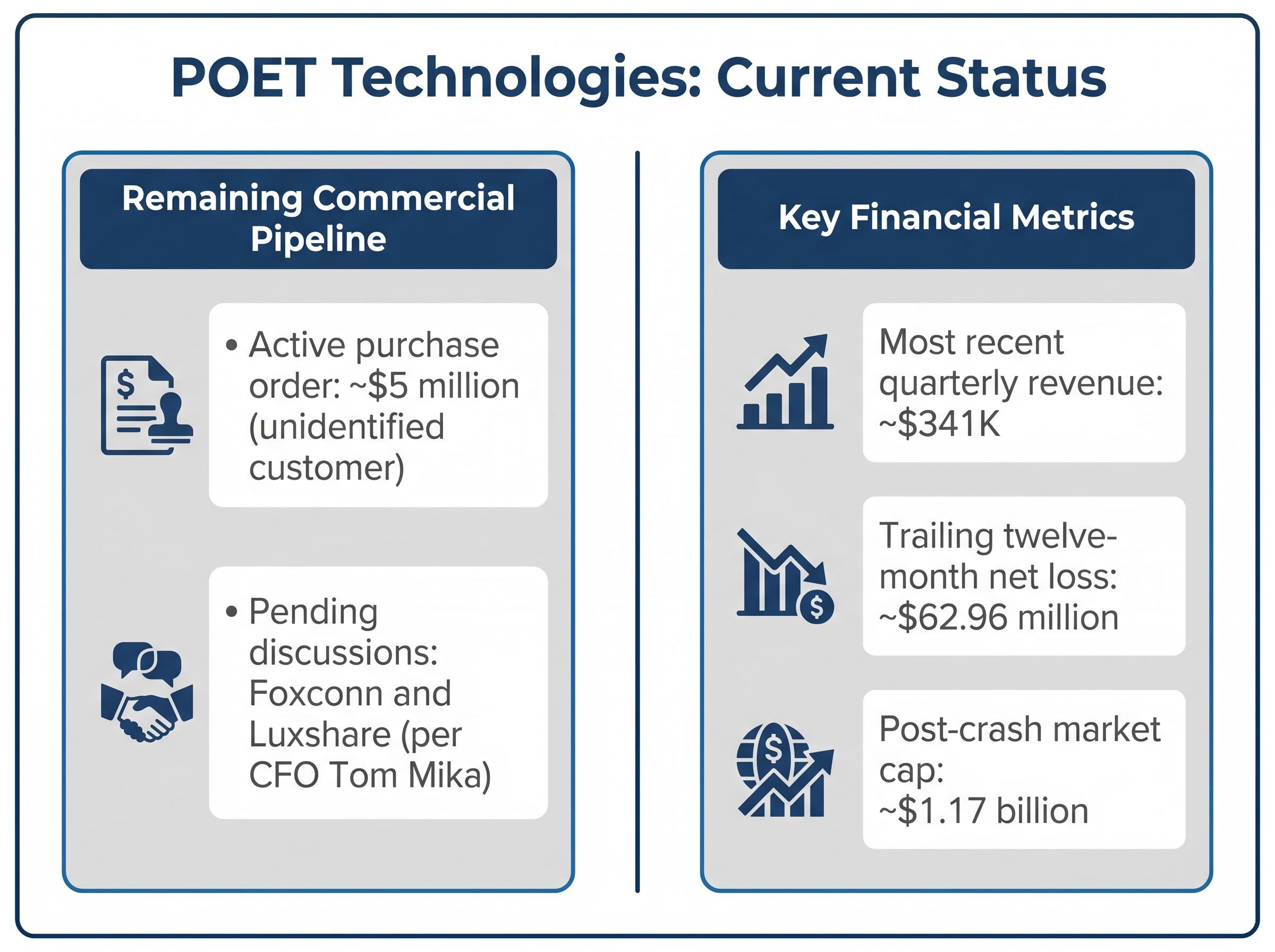
The $5 million active order and the Foxconn and Luxshare pipeline represent the entire visible commercial runway following the cancellation. Understanding their scale relative to the company’s quarterly burn rate, which the financial data in later sections quantifies, is the baseline for any investor evaluating what comes next.
The cancellation followed a specific sequence, and understanding the order of events matters for assessing what is known, what is contested, and what remains unanswered.
The orders cancelled included initial 2023 production units and shipping-detail-related orders. Marvell cited alleged confidentiality violations by POET as the stated justification.
Celestial AI developed Photonic Fabric optical interconnect technology designed for high-bandwidth, low-latency AI connectivity in data-centre environments. Its integration with POET’s Optical Interposer platform represented a meaningful commercial opportunity, pairing POET’s chip-scale photonic manufacturing with Celestial AI’s interconnect architecture for AI hardware applications.
No public statement from Marvell elaborating on the nature of the alleged violations has been made available. No independent confirmation of the specific breach details exists beyond POET’s own disclosure. That absence leaves investors unable to independently assess whether the confidentiality allegation reflects a remediable misstep or a more fundamental breakdown in the commercial relationship.
The disclosure timeline speaks for itself when laid out in sequence:
On Friday 24 April, POET shares surged 29% while the Marvell cancellation notice, received the previous day, sat undisclosed.
Retail investor reaction on Reddit forums dedicated to POET focused less on the business loss itself and more on management transparency and CFO conduct. The disclosure gap, not the partnership failure, became the primary source of frustration.
As of 27 April 2026, no formal SEC investigation, class-action lawsuit, or regulatory proceeding related to the disclosure timing has been announced. Whether the delay constitutes a legal violation or a governance failure remains unresolved. For retail investors who bought into the 24 April rally, the practical effect was identical: they took positions without access to information the company had already received.
The SEC disclosure obligations for foreign private issuers filing Form 6-K require companies to furnish material information promptly upon its occurrence or publication, a standard that sits at the centre of investor scrutiny over the four-day gap between POET receiving the Marvell cancellation notice and its Monday morning filing.
The 27 April crash did not arrive without prior signals. Wall Street’s consensus view and a short-seller report had both flagged concerns in the weeks before the Marvell cancellation became public.
Wall Street’s consensus Sell rating carried a $8.00 price target, a level that aligned almost exactly with POET’s $7.81 post-crash close on 27 April.
Wolfpack Research published a short-seller report in mid-April 2026 that labelled POET a stock promotion, flagged Passive Foreign Investment Company (PFIC) tax risk for US investors, and cited what it described as repeated business model shifts. POET countered that it does not consider itself a PFIC and announced plans to relocate its headquarters from Canada to the United States to pre-empt any further complications on that front.
| Metric | Value |
|---|---|
| Most recent quarterly revenue | ~$341K |
| Trailing twelve-month net loss | ~$62.96 million |
| Recent quarterly EPS | ~-$0.32 |
| Short interest (15 April 2026) | 9.45% of float |
| Analyst consensus price target | $8.00 (Sell) |
For US retail investors specifically, the PFIC tax risk flagged by Wolfpack warrants independent verification with a tax adviser regardless of POET’s stated position. PFIC classification can significantly alter after-tax returns on gains and dividends, and the company’s current listing on both NASDAQ and the TSX Venture Exchange places it in a jurisdiction category where the designation remains a live question.
The IRS Form 8621 reporting requirements for shareholders of a Passive Foreign Investment Company impose excess distribution tax treatment and mark-to-market or qualified electing fund elections that can substantially alter after-tax returns, which is why the PFIC question flagged by Wolfpack Research warrants independent tax advice regardless of POET’s stated position on its own classification.
The 9.45% short interest as of 15 April, near record highs, indicated that institutional scepticism was already elevated before the Marvell cancellation became public. The fundamental picture, quarterly revenue of $341K against annualised losses exceeding $62 million, had been visible in POET’s filings throughout.
The sequence is clear: a record single-day stock collapse triggered by a cancelled AI partnership, a disputed disclosure timeline that allowed a 29% rally to occur on information the company had already received, and a fundamental risk profile that Wall Street had flagged with a Sell rating before the crash arrived.
Several questions remain unresolved. Marvell has made no public statement elaborating on the alleged confidentiality violations. No regulatory or legal action related to the disclosure delay has been confirmed. The commercial pipeline now consists of a single $5 million order from an unidentified customer and pending conversations with Foxconn and Luxshare that have not yet produced confirmed commitments.
Investors tracking POET should watch for three developments: any SEC response to the 23 April to 27 April disclosure gap, any Marvell statement clarifying the nature of the confidentiality allegation, and whether the Foxconn or Luxshare discussions materialise into confirmed purchase orders.
Investors deciding whether POET’s remaining platform has any residual investment case will find our deep-dive into how equity markets price loss-making technology companies useful context, examining how markets distinguish between growth-driven losses and operational failures, with data on how long unprofitable technology companies have historically retained speculative value before fundamental reality asserted itself.
This article is for informational purposes only and should not be considered financial advice. Investors should conduct their own research and consult with financial professionals before making investment decisions.
—
POET Technologies stock fell 48.28% after Marvell Technology cancelled all purchase orders tied to its Celestial AI acquisition, citing alleged confidentiality violations by POET. The cancellation was received on 23 April but not disclosed publicly until 27 April, triggering the record single-day decline.
POET received Marvell's cancellation notice on Thursday 23 April 2026 but did not file a Form 6-K with the SEC or issue a press release until Monday 27 April, a gap during which the stock surged approximately 29% on Friday 24 April. Investors who bought during that rally did so without access to material negative information the company had already received.
Following the cancellation, POET confirmed a single active purchase order valued at approximately $5 million from an unidentified customer, along with pending but unconfirmed discussions with Foxconn and Luxshare referenced by CFO Tom Mika before the crash.
Wolfpack Research published a short-seller report in mid-April 2026 labelling POET a stock promotion, flagging Passive Foreign Investment Company (PFIC) tax risk for US investors, and citing repeated business model shifts. POET disputed the PFIC classification and announced plans to relocate its headquarters from Canada to the United States.
Key developments to monitor include any SEC response to the four-day disclosure gap between 23 April and 27 April, any public statement from Marvell clarifying the alleged confidentiality violations, and whether pending discussions with Foxconn or Luxshare result in confirmed purchase orders.


