
Indian Gold Demand Tilts Toward ETFs as Prices Surge 50%

Key Takeaways
- Investment-oriented gold products now account for 40-45% of India's total gold consumption, up from a historical 30-35%, marking the most significant structural shift in the market in decades.
- Gold ETFs recorded all-time record inflows of INR 430 billion in 2025, with the investor base growing 60% year-on-year to 10.2 million folios as market participation democratises.
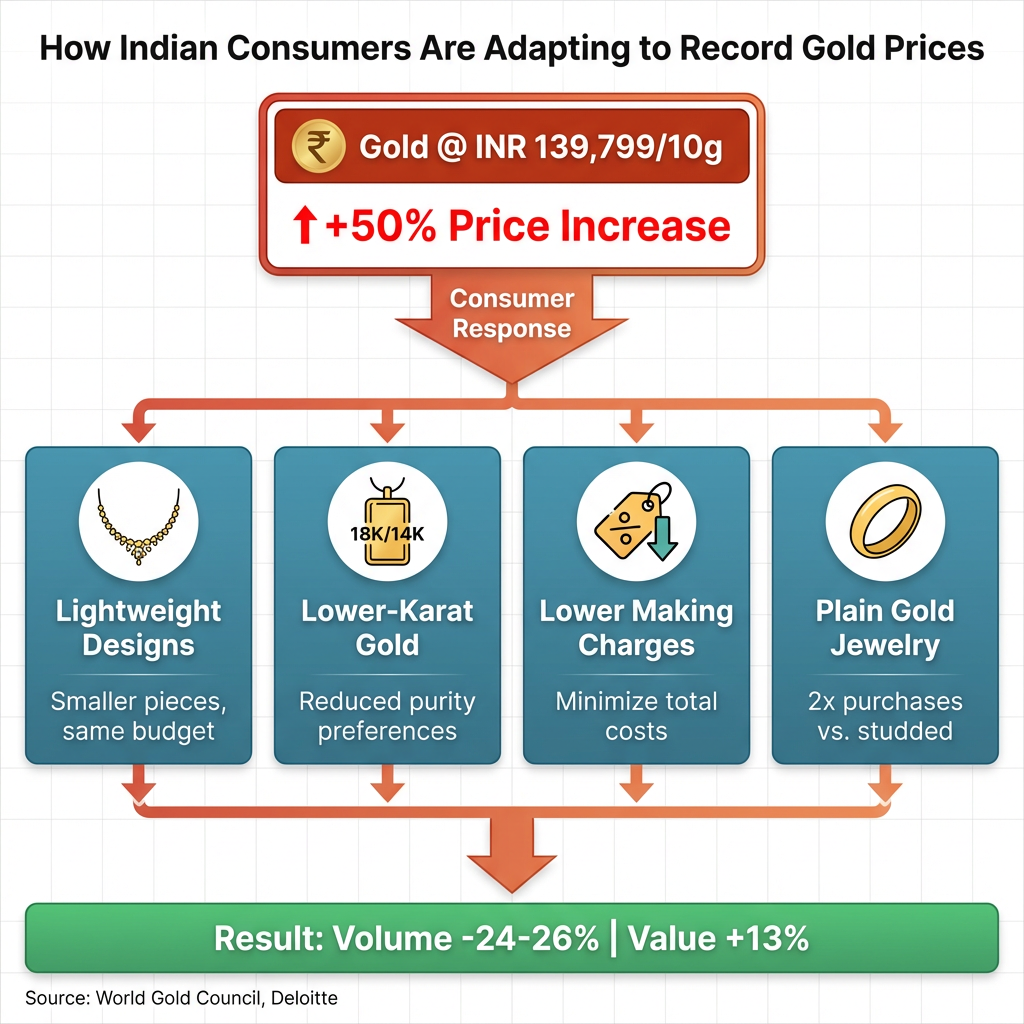
- Jewelry demand fell 24-26% in volume during H1 FY2026, yet value rose 13% as consumers adapted through lighter designs, lower-karat purchases, and plain gold jewelry rather than exiting the market.
- Digital gold platforms tripled transaction volumes to approximately 13.5 tonnes annually, with monthly transaction value surging from INR 8 billion to INR 21 billion on UPI-based platforms.
- With 3.8 million new ETF investors added in 2025 and deepening digital penetration, experts characterise the investment demand shift as structural rather than cyclical, carrying long-term implications for global gold flows given India's 85-88% import dependency.
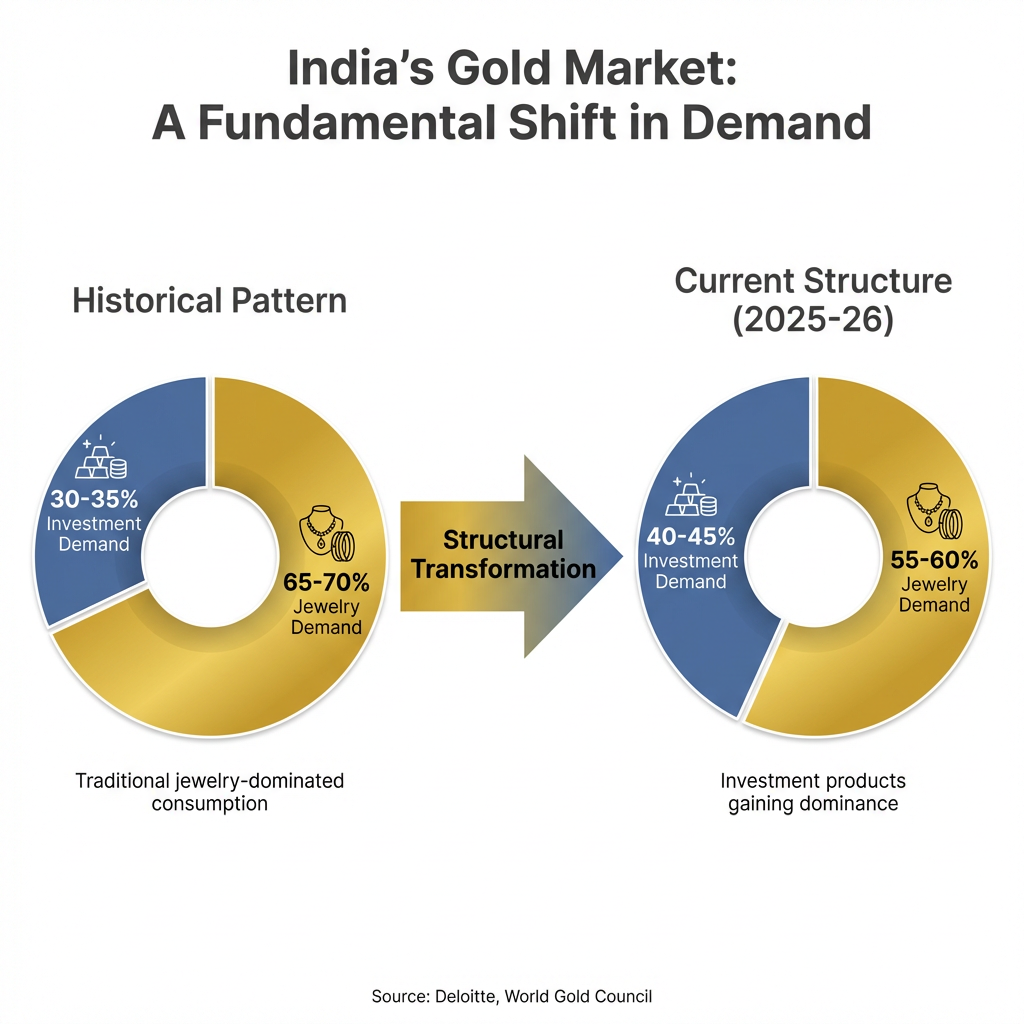
India’s gold market is undergoing its most significant structural transformation in decades. Investment-oriented products now account for 40-45% of total consumption, up from 30-35% historically, according to Deloitte’s Praveen Govindu. This shift represents a fundamental departure from the jewelry-dominated demand patterns that have characterised the world’s second-largest gold market for generations.
Gold prices surged 33% in FY2025 and exceeded 50% in H1 FY2026, reaching INR 139,799 per 10g. This sustained price appreciation is fundamentally altering consumption patterns, driving consumers toward investment products whilst reshaping traditional jewelry purchasing behaviour.
This analysis examines the investment product surge across ETFs, bars, coins, and digital platforms; the jewelry market’s adaptive response to price pressure; and the structural drivers reshaping Indian gold demand. Expert perspectives from the World Gold Council, ICRA-ASSOCHAM, and Deloitte inform the forward outlook for this globally significant market.
Understanding India’s Gold Demand Composition
India occupies a unique position as the world’s second-largest gold consumer, with 85-88% import dependency and approximately 87% of households owning gold. This consumption scale makes shifts in demand composition globally significant, influencing international gold flows and pricing dynamics.
The World Gold Council’s Gold Demand Trends quarterly report tracks granular consumption patterns across jewelry, bars and coins, ETFs, and central bank purchases, providing the industry-standard methodology for measuring Indian gold demand composition and structural shifts.
Gold demand in India divides into two primary categories, each with distinct characteristics:
- Jewelry demand: Ornamental purchases, wedding gold, and gifting. Historically comprised 65-70% of total Indian gold demand.
- Investment demand: Gold ETFs, bars and coins, digital gold platforms, and sovereign gold bonds. Traditionally represented 30-35% of consumption.
The distinction between these categories matters because jewelry demand tends to be price-inelastic and culturally driven, whilst investment demand responds to financial market dynamics and safe-haven sentiment. The shift between categories signals changing consumer psychology, moving from ornamental and cultural motivations toward financial asset accumulation.
When big ASX news breaks, our subscribers know first
Record-Breaking Investment Product Growth
Gold ETFs recorded their strongest performance in history during 2025, with inflows reaching INR 430 billion (US$4.9 billion, 37 tonnes). December 2025 alone added INR 116 billion, marking an unprecedented eighth consecutive month of gains. This sustained momentum reflects structural demand rather than temporary market timing.
| Investment Product | 2025 Performance | Key Metric |
|---|---|---|
| Gold ETFs | Record INR 430bn inflows | AUM reached INR 1,279bn |
| Bars & Coins | Up 15% volume H1 FY2026 | Up 73% in value late 2025 |
| Digital Gold | 3x transaction growth | ~13.5t annual volume |
| Investor Base | Folios up 60% YoY | 3.8 million new investors |
The investor base expansion reveals market democratisation beyond traditional gold buyers. ETF folios reached 10.2 million (up 60% year-on-year), whilst digital gold’s UPI-based platform growth surged from INR 8 billion to INR 21 billion in monthly transaction value. These figures represent 3.8 million new folios added in 2025, indicating genuine market expansion rather than existing buyers shifting between products.
> ICRA-ASSOCHAM Report Finding
> A structural shift has been identified in Indian and global gold markets, with investment-led demand now dominating. This transformation is driven by high prices and geopolitical uncertainties reshaping consumer behaviour.
Jewelry Market Adaptation Under Price Pressure
Jewelry demand fell 24-26% in volume during H1 FY2026 and late 2025, yet value rose 13% as consumer budgets held firm. According to the World Gold Council’s Sachin Jain, this volume-value divergence reflects adaptation rather than abandonment of gold purchases. Consumers are maintaining their gold expenditure whilst adjusting purchasing patterns to accommodate elevated prices.
Consumer adaptation strategies include:
- Lightweight designs replacing heavier traditional pieces to maintain affordability
- Lower-karat gold (18K, 14K) gaining market share, as noted by Deloitte’s Praveen Govindu
- Reduced making charges preferred to lower total transaction costs
- Plain gold jewelry purchases nearly doubled year-on-year versus studded or elaborately crafted pieces
Listed jewelry retailers reported 37-51% year-on-year revenue growth in October-December 2025. This price-led growth offset volume declines, indicating category resilience despite the structural demand shift toward investment products.
Deloitte’s Praveen Govindu highlighted that Indian consumers are increasingly choosing 18-karat and 14-karat jewelry rather than higher-purity options due to elevated prices. This behavioural change represents a departure from traditional preferences and may persist beyond the current price cycle, permanently altering the jewelry market’s product composition.
The next major ASX story will hit our subscribers first
Drivers Behind the Structural Shift
With gold at INR 139,799 per 10g following 33% and 50%+ annual gains, jewelry purchases at traditional weights have become prohibitive for middle-class buyers. Investment products offer gold exposure at accessible entry points, from fractional digital gold purchases to single-gram bars, democratising access beyond the jewelry market’s higher transaction minimums.
Multiple reinforcing factors drive the investment shift:
- Price appreciation making traditional jewelry weights unaffordable for typical household budgets
- Geopolitical uncertainty enhancing gold’s safe-haven appeal, as identified by ICRA-ASSOCHAM
- Digital accessibility via UPI-based platforms lowering investment barriers and transaction friction
- Generational shift toward viewing gold as a financial asset rather than purely ornamental
- Inflation hedging driving retail investment demand amid broader macroeconomic concerns
Recycling declined 19% in 2025 despite favorable prices, suggesting holders view current price levels as sustainable rather than peak-selling opportunities. The Reserve Bank of India’s slowdown to only 4 tonnes added in 2025 reflects broader institutional reassessment of gold’s pricing trajectory and portfolio positioning.
The Reserve Bank of India’s Report on Management of Foreign Exchange Reserves provides detailed quarterly data on central bank gold holdings, purchasing activity, and foreign exchange policy framework governing India’s official sector gold accumulation.
Whilst price normalisation could restore some jewelry demand, digital platform penetration and the expanded investor base suggest lasting structural changes. The 3.8 million new ETF investors represent a permanently expanded gold investment constituency unlikely to reverse entirely even with price corrections.
Outlook for Indian Gold Demand
The World Gold Council’s Sachin Jain expects jewelry demand to rebound if and when prices stabilise, whilst ICRA-ASSOCHAM characterises the investment shift as structural rather than cyclical. These perspectives suggest continued investment dominance with potential for jewelry recovery, though the 40-45% investment share likely represents an elevated baseline.
Deloitte’s Praveen Govindu characterises gold expenditure as bifurcating into distinct categories, with investment channels gaining permanent market share. This thesis suggests the current 40-45% investment allocation may represent a new equilibrium rather than a temporary spike awaiting mean reversion.
Key variables to monitor include gold price trajectory, digital platform expansion and regulatory developments, the regulatory environment for gold investment products, and wedding season demand patterns. These factors will determine whether investment share stabilises at current levels, continues rising, or moderates toward historical averages.
India’s gold market transformation carries global significance given its consumption scale and 85-88% import dependency. The shift toward investment-oriented demand may influence international gold flows, pricing dynamics, and supply chain positioning as the market’s composition changes. This structural evolution extends beyond domestic implications to affect global gold market mechanics.
This article is for informational purposes only and should not be considered financial advice. Investors should conduct their own research and consult with financial professionals before making investment decisions.
Frequently Asked Questions
What is driving the shift in Indian gold demand toward investment products?
A combination of sustained gold price surges exceeding 50% in H1 FY2026, geopolitical uncertainty, digital platform accessibility via UPI, and a generational shift toward viewing gold as a financial asset are collectively driving Indian consumers away from jewelry and toward ETFs, bars, coins, and digital gold.
How much have Gold ETF inflows grown in India in 2025?
Gold ETFs in India recorded record inflows of INR 430 billion (approximately US$4.9 billion or 37 tonnes) in 2025, with the investor base expanding by 3.8 million new folios, pushing total ETF folios to 10.2 million — a 60% year-on-year increase.
How is the Indian jewelry market responding to high gold prices?
Indian jewelry demand fell 24-26% in volume during H1 FY2026, but consumers are adapting by purchasing lightweight designs, lower-karat gold (18K and 14K), and plain gold pieces, while listed jewelry retailers still reported 37-51% year-on-year revenue growth driven by higher prices.
Is the structural shift in Indian gold demand permanent or cyclical?
ICRA-ASSOCHAM characterises the investment-led demand shift as structural rather than cyclical, and with 3.8 million new ETF investors added in 2025 and deepening digital platform penetration, the elevated 40-45% investment share likely represents a new long-term baseline even if prices stabilise.
What is the current gold price in India and how has it impacted consumption?
Gold prices in India reached INR 139,799 per 10g following gains of 33% in FY2025 and over 50% in H1 FY2026, making traditional jewelry weights unaffordable for many middle-class buyers and accelerating the shift toward lower-entry-point investment products like digital gold and ETFs.


