
Mercury delivers record FY26 EBITDAF of $1,068m, beats guidance and lifts FY30 target
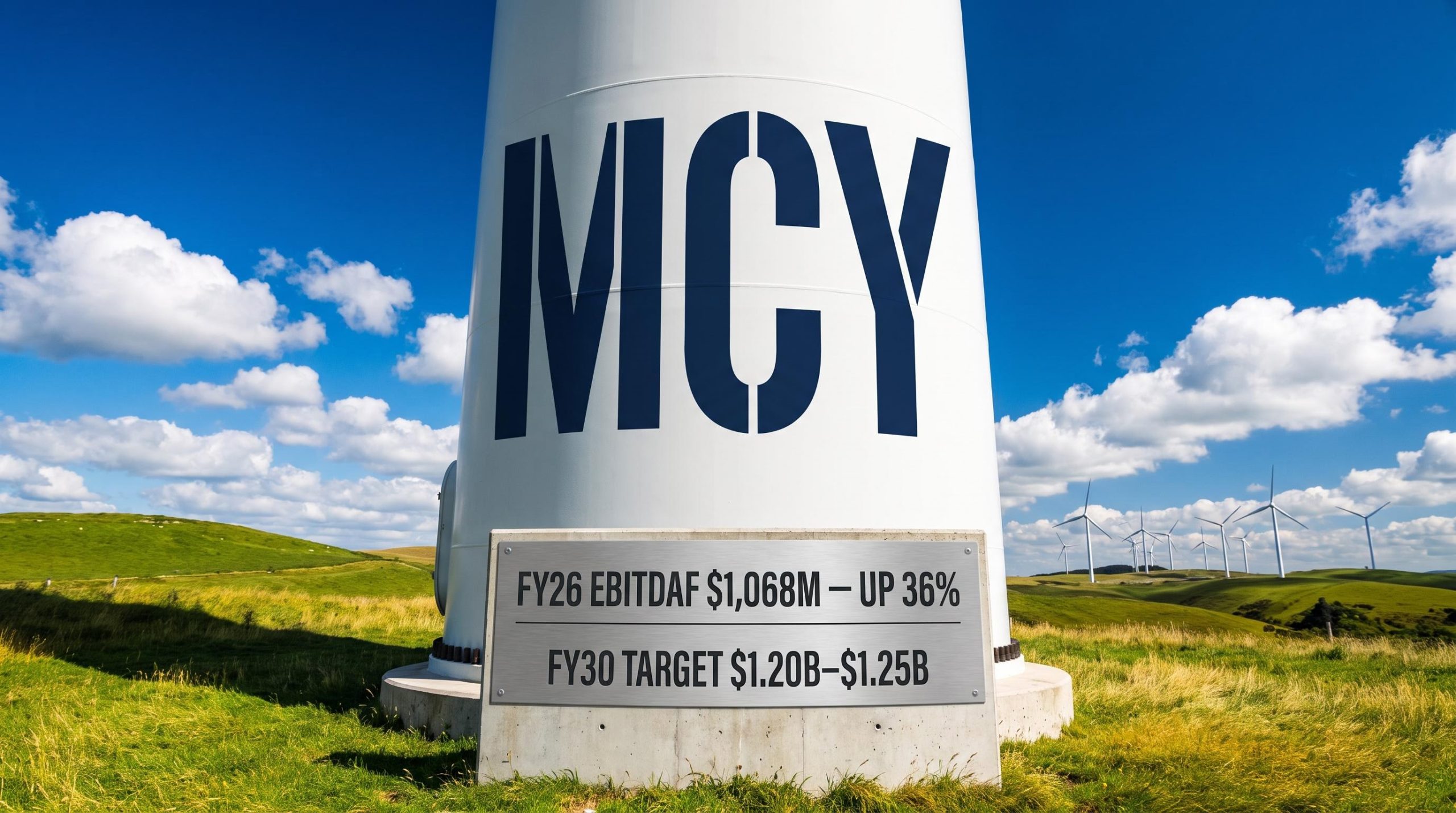
In its FY26 full year results presentation dated 18 August 2026, Mercury NZ reported record EBITDAF of $1,068m, up 36% on FY25’s $786m and $18m above its upgraded guidance (initial guidance was $1,000m).
Management outlined three “new today” items: a Final Investment Decision (FID) achieved at Puke Kapo Hau, FY27 EBITDAF guidance of $1,075m, and an FY30 target raised to $1.20b–$1.25b.
Mercury declared an FY26 total dividend of 27 cps, up 13% and marking 18 consecutive years of ordinary dividend growth, with FY27 guidance of 29 cps. The narrative was one of strong delivery funding a record renewable investment cycle.
When big ASX news breaks, our subscribers know first
FY26 results snapshot — every guidance metric met or beaten
The full-year scorecard showed all guidance metrics met or beaten, with earnings, cashflow and generation all stepping higher.
| Metric | FY26 | FY25 | Change |
|---|---|---|---|
| EBITDAF | $1,068m | $786m | +36% |
| Operating cashflow | $762m | $483m | +58% |
| Total dividend | 27 cps | 24 cps | +13% |
| Operating expenses | $370m | $396m | −6.6% (−10.2% real) |
| Generation | 9,070 GWh | 7,907 GWh | +15% |
| Safety (TRIFR) | 0.31 | 0.44 | Improved |
| Debt/EBITDA | ~2.0x | 2.5x | Improved |
| Total CAPEX | $710m | $485m | +46% |
Mercury reported zero fatality and high-severity health and safety incidents in FY26. Three new projects began generating during the period: OEC5, KD2 and Kaiwaikawe.
Higher generation and cost discipline drive the earnings step-up
Generation and cost drivers
The higher EBITDAF was driven by higher hydro generation, supported by strong 83rd percentile Waikato inflows, new geothermal and wind generation, and disciplined cost management.
Operating expenses were held at the $370m target, down $26m on FY25 despite ongoing inflationary pressure. Savings came primarily from employee costs (Generation $7m, Customer $6m) and lower asset maintenance. Higher yields were partly offset by lower wholesale prices.
Two-thirds of earnings reinvested
Mercury reinvested 66% ($710m) of FY26 EBITDAF into new and existing assets, reflecting continued growth investment within balance sheet guardrails.
-
Growth CAPEX of $560m, primarily KD2 wind ($300m), Kaiwaikawe ($178m) and OEC5 ($50m)
-
Debt/EBITDA reduced to 2.0x, inside the 2–3x BBB+ guardrails
-
$610m of undrawn committed facilities as at 30 June 2026
Three flagship renewable projects now generating
Management detailed three flagship projects delivered on time and on budget, together adding approximately 1.1TWh a year to the generation base.
-
OEC5 geothermal — first generation January 2026, delivered under budget, contributing approximately 390GWh annually.
-
Kaiwera Downs Stage 2 (KD2) wind — all 36 turbines erected and energised, contributing approximately 525GWh annually. Full generation is expected Q2 FY27 pending transformer #2 remediation, with output capped at 120MW in the interim.
-
Kaiwaikawe wind — first generation achieved in early July 2026, contributing approximately 221GWh annually, and on plan for full generation by December 2026.
What is EBITDAF and why the renewable build cycle matters
Reinvesting two-thirds of earnings into renewables matters to investors because it builds a higher future earnings base while staying within credit guardrails, funding growth without over-stretching the balance sheet.
Mercury commits capital through staged investment gates (IG1–IG4). Capital is only committed as projects clear technical, commercial and return checkpoints, reducing execution risk.
FID achieved at Puke Kapo Hau as WindPlatform drives costs down
Management announced an FID achieved at its August Board for Puke Kapo Hau, the Stage 2 expansion of the Mahinerangi Wind Farm, located west of Dunedin. Together with Stage 1, it is expected to be the largest wind farm in New Zealand. The name was gifted by Te Rūnanga o Ōtākou and means “the hill that catches the wind”.
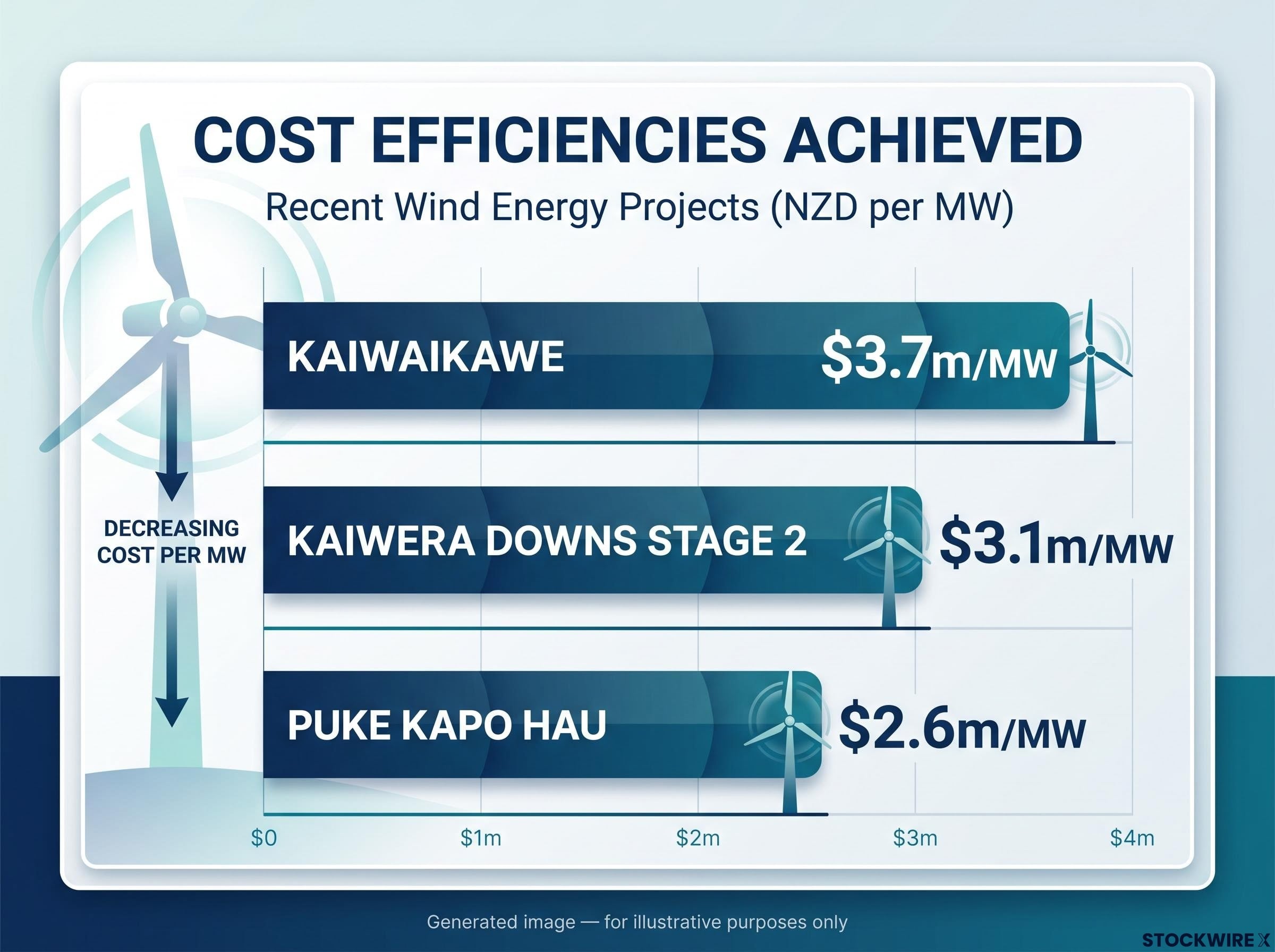
The 40-turbine project will add 192MW of capacity and generate approximately 533GWh annually. Its project cost of $2.6m/MW is down from KD2 at $3.1m/MW and Kaiwaikawe at $3.7m/MW, demonstrating repeatable WindPlatform capability driving cost down.
Puke Kapo Hau is the first Mercury project to receive approval through the fast-track consent process, granted in July 2026. The presentation outlined a timeline of civil work in Q2 FY27, first generation expected by Q4 FY28, and full generation expected by Q2 FY29.
| Project (at FID) | Capacity | P50 Yield | Project Cost |
|---|---|---|---|
| Puke Kapo Hau | 192MW | 533GWh pa | $2.6m/MW |
| Kaiwera Downs Stage 2 | 155MW | 525GWh pa | $3.1m/MW |
| Kaiwaikawe | 76.8MW | 221GWh pa | $3.7m/MW |
Presentation theme
“Delivery today. Disciplined growth tomorrow.”
A pipeline built for staged, disciplined growth
The presentation conveyed a growth roadmap in which options convert to earnings as demand firms and returns clear internal hurdles.
-
3.5TWh of new generation targeted by 2030, drawn from approximately 17TWh of total options, described as a leading NZ pipeline
-
87% of FY30 generation covered by retail and contracted demand, with new generation sequenced against demand rather than built ahead of it
-
GeoPlatform, described as NZ’s largest geothermal portfolio (up to 5TWh of options), with 1TWh in advanced feasibility and $75m Board-approved appraisal drilling (rig secured, drilling from Q4 FY27), first geothermal generation targeted 2030
Mercury’s GeoPlatform geothermal expansion strategy targets up to 5TWh of long-run options, with the $75m Board-approved drilling campaign representing the first committed capital step toward what management estimates as a $0.8-1.0 billion programme across Nga Tamariki and Rotokawa.
- Near-term pipeline including Whakamaru BESS (targeting FID H2 FY27), Waikokowai and Puketoi wind (feasibility and consenting)
Datagrid — a pathway to long-term demand
Mercury detailed an NZ$53m (US$30m) equity investment for a 12.7% minority stake in Datagrid Holding Group NZ, funded from existing facilities.
A 140MW / 15-year power purchase option creates a pathway to future demand and matching new generation. Management flagged that future capital remains optional and separately gated, with exposure limited.
The Datagrid NZ equity stake was structured alongside a separate 140MW power purchase option, giving Mercury a dual commercial relationship with the 360MW Southland data centre project and CEO Stew Hamilton a board seat providing early visibility on how AI-driven electricity demand develops in New Zealand.
Balance sheet strength and 18 years of dividend growth
Mercury reported Debt/EBITDA of 2.0x (down from 2.5x), inside the 2–3x BBB+ guardrails, with net debt of $2.4b and $610m of undrawn facilities. The company issued $250m MCY080 Green Bonds in April 2026, including $50m of oversubscriptions.
On the current plan, forecast leverage is expected to peak at around 2.6x over FY29–FY30 before declining, funding growth on the balance sheet.
The FY26 total dividend of 27 cps included a final dividend of 17 cps, up 13%, with a record date of 3 September 2026 and payment date of 30 September 2026. The dividend policy targets 70%–85% of Free Cash Flow on average over time, deliberately held at the lower end during the peak investment period.
Dividend settings under review
Management noted it will review its dividend policy and broader capital allocation settings over the next 12 months as the first major investment cycle nears completion and earnings and cashflow step up.
No outcome has been predetermined, and the current policy remains in place during the review. Progressive dividends remain a core part of shareholder returns.
FY27 guidance and a raised FY30 target
Mercury provided FY27 EBITDAF guidance of $1,075m, on 4.1TWh of hydro generation, subject to hydrological volatility, wholesale market conditions and any material adverse events.
FY27 ordinary dividend guidance was set at 29 cps (up 7.4%), with FY27 stay-in-business CAPEX guidance of $150m. Growth is expected to be driven by full-year contributions from OEC5, KD2 and Kaiwaikawe.
The FY30 EBITDAF target was raised to $1.20b–$1.25b, with the lower end lifted to $1.20b on increased confidence. Approximately 1.1TWh of delivered generation is expected to add around $100m by FY30, with Puke Kapo Hau the next material step (full generation expected Q2 FY29). The FY30 target assumes a $120–$130/MWh long-term wholesale price view in real FY27 dollars.
| Metric | FY26 Actual | FY27 Guidance | FY30 Target |
|---|---|---|---|
| EBITDAF | $1,068m | $1,075m | $1.20b–$1.25b |
| Ordinary dividend | 27 cps | 29 cps | — |
| SIB CAPEX | $150m | $150m | — |
The investment takeaway
Mercury enters FY27 with a stronger earnings base, with approximately 1.1TWh of new generation now in the base, a resilient contracted portfolio, disciplined capital allocation, and a raised FY30 target.
Diversification through geothermal and wind reduces dependence on hydro and weather. With El Niño presenting a different risk profile to FY25, more generation, firming cover through the Huntly Firming Option (50MW to Mercury) and a substantially contracted FY27–FY28 book are positioned to improve resilience. The presentation’s theme captured the arc: delivery today, disciplined growth tomorrow.
Don’t Miss the Next Utilities Sector Mover
Big News Blast delivers FREE breaking ASX news straight to your inbox within minutes of release, complete with in-depth analysis so the work is already done. Join 20,000+ subscribers who stay ahead of market-moving announcements across utilities and beyond. Click the “Free Alerts” button at Big News Blast to get started today.