
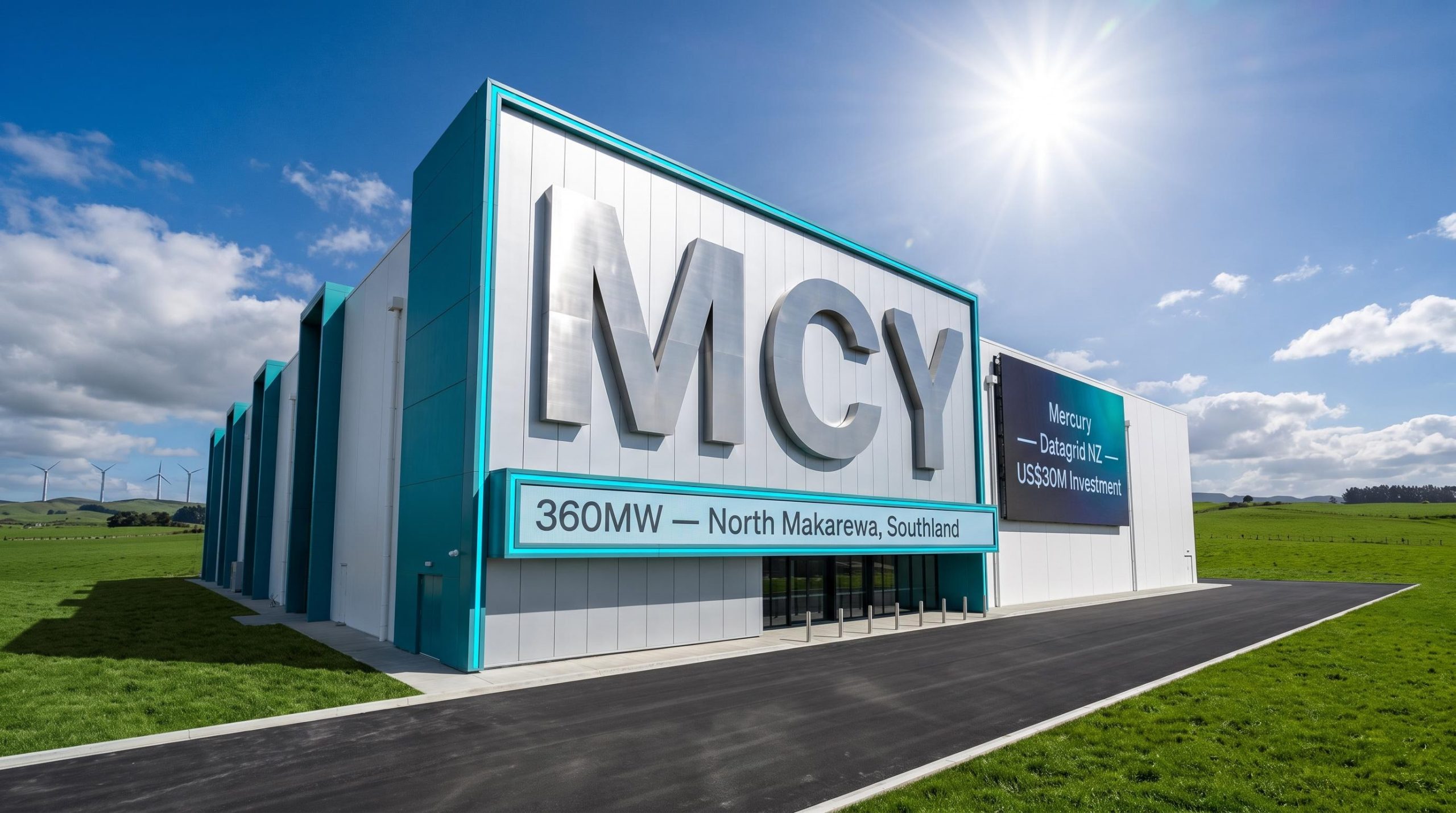
Mercury takes 12.7% stake in Datagrid NZ to anchor long-term renewable demand
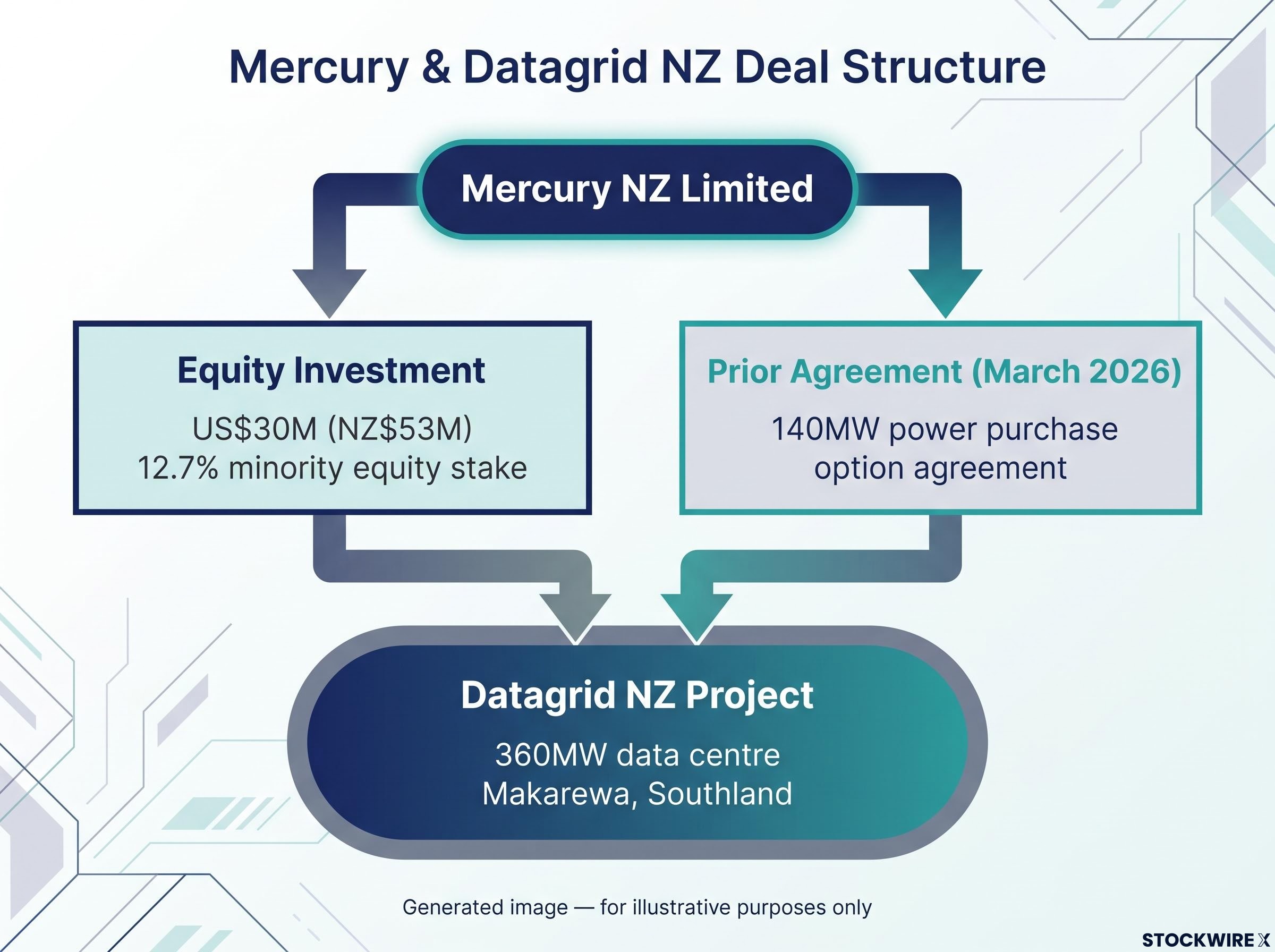
Mercury NZ Limited has invested US$30 million (NZ$53 million) for a 12.7% minority equity stake in Datagrid Holding Group NZ Ltd, securing exposure to a major emerging source of long-term electricity demand and helping underpin its future renewable generation investment.
Notably, the transaction is “funded from existing capital facilities and within capital management settings,” signalling no new equity raise and continued balance sheet discipline. Mercury is dual-listed on the NZX and ASX under the ticker MCY.
When big ASX news breaks, our subscribers know first
The deal at a glance
The equity investment sits alongside a prior, separate arrangement: a 140MW power purchase option agreement that Mercury signed with Datagrid in March 2026, providing a pathway for renewable electricity supply to the project. These are two distinct transactions and should not be conflated.
As part of the deal, Mercury Chief Executive Stew Hamilton has been appointed as a director of Datagrid NZ.
| Metric | Detail |
|---|---|
| Investment amount | US$30M (NZ$53M) |
| Equity stake | 12.7% minority equity stake |
| Project | North Makarewa data centre, Southland |
| Project capacity | 360MW |
| Prior offtake option (Mar 2026) | 140MW power purchase option agreement |
| Consent status | Holds resource consent; final investment decision expected later this year |
What Datagrid NZ is building, and why data centres matter to power generators
Datagrid NZ is developing what it describes as “New Zealand’s first AI factory,” a hyperscale data centre campus at Makarewa, Southland. A hyperscale data centre is large-scale digital infrastructure built to handle enormous computing workloads, in this case purpose-built for advanced artificial intelligence, sovereign cloud services, and high-density computing.
The 360MW project is developing into what is expected to be “New Zealand’s most advanced large-scale data centre project.” The “first AI factory” descriptor is Datagrid’s own wording drawn from the announcement.
Why does this matter to an electricity generator? Facilities of this type are large, long-duration and always-on consumers of power. That kind of steady, predictable demand gives a generator the certainty it needs to justify committing capital to new renewable capacity. In effect, a confirmed anchor customer helps de-risk the investment case for building future generation.
Why the investment strengthens Mercury’s growth case
The strategic logic connects long-duration demand to revenue certainty, which in turn supports Mercury’s renewable development pipeline. Management framed the move as disciplined, pointing to a staged structure, downside protection, and preserved balance sheet strength.
Hamilton said the investment was aligned with Mercury’s core strategy and structured to preserve financial flexibility across its wider capital programme.
Mercury’s renewable development pipeline extends well beyond this single investment, with a Board-approved $75 million appraisal drilling campaign targeting 1 TWh of new geothermal generation across the Nga Tamariki and Rotokawa projects, and total expansion expenditure estimated at $0.8-1.0 billion.
Stew Hamilton, Chief Executive, Mercury
“We have a deep renewable development pipeline, and long-duration demand from large electricity users like Datagrid NZ provides us with the revenue certainty that underpins our investments in new renewable generation developments.”
Executive GM Wholesale Tim Thompson said the investment would improve Mercury’s understanding of how large-scale AI and data centre demand will develop in New Zealand. He noted it “strengthens our position for future long-term offtake” and provides a closer link between future customer demand and renewable generation investment, describing it as “a staged investment with appropriate governance and downside protection.”
Next steps and what investors should watch
The key near-term catalyst is Datagrid’s final investment decision, which is expected to be made later this year. Founder and chair Rémi Galasso emphasised speed of delivery, noting that closing this round of funding allows the project to “begin horizontal construction works on the site.”
Investors can track the following watch-points:
-
Datagrid NZ final investment decision, expected later in 2026
-
Commencement of horizontal construction works at the Southland site
-
Progress on the 140MW power purchase option converting to firm offtake
-
Governance oversight via Hamilton’s board seat and staged investment milestones
Galasso framed the arrangement as more than a supply deal.
Rémi Galasso, Founder and Chair, Datagrid NZ
“Partnering with a leading New Zealand green electricity generator like Mercury is a strategic step for us, not just an electricity supply arrangement.”
The investment reflects Mercury’s broader strategy of linking future customer demand to renewable generation investment, positioning the company to convert emerging AI-driven power consumption into a longer-term driver of its renewable development pipeline.
Investors exploring the broader capital commitments sitting behind this deal can find more detail in our deep-dive into Mercury’s GeoPlatform geothermal strategy, which covers the Board-approved drilling campaign, Final Investment Decision timelines, and how projected New Zealand electricity demand growth supports the commercial case.
Don’t Miss the Next Utilities Sector Move
Big News Blast delivers FREE breaking ASX news straight to your inbox within minutes of release, complete with in-depth analysis already done for you. Join 20,000+ subscribers staying ahead of market-moving announcements across utilities and beyond. Click the “Free Alerts” button at StockWire X to start receiving alerts the moment news breaks.