

H1 FY27 results: revenue up 46% to $1.7 billion and a A$1 billion buy-back
Xero (ASX: XRO) reported H1 FY27 results for the six months to 30 September 2026, with operating revenue up 46% (41% in constant currency) to $1,745 million and adjusted EBITDA up 3% to $362 million. The Board also approved an on-market share buy-back of up to A$1 billion to be completed over the next 12 months.
All dollar figures are in NZD and compared against H1 FY26. Xero also upgraded its FY27 Outlook.
Adjusted EBITDA growth was tempered by the incorporation of Melio, which was included in H1 FY27 only. On a pro-forma basis, which incorporates Melio’s results for H1 FY26, adjusted EBITDA was up 23%.
Sukhinder Singh Cassidy, CEO
“Our H1 FY27 results show we’re continuing to do what we said we’d do, delivering strong macro-resilient growth at scale with momentum across every region…”
The table below sets out the headline financial measures.
| Metric | H1 FY27 | H1 FY26 | Change |
|---|---|---|---|
| Operating revenue | $1,745.3M | $1,194.2M | 46% |
| Pro-forma operating revenue | $1,745.3M | $1,377.7M | 27% |
| Adjusted EBITDA | $361.6M | $350.9M | 3% |
| Pro-forma adjusted EBITDA | $361.6M | $294.7M | 23% |
| Free cash flow | $238.1M | $321.1M | -26% |
| Pro-forma free cash flow | $238.1M | $180.5M | 32% |
| Rule of 40 | 54.9% | 44.5% | 10.4pp |
| Pro-forma Rule of 40 | 36.1% | 34.9% | 1.2pp |
Xero defines Rule of 40 as the sum of annual revenue growth percentage in constant currency and free cash flow margin percentage. The operating expense to revenue ratio was 68.9%, an improvement of 8.1 percentage points.
When big ASX news breaks, our subscribers know first
Customer growth and ARPC expansion
Xero said the result was driven by customer additions and average revenue per customer (ARPC) expansion across all markets, alongside continued payments growth. Annualised monthly recurring revenue (AMRR) rose 41% to $3.8 billion, including US payments growth of 62% on a pro-forma basis.
Key customer metrics for the half were:
- 226,000 net new customers, up 28%
- 5.1 million total customers (5,146,000)
- ARPC up 25% to $62.21
- Total lifetime value (LTV) of customers up 16% (10% in constant currency) to $22.7 billion
- Average monthly churn of 1.19%, with underlying churn at 0.83%
Net profit after tax (NPAT) was $18.5 million. Xero said operating income and NPAT were impacted, as expected, by a full six months of Melio following completion of the acquisition in H2 FY26, and described Melio as currently loss-making, reflecting its stage of maturity and journey to scale.
Pro-forma adjusted net profit after tax and acquired amortisation (NPATA) grew 159% to $81.1 million.
Regional performance
Each of Xero’s major markets contributed to the result:
- Australia and New Zealand: revenue rose 20% (15% in constant currency) to $795 million, with ARPC of $54.57 and 2.85 million customers.
- International: revenue rose 79% to $950 million following the Melio acquisition (33% on a pro-forma basis), with ARPC of $71.67 and 2.3 million customers. UK revenue grew 24%, reflecting customer acquisition related to Making Tax Digital (MTD) for Income Tax, supported by Xero Simple.
- US: revenue rose 536% (51% on a pro-forma basis) to $365 million, with ARPC of $106.21 and 455,000 customers.
In the US, the launch of Payroll powered by Gusto gives customers one connected platform for accounting, payroll and payments. Xero said this is enhanced by AI and Syft Analytics.
AI momentum: JAX, XeroForce and Xforce by Xero
Agentic AI refers to software that does more than answer questions: it can take actions on a user’s behalf. For small business accounting, that could mean software that helps with routine tasks such as chasing payments or matching bank transactions.
Xero said its infrastructure, data, scale and trust advantages position it well to help customers benefit in the agentic era.
Xero reported that 6x more customers now use JAX chat each month. JAX is the company’s agentic platform, powered by Xero OS. Examples of AI use cited in the results included:
JAX engagement was already climbing earlier in the year, with management previously tracking a 61% increase over a three-month window as the agentic platform moved from pilot to mainstream use.
- Automated bank reconciliation: more than 100 million transactions reconciled since launch, with 90% of customers returning to use it again and about 50% of monthly reconciliation time saved
- AI-enabled core daily tasks: cash flow forecasting, payment follow-ups and smart document capture, which saw an increase of about 4.5x in monthly customer use
XeroForce is designed to help accounting practices turn manual financial tasks into scalable workflows. It is in alpha, and Xero said feedback from the 40+ participating design partners has been very positive.
Xero also announced Xforce by Xero, which will initially provide accounting firms with a team of partner consultants and forward-deployed engineers to design workflows for the AI era. Xforce is in beta and has signed a select group of design partners in Australia, New Zealand and the UK.
Xero is aligning its commercial model to AI opportunities through three core principles:
- Keeping it simple by bundling AI features across existing plans
- Encouraging adoption by offering standalone AI add-ons
- Future-proofing its commercial models by establishing the foundations for future usage-based pricing to align costs with utility
A$1 billion buy-back and upgraded outlook
Capital management
The buy-back of up to A$1 billion is in addition to the recently completed A$550 million program to offset dilution. It includes an amount intended to offset dilution from expected FY28 share-based compensation.
The Board said it regards the program as a value-accretive use of capital for shareholders, because the current share price does not reflect Xero’s long-term value and growth potential. The buy-back will be conducted from time to time in the ordinary course of trading, at the company’s discretion.
Xero held cash and short-term deposits of NZ$1.15 billion at 30 September 2026. It intends to maintain balance sheet strength throughout the 12-month program and a healthy net debt to adjusted EBITDA ratio, supported by its FY27 Outlook for adjusted EBITDA growth and strong free cash flow generation.
FY27 Outlook upgrade
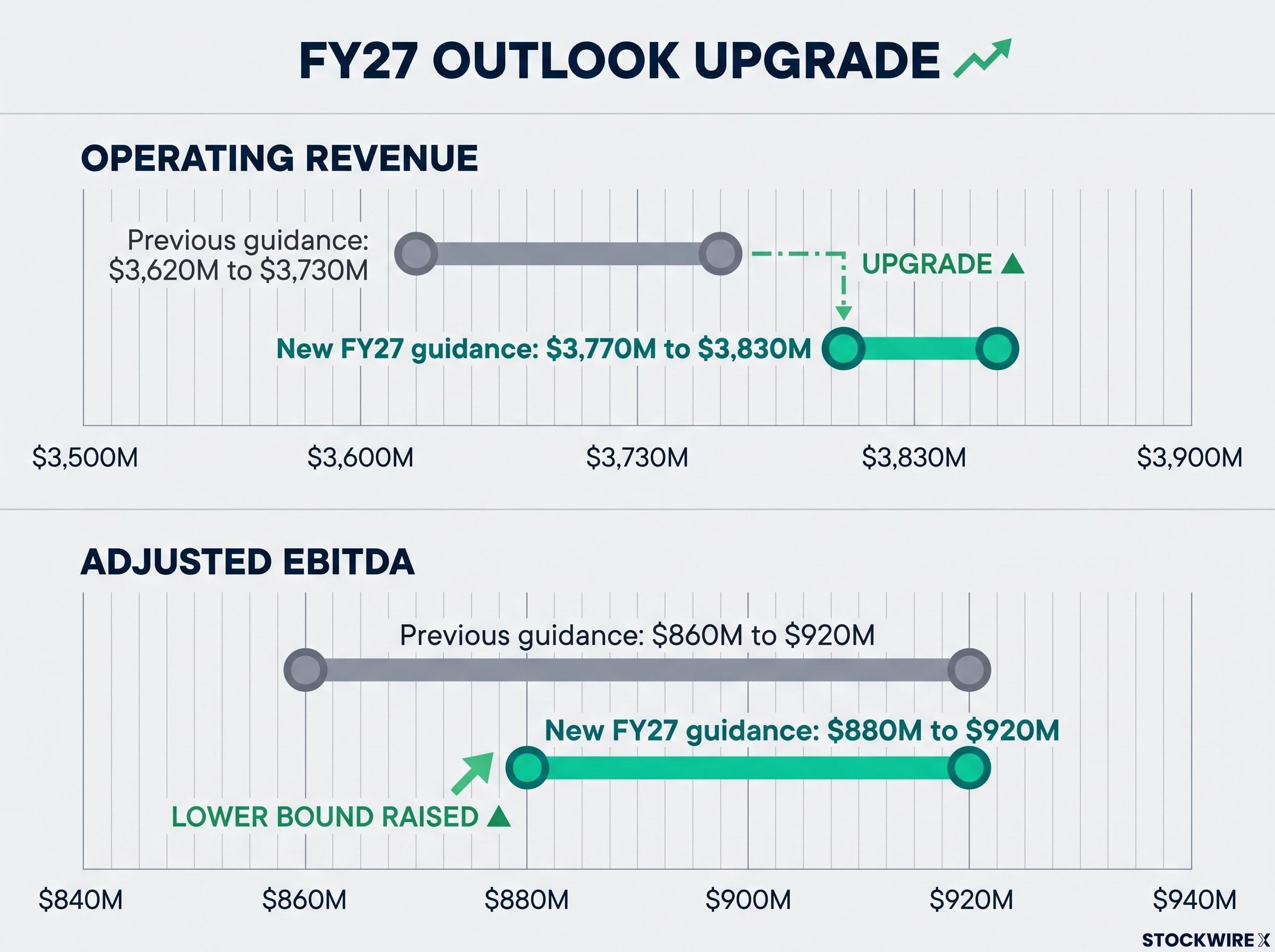
Xero upgraded its revenue guidance and lifted the bottom of its adjusted EBITDA range.
| Measure | New FY27 guidance | Previous guidance |
|---|---|---|
| Operating revenue | $3,770M to $3,830M | $3,620M to $3,730M |
| Adjusted EBITDA | $880M to $920M | $860M to $920M |
| Depreciation and amortisation | around $475M (up $10M from previous guide) | N/A |
The increase in revenue guidance largely reflects stronger Melio payments performance alongside an FX benefit from the weaker NZD. On a constant currency basis, revenue growth is expected to be between 24% and 27%.
The adjusted EBITDA guide continues to reflect a higher than historical second half weighting. Xero said second half adjusted EBITDA will reflect the benefit of announced price rises and payments growth momentum, disciplined headcount cost management, further operating efficiencies and an expected reduction in Melio’s adjusted EBITDA losses.
Xero now expects a Rule of 40 outcome of around 40% for FY27 on a pro-forma basis. That improves on its previous statement that, prior to FY28, it expected to deliver below Rule of 40 outcomes.
For FY28, Xero now sees the opportunity for revenue to be more than $4.6 billion, excluding revenue synergies. Its aspiration to deliver a greater than Rule of 40 outcome in FY28 remains.
Investors exploring how management arrived at this FY28 aspiration can read our deep-dive into Xero’s FY28 revenue targets and Melio integration, which sets out the AI monetisation thesis and the expected US$70 million of revenue synergies from combining payments with accounting.
What happens next for Xero
Xero set out the following upcoming steps:
- The H1 FY27 earnings webcast is scheduled for 10:00am AEDT on 12 November 2026.
- The buy-back is expected to commence on or after 13 November 2026, subject to prevailing share price and market conditions.
- Xero plans to notify shareholders in writing and release a separate standalone disclosure document on the ASX explaining the nature and implications of the buy-back, as required under the NZ Companies Act 1993.
- Melio is expected to reach adjusted EBITDA breakeven on a run-rate basis in H2 FY28, a guide Xero reiterated.
Want Alerts Like This on the Technology Stocks You Follow?
StockWire X Market Intelligence scores every announcement in our coverage for how significant it’s likely to be for investors, and which way it points, then alerts you on the stocks you follow. The first 1,000 founding members lock in 50% off for life: A$247 a year instead of the standard A$495. Join the founding waitlist today.