
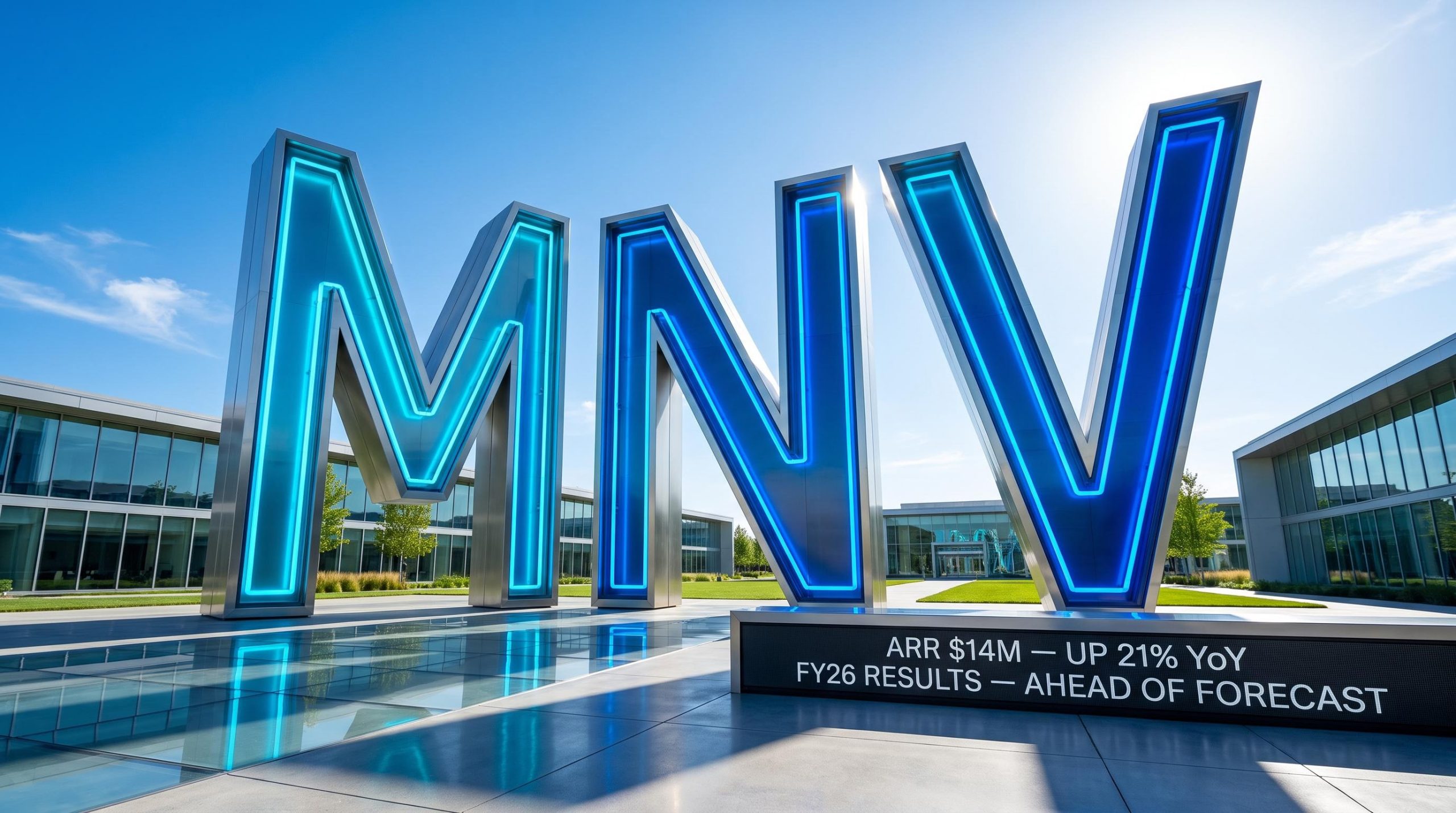
Monvia delivers maiden FY26 results ahead of prospectus forecasts
In its FY26 results presentation dated 26 August 2026, Monvia Limited outlined its first full-year result following the acquisition of Monvia Australia and subsequent ASX listing. The cloud-native life insurance software (SaaS) provider reported adjusted revenue of $27.7m, sitting 1% above prospectus forecast.
Management highlighted Adjusted EBITDA of $6.9m at a 24.9% margin, ahead of both the 24% forecast and the $6.6m pro forma forecast. Annual Recurring Revenue (ARR) reached $14m at 1 July 2026, up 21% year on year, delivering above prospectus forecasts in the company’s first reported period as a listed entity.
When big ASX news breaks, our subscribers know first
FY26 financial highlights at a glance
The presentation set out the headline scorecard across ARR, revenue, profitability and balance sheet strength.
| Metric | FY26 Result | Forecast/Comparison | Significance |
|---|---|---|---|
| ARR | $14m | Up 21% YoY / 28% 5yr CAGR | Recurring revenue base |
| Adjusted Revenue | $27.7m | 1% above forecast | Top-line delivery |
| Adjusted EBITDA | $6.9m | Ahead of $6.6m forecast; 24.9% margin | Underlying profitability |
| Adjusted NPAT | $6.5m | Positive result | Bottom-line profitability |
| Pro forma Net Cash | $5.1m | $11.1m cash less $6m debt | Balance sheet strength |
Adjusted figures are presented on a pro forma like-for-like basis to the prospectus financial information, per the company’s glossary. Statutory EBITDA was a loss of $6.7m, driven by non-recurring IPO and acquisition costs alongside non-cash fair value movements on financial liabilities. This statutory figure does not reflect underlying operating performance.
SaaS engine — how the ARR growth was built
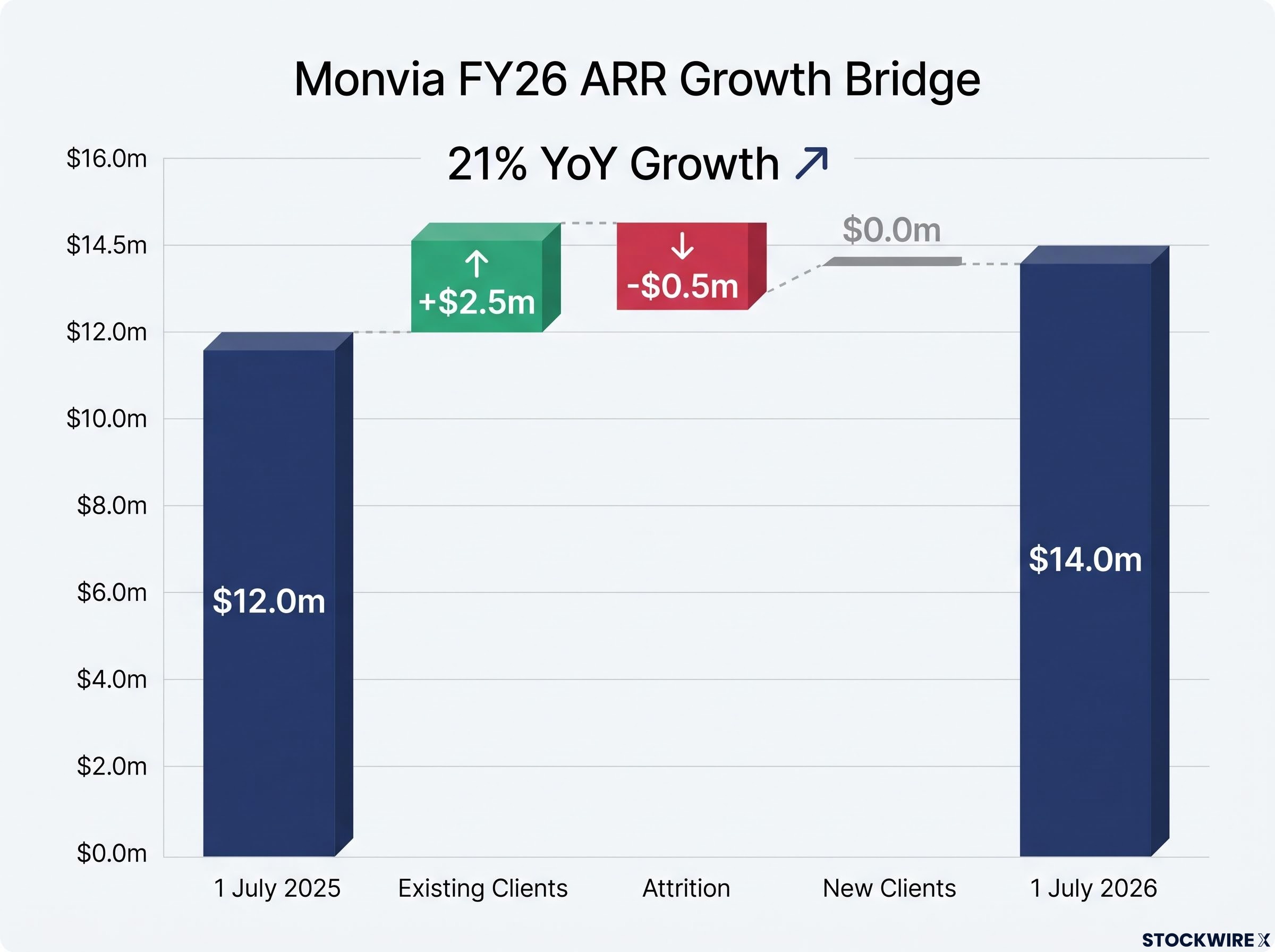
The presentation detailed how ARR climbed from $12m at 1 July 2025 to $14m at 1 July 2026. Growth was driven entirely from within the existing client base.
The ARR bridge breaks down as follows:
-
Growth from existing clients: +$2.5m (price increases and expansion of scope)
-
Attrition: -$0.5m (one client exit as a result of being acquired)
-
New clients: $0.0m (no new-logo ARR contracted in FY26)
The $2.5m uplift included a significant contribution from MetLife, contracted for five years. Management noted that since the acquisition on 1 July 2025, a strong strategic business pipeline has developed with maturing opportunities, expected to deliver New Client ARR in FY27. The expansion within the installed base underpinned the result, positioning new-logo wins as the key FY27 catalyst.
Retention underpins earnings quality
Management highlighted Net Revenue Retention averaging 121% over five years and Gross Revenue Retention averaging 95% over the same period.
According to the presentation, the Gross Revenue Retention figure demonstrates:
-
The stickiness of the platform
-
High switching costs
-
The risk and complexity associated with switching core life-insurance platforms
-
Long-term customer relationships
Management described revenue retention as a key driver of earnings quality, cash generation and long-term value creation, supporting a predictable and scalable ARR base.
What is ARR and why it matters for Monvia investors
Annual Recurring Revenue (ARR) measures the annualised contracted recurring revenue a software business holds at a given point, in Monvia’s case at 1 July each year. It typically captures maintenance, managed services, hosting, cloud and SaaS subscription revenue.
Investors tend to value recurring, contracted revenue because it offers predictability and visibility, translating into higher-quality earnings compared with one-off project revenue. Monvia also holds significant multi-year contracted professional services that are not counted within ARR, which management indicated adds further revenue predictability across the business.
The MetLife cornerstone and the acquisition-led listing story
Two structural events shaped the FY26 numbers. The company executed a 5-year cornerstone contract with MetLife with improved terms, a key driver of the ARR expansion.
The corporate structure was also reset. Monvia Limited (formerly Axe Group Holdings Pty Ltd) acquired Monvia Australia (formerly Axe Group Pty Ltd), followed by the ASX listing.
Key transaction mechanics disclosed in the presentation included:
-
$20.3m net assets acquired (acquisition accounting)
-
$37.3m goodwill generated (acquisition accounting)
-
Series A Preference Shares issued to raise capital; Series A and Series B preference shares valued at $50m and $12.4m respectively, classified as Borrowings at balance date (financing mechanics)
-
$21.4m cash paid to vendors, net of cash acquired (consideration)
Net assets sat in a deficit position of -$13.6m, driven by the Series A and B preference shares held as financial liabilities. Upon IPO execution on 24 July 2026, after period end, these liabilities were extinguished or repaid.
Balance sheet and cash generation
Management emphasised operating cash discipline alongside a strengthened post-IPO position.
| Metric | FY26 | Note |
|---|---|---|
| Net operating cash inflow | $4.1m | From core activities, strong collections |
| Pro forma cash | $11.1m | Includes $17.5m IPO proceeds, less Series B redemption & capital raise costs |
| Pro forma debt | $6m | Microequities Private Credit Fund facility |
| Pro forma Net Cash | $5.1m | Pro forma cash less pro forma debt |
| Capitalised development spend | $2.0m | Continued platform investment |
The net operating cash inflow of $4.1m was underpinned by strong customer collections and disciplined cash management. The $6m Microequities facility carries a maturity date of 31 August 2027, extended after the reporting date. Management noted that the business generates cash from core operations, with IPO proceeds having restructured the balance sheet.
FY27 priorities — the growth roadmap
Management outlined its strategic direction for FY27. The measures shown are indicative statements of management intent and are not earnings guidance or a forecast.
| Growth Pillar | FY27 Intent | Success Measure |
|---|---|---|
| Expand within existing clients | Multi-module adoption across installed base | ≥100% NRR |
| Win new ANZ clients | Convert the ANZ pipeline | 1-2 new-logo clients |
| Grow with partners | Systems Integrators & specialist firms | 1-2 partner agreements |
| International expansion | First offshore deployment (e.g. Southeast Asia) | 1-3 deals added to pipeline |
| Acquisition | Assess strategic targets | 2-3 targets under review |
The presentation set out four outlook pillars:
-
Accelerate ARR growth, lifting recurring revenue as a percentage of total revenue
-
Win new clients by converting the ANZ pipeline and building new pipeline locally and in markets such as Southeast Asia
-
Establish strategic partnerships to increase market distribution and accelerate the sales cycle
-
Technology and AI investment, embedding AI-enabled capabilities into the cloud-native platform
On the customer side, FY27 priorities include embedding AI into claims and underwriting workflows, with a target of two AI modules in production, alongside a 99.9% platform availability target.
The investment case
Management Outlook
No direct CEO quote is provided in the source. Management, led by CEO and Managing Director Simon Bright, framed the year around establishing a platform for sustainable growth over the long term.
Monvia’s maiden FY26 result exceeded prospectus forecasts, supported by 21% ARR growth, five-year average Net Revenue Retention of 121%, and the MetLife five-year cornerstone contract. The business delivered a net operating cash inflow of $4.1m from core operations, with a maturing pipeline positioned to drive potential new-logo wins in FY27. Management’s stated aim is establishing a platform for sustainable growth over the long term.
Don’t Miss the Next ASX Tech Winner
Big News Blast delivers FREE breaking ASX tech news directly to your inbox within minutes of release, complete with in-depth analysis. Join 20,000+ subscribers already staying ahead of the market. Click the “Free Alerts” button at StockWire X to get the next market-moving announcement the moment it drops.