
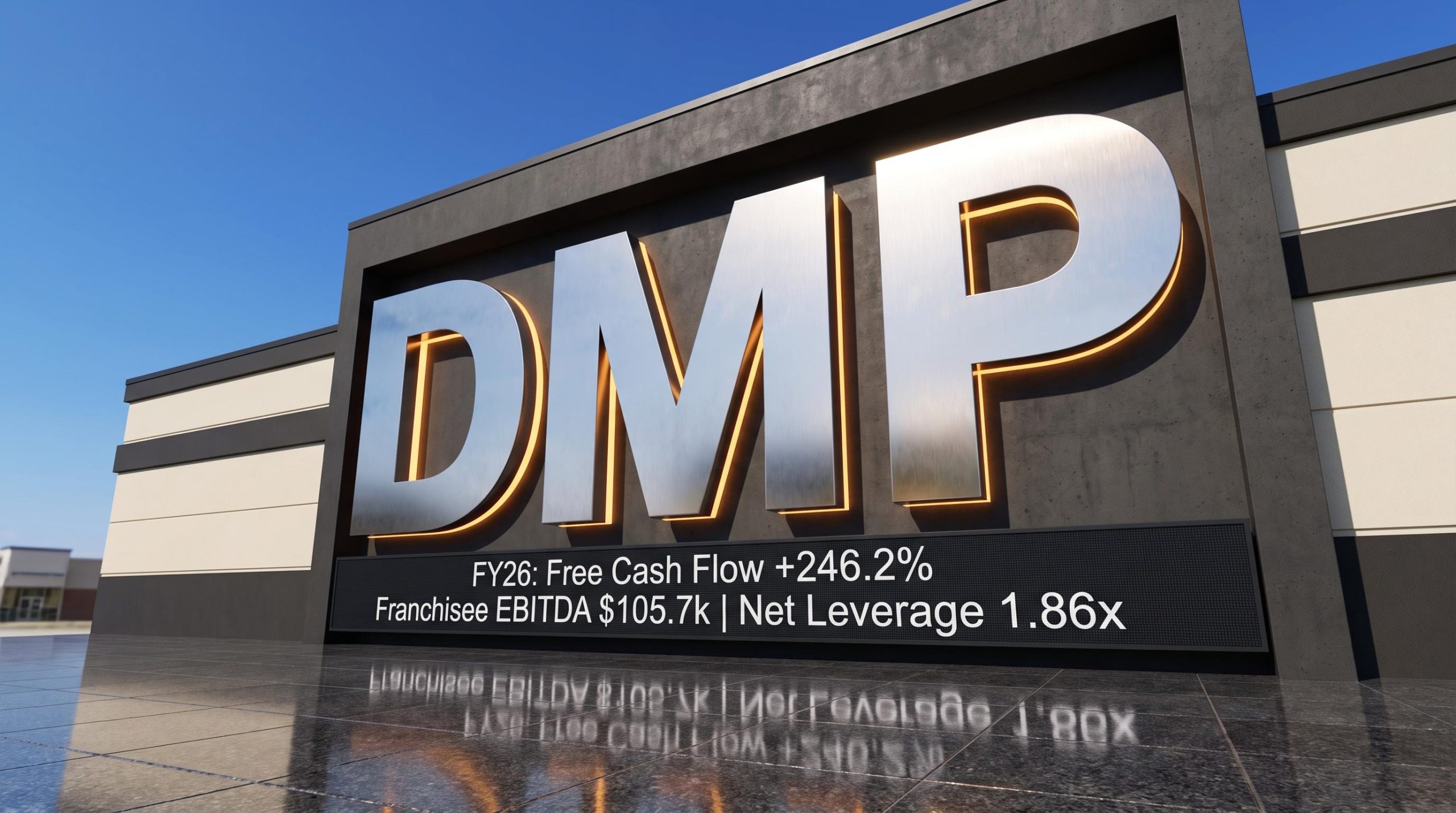
Domino’s caps its FY26 reset with stronger franchisee returns and a leaner balance sheet
In its FY26 results presentation, dated 26 August 2026 and covering the year ended 28 June 2026, Domino’s Pizza Enterprises told investors it had completed a strategic operational “reset” and would now pivot toward rebuilding profitable sales in FY27.
Management framed the year as one of deliberate trade-offs. Underlying NPAT rose 4.0% to $121.6m, free cash flow surged 246.2% to $164.1m, net leverage fell to 1.86x from 2.57x, and the final dividend lifted 51.2% to 32.5 cps.
That improvement came even as network sales declined 6.8% to $3.87b and same-store sales fell 4.1%. The company was clear that this reflected a deliberate promotional reset, not a collapse in demand.
The update was delivered by Jack Cowin (Chairman), Andrew Gregory (Group CEO & MD) and George Saoud (Group COO & CFO). The central message: margin and cash quality strengthened even as top-line sales were intentionally pulled back.
When big ASX news breaks, our subscribers know first
FY26 results: profit and cash flow strengthen despite softer sales
Domino’s delivered a result defined by improved earnings quality. Underlying earnings rose modestly while cash generation and balance sheet metrics improved materially.
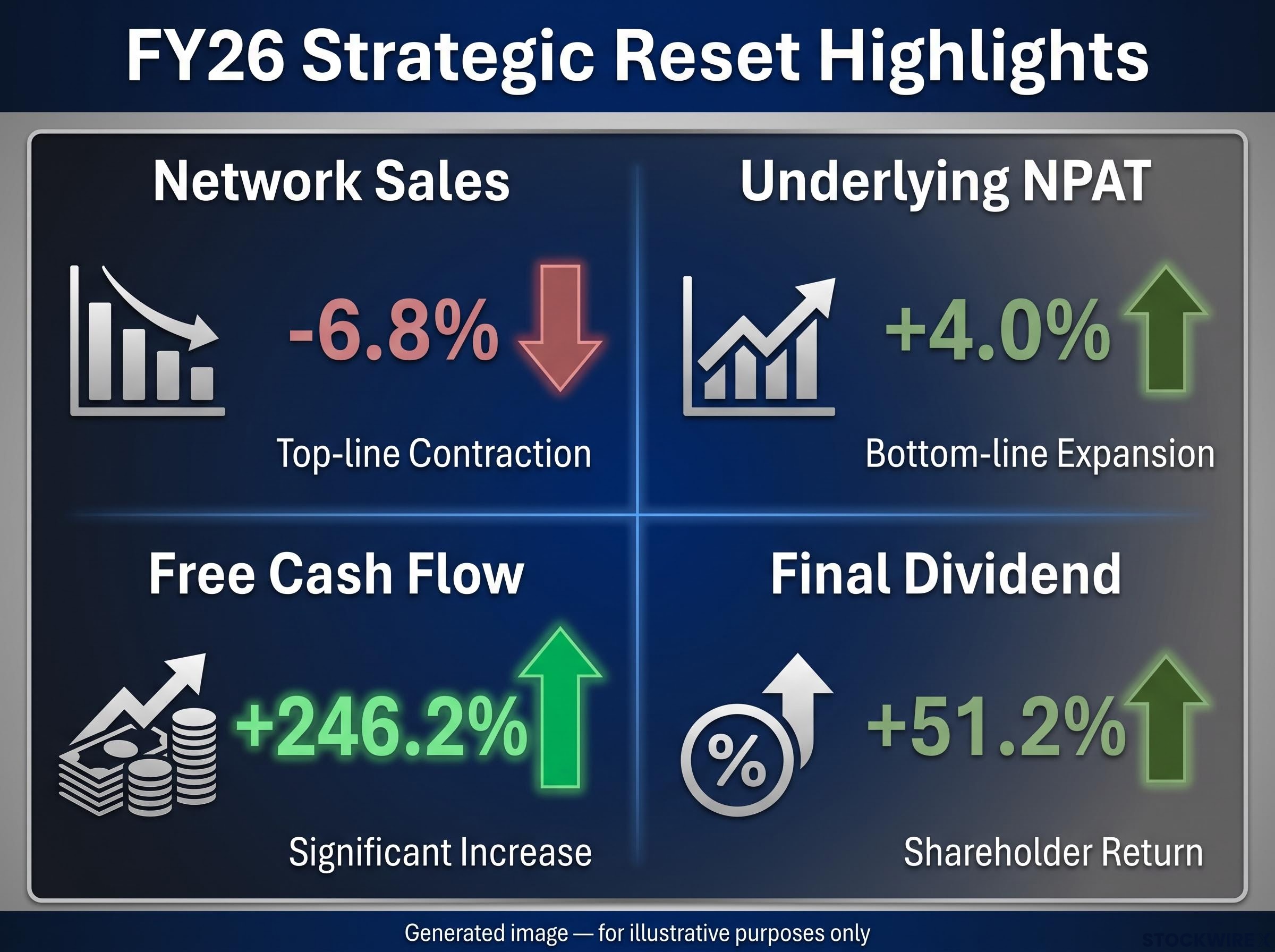
| Metric | FY26 | FY25 | Change | Change % |
|---|---|---|---|---|
| Network Sales | $3,868.5m | $4,152.7m | ($284.2m) | (6.8%) |
| Same Store Sales Growth | (4.1%) | (0.2%) | (3.9%) | — |
| EBIT (Underlying) | $200.1m | $198.1m | $2.0m | +1.0% |
| NPAT (Underlying) | $121.6m | $116.9m | $4.7m | +4.0% |
| NPAT (Statutory) | ($134.2m) | ($3.7m) | ($130.5m) | — |
| Free Cash Flow | $164.1m | $47.4m | $116.6m | +246.2% |
| Net Debt | $497.0m | $724.8m | ($227.8m) | (31.4%) |
| Final DPS | 32.5cps | 21.5cps | 11.0cps | +51.2% |
Several points sit behind the headline numbers:
-
Underlying EBIT rose despite roughly $10m lower profit on store sales and lower order volumes, helped by cost savings and stronger contributions from Europe and Asia.
-
The statutory NPAT loss of ($134.2m) reflects $255.7m of after-tax non-recurring items, largely non-cash write-downs across France and Taiwan goodwill, IT assets and underperforming stores. These items are largely non-cash and one-off.
The statutory loss was concentrated in France, where goodwill write-downs reflected the underperformance that also shaped the France and Belgium MFA renewals process, with both agreements extended to 30 September 2026 to satisfy local-law preconditions while commercial alignment between the parties remained broadly in place.
The distinction matters. On an underlying basis the business generated more profit and far more cash. The statutory loss represents an accounting reset following a balance sheet review, not a deterioration in operating performance or a cash outflow.
What the “reset” actually means for investors
During FY26 the company deliberately reduced heavy voucher discounting and simplified its pricing. That lowered order volumes and headline sales, but lifted the average ticket and improved store margins.
Franchise partner profitability is central to the thesis. Healthier partners are better positioned to reinvest, open new stores and sustain the broader network over time.
The result showed progress on this measure. Average franchisee EBITDA rose 11.3% to $105.7k, while store EBITDA margin improved from 7.1% to 7.9%. Management noted around two-thirds of FY26 cost savings were passed through to franchise partners.
In short, Domino’s traded short-term sales volume for more durable unit economics.
The WA pricing trial: the template for FY27
The company detailed its Western Australia pricing trial as the proof point for its FY27 approach. Broad discounting was withdrawn in September 2025, but order volumes fell too far.
Between February and June 2026 the offer was rebalanced with targeted carry-out value and lower delivery fees. Management reported that WA’s Q4 same-store sales outperformed the rest of Australia, carry-out comparable sales turned positive, and the state recorded record franchisee EBITDA. A $5.95 delivery fee was implemented in August.
Domino’s said it intends to scale these “proven learnings” across the Australian network in FY27.
Balance sheet and cash flow: leverage cut, dividend lifted
The strengthened financial position was the clearest positive of the result. Net debt reduced by $227.8m, comprising $138.9m of cash repayments and $88.9m of favourable FX translation.
Net leverage of 1.86x came in below the company’s <2.0x target, down from 2.57x, with interest coverage strong at 20.6x. Domino’s also completed a $1.05b refinancing in December 2025 with improved pricing and a weighted average tenure of around four years.
The step-up in free cash flow was driven by lower capital expenditure, which fell $48.1m to $38.7m, improved working capital, and $44.9m in lower tax payments.
On costs, the company actioned $67m in annualised savings, of which $35.3m was realised in FY26, with a further $15–25m in opportunities identified. The final dividend of 32.5 cps was unfranked and equivalent to a 50% payout of second-half underlying NPAT, with a non-underwritten dividend reinvestment plan (DRP) remaining in place.
Andrew Gregory, Group CEO & MD
This is a platform to build on, not to rebuild. The immediate task is to turn stronger foundations into sustainable order growth, franchise partner returns and shareholder value.
FY27 outlook: the pivot to profitable sales growth
Management was candid on near-term trading. Group same-store sales for the first eight weeks of FY27 stood at -5.8% (week ending 23 August), consistent with the second-half run-rate. The company said trading remained below expectations but was stabilising at that level.
Each region has plans underway. In ANZ, new product ranges and a Coca-Cola partnership are expected to support momentum into September. In Europe, Germany’s pricing initiatives are anticipated to improve same-store sales in September. In Asia, Japan initiatives are expected to strengthen trends through August and September.
Three priorities and the franchisee EBITDA target
Management set out three priorities for restoring profitable growth:
-
Grow average weekly unit orders by scaling WA learnings, simplifying the range, sharpening marketing and driving store execution.
-
Improve franchisee profitability sustainably, targeting $130k EBITDA per store, an uplift of $24.3k from the current $105.7k.
-
Lead with urgency and accountability through empowered market teams and faster local execution.
The $130k franchisee EBITDA target gives investors a tangible medium-term goalpost to track.
FY26 rebuilt the financial and operational foundations, with stronger cash generation, lower leverage and improved franchise partner margins. FY27 becomes the test of whether Domino’s can convert those foundations into profitable order growth.
Don’t Miss the Next Consumer Discretionary Turnaround
Big News Blast delivers FREE breaking ASX news straight to your inbox within minutes of release, complete with in-depth analysis already done for you. Join 20,000+ investors who stay ahead of the market the moment announcements drop. Click the “Free Alerts” button to start receiving alerts across ASX Consumer, Tech, Healthcare and more.