
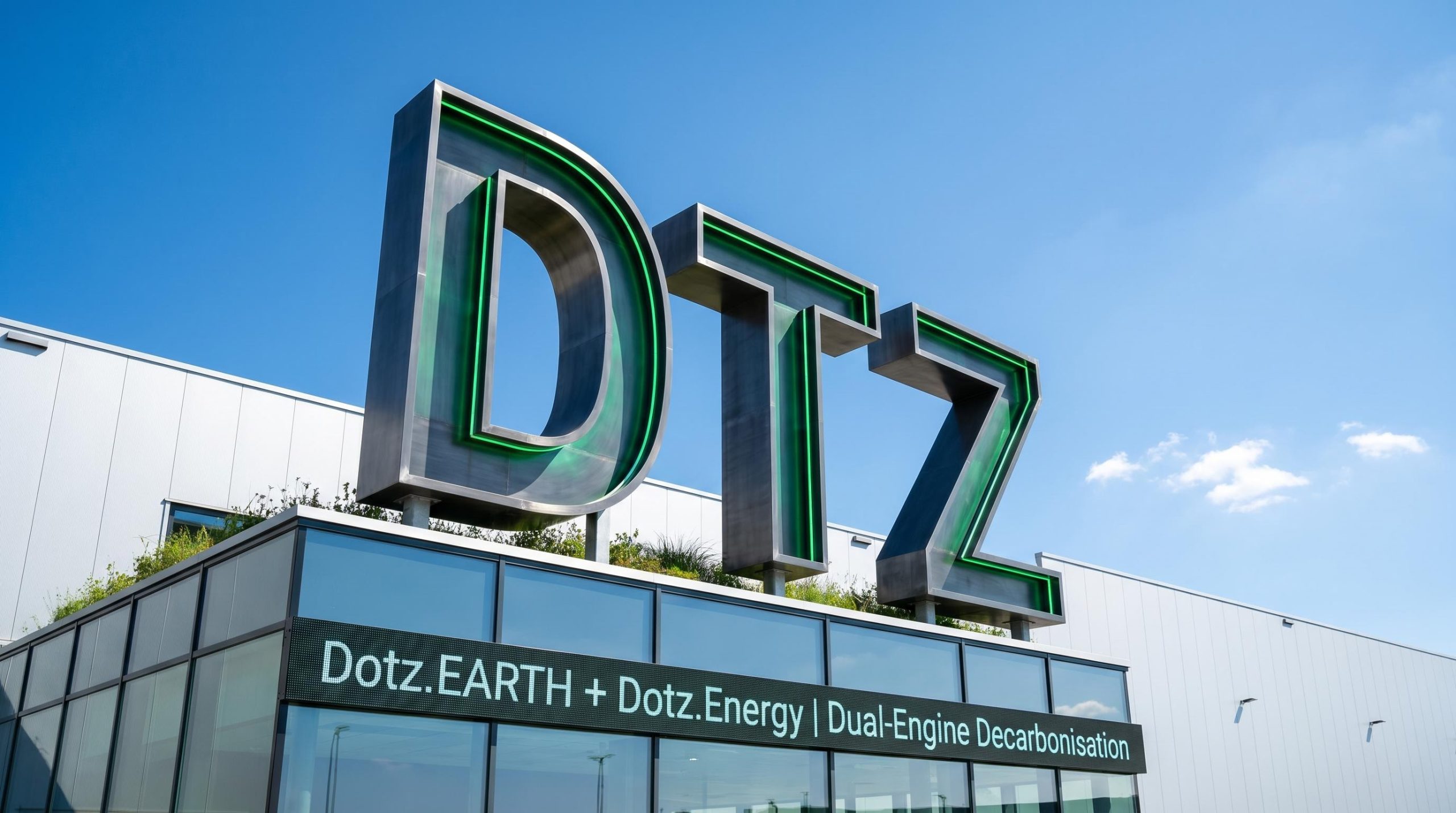
Two engines of decarbonisation across one materials science platform
In its July 2026 investor presentation, Dotz Nano (ASX: DTZ | OTC: DTZNY / DTZZF) positioned itself as a materials science and engineering company operating two distinct growth engines under a single decarbonisation mission.
The company detailed a strategy built around Dotz.EARTH, its carbon capture sorbent platform, and Dotz.Energy, an energy optimisation and decarbonisation solution.
Management framed the update around a transition point, describing the moment “as Dotz Earth begins to commercialize and Dotz Energy moves to execution.” The presentation combined market sizing, performance benchmarking and business model economics, with no new binding financial commitments disclosed.
When big ASX news breaks, our subscribers know first
Dotz.EARTH: targeting a sorbent market forecast to more than triple by 2030
The first engine centres on Dotz’s proprietary AMP sorbents, engineered materials designed to capture carbon dioxide for industrial applications. Management outlined a substantial market opportunity, with all figures presented as company estimates based on the IEA CCUS projects database (2025).
According to management estimates, the direct air capture (DAC) sorbent market was valued at approximately $600m in 2026, forecast to grow 3.5x to an estimated $2.1bn by 2030. This trajectory implies a compound annual growth rate (CAGR) of around 36.7%.
| Year | Estimated Market Value ($m) |
|---|---|
| 2026 | $600m |
| 2027 | $1,370m |
| 2028 | $1,700m |
| 2029 | $1,800m |
| 2030 | $2,100m |
These figures rest on stated modelling assumptions, including 3,000-cycle durability, a 3-hour cycle, low-temperature TVSA regeneration, a 1 tpa DAC unit and a $50k/tonne sorbent price. They represent a market estimate, not a company revenue forecast.
Performance that management says outperforms commercial benchmarks
The presentation detailed several differentiated performance metrics for the Dotz AMP sorbent range. Management stated the following characteristics:
- >2x CO₂ capture capacity
- >3x sorbent cyclability
- Low-temperature regeneration
- Dotz p-Amp measured at 3.1 mmol/g versus a commercial sorbent (Lewatit VPOC 1065 amine grafted) at 0.95 mmol/g
Dotz Amp was recorded at 2.1 mmol/g in the same comparison. Management stated these results have been “independently verified by end-users” and that outcomes “consistently outperform commercial benchmarks across all applications.”
The company noted the technology is protected by patent-protected IP, with patents filed in the US, EU and Asia. Proprietary formulation and production methods are protected as trade secrets.
Commercial pipeline and utility pathways
Management outlined how the sorbent platform extends beyond direct air capture into a broader set of applications. The stated pathways include:
- DAC for atmospheric CO₂ capture
- eSAF to support sustainable fuel pathways
- Potential utility in food and beverage applications
- Potential utility across agriculture and greenhouse applications
The commercial update disclosed two named partners at later pipeline stages. Hengst Filtration was shown at the MoU / collaboration agreement stage, while soletair power was positioned at the lab/bench demonstration stage. Other partner logos in the pipeline chart were not disclosed.
Dotz.Energy: a fully-funded, shared-savings model for large institutions
The second engine, Dotz.Energy, was introduced as a cloud-enabled, owned and operated platform combining heat pumps, thermal storage, carbon capture and smart controls. The company detailed how it addresses a specific institutional challenge.
Hotels, hospitals and nursing homes require hot water around the clock. This continuous demand drives high energy use, heavy carbon emissions and rising operating costs. The platform aims to reduce that burden through integrated energy efficiency and decarbonisation technology.
Management presented the following figures, all flagged as Dotz Energy internal modelling that is site-dependent and potential, not guaranteed:
- $200–400K annual hot-water cost per large hotel
- 30–40% of hotel energy used for water heating
- 60–80% lower energy use
- Up to 80% lower carbon emissions
For investors, the platform represents a potential recurring revenue channel tied to measurable operational performance rather than one-off equipment sales.
How the business model works
The presentation detailed a performance-based, shared-savings structure. Management set out the following key terms:
- Dotz Energy funds the system, installation, monitoring and optimisation.
- Customers share only in verified savings.
- The Dotz share is 75% for the first 5 years, then cascades down 5% per year to a 50/50 split by Year 10.
- A one-time deposit fee applies, with Dotz Energy guaranteeing first-year savings at least equal to the deposit fee.
This model positions Dotz Energy for potential recurring, performance-aligned revenue. The presentation disclosed no signed customer contracts or revenue figures.
The addressable market: a modelled savings opportunity
Management presented a total addressable market (TAM) analysis for Dotz.Energy, framed as an illustrative customer savings pool rather than a revenue projection. The company stated explicitly that the A$38.3B / year base case “is not company revenue and should not be interpreted as a revenue forecast.”
| Scenario | Thermal TAM (TWh/yr) | Delivered Fuel Price | Efficiency Savings | Customer Savings Pool |
|---|---|---|---|---|
| Low | 302 | A$10 / GJ | 45% | A$4.9 Billion |
| Base | 910 | A$18 / GJ | 65% | A$38.3 Billion |
| High | 1,919 | A$25 / GJ | 75% | A$129.5 Billion |
Under the base case, management cited a Technically Eligible TAM of 910 TWh and illustrative avoided operational CO₂ of 91 MtCO₂/year. The company noted these outputs are sensitive to delivered fuel prices, technical eligibility, remaining fossil share and efficiency assumptions, with actual outcomes varying by site, geography, tariffs and grid emissions.
Investment thesis: two platforms, one transition point
The July 2026 presentation positioned Dotz Nano at an inflection between research and development and commercialisation across both engines. Management framed the update as a moment of transition rather than a single catalyst.
The presentation noted that the company values ongoing communication with investors as Dotz Earth begins to commercialize and Dotz Energy moves to execution.
The company described Dotz.EARTH as having commercial traction underway, supported by named pipeline partners and benchmarked sorbent performance. Dotz.Energy was presented as owned and operated in-house, moving toward execution under its shared-savings model.
For investors, the presentation set out a two-platform structure spanning carbon capture and energy efficiency. The market, TAM and impact figures remain management estimates and modelled scenarios, not revenue forecasts, and the company disclosed no signed customer contracts within the update.
Don’t Miss the Next Clean Technology Breakout
Big News Blast delivers FREE breaking ASX news straight to your inbox within minutes of release, complete with in-depth analysis already done for you. Join 20,000+ investors staying ahead of the market across tech, healthcare, and beyond. Click the “Free Alerts” button at Big News Blast to start receiving alerts the moment news breaks.