

Connected Minerals (ASX:CML) subsidiary Frontier Resources Angola, Limitada (FRAL) has acquired the historical geological and exploration data for the Bailundo Carbonatite Project in Huambo Province, Angola. The Connected Minerals announcement of 27 October 2026 covers the ~39km² Bailundo Carbonatite Complex and includes historical niobium and rare earth drilling results.
The data was acquired from Genius Mineira, Limitada and MINARA – Exploração e Desenvolvimento Mineiro, Limitada at a “non-material” cost.
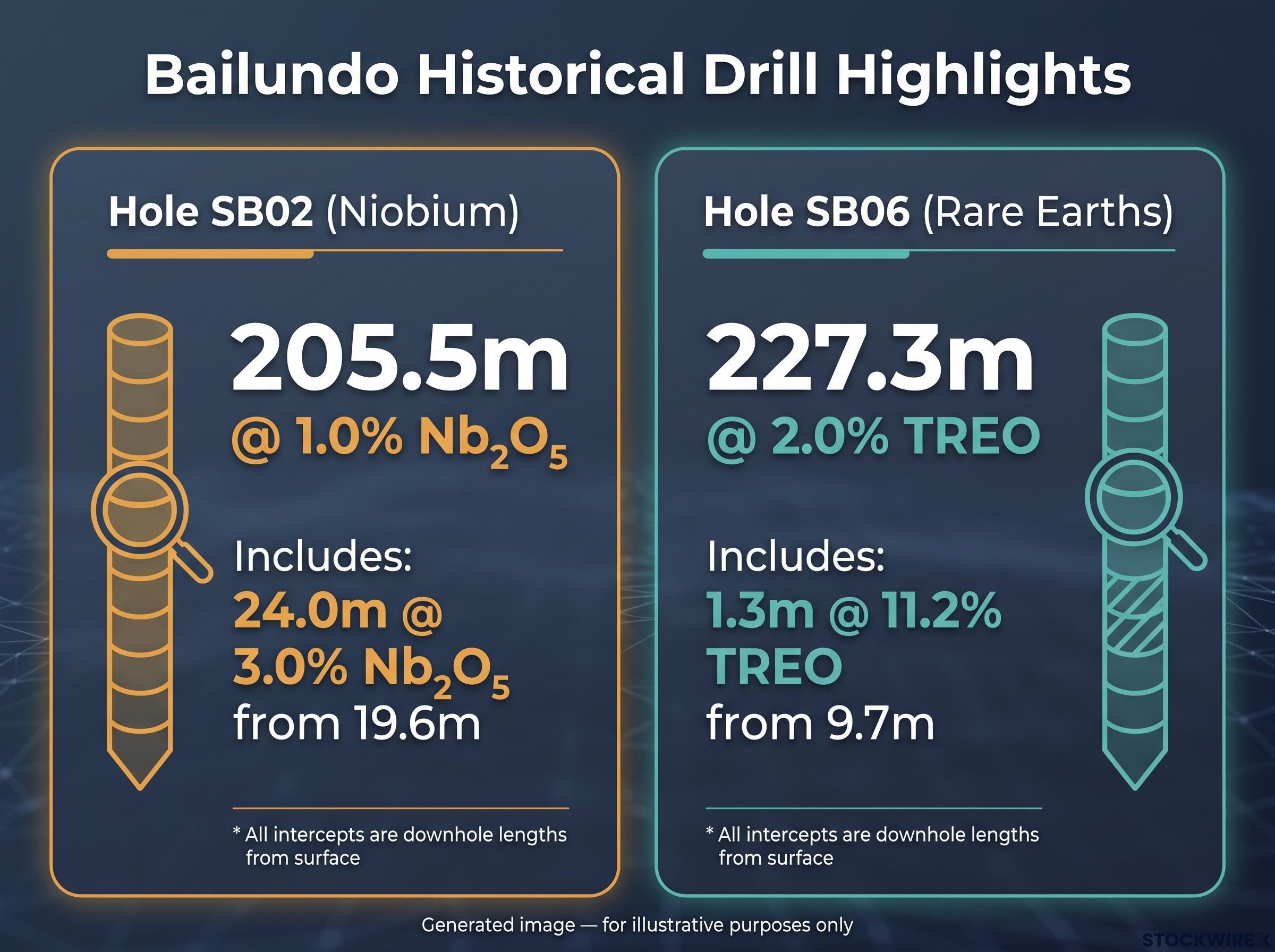
Historical data acquired: 205.5m at 1.0% Nb₂O₅ and 227.3m at 2.0% TREO
Headline historical intercepts are all downhole lengths from surface. Hole SB02 returned 205.5m @ 1.0% Nb₂O₅, including 24.0m @ 3.0% Nb₂O₅ from 19.6m. Hole SB06 returned 227.3m @ 2.0% TREO, including 1.3m @ 11.2% TREO from 9.7m.
For investors, ownership of the database allows the company to integrate these results with its ongoing drilling and technical studies. The historical data is being incorporated into the geological interpretation and current exploration planning, giving a basis for target refinement.
Stephen Wetherall, Chief Executive Officer
“Securing the historical exploration database represents an important step in drill targeting as we advance our exploration efforts…”
Mr Wetherall also said the results reinforce the company’s view that Bailundo “has the potential to be a significant niobium and rare earth opportunity…”
The acquisition covers:
- Geological mapping
- Soil and rock-chip geochemistry
- Historical diamond drilling data
- Drill-core photographs
- Geological and geotechnical logs
- Laboratory assay records and associated technical studies
The agreement also provides for delivery of remaining historical drill core, samples, pulps and rejects. Available petrographic, mineralogical and preliminary metallurgical studies are included as well.
When big ASX news breaks, our subscribers know first
Drilling results show broad, high-grade mineralisation from surface
Niobium and rare earth intersections
The historical programme comprised 10 diamond holes (SB01 to SB09 and SB11) totalling 3,414.4m. Assay records exist for six holes (~1,881m), and the compiled database holds 1,450 final core-assay records.
The tables below reproduce the source’s headline intersections for selected holes. Grades are Nb₂O₅ for niobium and TREO (total rare earth oxides) for rare earths.
| Hole | Element | Historical intersection | Included intervals |
|---|---|---|---|
| SB02 | Nb₂O₅ | 205.5m @ 1.0% from surface | 44.1m @ 2.2% from 10.6m; 24.0m @ 3.0% from 19.6m |
| SB01 | Nb₂O₅ | 59.6m @ 0.9% from surface | 19.5m @ 1.6% from surface; 4.1m @ 2.1% from 3.0m |
| SB06 | TREO | 358.9m @ 1.7% from surface | 227.3m @ 2.0% from surface; 49.5m @ 3.0% from surface; 17.4m @ 5.4% from surface; 1.3m @ 11.2% from 9.7m |
| SB03 | TREO | 121.3m @ 2.4% from surface | 71.3m @ 3.0% from surface; 7.4m @ 4.3% from 10.2m |
| SB04 | TREO | 201.8m @ 1.8% from surface | 118.4m @ 2.2% from surface; 65.4m @ 3.2% from surface; 28.2m @ 4.0% from surface; 12.9m @ 6.7% from surface |
All figures are downhole lengths. True widths and continuity have not been established.
The results include mineralised downhole intervals exceeding 200m in individual holes.
Mineralisation beyond the weathered profile
Historical assays and logging identify niobium and rare earth mineralisation in weathered carbonatite and in underlying less-weathered to fresh rock. The company says elevated grades are therefore not restricted to the weathered horizon.
The drilling and surface sampling also distinguish a Central/Southern niobium target from a Northern rare earth target. The complex is described as a zoned system roughly 7km in diameter, with substantial parts sparsely tested, particularly at depth.
Gallium (Ga) is flagged as an additional critical mineral exploration opportunity. Historical assays returned up to 167.5ppm Ga from 3.0m to 6.9m in SB04, within logged saprolite.
Surface geochemistry and unassayed core point to upside
Soil and rock-chip results
The historical data includes 1,089 soil and 458 rock-chip samples. The principal soil grid covers about 1.4km x 1.1km across the central carbonatite.
Key soil results include:
- 118 soil samples at or above 0.5% Nb₂O₅, with a peak of 1.43% Nb₂O₅, equal to the upper analytical reporting limit for niobium
- 339 soil samples at or above 1.5% TREO, with a peak of 3.36% TREO
- 687 samples at or above 0.2% NdPr (combined neodymium and praseodymium oxides), including 371 at or above 0.3%, with a highest result of 0.71% NdPr
Several of the highest assays reached upper analytical reporting limits. The company states that actual niobium concentrations in those samples may be higher than reported. It also says the calculated TREO grades for affected samples may represent minimum values, with the extent of any understatement yet to be determined.
Unassayed core
About 1,534m of historical drilling remains unassayed. This includes four entire holes (SB07, SB08, SB09 and SB11) totalling 1,046m, plus partly assayed holes SB02, SB03 and SB05.
The company intends to assess the remaining core for geological re-logging, systematic multi-element assaying, and mineralogical and metallurgical sampling. Selected historical samples may also be re-assayed to verify historical results and address the upper reporting limits.
What is carbonatite niobium and rare earth exploration?
Carbonatites are igneous rocks rich in carbonate minerals. Bailundo is described as a large, zoned carbonatite system prospective for niobium and rare earth elements.
Weathering matters because prolonged chemical weathering of carbonatite can remove more soluble components. That can leave a residual concentration or redistribution of niobium- and rare earth-bearing minerals, which is why the weathered profile (regolith) is a target. Weathering locally extends beyond 50m at Bailundo.
Nb₂O₅ is niobium pentoxide, calculated from elemental niobium assays. TREO is total rare earth oxides, including yttrium oxide, expressed as a weight percentage.
Mineralisation in both weathered and fresh rock is relevant to investors because processing characteristics may differ between the two. The company says drilling, mineralogical investigations and metallurgical studies will seek to establish distribution, continuity, mineral hosts and potential processing characteristics of the different domains.
Next steps at Bailundo
The source lists the following key activities, without stating dates:
- Diamond drilling: continue testing the lateral and vertical extent of niobium, rare earth and gallium mineralisation, including the relationship between weathered and fresh-rock domains.
- Historical core evaluation: review and re-log remaining core, undertake targeted assaying of unassayed intervals and selected confirmatory re-assaying, subject to core condition.
- Geological modelling: integrate historical and current drilling, geochemistry and geophysical data to refine lithological, weathering and mineralisation models.
- Mineralogical characterisation: investigate niobium-, rare earth- and gallium-bearing mineral phases across weathered, transitional and fresh-rock domains.
- Metallurgical investigations: undertake representative testwork on mineral deportment, liberation, potential processing pathways and recovery characteristics.
The company’s own maiden 6,000m drilling campaign is designed to test the Southern Zone niobium and Northern Zone rare earth targets, with holes planned to nominal depths of 50-75m and completion targeted ahead of the November wet season.
The historical results are exploration results and do not constitute a Mineral Resource or Ore Reserve estimate. The company states that further verification will be required before the historical data is relied upon for Mineral Resource estimation.
Connected Minerals holds an indirect 80% interest in the Bailundo Carbonatite Project.
The historical database adds to the project footprint following the completed acquisition of Bailundo in August 2026, which gave Connected Minerals an indirect 80% interest in the niobium and rare earth complex.
Don’t Miss the Next Niobium and Rare Earths Breakout
Join 20,000+ investors getting FREE breaking ASX news delivered to their inbox within minutes of release, complete with in-depth analysis. Click the “Free Alerts” button at Big News Blast to receive market-moving announcements the moment news breaks and stay ahead of the market.