
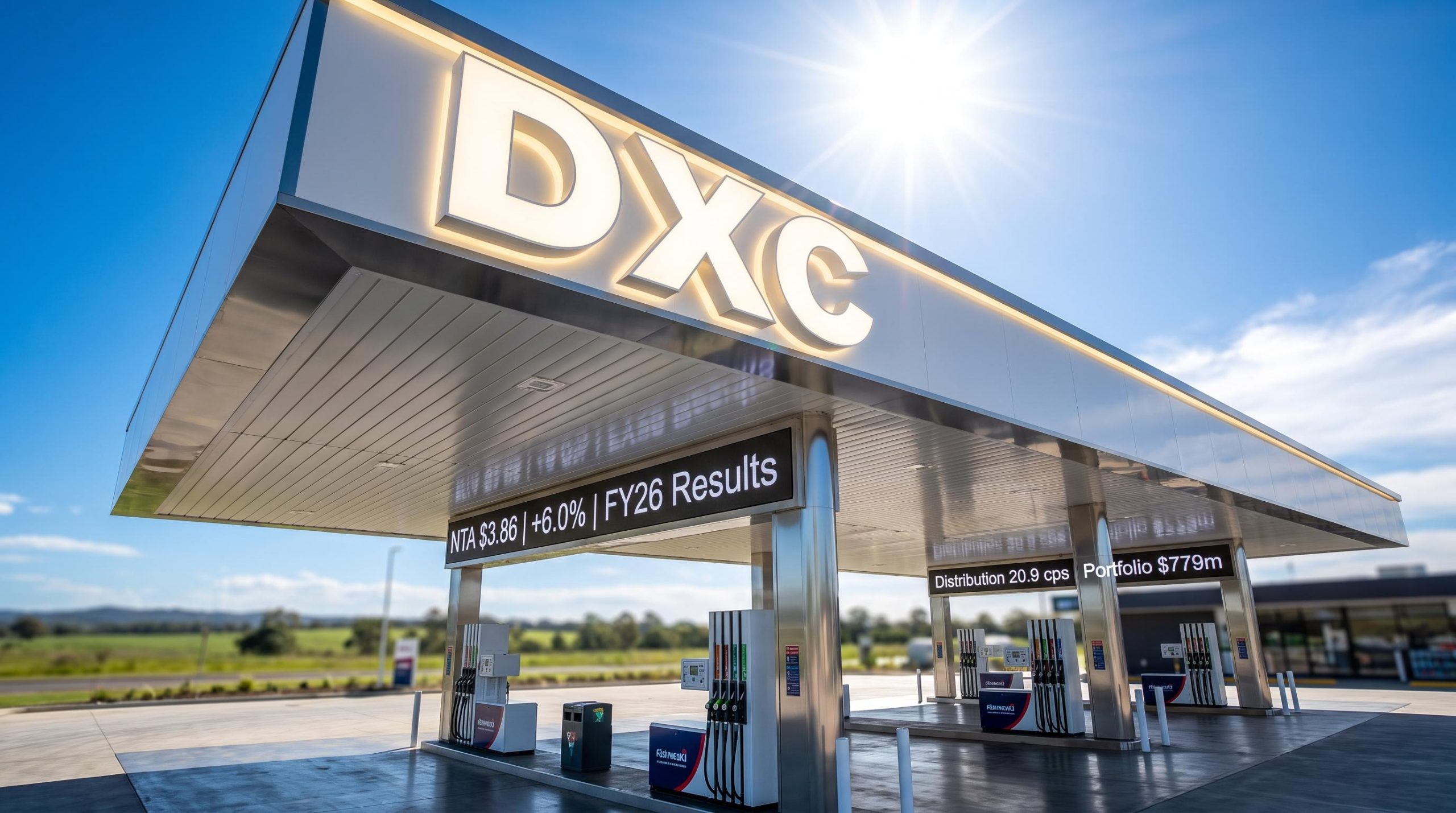
DXC delivers FY26 results in line with guidance as NTA climbs 6%
In its FY26 annual results presentation released on 10 August 2026, Dexus Convenience Retail REIT detailed a year of resilient income delivery, reporting funds from operations (FFO) and distributions of 20.9 cents per security (cps), in line with guidance despite higher interest rates.
The standout metric was net tangible assets (NTA) per security, which climbed 6.0% to $3.86, driven by a $27.4m valuation gain across the portfolio.
At 30 June 2026, the portfolio was valued at approximately $779 million across 91 assets, predominantly located on Australia’s eastern seaboard. Occupancy was maintained at 99.2% with a weighted average lease expiry (WALE) of 7.6 years, reinforcing the trust’s positioning as a defensive, income-focused vehicle executing on portfolio quality and capital discipline.
When big ASX news breaks, our subscribers know first
FY26 results highlights: resilient income and portfolio quality
Across the reporting period, DXC delivered income growth while enhancing portfolio quality through selective recycling and buy-back activity. Rent review outcomes and high occupancy underpinned the result.
Key achievements included:
- +3.0% like-for-like income growth
- +3.3% average rent review delivered
- 99.2% occupancy maintained with a 7.6 year WALE
- Lease terms agreed across 10 tenancies, including 9 extensions, with minimal incentives
- Three assets divested for $8.0m at a premium to book value
- 30.6% gearing, at the lower end of the 25-40% target range
- Securities buy-back doubled to 5%, with 60% of the initial 2.5% programme completed at an average price of $2.67
The three assets divested, located in Gwelup WA, Monto QLD, and Zilzie QLD, were sold at a 1.4% premium to their December 2025 book values, with proceeds directed into the on-market security buy-back rather than reinvested into new acquisitions.
The following table compares the headline financial metrics against the prior year.
| Metric | FY26 | FY25 | Change | Why it matters |
|---|---|---|---|---|
| FFO / distributions (cps) | 20.9 | 20.7 | +1.2% | Income maintained in line with guidance despite higher rates |
| NTA per security | $3.86 | $3.64 | +6.0% | Reflects valuation uplift from contracted rent growth |
| Property FFO | $44.7m | $44.0m | +1.5% | Driven by like-for-like income growth |
| Gearing | 30.6% | 29.4% | +1.2 ppts | Remains at the lower end of target range |
| Cost of debt | 4.8% | 4.5% | +0.3 ppts | Higher funding costs reduced by interest savings following divestments |
What convenience retail REITs offer investors
A convenience retail REIT owns fuel and convenience retail sites, such as service stations and roadside outlets, and leases them to operators under long-term agreements. The appeal for investors lies in predictable, contracted income.
Central to this model is the WALE, or weighted average lease expiry, which measures the average remaining lease term across a portfolio. A longer WALE signals greater income security. Leases typically feature contracted rental escalators, which are pre-agreed rent increases that can be fixed or linked to the Consumer Price Index (CPI), a measure of inflation.
For DXC, 73% of income is subject to fixed reviews growing at approximately 3.1% per annum, while 27% is CPI-linked. In a higher-rate environment, this contracted growth supports income durability.
The defensive income thesis rests on three pillars:
- Contracted income through fixed and CPI-linked rental escalators.
- Long WALE and high occupancy, providing income visibility.
- Blue-chip tenant covenants from well-capitalised operators.
Many leases are structured as double net or triple net arrangements, where tenants cover most property outgoings, meaning minimal capital requirements for the landlord. Structurally, around 21 million fuel-reliant vehicles remain on Australian roads versus roughly 450,000 EVs (approximately 2% of the fleet), suggesting fuel demand remains resilient even as operators diversify.
Blue-chip tenants investing beyond fuel
Income security is underpinned by large-cap, well-capitalised operators, with 95% of income sourced from major domestic and international operators across 62 tenant operators. These operators are increasingly diversifying earnings beyond fuel into quick-service restaurants (QSR), convenience retail and EV charging, which supports the durability of DXC’s income base.
The presentation noted several operator initiatives. Viva Energy is targeting more than 50% non-fuel earnings, Ampol completed its EG Australia acquisition, and bp is targeting a doubling of its network by 2030. ENEOS Holdings has agreed to acquire Chevron’s Australia and South-East Asia fuel business for approximately $3.3b, expected to complete in 2027 subject to regulatory approval, with the Caltex brand to be retained.
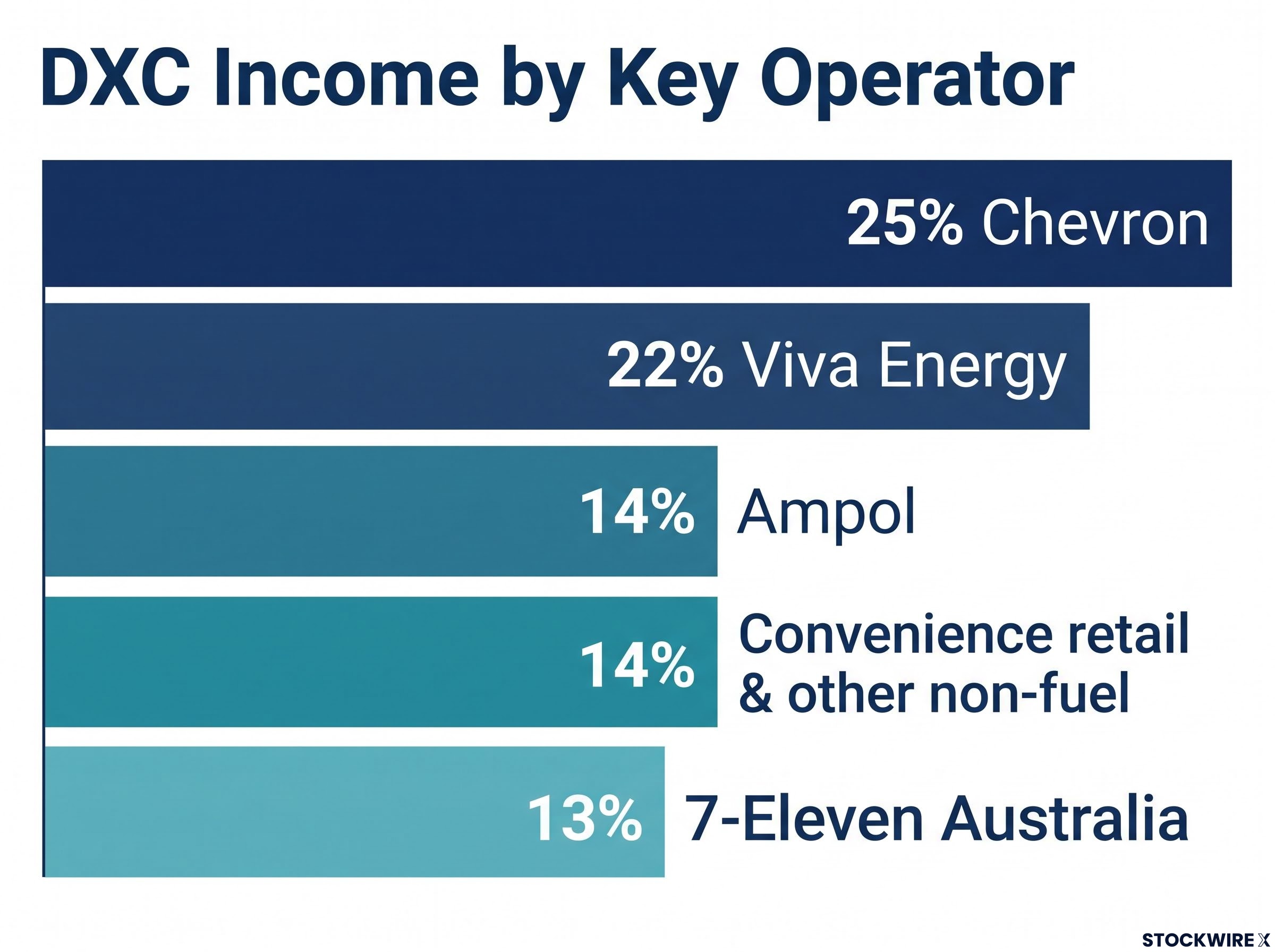
Income by operator was distributed as follows:
- Chevron: 25%
- Viva Energy: 22%
- Ampol: 14%
- 7-Eleven Australia: 13%
- Convenience retail and other non-fuel: 14%
Development pipeline and portfolio evolution
A key portfolio quality milestone during the period was the completion of the Glass House Mountains Northbound development. The asset is fully operational and income generating, with Viva Energy / OTR and Hungry Jack’s trading alongside McDonald’s, KFC and Guzman y Gomez.
The completed development delivered:
- $25m project cost
- 17% development project IRR
- 5.8% yield on cost
- 18-year WALE
- 43% QSR income
Looking ahead, the fund-through development pipeline is positioned to support future income. DXC has exchanged contracts on two fund-through acquisitions, Mayfield NSW and Bulahdelah NSW, which remain subject to conditions precedent.
Portfolio curation over FY22 to FY26 saw approximately $108m of assets divested and redeployed into a development pipeline of around $95m alongside the securities buy-back, enhancing the trust’s metro and highway-focused profile.
The investment case and FY27 outlook
DXC frames its investment proposition around high yield, secure income and value upside. Based on the closing security price as at 7 August 2026, the trust offered a distribution yield of approximately 7.8% while trading at around a 30.8% discount to NTA.
The value proposition is anchored by the following characteristics:
- ~7.8% distribution yield (based on the 7 August 2026 closing price)
- ~30.8% discount to NTA (based on the 7 August 2026 closing price)
- 7.6-year WALE with occupancy above 99%
- Approximately 33% tax-deferred distributions
For FY27, and barring unforeseen circumstances, distributions are expected to be maintained at 20.9 cps. DXC has updated its distribution policy to target a payout ratio of 95-110% of FFO, with distributions expected to be modestly above 100% of FFO in FY27 as the fund transitions to a higher interest rate environment.
With minimal near-term lease expiries and no significant expiries until FY32+, the trust positions itself as one of the highest-yielding in the sector trading at a discount to underlying asset value, with income visibility underpinned by contracted growth.
Don’t Miss the Next ASX REIT Opportunity
Big News Blast delivers FREE breaking ASX announcements straight to your inbox within minutes of release, complete with in-depth analysis already done for you. Join 20,000+ investors staying ahead of the market across REITs and beyond. Click the “Free Alerts” button to start receiving real-time coverage the moment news breaks.