
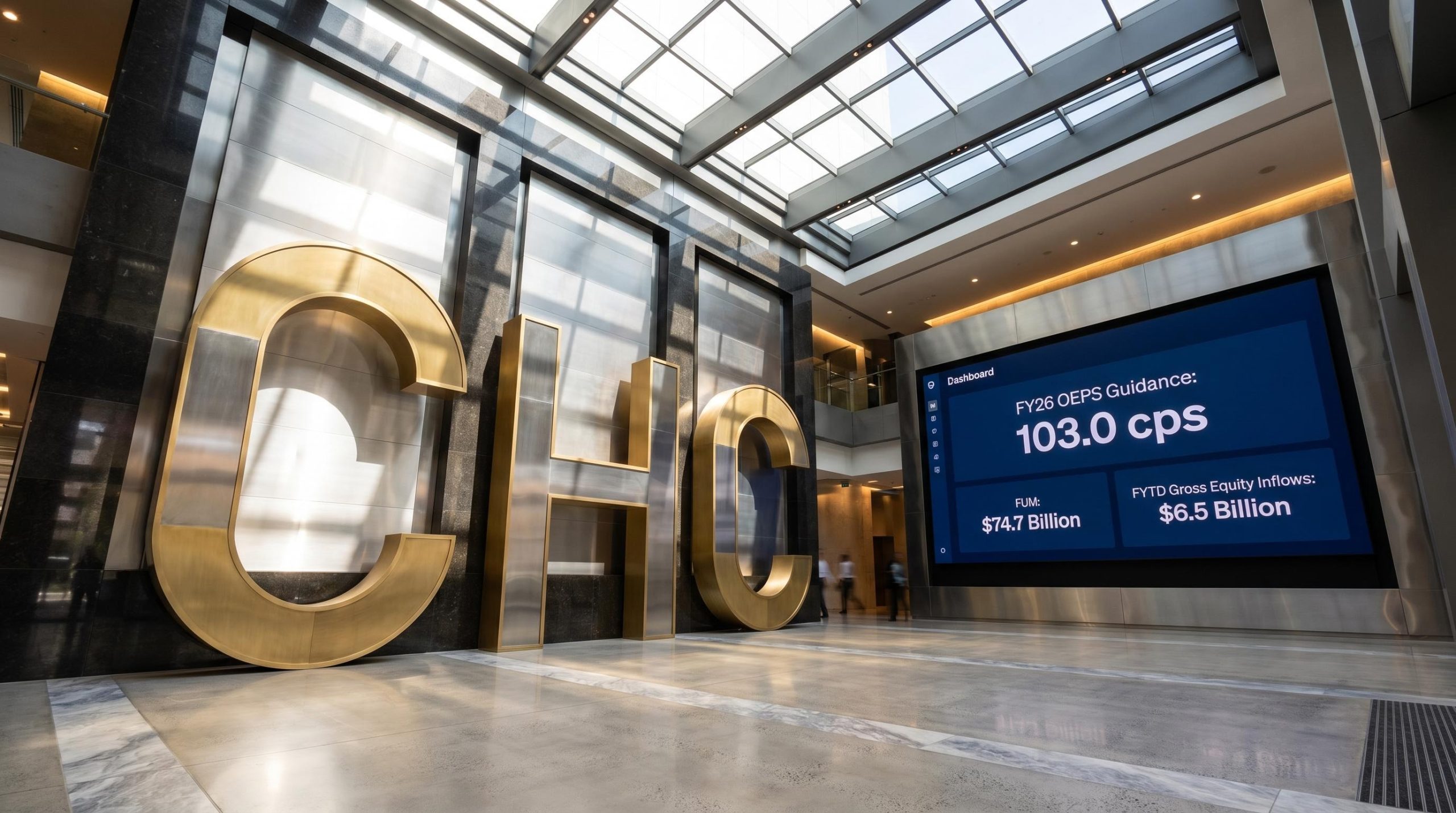
Charter Hall lifts FY26 earnings guidance to 103.0 cents per security
Charter Hall Group (ASX: CHC) has announced a further 3.0% upgrade to its FY26 operating earnings per security (OEPS) guidance, lifting the target from 100.0 cents to 103.0 cents per security on 25 May 2026. The upgrade assumes no material adverse change in market conditions and nil contribution from performance fee revenues.
The revised guidance represents a 26.5% increase on FY25 OEPS of 81.4 cents per security and a 35.6% increase on FY24 OEPS. Underpinning the upgrade are $6.5 billion in financial year-to-date (FYTD) gross equity inflows and funds under management (FUM) now standing at $74.7 billion. FY26 distribution per security (DPS) guidance remains at 6% growth over FY25, extending the Group’s consecutive DPS growth record to 15 years.
When big ASX news breaks, our subscribers know first
Platform momentum driving the upgrade
$6.5 billion in equity inflows — the Group’s strongest capital-raising year in 35 years
FYTD gross equity inflows have reached $6.5 billion, representing an increase of $1.7 billion since 1H FY26. Management has described FY26 as set to be the strongest year of capital raising in the Group’s 35-year history.
Growth has been driven by two complementary forces: existing institutional clients increasing their allocations within current investments, and capital diversifying into additional Charter Hall managed strategies and sectors. Over the last 18 months, 25 new institutional investors have been added to the platform, including several making initial allocations to the Australian property sector.
FUM reaches $74.7 billion on active deployment
FUM has increased to $74.7 billion, up from $71.7 billion as at 31 December 2025. The Group attributes this growth to disciplined capital deployment targeting high-quality assets with long weighted average lease expiries (WALEs) and strong tenant covenants.
Key activity during 2H FY26 to date includes:
- A new $1.2 billion diversified core direct institutional real estate mandate, following the $2.1 billion mandate secured in 1H FY26, bringing the combined total to $3.3 billion of additional FUM
- Acquisition of The O’Connell Precinct (TOP) for a total value of $1.15 billion (100%) as a new institutional Sydney CBD office partnership, comprising a strategic consolidated 6,750 sqm land holding with Stage 1 planning approval for a 130,000 sqm NLA precinct
- Launch of IP6, a new institutional industrial partnership with an initial $600 million in end-value projects, structured as CPIF (50%) and a domestic institutional partner (50%), focused on pre-leased, long WALE logistics developments
- Establishment of Charter Hall Inflation Protected Partnership 1 (CHIP1), an institutional social infrastructure partnership seeded with a life science asset on a 20-year NNN lease
- Launch of Telco Exchange Fund No.2 (TEF2) by Charter Hall Direct, achieving full reservation of its $82 million equity raising, oversubscribed within weeks
| Metric | FY24 | FY25 | FY26 Guidance |
|---|---|---|---|
| OEPS (cps) | 75.96 cps (implied) | 81.4 cps | 103.0 cps |
| OEPS growth (%) | – | – | +26.5% on FY25; +35.6% on FY24 |
| DPS growth (%) | 6% p.a. (10-year track record) | 6% p.a. | 6% growth over FY25 |
| FUM ($bn) | – | $71.7bn (31 Dec 2025) | $74.7bn |
What is operating earnings per security — and why does the upgrade matter?
Operating earnings per security (OEPS) is the core profitability metric used by ASX-listed property and funds management groups. Unlike statutory profit, OEPS excludes non-cash items such as unrealised property revaluations and amortisation charges, focusing instead on the recurring income generated by the business. This makes it the preferred measure for assessing the underlying earnings quality of a platform like Charter Hall’s.
For investors, a mid-cycle guidance upgrade carries considerable weight. It signals that management holds sufficient visibility over near-term earnings to revise targets upward with conviction, rather than simply maintaining prior guidance as a precaution. When that upgrade also assumes nil performance fee revenues, the implication is that the core recurring earnings base, drawn from base funds management fees, property services income, and co-investment returns, is performing ahead of earlier expectations.
Charter Hall’s upgrade from 100.0 cps to 103.0 cps mid-cycle reflects exactly this dynamic. The 15-year consecutive DPS growth track record further reinforces the consistency of the earnings engine that underlies distributions.
David Harrison, Managing Director and Group CEO, Charter Hall
“Australia continues to attract institutional capital as a stable and highly dependable real asset market. We are seeing increased allocations from existing institutional investors alongside new domestic and offshore inflows seeking diversified exposures.”
Outlook and the road to FY27
Management has framed the forward earnings trajectory around a compounding growth thesis. Gross equity inflows typically support earnings growth in subsequent periods due to the annualised impact of a growing platform, meaning the $6.5 billion raised in FY26 is expected to contribute meaningfully to earnings in FY27 and beyond.
On the deployment side, several additional industrial partnerships beyond IP6 are described as well advanced for targeted deployment in FY27, suggesting the pipeline of FUM-generating activity remains active.
Management also flagged a potential structural tailwind from recent Federal budget changes. Amendments to capital gains tax and negative gearing arrangements for the residential property sector are expected to reduce the income returns and tax advantages of residential investment. Charter Hall’s view is that this could drive a rotation of capital demand toward higher-yielding commercial assets, particularly retail, industrial, social infrastructure, and office properties secured on long lease contracts with fixed and inflation-linked annual rental growth.
The Group is positioned as Australia’s largest diversified manager of attractive yielding real estate, active across both public and private markets. Full-year FY26 results are scheduled for release on Thursday, 20 August 2026.
David Harrison, Managing Director and Group CEO, Charter Hall
“With $6.5 billion in FYTD inflows, FY26 is set to be the strongest year of capital raising in the Group’s 35-year history.”
Don’t Miss the Next Real Estate & Finance Mover on ASX
Big News Blast delivers FREE breaking ASX announcements straight to your inbox within minutes of release, complete with in-depth analysis already done for you. Join 20,000+ investors who stay ahead of the market the moment news drops. Click the “Free Alerts” button at Big News Blast to start receiving real-time coverage today.