
FY26 results land at upper end of guidance as defence momentum builds
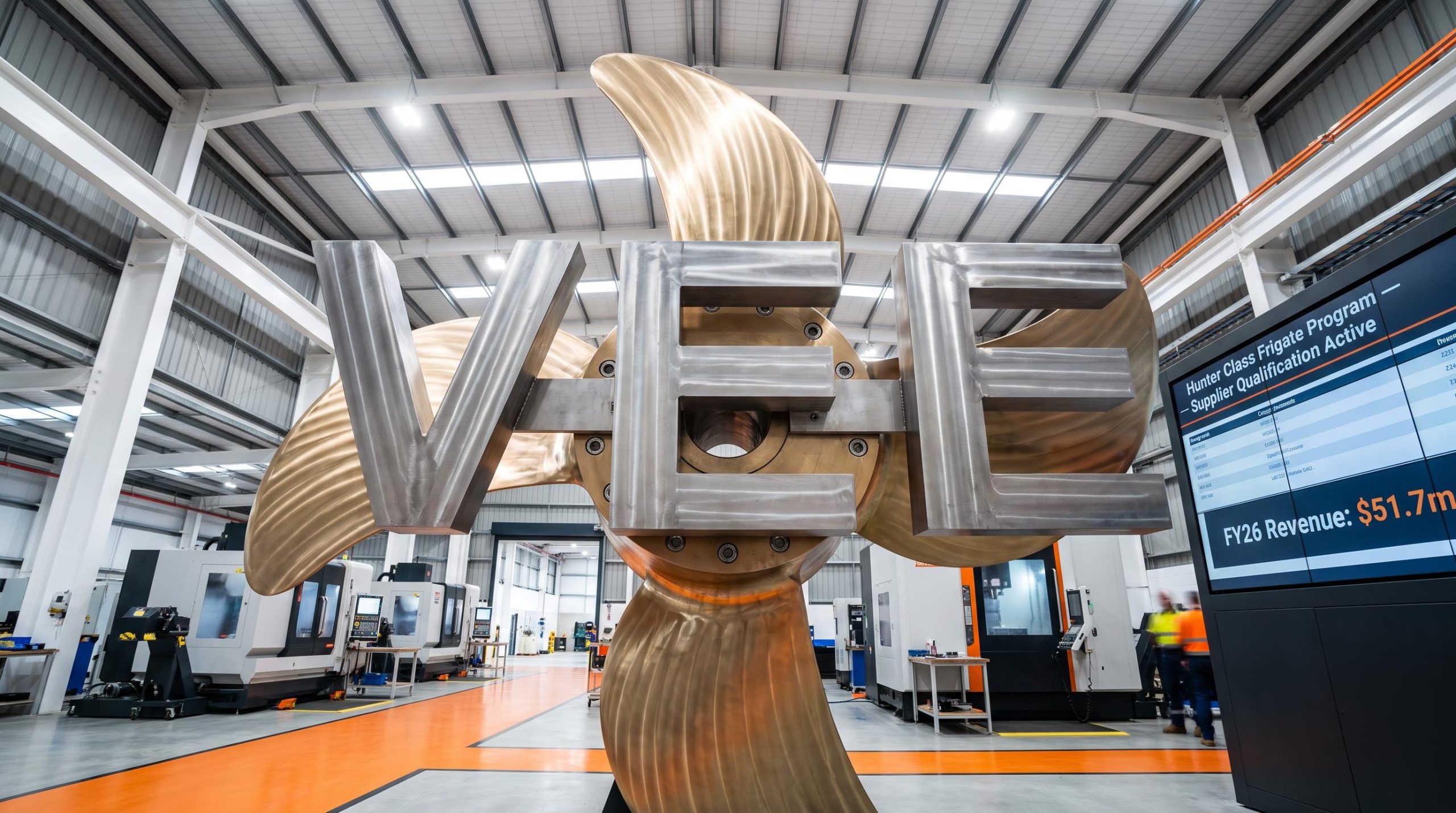
VEEM Limited (ASX: VEE), an Australian Defence manufacturer and designer of marine propulsion and large gyrostabiliser systems, delivered FY26 full-year revenue of $51.7m, landing at the upper end of its $50m–$52m guidance range for the year ended 30 June 2026.
Underlying operating momentum built through the second half, though the statutory result was weighed down by a one-off non-cash impairment. On a full-year basis, revenue was down 25% on FY25, reflecting a soft first half before deliveries accelerated.
Key FY26 full-year figures included:
- EBITDA of $3.6m, at the upper end of the $3.25m–$3.75m guidance range
- Cashflow from operations of $4.8m, up 64% on the prior comparable period
- Net loss after tax (NLAT) of $17.8m, versus a $3.0m profit after tax in FY25
- Net debt of $1.2m at 30 June 2026, reduced by $12.5m
The statutory loss stemmed from a one-off non-cash impairment of $24.8m relating to gyrostabiliser items, recognised in the first half. This accounting charge is separate from the company’s underlying operating trajectory, which strengthened materially across the second half.
When big ASX news breaks, our subscribers know first
The second-half turnaround: where the real story is
FY26 was characterised by a weak first half followed by a marked recovery. Deliveries accelerated through 2HFY26, driven by rising defence workloads and increased propeller orders as the marine market began to recover.
Second-half revenue reached $28.3m, up 21% on 1HFY26. EBITDA of $3.8m in 2HFY26 represented a $4.0m improvement on the first half. Defence revenue climbed from $3.7m in 1HFY26 to $8.6m in 2HFY26, an increase of 130%.
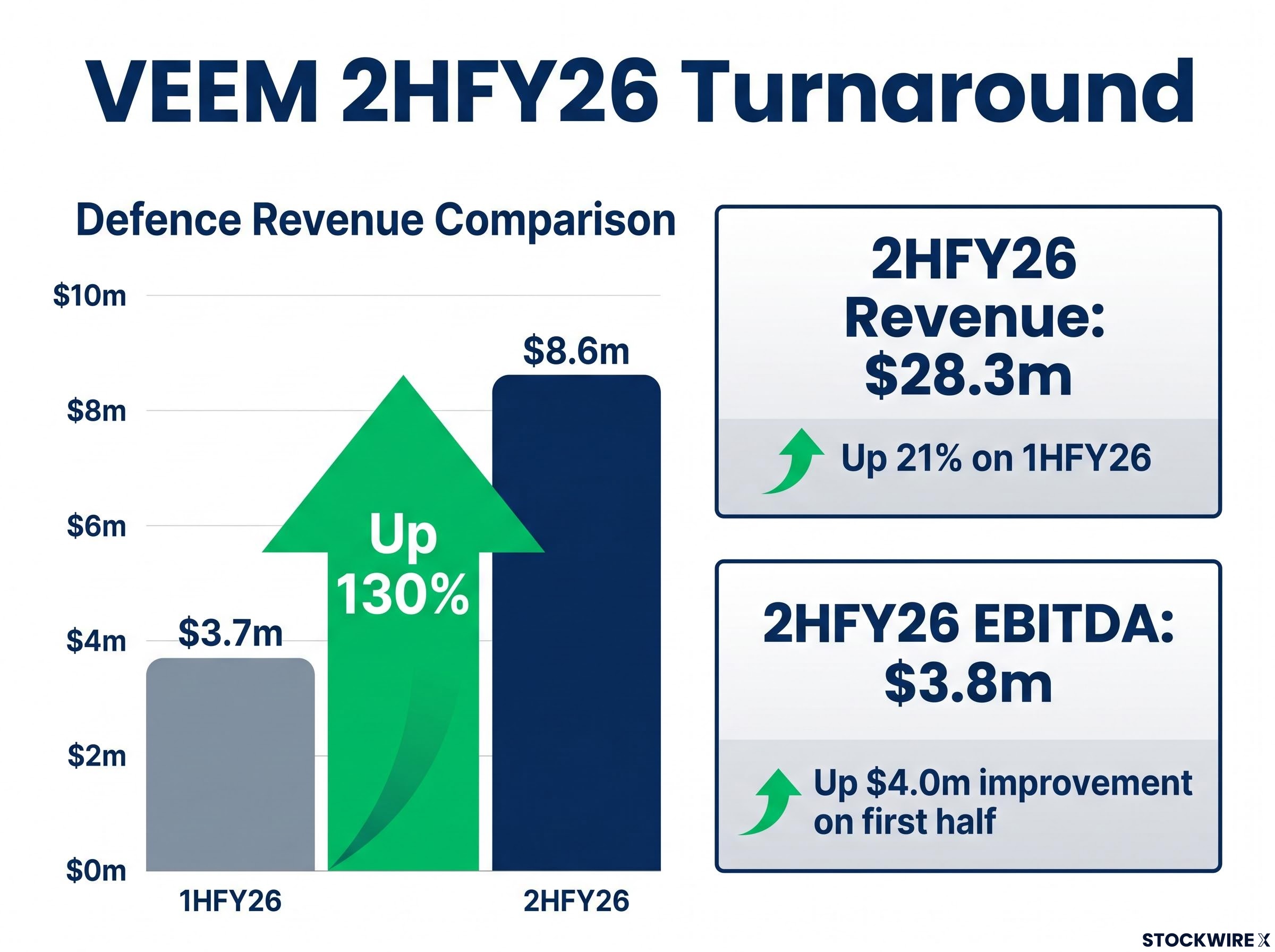
VEEM attributed the improvement to cost-reduction measures implemented at the end of 2025, economies of scale from higher activity, the submarine refit programme (ASC orders), rising propeller orders, and continued automation efficiencies.
| Metric | 1HFY26 | 2HFY26 | Trend/Change | Investor takeaway |
|---|---|---|---|---|
| Revenue | Not disclosed | $28.3m | Up 21% | Momentum returning to the top line |
| EBITDA | Not disclosed | $3.8m | Up $4.0m | Cost measures and scale flowing through |
| Defence revenue | $3.7m | $8.6m | Up 130% | Submarine refit deliveries ramping |
Understanding the gyro impairment (and why it’s non-cash)
Gyro sales below budget in 1HFY26 acted as an impairment indicator, triggering an impairment test. The result was a combined $24.8m charge, comprising $24.2m of gyro capitalised development costs and $0.6m of obsolete inventory, all recognised in the first half.
Gyro revenue was down $9.5m compared with FY25, primarily due to the marine market slowdown, which resulted in no gyro sales during 1HFY26. Sales resumed in 2HFY26, with a current gyro order book of $1.0m. Sales are expected to pick up with the rollout of the Mark III range launched in FY26.
Key features of the Mark III range include:
- New oiling system (patent pending): elimination of seals means no scheduled maintenance and 20% less power usage
- Custom low-friction bearings: 20% additional power reduction for small and mid-frame models
- Internal fluid galleries: reduces assembly time
Defence and the Hunter Class opportunity
The forward-looking defence thesis centres on the Hunter Class Frigate Program (HCFP). VEEM has received the final technical specification for the blades and hubs for the HCFP demonstrator for BAE Systems Australia, which took longer than initially envisioned.
Successful completion would confirm VEEM as a qualified supplier, making it one of only two suppliers globally able to produce this level of precision and move to the final tender stage. This is expected to lead to other defence opportunities.
Alongside the frigate opportunity, the submarine refit programme (ASC orders) drove the surge in 2HFY26 defence revenue. Deliveries into these orders gathered pace through the half and are expected to remain strong into 1HFY27.
VEEM Extreme propulsion: opening new markets
The launch of the VEEM Extreme propulsion range emerged as a commercial growth driver during the year. The range demonstrated 24.1% fuel savings against a standard setup, comprising propeller (11.9%), rudder (6.2%) and bracket (6.0%) contributions.
Manly Fast Ferries is the launch customer, with the rollout expected to gather pace in FY27. The range opens the existing vessel and slow-boat market that was previously unavailable to VEEM.
Revenue from engineering products and services, including hollow bar, was $14.3m, down 14% on FY25 as defence utilised a greater share of capacity in 2HFY26 to meet demand.
Balance sheet strengthened for US defence push
During the year, VEEM raised $13.1m net of costs in anticipation of growth via entry into US defence. The Miocevich family contributed $1.0m as part of the capital raising.
This strengthened the balance sheet and reduced net debt to $1.2m at 30 June 2026, even after $2.4m in additional asset-related debt was taken on. VEEM also held $7.1m in combined undrawn overdraft and trade facilities at 30 June 2026.
Reinvestment was directed across capital equipment and research. Over $2.5m was invested in capital equipment, primarily a 3D printer and propeller tooling, while $4.5m was spent on formal research and development as the VEEM Extreme and Mark III gyro programmes were completed.
The factory extension was completed and handed over in June. Three CNC machines have been delivered, with installation and commissioning advanced and expected to be complete in September, accommodating potential increases in conventional propeller demand and higher-volume VEEM Extreme deliveries.
What FY26 sets up for FY27
With development costs rolling off, management framed the year as a transition now behind the company, shifting focus toward commercialisation.
Mark Miocevich, Managing Director
“FY26 was a transitional year which saw the completion of development of the VEEM Extreme propulsion range and Mark III gyro. With those costs rolling off our focus is now on commercialising and rolling out the products and contributing to growth in FY27.”
The outlook points to several potential tailwinds for FY27: a recovering marine market with propeller orders continuing into the new year, sustained ASC and defence deliveries, the VEEM Extreme rollout, Mark III commercialisation, and the potential Hunter Class qualification milestone. Whether these translate into sustained earnings growth will depend on execution across the coming period.
Don’t Miss the Next ASX Defence Winner
Big News Blast delivers FREE breaking ASX news straight to your inbox within minutes of release, complete with in-depth analysis already done for you. Join 20,000+ subscribers already getting an edge on the market. Click the “Free Alerts” button at Big News Blast to make sure the next major defence or manufacturing announcement lands in your inbox the moment it breaks.