
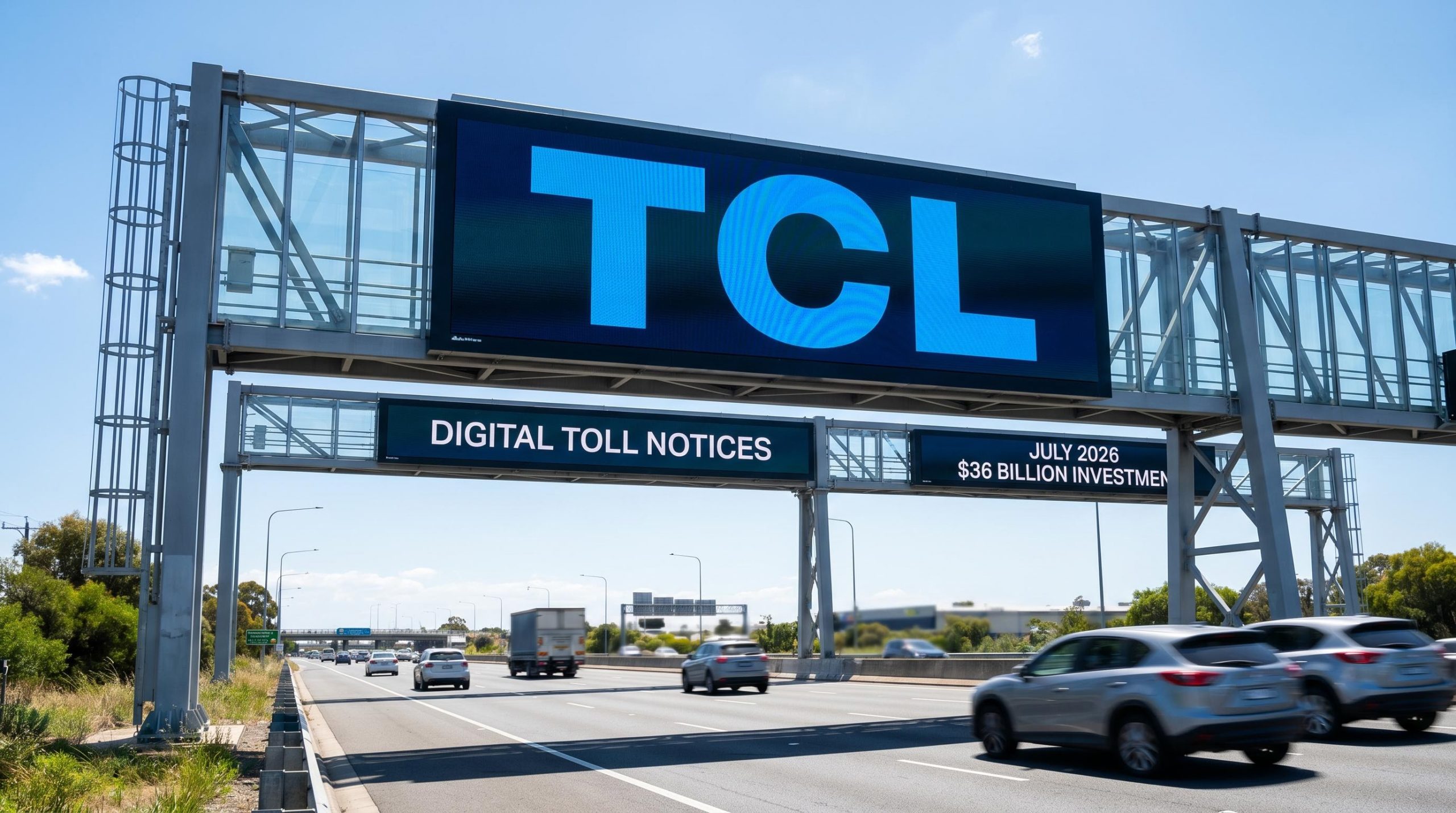
Transurban and NSW Government announce digitisation of toll notices
Transurban and its investment partners have agreed with the NSW Government to a comprehensive overhaul of the unpaid tolls framework for NSW toll roads. Paper toll notices and their corresponding toll notice administration fees will be switched off and replaced by digital notifications via email and SMS where contact details are available. These changes are expected to be phased in during July 2026.
The reforms are described as “the most significant improvement of unpaid tolling processes and enforcement in more than a decade.” The announcement sits within broader Toll Reform discussions, with a final package expected to be announced “over the coming weeks.”
For investors, this signals constructive engagement between Transurban and the NSW Government. The changes are designed to protect the $36 billion investment by Transurban and its partners in Sydney’s road network while delivering operational efficiencies.
When big ASX news breaks, our subscribers know first
What the new toll payment process looks like
The reform is built on five key pillars:
- Transition to digital notifications via email and SMS
- Earlier communication with motorists
- Switching off toll notice administration fees
- Clear consequences for people who refuse to pay their tolls
- Support for motorists in financial hardship
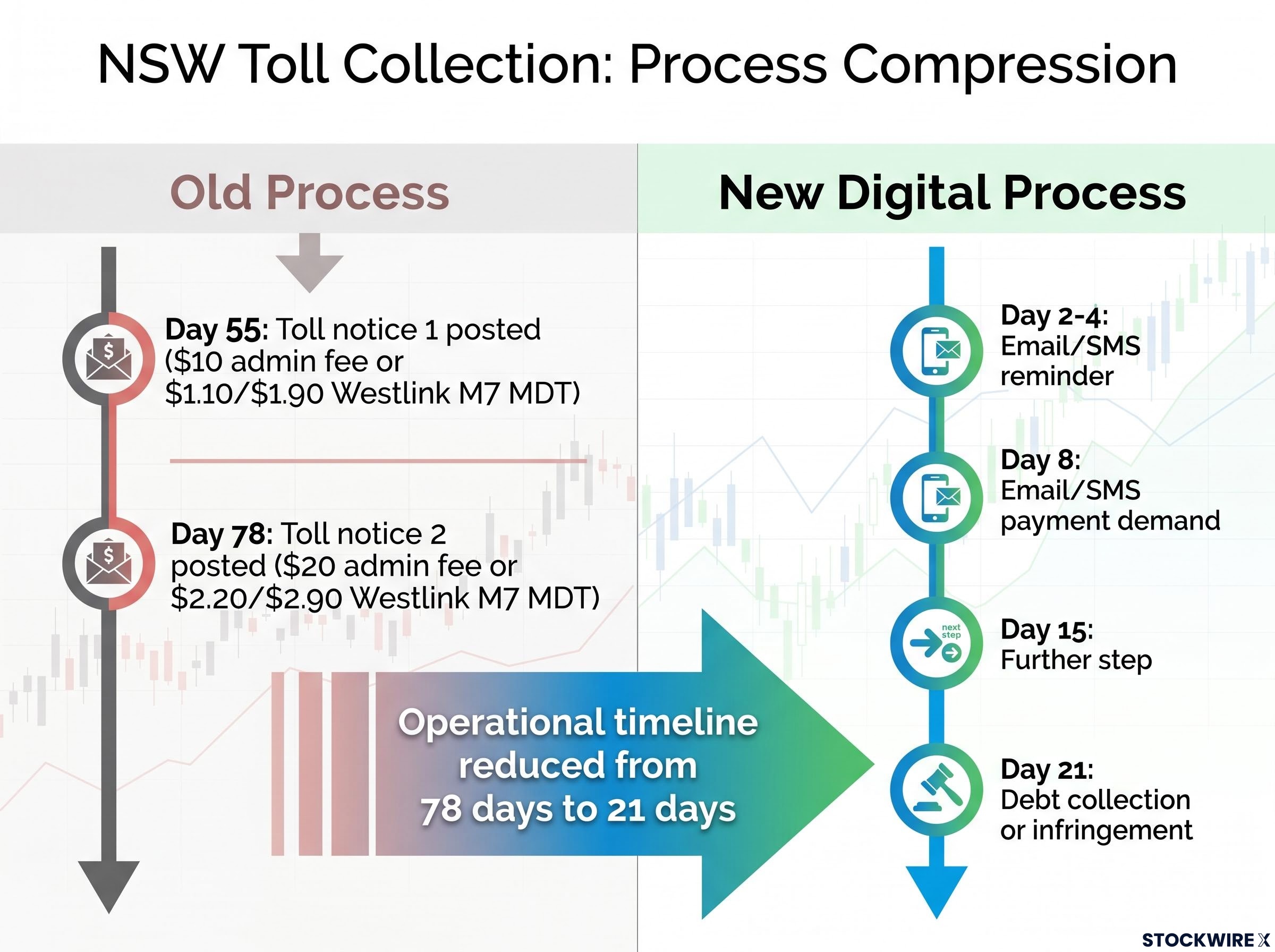
The new process compresses the communication timeline and eliminates paper-based notices entirely. Under the old system, motorists received two posted toll notices at day 55 and day 78, each carrying administration fees of $10 and $20 respectively (or $1.10 (or $1.90 for Westlink M7) and $2.20 (or $2.90 for Westlink M7) MDT). Under the new system, motorists receive an email or SMS reminder at day 2-4, a payment demand at day 8, a further step at day 15, and face debt collection or infringement at day 21.
| Stage | Old Process | New Process |
|---|---|---|
| Day 2-4 | — | Email/SMS reminder |
| Day 8 | — | Email/SMS payment demand |
| Day 15 | — | — |
| Day 21 | — | Debt collection/Infringement |
| Day 55 | Toll notice 1 posted (**$10** admin fee or **$1.10** (or **$1.90** for Westlink M7) MDT) | — |
| Day 78 | Toll notice 2 posted (**$20** admin fee or **$2.20** (or **$2.90** for Westlink M7) MDT) | — |
The compressed timeline and removal of paper notices represents material operational cost savings. Millions of toll notices were sent in FY26, with digital channels expected to significantly reduce paper-based toll notices. This efficiency gain flows directly to the bottom line.
The Westlink M7 refinancing, which secured a A$300 million syndicated bank facility maturing April 2029, removed near-term rollover risk for one of the Sydney assets directly named in the new toll notice fee structure.
What is toll road digitisation and why does it matter?
Toll road digitisation refers to the replacement of physical posted toll notices with electronic communications sent via email and SMS. For motorists, this means faster, clearer communication about unpaid tolls. For the toll operator, it eliminates the administrative overhead associated with printing, posting, and processing paper notices.
Toll roads are infrastructure assets where operating efficiency directly impacts margins. Reducing administrative overhead from paper notices and associated fees simplifies the cost base without compromising revenue collection. The changes are “consistent with the Government’s commitment to respecting the value of existing contracts and the revenue of concessionaires.”
From an investor perspective, digitisation aligns operational processes with modern customer expectations while protecting concession economics. The dual benefit of improved customer experience and reduced operating costs strengthens the investment case for toll road operators.
Contingencies and broader Toll Reform context
The commencement of these reforms is subject to finalisation of updated administrative arrangements and systems with Transport for NSW, anticipated for July 2026. Crucially, the continuity of these reforms is contingent on broader Toll Reform outcomes being concluded and taking effect between private toll road concessionaires and the NSW Government.
The enforcement reforms “mark one of the last steps towards a final Toll Reform package, expected to be announced over the coming weeks.” The collaborative framing is significant. Transurban, together with its investment partners, has worked constructively with the NSW Government throughout the reform process.
For investors, this provides clarity that negotiations are progressing positively. The broader Toll Reform package announcement in coming weeks will deliver the full picture of how these changes fit within the wider concession framework.
What this means for Transurban shareholders
The key investment implications are:
-
Operational efficiency gains from eliminating paper notices and administration fees. Digital channels are materially cheaper to operate at scale.
-
Protection of capital deployed in Sydney’s road network. The reforms explicitly protect the $36 billion investment by Transurban and its partners.
-
Constructive government relationship demonstrated through the collaborative reform approach. This reduces regulatory risk and signals a stable operating environment.
-
Improved collection rates may follow from the compressed timeline and clearer enforcement consequences. Motorists who refuse to pay face defined penalties, while hardship support targets those who genuinely cannot pay.
-
Final conclusions on financial impact await the broader Toll Reform package announcement in coming weeks. Investors should monitor that release for comprehensive detail on revenue and cost implications.
The announcement positions Transurban as an active participant in modernising NSW toll infrastructure, rather than a passive recipient of regulatory change. This bodes well for the long-term sustainability of the concession arrangements.
The digitisation reforms sit alongside a broader operational push across Transurban’s Sydney network, where the M7-M12 Integration Project opened to traffic in June 2026, adding capacity for up to 30,000 additional vehicles per day across 26 kilometres of motorway.
Don’t Miss the Next Infrastructure Winner
Join 20,000+ investors getting FREE breaking ASX news delivered to your inbox within minutes, complete with in-depth analysis. Click the “Free Alerts” button at Big News Blast to start receiving alerts the moment market-moving announcements drop across Infrastructure, Healthcare, Tech, and beyond.