
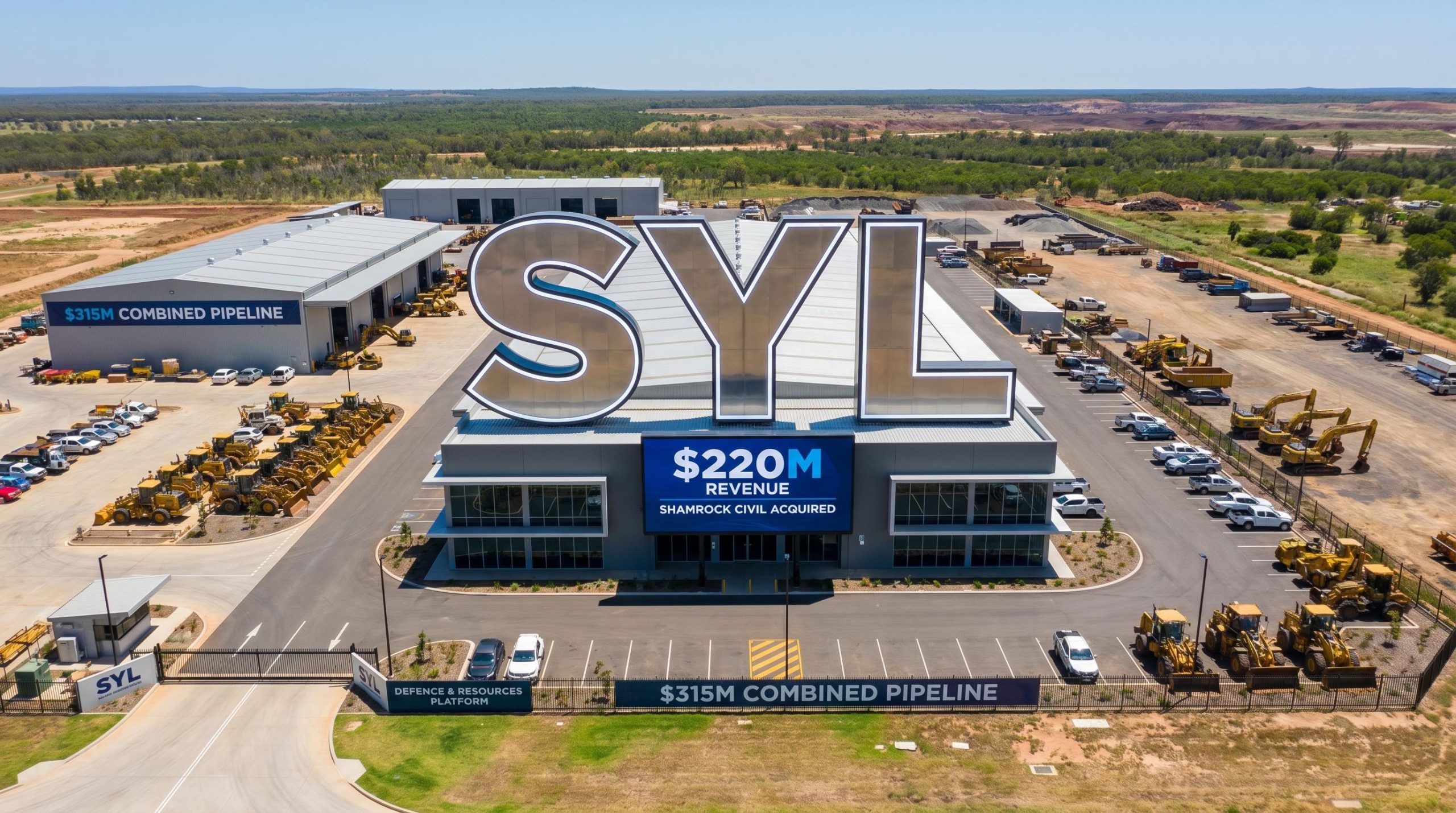
Symal acquires Shamrock Civil, creating a scaled defence and resources platform
In its June 2026 investor presentation, Symal Group Limited outlined its agreement to acquire 100% of the Shamrock Group, a Queensland-headquartered civil contractor with 30+ years operating history and a 200+ workforce. The presentation detailed how Shamrock brings approximately $220m in annual revenue (with approximately 50% from defence), FY26e EBITDA of $16m (representing a 7.3% margin), and a combined work-in-hand and tendered pipeline of approximately $315m — with approximately 85% in defence and resources sectors.
Management highlighted that the transaction is earnings per share accretive in Symal’s first full year of ownership. The combined pipeline positions the enlarged group ahead of a structural multi-decade spending uplift in defence and gas infrastructure, with Shamrock bringing established credentials rather than speculative exposure.
The presentation emphasised Shamrock’s positioning as a self-performing, founder-led business with recurring revenue at scale. The acquisition represents a platform-level transformation for Symal, adding a credentialed defence contractor with proven delivery relationships across Department of Defence, Aurecon, BESIX, Watpac, Lendlease, Laing O’Rourke, CPB, Sitzler, and Hansen Yuncken.
When big ASX news breaks, our subscribers know first
Deal structure and funding
The presentation outlined a total upfront consideration of $51m, comprising $40.8m cash and $10.2m in fully paid ordinary SYL shares held in escrow for two years. Of this upfront amount, $16.1m in payments are deferred pending the finalisation of a commercial and legal matter, with resolution currently expected in late 2026.
Management outlined a performance-based earn-out structure tied to FY26 and FY27 EBITDA delivery. The earn-out is calculated at 4x EBITDA above a threshold level, capped at $28.4m, and structured as 80% cash and 20% scrip. The arrangement aligns vendor incentives with post-completion performance while preserving Symal’s balance sheet capacity.
The presentation stated that the acquisition will be cash funded from Symal’s existing balance sheet, with post-completion leverage remaining well within target levels. The transaction is subject to customary prerequisites including ACCC approval.
Symal’s 1H FY26 results reported record revenue of $504.2 million alongside a net cash position and reaffirmed EBITDA guidance of $117-127 million, the balance sheet strength underpinning the group’s ability to fund the Shamrock acquisition without a dilutive capital raise.
| Component | Details |
|---|---|
| Upfront Consideration | $51m total: $40.8m cash + $10.2m SYL shares (2-year escrow). $16.1m deferred pending matter resolution (expected late 2026) |
| Earn-Out | FY26 & FY27 performance-based at 4x EBITDA above threshold, capped at $28.4m (80% cash / 20% scrip) |
| Funding Source | Cash funded from Symal balance sheet; post-completion leverage within target levels |
| Prerequisites | ACCC approval and customary completion conditions |
The structure avoids dilutive capital raises while incentivising Shamrock’s founders to deliver on EBITDA thresholds over the two-year earn-out period.
What is a “self-performing” civil contractor?
The presentation referenced Shamrock as a self-performing civil contractor. This term describes contractors that own their plant and equipment fleet and employ their workforce directly, rather than subcontracting the majority of project work to third parties.
Self-performing contractors typically capture higher margins because they retain control over labour costs, equipment utilisation, and project delivery timelines. They maintain quality control directly and have operational flexibility to respond to client requirements without relying on subcontractor availability.
In Shamrock’s case, the business is founder-led with an established plant fleet. The self-performing model positions the company to deliver recurring revenue streams with greater margin capture compared to contractors that rely heavily on external subcontractors for execution.
For investors assessing civil construction businesses, the self-performing model is a quality indicator. It signals operational capability, asset ownership, and the ability to scale delivery capacity without being constrained by subcontractor networks.
Defence platform scaled to capture $425 billion pipeline
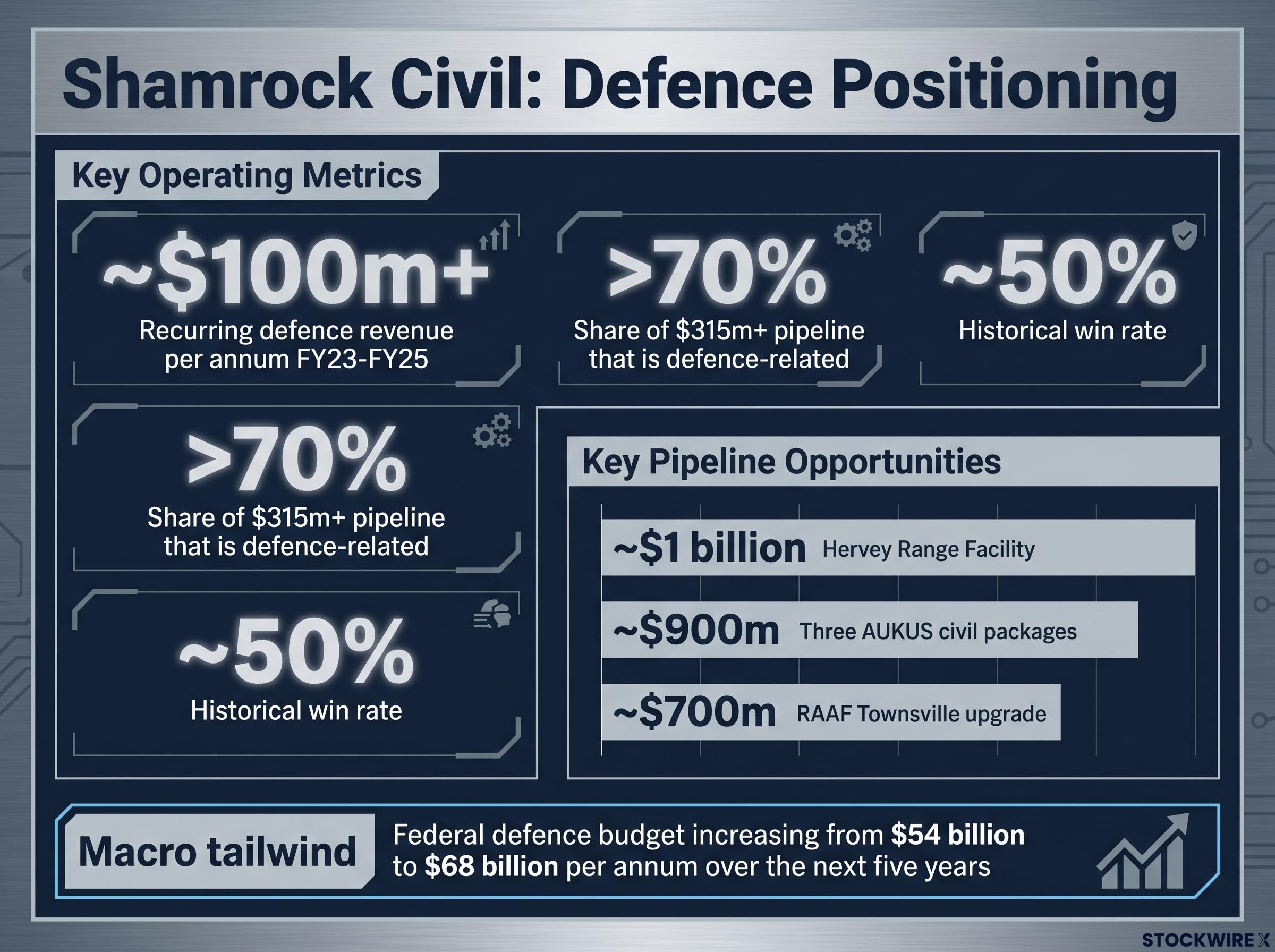
Management outlined the strategic context underpinning Shamrock’s defence exposure. The Federal defence budget is increasing from $54 billion to $68 billion per annum over the next five years, with $425 billion committed over the next decade per the 2026 Defence Integrated Investment Program.
The presentation revealed that more than 70% of Shamrock’s $315m+ work-in-hand and tendered pipeline is defence-related. Shamrock holds an established Department of Defence position, with DFAT and AIFFP panel memberships and NAVFAC eligibility (Australian-US). The business has demonstrated a historical win rate of approximately 50% across tendered opportunities.
Shamrock’s delivery partner relationships include Department of Defence, Aurecon, BESIX, Watpac, Lendlease, Laing O’Rourke, CPB, Sitzler, and Hansen Yuncken. These tier-one contracting relationships provide recurring revenue visibility and access to major pipeline opportunities.
Key pipeline opportunities highlighted in the presentation include:
- Approximately $900m across three AUKUS civil packages
- Approximately $700m for the RAAF Townsville upgrade
- Approximately $1 billion for the Hervey Range Facility
The presentation positioned Shamrock as an incumbent with recurring revenue and a proven win rate, rather than a speculative entrant chasing defence exposure. With approximately $100m+ in recurring defence revenue per annum (over the FY23–FY25 period), Shamrock enters the transaction with established credentials ahead of a structural multi-decade spending uplift.
Resources exposure adds gas and energy infrastructure optionality
The presentation outlined Shamrock’s 20-year operating history in the Surat Basin, with established relationships across coal seam gas operators including QGC, Arrow Energy, Santos, and Origin Energy. This positions the combined group to capture civil works opportunities as gas infrastructure investment accelerates.
Management referenced the Federal Future Gas Strategy (June 2024), which supports gas through to 2050 and beyond. The policy framework provides a multi-decade tailwind for gas-related civil infrastructure, including supply, pipelines, and storage construction.
AEMO’s 2026 Gas Statement of Opportunities projects that southern gas production will decline 46% over the next five years without significant structural investment. The report forecasts a 160 PJ annual shortfall by 2033, with currently committed projects insufficient to close the production gap.
The presentation highlighted the structural requirement for supply, pipeline, and storage construction to meet projected demand. Shamrock’s trusted relationships with major gas operators position the combined group to secure civil works as investment accelerates to address the supply gap.
Management noted synergies with Symal’s existing McFadyen business, which operates in gas, water, and mining sectors. The combination creates a diversified resources platform with complementary capabilities across energy infrastructure.
WSU Civil expands Indigenous contracting capability
The presentation detailed Shamrock’s 49% stake in WSU Civil, a 51% Indigenous-owned joint venture between Shamrock and Waanyi Aboriginal Corporation. WSU has operated since 2017, delivering civil works in regional and remote locations across northern and central Australia.
WSU Civil is Supply Nation certified and an eligible supplier under the Commonwealth Indigenous Procurement Policy (IPP). The business maintains approximately 40% Indigenous workforce participation, providing training and career pathways for Indigenous people in the construction sector.
Management highlighted the strategic value of Indigenous procurement credentials. The IPP provides preferential access to government and defence contracts, deepening Defence and government relationships in regions where Symal has previously had limited presence.
The presentation noted that WSU complements Symal’s existing Wamarra Indigenous platform, expanding the group’s eligible supplier status into new geographies with proven remote delivery capability. This positions the combined group to compete for a broader range of government and defence opportunities where Indigenous participation is a tender requirement or provides competitive advantage.
Geographic footprint expanded to seven sites nationally
The presentation outlined Shamrock’s addition of two new strategic locations to Symal’s footprint: Rockhampton and Roma. Roma is adjacent to the Surat Basin, positioning the combined group to support Queensland’s resources industry.
Management highlighted Shamrock’s established Northern Territory presence, backed by Symal’s platform, as positioning the group to secure opportunities in the NT’s $4.25 billion infrastructure pipeline and strategic defence works.
In South Australia, the combination of Shamrock and Symal’s existing Davison business positions the group for approximately $900m of AUKUS civil packages and $27.3 billion in public sector infrastructure spend through 2029.
Queensland opportunities were quantified at $127.5 billion in infrastructure opportunities through to 2030. The presentation also referenced Shamrock’s placement on the AIFFP panel with proven PNG delivery, with Symal’s balance sheet unlocking larger Pacific opportunities previously constrained by Shamrock’s standalone capacity.
Key geographic opportunities by state include:
- Queensland: $127.5 billion infrastructure pipeline to 2030 (Queensland Major Projects Pipeline 2025)
- South Australia: $27.3 billion public sector infrastructure spend to 2029; approximately $900m AUKUS civil packages
- Northern Territory: $4.25 billion infrastructure pipeline; strategic defence works
- Pacific (DFAT panel): On the AIFFP panel with proven PNG delivery; greater opportunity in the Pacific unlocked by Symal’s balance sheet
The acquisition creates a national platform with seven complimentary sites, reducing reliance on any single region while concentrating exposure to defence and resources growth corridors.
Founder alignment and scalable platform
The presentation emphasised the cultural alignment between Symal and Shamrock’s founder-led management team. Shamrock’s founders are receiving SYL shares as part of the upfront consideration and will remain in day-to-day operations post-completion. The two-year escrow period and performance-based earn-out structure incentivises delivery over FY26 and FY27.
Management outlined what the presentation described as Shamrock’s “revenue ceiling” — the business has consistently delivered revenue greater than $220m profitably, but Symal’s balance sheet is expected to unlock capacity for larger and more complex opportunities. The presentation positioned this as removing capital constraints rather than executing a turnaround or early-stage investment.
Shamrock is already delivering profitably at scale with an established client base, recurring revenue, and proven project delivery capability. The thesis outlined in the presentation centres on backing a proven operator and removing the capital constraints that have historically limited Shamrock’s ability to pursue larger defence and resources opportunities.
Director commentary
The presentation outlined the strategic rationale for the acquisition across four themes: geographic expansion, scaling acquired businesses, group capability synergies, and end-market diversification.
Strategic Themes
Geographic expansion: Winning nationally as we grow.
Scale what we acquire: Buying business with room to scale and backing the people who built them.
Group capability: Businesses that are stronger together.
End-market diversification: More growth, less concentration risk.
Management highlighted that Shamrock accelerates Symal’s growth across defence, resources, and environmental sectors, reducing concentration risk while positioning the group ahead of structural spending growth in each end-market.
Next steps and completion timeline
The presentation confirmed that the transaction is subject to customary prerequisites, including ACCC approval. Resolution of the $16.1m deferred payment matter — tied to a commercial and legal matter being finalised — is currently expected in late 2026.
The presentation was dated 17 June 2026. Investors should monitor for ACCC clearance and finalisation of the deferred payment matter as key near-term catalysts ahead of transaction completion. The earn-out structure will be assessed over FY26 and FY27 based on EBITDA performance above agreed thresholds.
Don’t Miss the Next Defence and Infrastructure Play
Join 20,000+ investors receiving FREE breaking ASX news within minutes of release, complete with in-depth analysis. Click the “Free Alerts” button at Big News Blast to get industrials sector updates delivered straight to your inbox the moment market-moving announcements drop.