
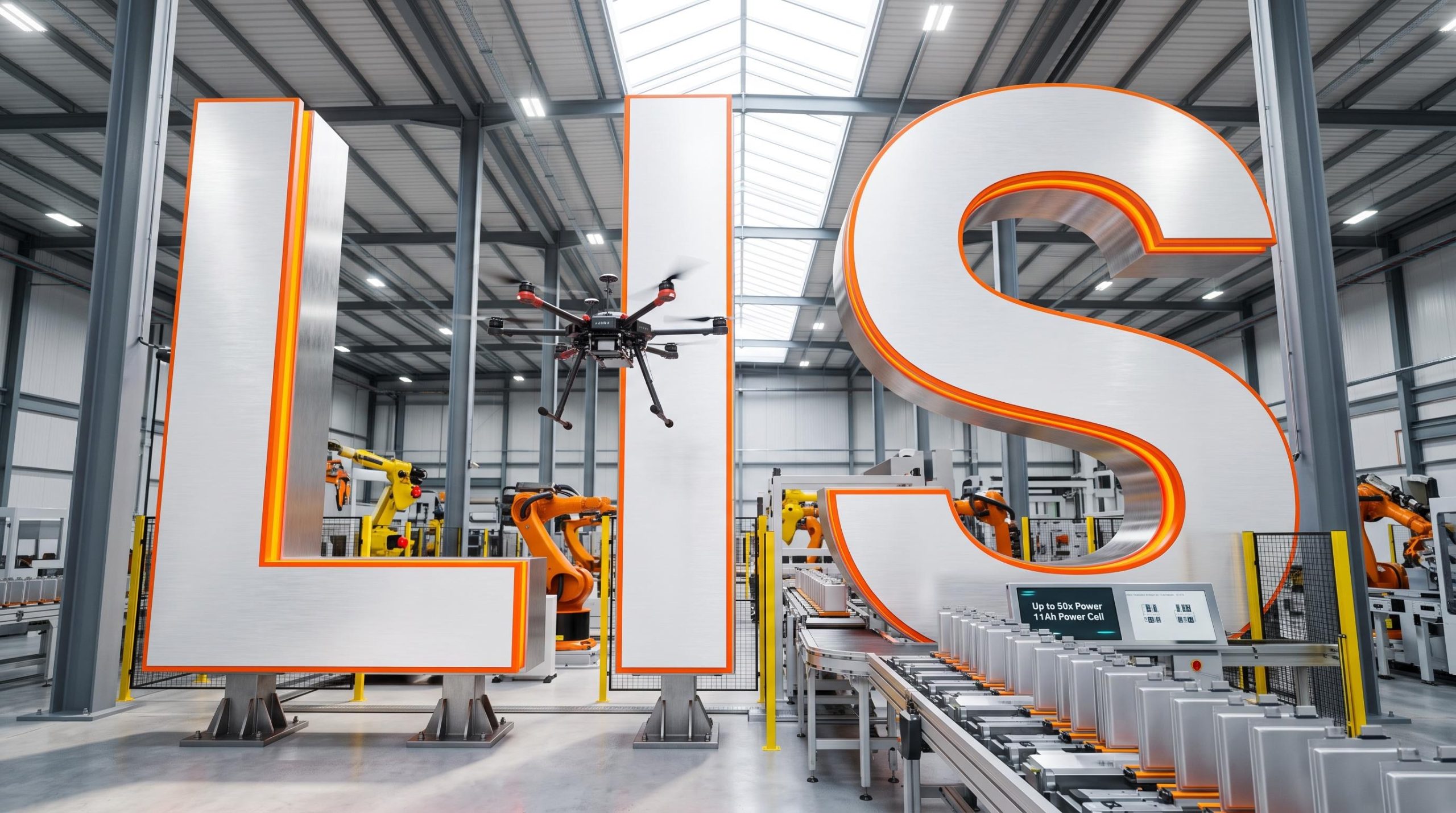
Li-S Energy finalises Power Cells with up to 50 times the power of traditional lithium-sulfur
Li-S Energy (ASX: LIS) has completed development, successful testing and characterisation of two new Power Cell designs, with datasheets completed and shared with partners under NDA. The new high power lithium-sulfur cells deliver up to 50 times the power of “traditional” lithium-sulfur cells, with energy density approaching 400 Wh/kg.
The 50 times figure is measured against the Company’s own Energy Cell optimised for a C/5 discharge rate, using the 11Ah cell at up to 10C. Both variants are produced on the automated Phase 3 production line, making this a commercial-sized product rather than a laboratory result.
When big ASX news breaks, our subscribers know first
Two cell designs and the performance data
“Traditional” lithium-sulfur cells typically discharge at 0.1 to 0.2C continuously, compared with 7C for the new 11Ah Power Cell. The two designs are set out below.
| Cell | Continuous rate | Peak rate | Energy yielded | Best suited to |
|---|---|---|---|---|
| 10Ah Power Cell | 2C | 5C | 100% of total energy stored | Systems requiring longer cycle life |
| 11Ah Power Cell | 7C | 10C | 96% of total energy stored | High power applications where cycle life is not a critical requirement |
The new Power Cells deliver:
- A continuous power density of 1700W/kg
- A peak power density of 2400W/kg
- A gravimetric energy density approaching 400 Wh/kg
According to the Company, these power densities bring the technology into “the highly lucrative fast multi-rotor UAV space”.
Dr Steve Rowlands, Chief Technology Officer
“Our 11Ah Power Cell operates at a continuous 7C – delivering over 95% of its energy in under nine minutes while still maintaining close to 400 Wh/kg by standard measures…”
What C-rate means for investors
C-rate is a measure of a battery’s power. A 1C cell is designed to discharge in one hour, C/2 in two hours and 2C in 30 minutes, so a higher C-rate means more power.
High power delivery has been a long-recognised limitation of lithium-sulfur chemistry, reducing the number of applications for the technology. Lifting that limitation widens the range of uses the cells can address.
Opening new markets alongside GEN3
In 2024, the Company’s GEN3 cell achieved 456 Wh/kg after formation cycling, around twice the energy density of lithium-ion. It was designed for low power, long endurance platforms where weight is paramount, such as fixed wing drones and marine systems.
The Power Cell range complements that offering by serving applications that require much higher power delivery. Twelve months ago, the Company announced that it was looking to overcome the power limitation.
The new cells target applications where higher power is essential, including:
- Multi-rotor drones
- Soldier-carried systems
- Robotics
- Communications
A separate US Army evaluation at Aberdeen Proving Ground marks the company’s first engagement with a US Government agency, though no contract or order is attached to the shipment.
The Company said the development of the commercial Power Cell range demonstrates the value of its Phase 3 production line and Battery Test Centre to rapidly scale research concepts into commercial sized cells produced consistently and in volume.
Dr Lee Finniear, Managing Director and CEO
“These new Power Cells open up a massive market sector for the Company, and I am very proud of our development and production teams’ dedicated focus on rapidly scaling from concept to proven production cells.”
What happens next for Li-S Energy
The Li-S Energy team expects to continue advancing the capabilities of its Power Cells. The company has outlined two next steps:
- Increase energy density whilst maintaining high power performance, with the aim of further extending system range, operating time and payload.
- Update the market as these development programs progress, in accordance with its continuous disclosure obligations.
Don’t Miss the Next Battery Tech Breakthrough
Join 20,000+ investors getting FREE breaking ASX news within minutes of release, complete with in-depth analysis. Click the “Free Alerts” button at Big News Blast to receive industrial technology updates the moment market-moving announcements break, and stay ahead of the market.