

Q1 FY27 highlights: TTV up 18.0% to $4.6b, FY27 guidance reconfirmed
In its Q1 FY27 results update for the three months ended 30 September 2026, Zip Co recorded total transaction volume (TTV) of $4.6b, up 18.0% on 1Q26. Total income reached $376.1m (up 17.0%) and transactions rose 21.8% to 31.6m.
Adjusted cash EBTDA was $75.1m, up 19.5% (or 28.7% on a constant currency basis). Reported cash EBTDA was $65.0m (up 3.4%), after $10.1m of operating expenses relating to an external fraud event in the US.
The company reconfirmed FY27 guidance for Group cash EBTDA of $340m, up 26% year on year. Revenue margin was flat at 8.2%.
Cynthia Scott, Group CEO and Managing Director
“Customers are choosing to use Zip more often, driving strong top line growth, with transactions per customer up 27.0% in the US and 14.2% in Australia…”
| Metric | 1Q27 | 1Q26 / change |
|---|---|---|
| TTV | $4.6b | Up 18.0% |
| Total income | $376.1m | Up 17.0% |
| Transactions | 31.6m | Up 21.8% |
| Cash NTM | 3.8% | 4.0% in 1Q26 |
| Net bad debts (% of TTV) | 1.97% | 1.65% in 1Q26 |
When big ASX news breaks, our subscribers know first
US performance: TTV up 34.1% as fraud event contained
Growth and engagement
US TTV grew 34.1% and revenue 32.0% year on year (both in USD). Spend per customer rose 30.2% to US$1,958 per annum, while transactions per customer increased 27.0% to 14.0x per annum.
US merchants increased 31.2% to 32.6k, including the addition of Puma, CommentSold, Crutchfield and Just Energy.
The quarter also coincided with leadership change in the division, with Rory Herriman stepping in as interim US CEO after Joe Heck resigned, a notable shift given the US generates roughly 80% of cash earnings.
Fraud event and credit
Zip identified and contained an external fraud event involving coordinated individuals establishing new accounts using legitimate credentials to execute unpaid transactions. It temporarily affected TTV and new customer growth in July and August, and resulted in US$7.2m (A$10.1m) of cash operating expenses.
September TTV rose 41% year on year (in USD), with positive momentum continuing into October. Zip notified the relevant authorities and lodged a claim with its insurer.
US net bad debts were 1.93% of TTV. The company said the quarter-on-quarter movement was primarily driven by seasonality, with some impact from TTV being temporarily moderated by the fraud mitigation measures.
Zip is forecasting 2Q27 net bad debts as a percentage of TTV to be lower than 1Q27 and to remain within the top half of the 1.5 – 2.0% target range.
Product and funding
Zip planned the launch of Zip® Cash, a same-day cash loan product, to select US customers during the holiday season. It also signed an agreement with Paycile to offer customers the option to use Pay-in-2 for rental payments.
In October, Zip selected Google Cloud and Quantium to establish the agentic foundation for an AI-Native Product Factory powered by Gemini Enterprise. It also entered a new banking partnership with nationally chartered bank Column N.A.
On funding, Zip established a two-year US$300.0m securitisation, the first Asset Backed Security (ABS) issuance for Zip US, priced at a fixed rate yield of 5.68%. The limit of AR5 was increased to US$583.4m in October.
The inaugural US securitisation drew AAA rated notes from Fitch on the senior tranche, which supported competitive pricing and broadened the institutional investor base behind Zip’s US receivables funding.
Zip AU and how buy now, pay later credit works
Australian momentum
AU revenue rose 8.3% and receivables grew 11.8% year on year to $2,333.2m. Excess spread was 8.5% and portfolio yield 18.9%, while arrears fell to 2.35% from 2.67% at 30 June 2026.
Spend per customer rose 13.0% to $2,265 per annum, and transactions per customer increased 14.2% to 29.7x. AU merchants grew 9.3% to 64.0k, including Vietnam Airlines, Phil Hoffmann Travel and Carbar.
Credit and customer numbers were mixed. AU net bad debts were 3.51%, down from 3.83% at 30 June 2026 but above 3.33% a year earlier. Active AU customers were down 6.9% year on year to 1.7m.
AU figures exclude New Zealand, with the wind down of that business expected to complete by the end of CY2026.
Educational: Understanding excess spread and net bad debts
Excess spread shows how much margin a lender keeps after funding and credit costs:
- Yield: the income earned on customer receivables.
- Funding cost: the cost of the borrowing used to fund those receivables.
- Net loss rate: the share of receivables written off as bad debts, after recoveries.
- Excess spread: the margin left after funding cost and net loss rate are taken from yield.
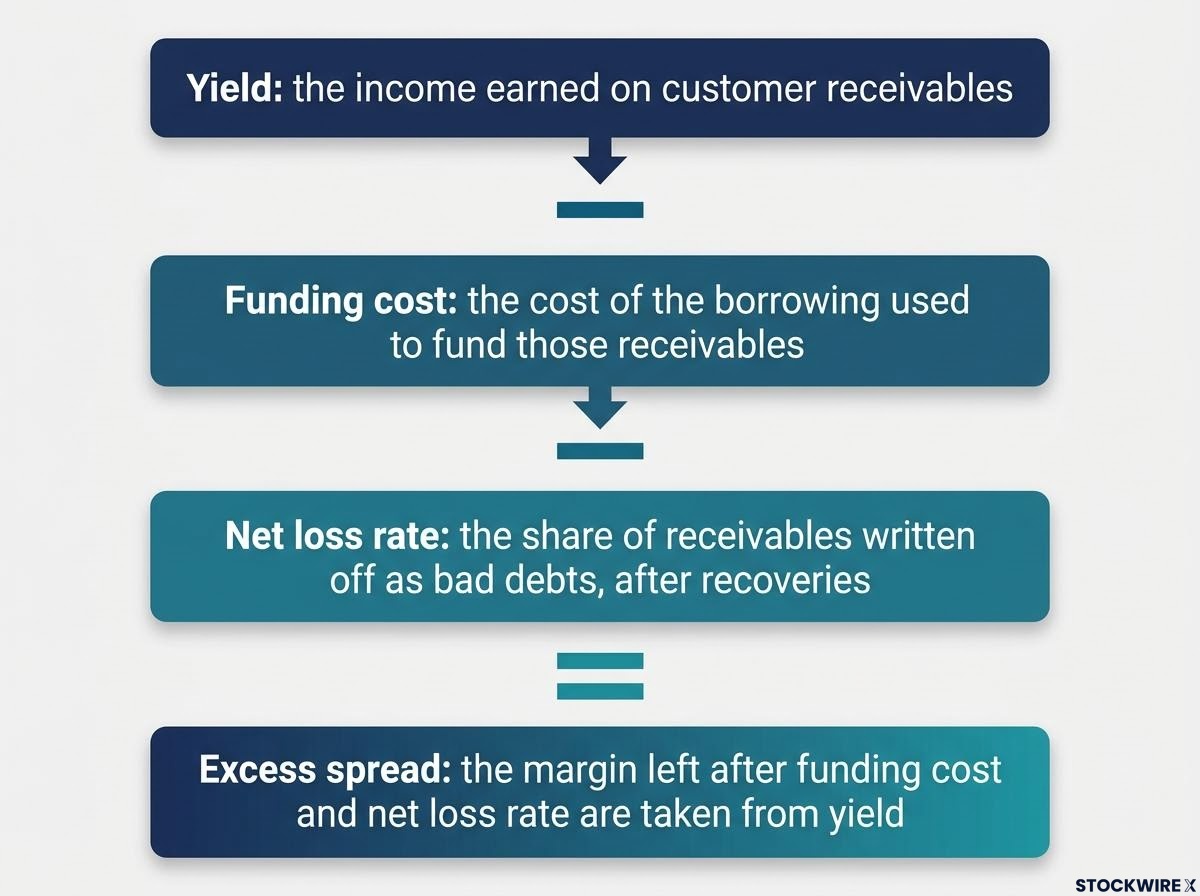
This is why investors watch net bad debts as a percentage of TTV alongside growth. Rising volumes can add income, but higher losses reduce the margin that remains.
Balance sheet, capital management and FY27 outlook
At 30 September 2026, Zip held $452.0m of total cash, with $224.4m in available cash and liquidity.
During the quarter, Zip acquired 9.7m shares for $23.7m on market via its Employee Share Trust to minimise dilution from Equity Incentive Plan allocations. It also commenced an on-market share buy-back of up to $50m, with 7.6m shares purchased for $15.7m by 30 September 2026.
Group funding facilities comprised an AU limit of $2,422.5m (drawn $2,186.6m) and a US limit of US$858.6m (drawn US$468.2m).
Zip reconfirmed its FY27 guidance, which is subject to market conditions:
- US TTV growth greater than 30% (in USD)
- Group revenue margin of circa 8%
- Group cash net transaction margin of between 3.8% – 4.0%
- US net bad debt target range of 1.5 – 2.0% of TTV
- Group operating margin expected to expand to between 20% – 22%
- Group cash EBTDA of $340m, growth of 26% year on year
Upcoming investor engagement dates:
- Evans & Partners SMID Caps Conference, Melbourne: 28 October 2026
- UBS Australasia Conference, Sydney: 10 November 2026
- Zip Annual General Meeting: 19 November 2026
- UBS Global Technology and AI Conference, Scottsdale: 30 November 2026
Stay Ahead on Fintech News Before the Market Moves
Join 20,000+ investors receiving FREE breaking ASX news within minutes of release, complete with in-depth analysis. Click the “Free Alerts” button at Big News Blast to get the next fintech and financials update in your inbox the moment it breaks.