
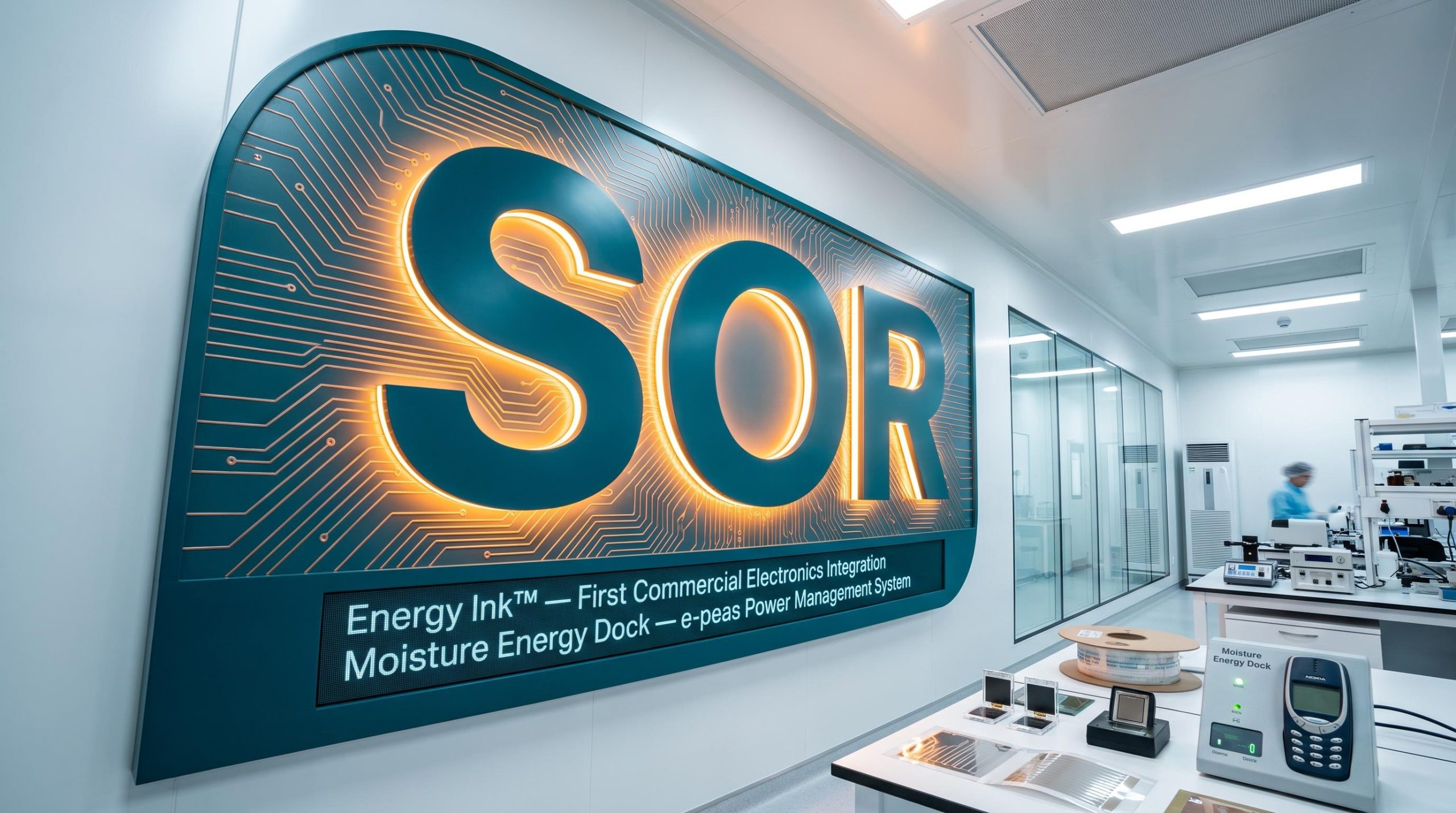
Energy Ink hits first commercial electronics milestone
Strategic Elements (ASX: SOR) has reported the first successful integration of a prototype Energy Ink™ cell system with commercial power-management electronics supplied by e-peas, achieved during work on the Moisture Energy Dock demonstrator.
The milestone marks a first for Energy Ink™ specifically. Until now, the technology’s electrical output had principally been measured using laboratory or in-house equipment. This integration demonstrates that the output can be captured and managed by commercial electronics, an early step toward integration with components used in real-world electronic systems.
Energy Ink™ is being developed to generate electrical energy from moisture by 100%-owned Australian Advanced Materials, in conjunction with a materials science team at the University of New South Wales (UNSW) and other research and development collaborators.
When big ASX news breaks, our subscribers know first
Why the e-peas integration matters
The integration links a prototype Energy Ink™ cell to power-management electronics from e-peas, a Belgium-based fabless semiconductor company supplying power-management circuits for applications across “consumer electronics, industrial IoT, smart homes and buildings, wearables and logistics.”
A fabless semiconductor company designs chips but outsources their physical manufacturing to third-party foundries. e-peas specialises in low-power electronics designed to “capture and manage small and variable electrical inputs from energy-harvesting technologies.”
According to the company, the successful integration provides an important link between the Energy Ink™ cell system and the broader electronic architecture being assembled within the Moisture Energy Dock. For investors, the step moves the technology from an isolated cell measured on lab equipment toward a component that can operate within a wider system.
Charles Murphy, Managing Director
“Energy Ink™ is pioneering work in the emerging field of moisture energy. Deep-tech innovations, especially new power sources, take time to mature but can deliver significant upside. Our Pooled Development Fund structure is designed for this — providing patient capital to capture breakthrough opportunities. The Energy Ink™ team is highly focused on transferring energy from the Moisture Energy Dock into a lithium-ion battery and accelerating the separate battery-free pathway.”
Inside the Moisture Energy Dock demonstrator
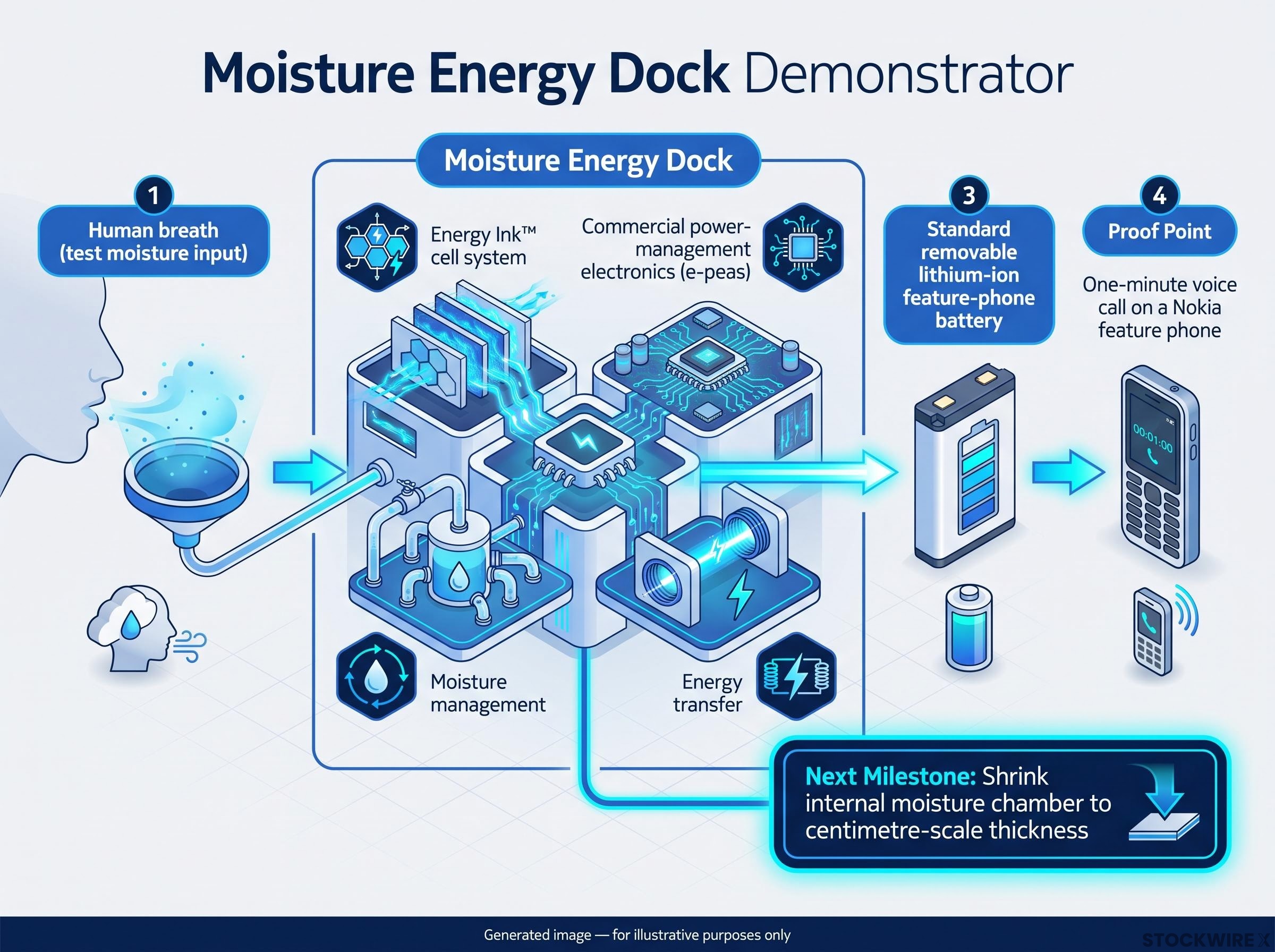
The Moisture Energy Dock brings together an Energy Ink™ cell system, moisture management, commercial power-management electronics and energy transfer within a compact demonstrator. Its objective is to transfer energy into a standard removable lithium-ion feature-phone battery.
Human breath is being used as the test moisture input. The deliberately simple proof point is whether sufficient energy can be transferred by the Dock to support a one-minute voice call on a Nokia feature phone.
The Nokia feature phone proof point has its roots in earlier prototype work: the breath-powered phone call program was structured as a three-stage demonstration after a 2cm x 2cm Energy Ink cell generated approximately 7mWh from a single breath, more than 1,000% above comparable ambient moisture-only systems.
The company describes the phone-call demonstration as an easily understood endpoint. Development of the Dock also provides a platform for addressing the practical engineering constraints involved in progressing Energy Ink™ toward future electronic systems.
Next milestone: shrinking the moisture chamber
The roadmap set out in the announcement includes the following focus areas:
-
Key next milestone: reduce the Dock’s internal moisture chamber to centimetre-scale thickness while maintaining successful system operation.
-
Why it matters: this supports a pathway toward integration of Energy Ink™ into thinner electronic devices.
-
Engineered-moisture focus: environments where humidity is controlled, predictable or can be readily maintained, such as climate-controlled buildings, data centres and certain industrial environments.
-
Other potential formats: skin-contact and wearable applications, where local moisture may provide opportunities for very low-power battery-free electronics.
What is Energy Ink and moisture energy?
Energy Ink™ is an early-stage energy technology being developed to generate electrical energy from moisture. In simple terms, it aims to draw usable electricity from water vapour in the surrounding air or from other moisture sources.
The technology is being advanced across materials design, prototype development, industrial screen-printing, engineered moisture, power management and prospective application pathways. It is also being developed toward thin, flexible and battery-free electronic formats, with potential use in low-power devices where conventional batteries can create design, maintenance and end-of-life constraints.
More than $5 million in competitive Federal research and innovation funding has been secured across the Energy Ink™ program, supporting its development alongside Strategic Elements’ patient capital.
The IP underpinning the technology has also been advancing in parallel: a Japanese patent for Energy Ink was granted to Australian Advanced Materials covering the functional material, moisture electric cell and preparation method, with broader applications across the US, Europe, Canada, China and Korea still under examination.
In parallel, a separate battery-free materials program is evaluating alternative Energy Ink™ cell architectures and electrode materials, including commercial and emerging materials and potential collaboration opportunities. This work is distinct from the Moisture Energy Dock demonstrator pathway.
The Strategic Elements investment case
Strategic Elements is a registered Pooled Development Fund that provides patient capital to Australian innovation through wholly owned operating ventures, with the objective of building value before seeking an appropriate strategic partner, investor or commercial pathway.
The structure is described as particularly suited to technologies with longer development timelines and provides eligible shareholders with tax concessions including “tax-free capital gains and dividends” (subject to forward-looking qualifications noted in the announcement).
The company’s current operating ventures include Australian Advanced Materials, developer of Energy Ink™, and Stealth Technologies, developer of the EdgeiQ industrial intelligence platform. For investors, this milestone represents incremental de-risking of a deep-tech program rather than commercialisation or near-term revenue.
| Development Step | Status | What It Proves | Next Step |
|---|---|---|---|
| Commercial electronics integration (e-peas) | Achieved | Output can be captured and managed by commercial electronics | Shrink moisture chamber |
| Moisture Energy Dock demonstrator | In progress | Energy transfer into lithium-ion battery | One-minute Nokia call proof point |
| Battery-free materials program | In progress (separate) | Alternative architectures and electrode materials | Establish battery-free foundations |
Looking ahead, the company’s stated priorities centre on reducing the Dock’s moisture chamber to centimetre-scale thickness and accelerating the separate battery-free pathway, two threads that together shape the next phase of Energy Ink™ development.
Don’t Miss the Next Deep-Tech Breakthrough on ASX
Big News Blast delivers FREE breaking ASX announcements straight to your inbox within minutes of release, complete with in-depth analysis already done. Over 20,000 investors rely on it to stay ahead of market-moving technology news. Click the “Free Alerts” button at Big News Blast to make sure the next milestone lands in your inbox before the market moves.