
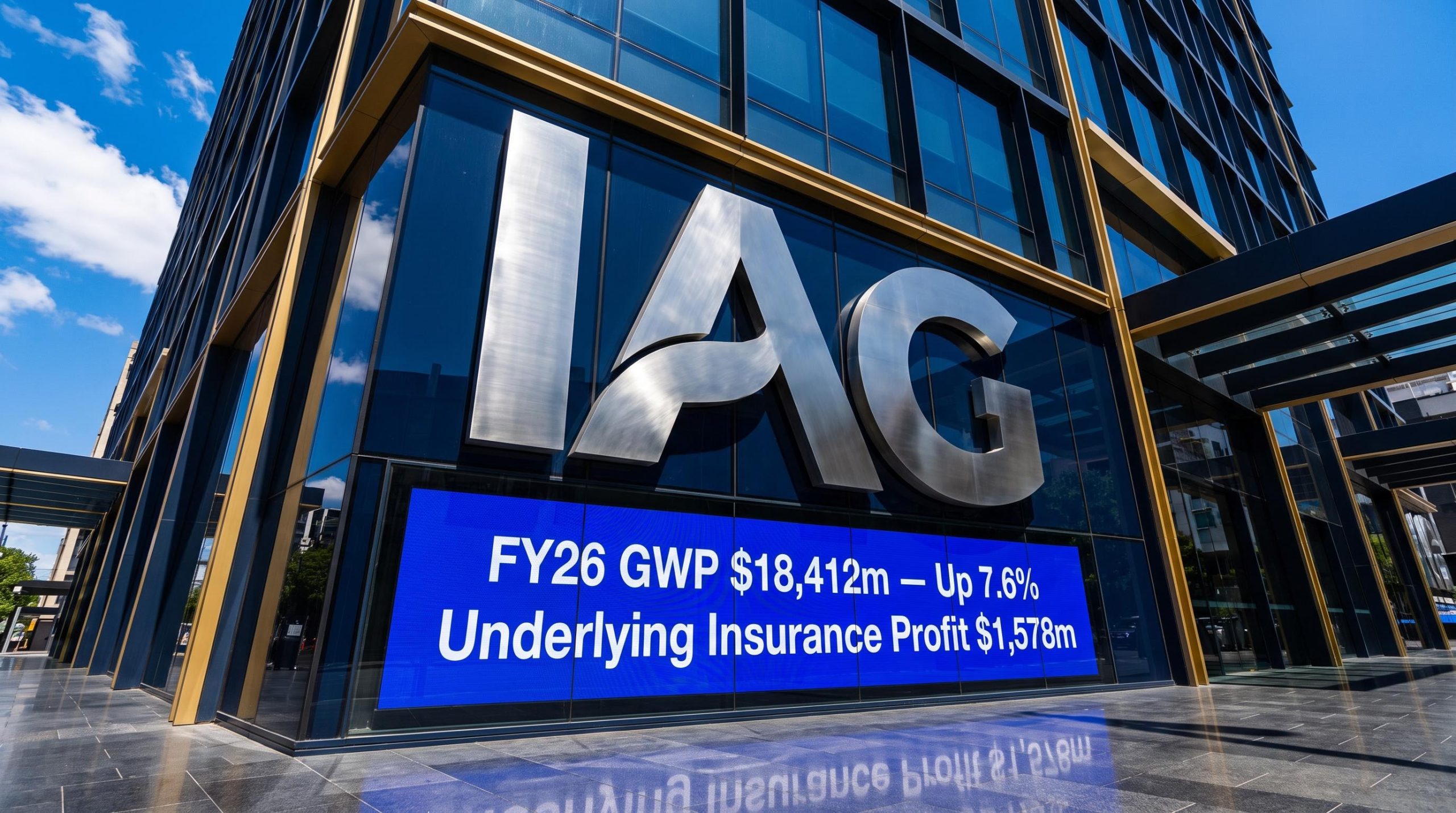
IAG delivers 7.6% GWP growth as underlying profit climbs to $1,578m in FY26
Insurance Australia Group delivered Gross Written Premium of $18,412m for the full year ended 30 June 2026, up 7.6%, in what the insurer framed as a year of strategic execution. Underlying Insurance Profit rose 2.3% to $1,578m, while Net Profit After Tax came in at $1,022m.
The headline 24.8% NPAT decline reflects a high prior-year base rather than any deterioration in the current year. FY25 was elevated by favourable natural perils and a business interruption (BI) reserve release, both of which did not recur at the same scale in FY26.
Underneath the reported figures, the group’s core earning power strengthened. IAG lifted its final dividend to 20cps, up 1cps, bringing the full-year dividend to 32cps, up around 3%.
The result was shaped by the ten-month contribution from the RACQI portfolio, continued rate increases across Australian personal lines, and disciplined underwriting in softer commercial markets. Momentum in direct retail, which represents roughly 60% of the group’s premium pool, provided a durable base for growth.
When big ASX news breaks, our subscribers know first
Headline results at a glance
The group financial summary shows reported metrics pressured by the prior-year comparison, while underlying measures improved. Notably, the underlying insurance margin excluding RACQI rose to 16.0%.
| Metric | FY25 | FY26 | Change |
|---|---|---|---|
| GWP ($m) | 17,106 | 18,412 | +7.6% |
| NEP ($m) | 9,984 | 10,523 | +5.4% |
| Reported insurance profit ($m) | 1,743 | 1,552 | (11.0%) |
| Underlying insurance profit ($m) | 1,542 | 1,578 | +2.3% |
| Underlying insurance margin ex-RACQI (%) | 15.5 | 16.0 | +50bps |
| NPAT ($m) | 1,359 | 1,022 | (24.8%) |
| Dividend (cps) | 31.0 | 32.0 | +3.2% |
For investors, the improvement in the underlying margin ex-RACQI to 16.0% is a key positive, signalling that the core business became more profitable despite the tougher reported comparison.
Growth driven by RACQI and direct retail strength
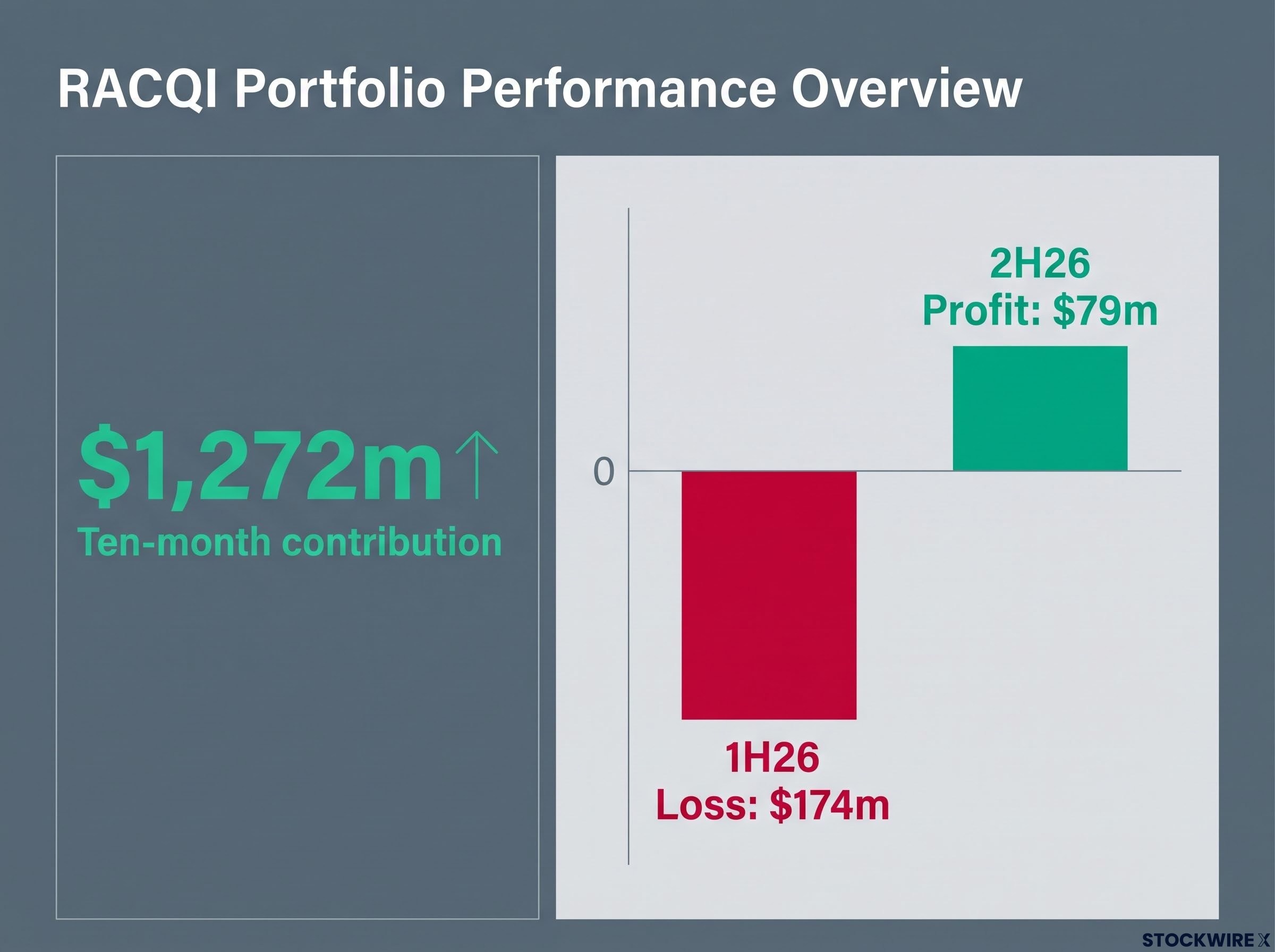
The RACQI portfolio delivered a $1,272m ten-month contribution, the single largest driver of reported growth. IAG completed the RACQI transaction, with reinsurance synergies delivered and integration progressing.
Stripping out the acquisition, underlying GWP growth was 1.9%, showing that reported growth of 7.6% was substantially boosted by RACQI. Direct retail momentum remained solid, with 4.8% RIA direct underlying growth and 5.1% NZ direct underlying growth (in NZ$).
Divisional underlying growth was mixed:
- Retail Insurance Australia (RIA): ~4.5%
- New Zealand Retail: ~4%
- Intermediated Insurance Australia (IIA): ~2%
- New Zealand Intermediated: ~11% decline
The RACQI portfolio recovered strongly in the second half, contributing $79m to insurance profit in 2H26, following a $174m loss in 1H26 driven by severe perils prior to integration into the group’s long-term perils volatility cover.
Divisional performance snapshot
| Division | FY26 GWP | Growth | Underlying margin note |
|---|---|---|---|
| Retail Insurance Australia | $10,308m | +17.8% | 14.7% (16.4% ex-RACQI) |
| Intermediated Insurance Australia | $4,600m | +1.1% | Stable underlying profit $308m |
| NZ Retail | NZ$2,448m | +3.7% | Strong margin 25.3% |
| NZ Intermediated | NZ$1,612m | -11.0% | Disciplined in soft commercial market |
RIA delivered strong headline growth, with the ex-RACQI underlying margin improving to 16.4%. IIA held underlying profit stable at $308m, supported by cost discipline and reserve releases. NZ Retail combined 3.7% GWP growth with a robust 25.3% underlying margin.
The NZ Intermediated decline reflected deliberate underwriting discipline in a soft commercial market rather than lost business, with 33 of 35 largest accounts retained.
Understanding insurance profit — why “underlying” matters for investors
Insurance results can look volatile from year to year, largely because natural perils such as storms and floods vary in severity. IAG reports two profit measures to help investors read through this noise.
Reported insurance profit includes the actual cost of natural perils in a given year. Underlying insurance profit strips out one-off items and perils variance to show the true earning power of the business across a normal year.
In FY26, net perils cost was $1,579m, sitting $114m above allowance, largely due to severe perils in the RACQI portfolio during 1H26. Beneath this, the underlying claims ratio improved 50bps to 51.6%, and the expense ratio improved 120bps to 22.6%.
This is precisely why the headline NPAT figure does not tell the full story. The group’s underlying earning power strengthened even as reported profit absorbed elevated perils and a tougher prior-year comparison.
Capital strength, dividend lift and the RAC Insurance acquisition
IAG ended the year with a CET1 ratio of 1.14 at June 2026, above its target range of 0.9–1.1x PCA. The group completed a $200m on-market buyback, reducing its share count by around 27.3m shares at an average price of approximately $7.30.
The FY26 final dividend of 20cps, up 1cps, brought total dividends to 32cps and represented a payout ratio of 74%, in line with the 60–80% policy range. Franking increased to 80% in 2H26, with the group expecting franking of 80% to 100% in FY27.
On the pending RAC Insurance acquisition, indicative pro-forma CET1 modelling showed an acquisition impact of -0.36, landing pro-forma June 2027 CET1 at approximately 1.00. The acquisition of RAC Insurance is subject to regulatory approvals and customary closing conditions.
The RAC Insurance regulatory review entered an extended ACCC Phase 2 assessment earlier in 2026, a process that can run up to 90 business days and represents the primary variable in the acquisition timeline ahead of any potential FY27 earnings contribution.
Nick Hawkins, Managing Director and Chief Executive Officer
FY26 was a year of strategic execution, delivering a stronger IAG.
FY27 guidance and the road to Ambition 2030
Looking ahead, IAG issued FY27 guidance, which remains subject to forward-looking risks. The group is targeting a reported insurance margin of 14.5% to 16.5% and GWP growth of 5% to 8%.
That growth outlook reflects mid single-digit underlying growth in Australian and New Zealand retail businesses, low single-digit growth in the intermediated businesses, and additional RACQI premiums alongside multi-year workers’ compensation premiums of approximately $100m, offset by the exit of the Honey portfolio of approximately $150m.
The group administration ratio ex-levies is expected to reduce to under 11% in FY27. IAG also flagged FY27 technology investment of approximately $200m in AI and AI enablement, plus a further approximately $200m in technology modernisation.
As part of its modernisation agenda, IAG detailed a new OpenAI partnership expected to deliver benefits across Claims, Customer Experience and Sales & Service.
The group’s Ambition 2030 targets frame the longer-term investment case:
- 11m+ customers, 55 tNPS and $25bn+ GWP
- ROE of 15%+ and high single-digit EPS growth
- Sustainable growing dividends
- Leading advocacy role in community risk reduction
Taken together, the FY26 result positions IAG as a capital-lite, lower-volatility insurer targeting sustainable growth, improving margins and a clear return-on-equity ambition, with the pending RAC Insurance acquisition a further potential driver subject to regulatory approval.
Investors wanting the full strategic context behind these targets can find our deep-dive into IAG’s Ambition 2030 strategy, which covers the group’s five-year delivery track record, the quota share reinsurance structure providing roughly $1 billion in capital relief, and the AI deployment roadmap underpinning the cost efficiency outlook.
Stay Ahead on ASX Finance and Insurance News
Get breaking ASX announcements delivered to your inbox within minutes, complete with in-depth analysis already done. Join 20,000+ investors who rely on Big News Blast for FREE real-time coverage across Finance, Insurance, and beyond. Click the “Free Alerts” button to start receiving alerts the moment market-moving news hits.