
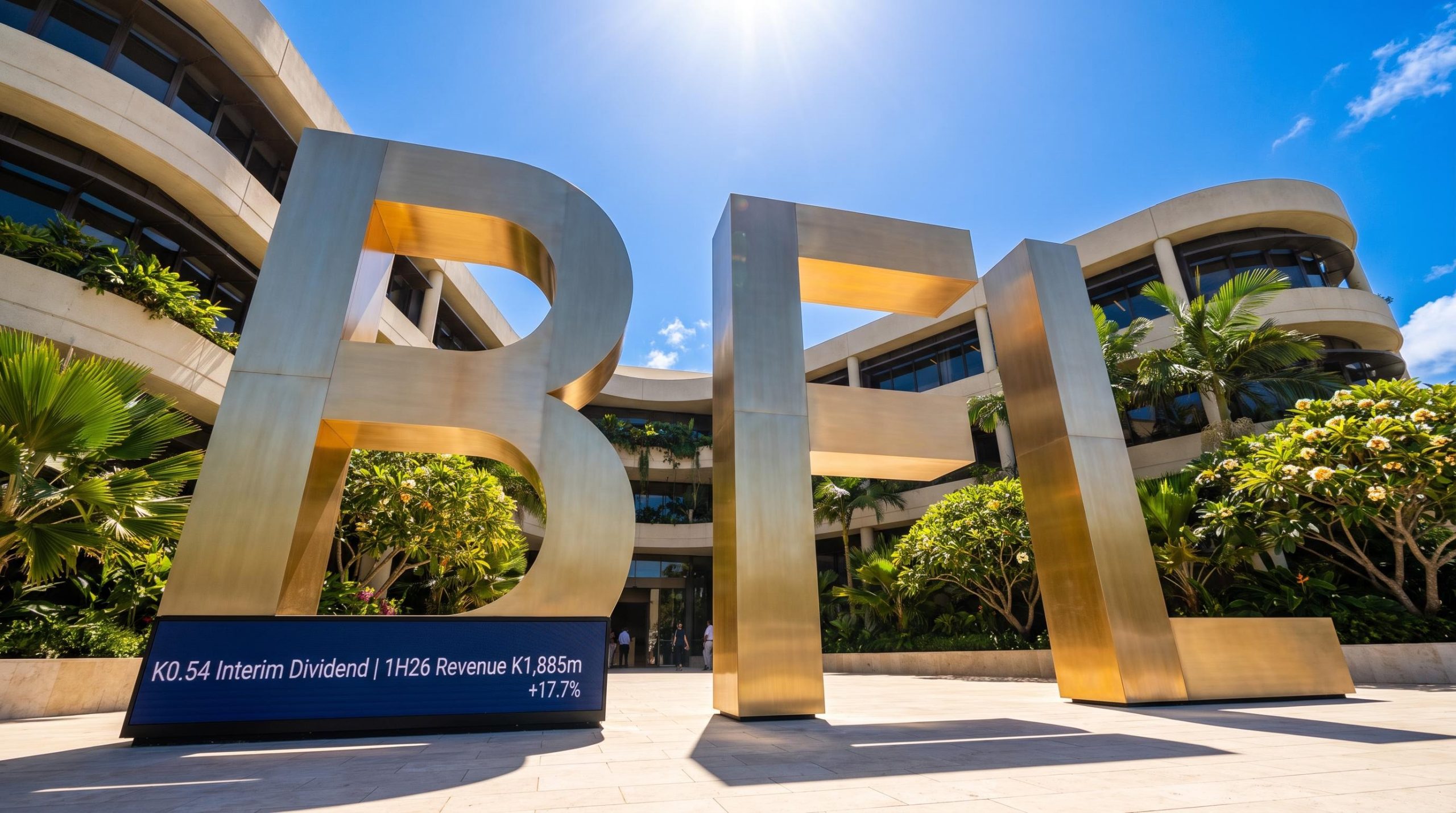
BSP posts record first-half earnings as Kina revenue climbs 17.7%
In its 1H26 results presentation delivered on 21 August 2026, BSP Financial Group (ASX:BFL, PNGX:BSP) reported record first-half revenue and profit, driven by broad-based growth across lending, deposits and payments income.
Measured in Papua New Guinean Kina, the Group reported revenue of K1,885m, up 17.7% on the prior corresponding period, with statutory net profit after tax (NPAT) of K620m, up 8.4%. Return on equity (ROE) came in at 23.9%, and the interim dividend rose 8.0% to K0.54 per share.
Management flagged an important currency nuance. In Australian dollar terms, revenue was broadly flat at A$620m and NPAT eased to A$204m, a translation effect stemming from a stronger AUD rather than any deterioration in underlying business performance.
BSP described itself as the largest banking franchise in the South Pacific, operating across seven countries with 25 years of uninterrupted profitability.
When big ASX news breaks, our subscribers know first
1H26 financial results at a glance
The following table summarises the Group’s key performance measures in Kina, the primary currency reflecting operating performance.
| Metric (PGK) | 1H25 | 1H26 | Change |
|---|---|---|---|
| Revenue | K1,602m | K1,885m | +17.7% |
| Operating profit | K921m | K1,060m | +15.1% |
| Statutory NPAT | K572m | K620m | +8.4% |
| Return on equity | 24.5% | 23.9% | -60bps |
| Cost-to-income ratio | 42.5% | 43.8% | +130bps |
| Capital adequacy ratio | 25.4% | 25.3% | -10bps |
Why the AUD numbers look different
Because the Kina is pegged to the US dollar, a stronger AUD/USD exchange rate pushed the PGK/AUD conversion rate lower, moving from 0.3875 in 1H25 to 0.3290 in 1H26. This cross-currency conversion effect is what caused AUD revenue to appear flat at A$620m and NPAT to fall 7.9% to A$204m, despite strong underlying growth in local-currency terms.
Revenue drivers
Growth was underpinned by diversified income streams:
- Net interest income up 15.4% to K1,174m
- Foreign exchange income up 33.8% to K429m
- Fee and commission income up 11.5% to K236m
Non-interest income now represents 38% of total income, up from 37%, with FX income alone contributing 23%. This diversified base reduces the Group’s reliance on interest margins.
Understanding the story behind the numbers
For investors less familiar with banking metrics, two figures in this result warrant plain explanation.
What is Return on Equity (ROE) and why 23.9% matters
Return on Equity measures how much profit a bank generates for every dollar of shareholder capital it holds. A higher figure generally indicates more efficient use of shareholder funds. BSP’s 23.9% is strong by global banking standards, and the 60bps dip reflects heavy reinvestment during the current phase rather than any decline in earnings quality.
What the Cost-to-Income (CTI) ratio tells investors
The Cost-to-Income ratio shows operating costs as a percentage of income, where a lower number signals greater efficiency. BSP’s 43.8% sits within its 42–45% guidance range and below Australian bank peers. Management attributed the increase to the deliberate investment phase of its Modernising for Growth programme.
Balance sheet growth, resilient credit and digital momentum
Lending and deposits expand across all segments
The Group reported broad-based balance sheet expansion as at June 2026:
- Total assets of K45.2b (A$15.0b), up 16.2%
- Gross loans of K19.1b (A$6.3b), up 8.6%
- Deposits of K36.2b (A$11.9b), up 17.8%
Within the loan book, personal loans grew 20.9%, retail mortgages rose 13.2%, and business loans increased 4.0%.
Credit quality holds firm
Credit metrics improved over the half. The non-accrual rate improved to 2.6%, down 20bps, while provisions to loans held stable at 3.3%.
Digital adoption accelerates
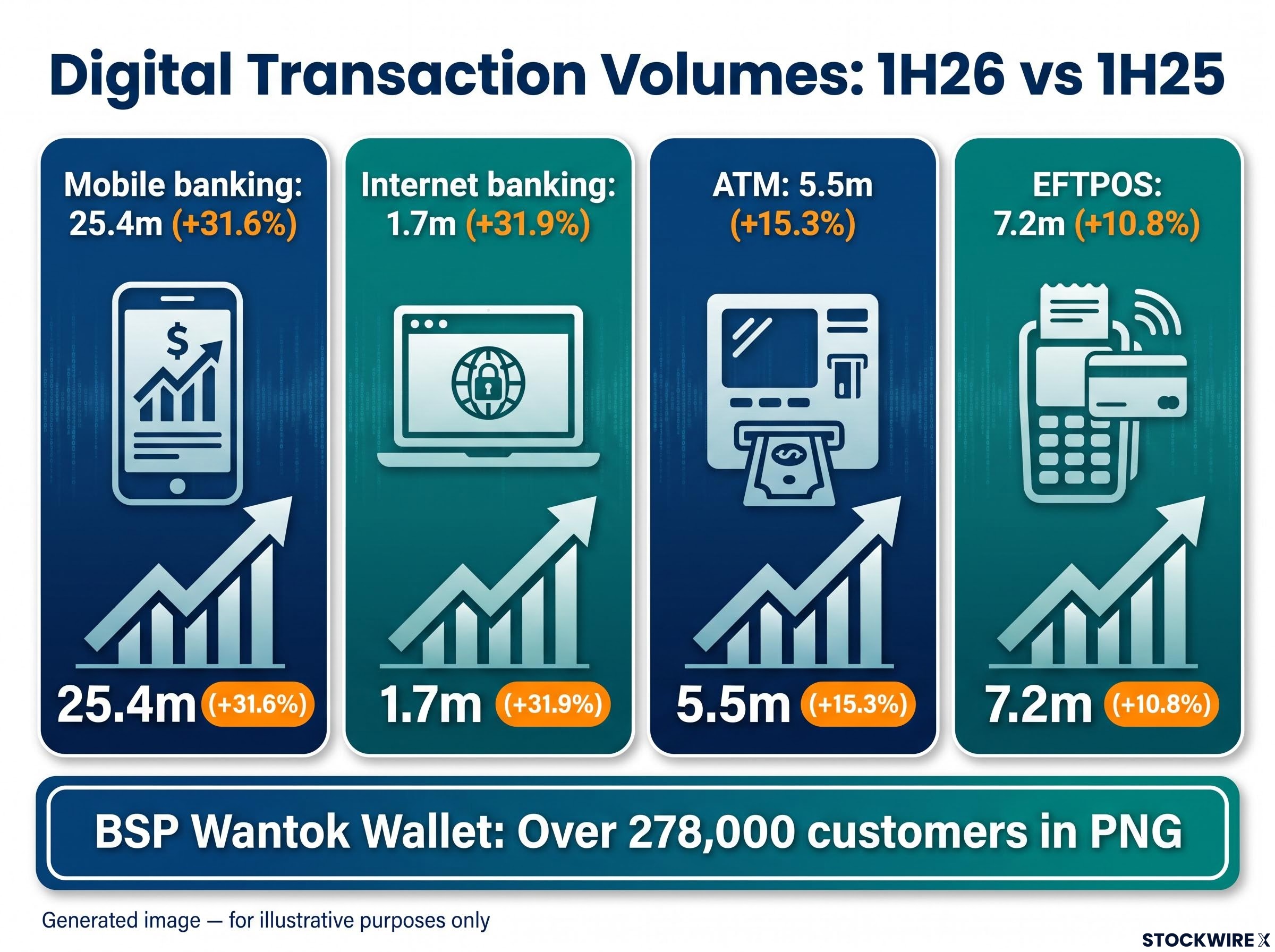
Average monthly transaction volumes climbed sharply across digital channels (1H26 versus 1H25):
- Mobile banking: 25.4m (+31.6%)
- Internet banking: 1.7m (+31.9%)
- ATM: 5.5m (+15.3%)
- EFTPOS: 7.2m (+10.8%)
The BSP Wantok Wallet is now used by over 278,000 customers in PNG, reflecting continued expansion of digital financial inclusion.
Investing in Modernising for Growth
Management outlined Modernising for Growth (MFG) as a multi-year modernisation programme, launched in 2024, that is driving the current cost uplift. During 1H26, the Group spent K138m on the programme, of which K77m was capitalised and K61m expensed.
Key initiatives delivered to date include:
- Establishment of the Business Bank, with investment in digital banking, credit decisioning and relationship management.
- Deployment of over 210 new ATMs and more than 10,000 EFTPOS terminals.
- Six new and refurbished branches across PNG and the South Pacific.
- Enhanced back-office operations and call-centre technology.
- Continued expansion of the BSP Wantok Wallet.
Strategic Message: Modernising for Growth
Management framed the elevated cost base as a deliberate, investment-led phase. The programme is positioned to improve customer experience, drive efficiencies and support sustainable long-term growth, with the current uplift in operating expenses reflecting delivery rather than deterioration.
Outlook, shareholder returns and what comes next
Attractive and growing shareholder returns
The interim dividend rose 8.0% to K0.54 per share, while earnings per share increased to 132.8 toea, up from 122.5 toea. On a total shareholder return basis, the Group reported 15% over one year, 186% over five years, and 366% over ten years.
| Exchange | Ex-Date | Record Date | Payment Date |
|---|---|---|---|
| ASX | 26 Aug 2026 | 27 Aug 2026 | 24 Sep 2026 |
| PNGX | 27 Aug 2026 | 31 Aug 2026 | 24 Sep 2026 |
BSP noted that its dividend timetable differs between the ASX and PNGX because each exchange applies different listing requirements.
Strategic priorities ahead
Management pointed to several forward-looking opportunities, including a growing regional middle class, deeper financial inclusion, and expansion of Business Banking across underserved markets. BSP is also a major sponsor and exclusive banking partner for the Rugby League World Cup 2026, to be hosted across Australia, New Zealand and PNG from 15 October to 20 November.
The Group is investing in a new purpose-built Port Moresby headquarters, expected to be completed in the early 2030s. The project is expected to be funded from existing capital resources and, based on current assessments, is not expected to have a material impact on Group earnings during the development phase.
Management also disclosed key risks, including climate and El Niño events, geopolitical and energy market volatility, rising cyber and compliance requirements, and competitive pressure from banks and fintechs. With a capital adequacy ratio of 25.3%, well above the 12% minimum regulatory requirement, the Group reinforced its position as a well-capitalised regional leader reinvesting for durable growth.
The cyber risk disclosure is not purely hypothetical: an earlier BSP cyber breach in May 2026 saw unauthorised third-party access contained to a non-production test environment, with all customer-facing services restored and no live data compromised.
Stay Ahead on ASX Finance News
Get FREE breaking ASX financial sector alerts delivered to your inbox within minutes of release, complete with in-depth analysis already done for you. Join 20,000+ subscribers who never miss a market-moving announcement. Click the “Free Alerts” button at Big News Blast to get the next big finance story the moment it breaks.