

Bendigo and Adelaide Bank delivers $530.2m cash earnings as deposit franchise strengthens
In its FY26 results presentation released 24 August 2026, Bendigo and Adelaide Bank reported cash earnings of $530.2m for the year ended 30 June 2026, up 3.0%. Total income rose 5.1% to $2,045.9m, while operating performance lifted 6.7% to $786.3m.
The full-year dividend was held flat at 63cps, comprising a final dividend of 33cps, fully franked. Management framed the year around three building blocks to return on equity (ROE): optimising the deposit franchise, driving productivity, and pursuing sustainable growth, each enabled by a program of risk uplift.
FY26 financial results at a glance
The full-year scorecard delivered margin expansion and steady returns, with the bank recording improvements across income, ROE, and capital.
| Metric | FY26 | YoY change |
|---|---|---|
| Total income | $2,045.9m | +5.1% |
| Cash earnings (after tax) | $530.2m | +3.0% |
| Net interest income | $1,756.0m | +4.6% |
| Operating expenses | $1,259.6m | +4.2% |
| Net interest margin (NIM) | 1.95% | +7bps |
| Return on equity (ROE) | 8.01% | +67bps |
| CET1 | 11.34% | +34bps |
| Full year dividend | 63cps | Flat |
Statutory earnings came in at $375.1m, reflecting elevated non-cash items including the risk rectification plan, restructure costs, and the Homesafe portfolio run-off. Cash earnings and statutory earnings are distinct measures; the difference of $155.1m in after-tax non-cash items separates the two.
Deposit franchise and lending momentum drove the result
The presentation detailed operational progress across deposits, lending, and the Up digital brand.
-
Deposits: Lower cost deposits grew 6.8% to $40.6b, now representing 54.8% of total customer deposits, up from 52.5%. Digital deposit sales reached 51.8%, up from around 38.6% a year earlier.
-
Lending: Total lending rose 1.5% year-on-year, with residential lending regaining momentum across the second half (up 1.9%). Business and Agribusiness lending grew to a combined $18.5b.
-
Up: The digital brand ended the year with 1.3 million customers (+11.5% YoY), loans of $2.6b (+56%), and deposits of $4.1b (+45%). Management noted Up is profitable today.
Management commentary on strategic direction
Management outlined a clear strategic focus for the year, positioning risk management as the number one priority for the Board and Executive while pursuing disciplined growth.
Strategic direction
Management highlighted that strengthening the low-cost deposit franchise, operating more simply and efficiently through productivity programs, and allocating capital with discipline remain the core levers to lift ROE, with risk uplift underpinning each.
What ROE and NIM mean for bank investors
Two metrics sit at the centre of how bank performance is assessed, and both featured prominently in the presentation.
Net Interest Margin (NIM) measures the spread between what a bank earns on its loans and what it pays for deposits and other funding, expressed as a percentage of interest-earning assets. The bank’s NIM of 1.95% improved 7bps over the year. Growing lower-cost deposits, such as savings and transaction accounts, helps lift this margin by reducing funding costs.
Return on Equity (ROE) measures how efficiently a bank converts shareholder capital into profit. The bank recorded an ROE of 8.01%, up 67bps, against a stated target of above 10% by 2030.
Improving the deposit mix and executing on productivity are the primary levers management indicated it is pulling to close the gap to that ROE target.
RACQ Bank acquisition on track for 1H27 completion
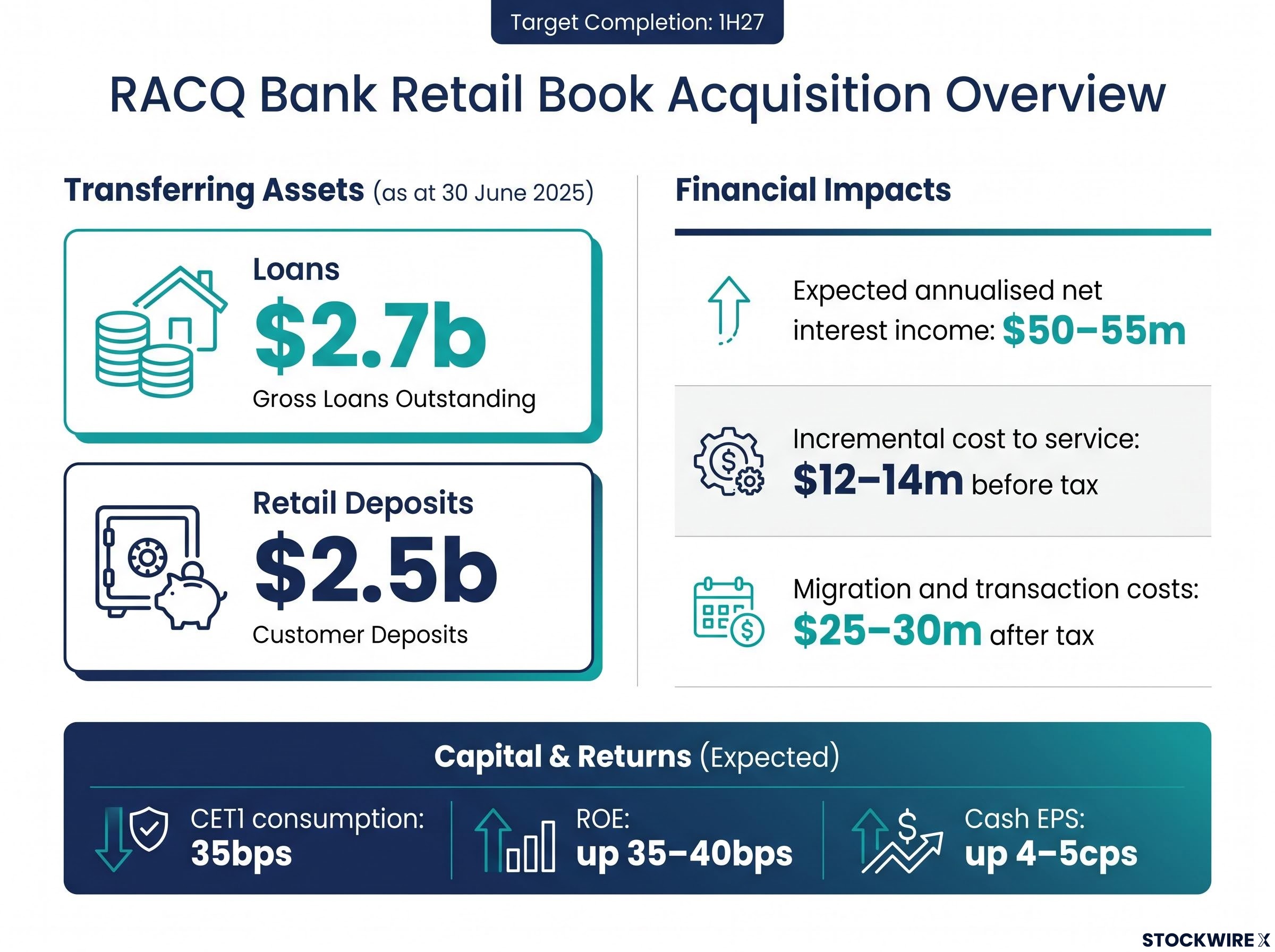
The presentation reaffirmed the planned acquisition of the RACQ Bank retail loan and deposit books, which management stated remains on track for completion during 1H27, subject to regulatory approvals and other customary conditions. Figures are based on the transferring book as at 30 June 2025.
-
Loans of $2.7b and retail deposits of $2.5b transferring
-
Expected annualised net interest income of approximately $50–55m, with incremental cost to service of approximately $12–14m before tax
-
Estimated migration and transaction costs of approximately $25–30m after tax
-
Approximately 35bps of CET1 consumption, to be funded from excess capital
-
Expected to be ROE and cash EPS accretive on an annualised basis, subject to completion: ROE up 35–40bps and cash EPS up approximately 4–5cps
The transaction is expected to complete during 2Q FY27, with customer migration to the bank’s products and core banking system at completion.
Risk management named the number one priority
The presentation was candid that risk uplift is central to the FY26 story and to future sustainable growth.
The Risk Rectification Plan carries an initial estimated cost of $70m provided for in FY26. The bank noted it is working proactively with its regulators, with the appointment of an Independent Reviewer and a comprehensive rectification plan to be prepared in line with APRA’s directions.
Separately, the Financial Crime Transformation Program targeting anti-money laundering and counter-terrorism financing (AML/CTF) is expected to absorb $70m to $90m of operating expenses over the next 2.5 years to uplift financial crime detection capability.
A proposed Banking Act penalty of $9.8m, including legal fees, sits within non-cash items. Management positioned these combined costs as foundational investments that weigh on statutory earnings in the near term while supporting sustainable growth.
FY27 outlook and 2030 targets
Management provided guidance for FY27 and reaffirmed its medium-term targets, framed as expectations rather than certainties.
| Item | FY27 guidance |
|---|---|
| BAU operating expense growth (ex RACQ) | 4–5% |
| Investment spend | $230–240m |
| Digital deposit sales target | >55% |
| Strategic partnership benefits (FY27) | $25–30m |
| Strategic partnership benefits (by FY28) | $65–75m |
| RACQ ROE uplift (FY27) | 23–27bps |
Over the medium term, management reaffirmed a target ROE of above 10% by 2030, a dividend payout ratio of 60–80% of cash earnings, and a Board CET1 target of above 10%.
The investment case
The presentation set out a strategy built on a strengthening low-cost deposit franchise, a disciplined productivity program leveraging partnerships with Infosys, Genpact and Google, and the growth optionality offered by the RACQ book acquisition. The bank’s CET1 ratio of 11.34%, described as approximately 28% above the major bank average on standardised risk-weighted assets, provides balance sheet flexibility.
The Infosys and Genpact partnerships carry upfront transition costs of $85-95m, with the majority expected to hit earnings in FY27 before a 15-month payback period returns the investment and the run-rate savings begin flowing through.
Brand strength featured heavily, with a Net Promoter Score of +21.8 above the industry average and a customer base of 2.95 million. These attributes support the bank’s target customer segments and its deposit-led growth strategy.
Balancing the outlook is the near-term reality of elevated non-cash and risk investment spend, which compresses statutory earnings while the journey towards the 2030 ROE target plays out. The result frames FY26 as a year of foundational investment against a backdrop of steady cash earnings and a maintained dividend.
When big ASX news breaks, our subscribers know first
Stay Ahead on ASX Finance News
Breaking ASX financial sector announcements land in your inbox within minutes of release, complete with in-depth analysis already done. Join 20,000+ investors who rely on Big News Blast for FREE real-time coverage the moment news breaks. Click the “Free Alerts” button to start receiving alerts before the broader market has a chance to react.