

EDU Holdings delivers 50% revenue growth as higher education transition accelerates
In its 1H26 results presentation, EDU Holdings reported revenue of $54.3m, up 50%, and net profit after tax of $9.3m, up 49%, with margins held steady at 17% for the half-year ended 30 June 2026.
Management outlined that the result was driven by the company’s ongoing shift toward higher education, which now accounts for 83% of Group enrolments. The company ended the period with $24.0m in cash and no debt, and declared a 3.0 cps fully-franked interim dividend, tripled from 1.0 cps in the previous corresponding period (PCP).
The presentation framed the half as a demonstration of both operating momentum and disciplined capital management, with the company returning surplus capital to shareholders while continuing to invest in growth.
When big ASX news breaks, our subscribers know first
1H26 result at a glance: earnings, cash and enrolment growth
EDU reported broad-based growth across its key financial metrics. Revenue rose 50% to $54.3m, EBITDA climbed 54% to $16.8m, and profit before tax increased 61% to $13.3m. Net profit after tax reached $9.3m, up 49% on the PCP.
The 1H26 result builds directly on record FY25 earnings that saw revenue reach $82.4m and NPAT surge to $14.8m, establishing the earnings base from which the current half’s 50% revenue growth is measured.
Operating cash generation remained strong, with operating cashflow of $25.1m supporting a closing cash balance of $24.0m and no debt. The company noted this position was maintained after $11.4m of buybacks and $3.8m of dividends paid during the half.
The enrolment story underpinned the earnings result. Higher education (HE) enrolments rose 57%, with Ikon recording 5,847 enrolments in T2’26 compared with 3,725 in the PCP. Total Group enrolments reached 7,036, up 32%.
| Metric | 1H26 | 1H25 | % change |
|---|---|---|---|
| Revenue | $54.3m | $36.1m | 50% |
| EBITDA | $16.8m | $10.9m | 54% |
| Profit before tax | $13.3m | $8.3m | 61% |
| NPAT | $9.3m | $6.3m | 49% |
| Enrolments | 7,036 | 5,321 | 32% |
Key enrolment mix shifts during the half included:
-
HE enrolments up 57%
-
Domestic new student enrolments (NSEs) up 98%
-
Postgraduate NSEs up 174%
Why the higher education shift matters
EDU has been progressively moving its portfolio away from lower-value vocational education and training (VET) courses toward higher education degrees. HE courses typically carry higher prices, longer study durations and more stable revenue over time, which improves the predictability and quality of the company’s earnings.
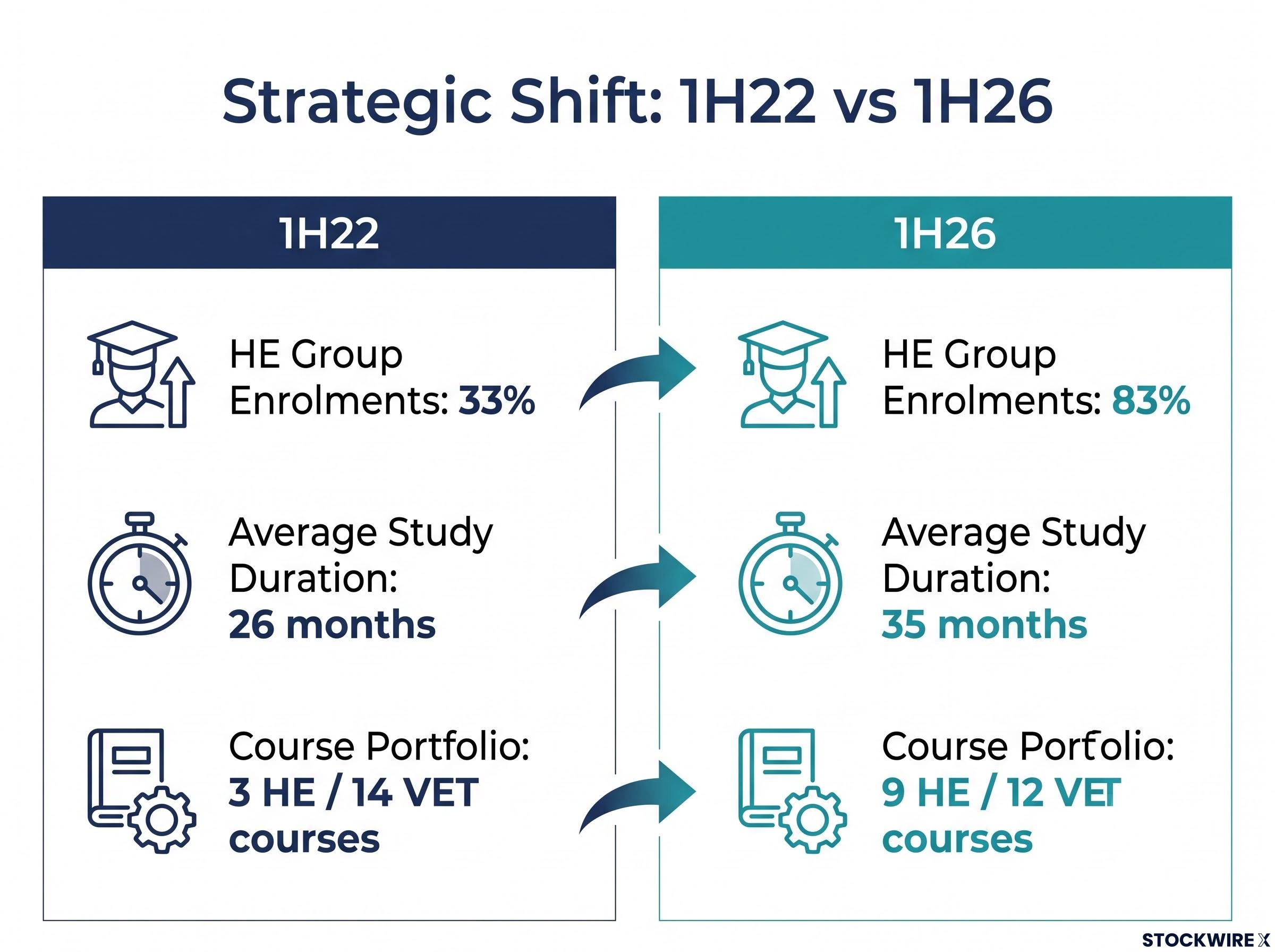
The scale of the transition is significant. Higher education represented 83% of Group enrolments in 1H26, up from just 33% in 1H22. Over the same window, the average study duration across programmes lengthened to 35 months from 26 months, and 98% of 1H26 enrolments sat within Education and Human Services courses, an area aligned to national skills shortages.
EDU’s course portfolio has expanded to 9 HE and 12 VET courses, compared with 3 HE and 14 VET courses in 1H22, with a further 2 HE courses submitted for accreditation. For investors, the shift to higher education enhances earnings quality through longer average study duration.
| Course type | Avg price/year | Avg duration |
|---|---|---|
| Certificates | $12,600 | <1 year |
| Diplomas | $16,200 | 1–2 years |
| Bachelors | $19,500 | 3–4 years |
| Masters | $21,700 | 1.5–2 years |
Diversification driving resilient growth
Management pointed to a broadening set of growth engines that are reducing concentration risk across the business. New courses launched since 2025 accounted for 30% of total HE enrolments in 1H26, equivalent to 1,729 enrolments in T2’26, while postgraduate market entry drove 43% of HE enrolment growth over the past 18 months.
Domestic momentum was a standout feature of the half:
-
T2’26 total enrolments up 38% on the PCP
-
Domestic NSEs up 98%, supported by a step-up in performance marketing and an expanded sales team
-
Campus footprint of 84 classrooms (+10 vs PCP) across four states plus online, with utilisation headroom (Adelaide at 27%, Sydney at 62%)
Growing the domestic base is strategically important because domestic students are not affected by tighter visa settings, reducing EDU’s exposure to regulatory uncertainty affecting international students. The company also continued investing in offshore recruitment, deploying in-country sales managers across Latin America, Europe, Africa, South Asia and Southeast Asia, though this will take time to build meaningful volume.
A fortified balance sheet and strong cash generation
EDU reported operating cashflow of $25.1m, up from $19.7m in the PCP, and free cashflow of $20.8m, which the company noted reflects the seasonality of tuition fee inflows. Closing cash stood at $24.0m with no debt, and net cash rose $5.5m over the half.
A notable milestone was the company’s return to positive retained earnings. EDU recorded $1.3m in retained earnings, an improvement of $6.0m from a $4.7m accumulated loss position.
During the half, $15.2m was returned to shareholders via buybacks and dividends, with 20.2m shares bought back and cancelled for $11.4m.
The Board noted it remains confident in EDU’s long-term positioning as a quality provider in high demand sectors.
Navigating the regulatory landscape
International education operates within a defined planning framework. The National Planning Level (NPL) is a benchmark for new international student commencements, used to guide offshore visa processing prioritisation. The 2026 and 2027 NPL is set at 295,000, up from 270,000 in 2025, with growth weighted toward higher education, particularly public universities.
A key positive for EDU is the lift in its 2027 Provider Limits. Ikon’s limit rises to 900, up from 205 in 2026, while ALG’s increases to 488 from 471. Management clarified that Provider Limits are not caps; all applications continue to be processed, but at different speeds depending on priority level.
Recent amendments to the National Code 2018 restrict providers from paying commissions to education agents for onshore transferring students. Notably, there are no restrictions for domestic, offshore, or onshore students commencing a new course after completing their principal course. EDU’s domestic and diversification strategy positions it to adapt to these settings.
2H26 outlook and what comes next
For 2H26, management guided revenue, EBITDA and NPAT to be up on the PCP, alongside a step-up in costs to support higher student volume and continued investment in diversification. Further guidance is expected to be provided later in the year.
Investors exploring the enrolment data in depth can find our detailed coverage of EDU’s T2 2026 enrolment results, which breaks down the postgraduate intake surge, domestic share shift, and forward revenue visibility implied by year-to-date enrolments of 13,663.
On capital management, the company reiterated its focus on balancing growth investment, balance sheet flexibility and shareholder returns. The new Adelaide campus fit-out is expected to be completed imminently, with teaching to begin in T3’26, while the Melbourne campus upgrade is expected to commence in 2H26 and be delivered in phases through to June 2027.
The 3.0 cps fully-franked interim dividend carries a record date of 18 September 2026 and is payable on 30 September 2026. Management closed by reaffirming the Board’s confidence in EDU’s long-term positioning as a quality provider in high-demand sectors.
Don’t Miss the Next Consumer Sector Winner on ASX
Big News Blast delivers FREE breaking ASX news and in-depth analysis straight to your inbox within minutes of release. Join 20,000+ investors who stay ahead of the market the moment announcements drop. Click the “Free Alerts” button at Big News Blast to start receiving real-time coverage across ASX Consumer and beyond.