
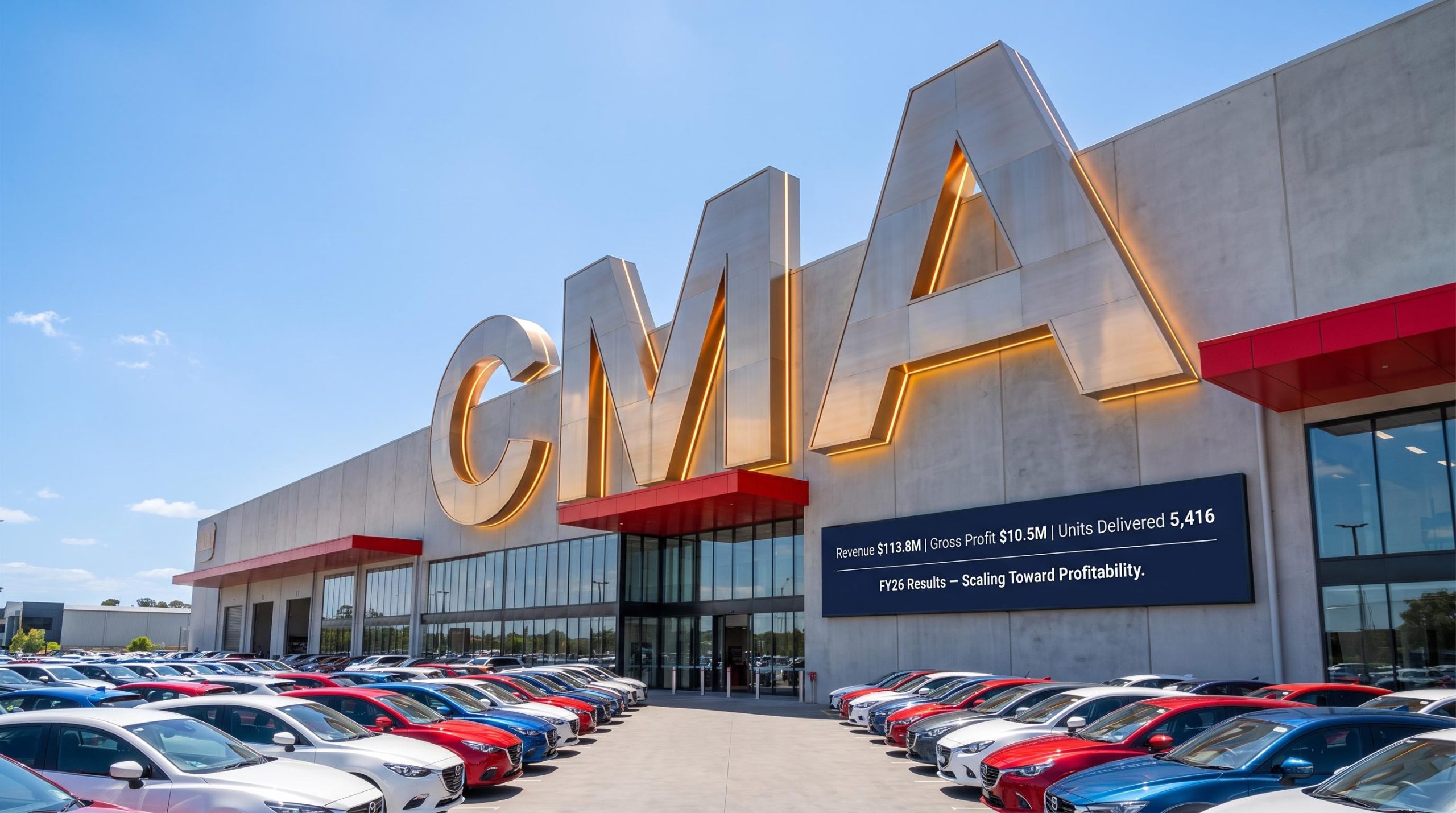
Carma outlines doubling of gross profit and a clear path to profitability in FY26 results
In its FY26 results presentation, Carma (ASX) reported that gross profit more than doubled to $10.5m (up 102%), while revenue rose 59% to $113.8m and units delivered climbed 86% to 5,416 for the year ended 30 June 2026.
The Carma FY26 results depict a scaling online used-car retailer moving toward profitability, backed by its November 2025 initial public offering (IPO).
Management framed the year around three threads: record volumes, improving unit economics, and an ambitious FY27 roadmap. Each figure below is drawn directly from the presentation delivered on 31 August 2026.
When big ASX news breaks, our subscribers know first
FY26 by the numbers: revenue, volumes and margins all step higher
Higher volumes translated into wider margins as the business scaled, with profitability improving across the board. The company delivered 5,416 units (up 86%), generating revenue of $113.8m (up 59%) and gross profit of $10.5m (up 102%).
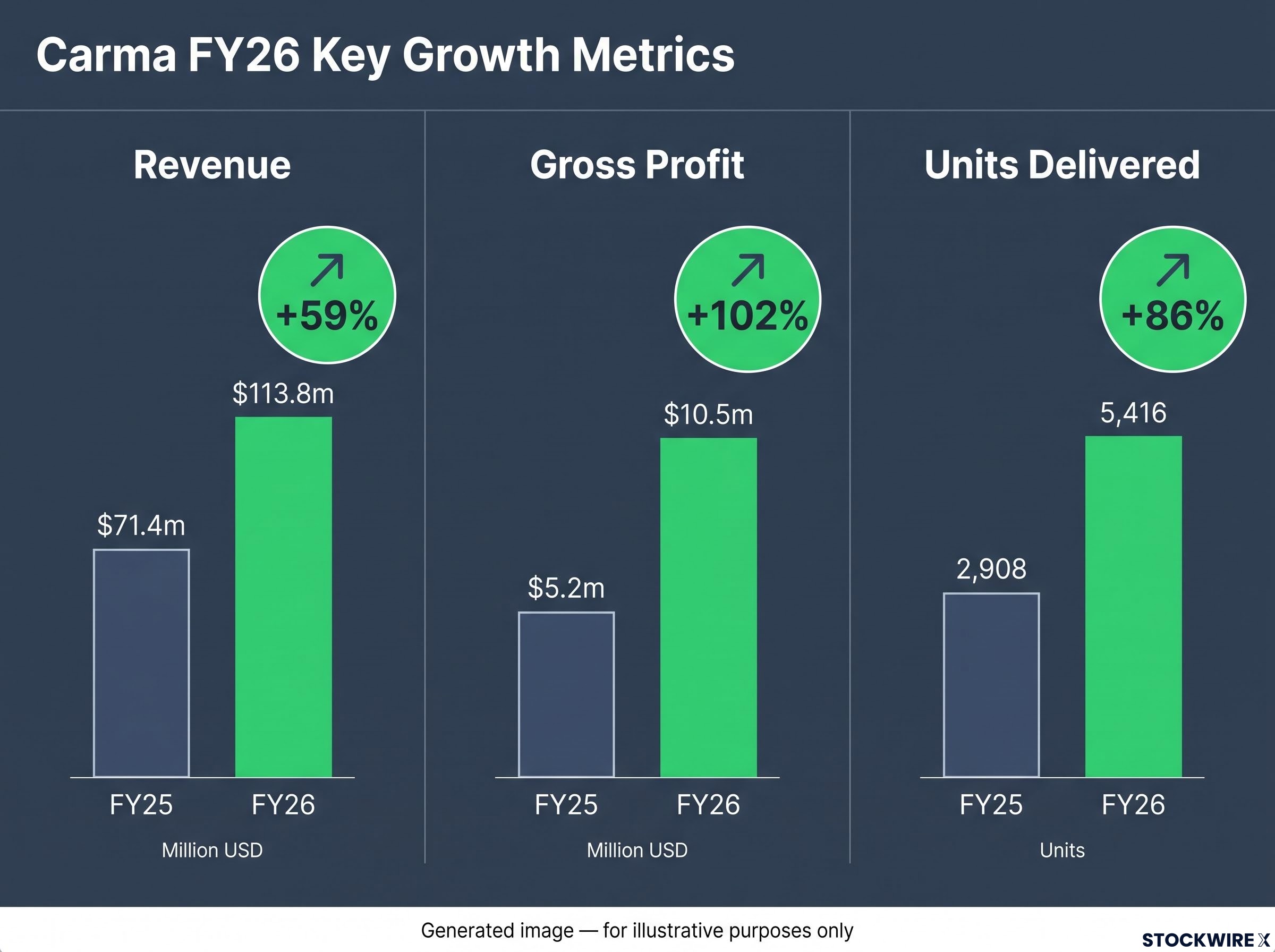
Gross profit margin expanded to 9.2%, an improvement of 196bps on FY25. On a Pro Forma basis, the EBITDA margin came in at (26.5%), an improvement of 1,248bps versus the prior year.
The operational engine supported these results. Vehicles purchased grew 127% to 6,235, while retail units reconditioned rose 99% to 3,743. The scorecard below summarises the year-on-year movement across the headline metrics.
| Metric | FY25 | FY26 | Change | Why it matters |
|---|---|---|---|---|
| Revenue | $71.4m | $113.8m | +59% | Reflects record unit volumes despite lower average selling prices |
| Gross profit | $5.2m | $10.5m | +102% | Profit growth outpaced revenue, signalling margin expansion |
| GP margin | 7.3% | 9.2% | +196bps | Direct sourcing lowered purchase costs |
| Pro Forma EBITDA margin | (38.9%) | (26.5%) | +1,248bps | Operating leverage narrowing losses as volume scales |
| Units delivered | 2,908 | 5,416 | +86% | Record throughput underpinning the growth story |
Sell-to Carma now supplies nine in ten vehicles
The strategic engine of the business is Sell-to Carma, the company’s direct and proprietary consumer sourcing channel. Management highlighted that Sell-to Carma accounted for 89% of all FY26 vehicle purchases, growing 3.5x over the prior year.
Nine centres were open at 30 June 2026 across New South Wales, including geographical expansion beyond Sydney into Newcastle (Kotara) and Wollongong (Albion Park). Direct channels drove over 50% of retail deliveries.
The company noted that cars purchased direct from consumers typically deliver greater profitability than traditional sources, while also fuelling growth in the wholesale business. Carma is also designated as the NRMA’s exclusive preferred used car dealership.
Underpinning volume growth was the completed upgrade to the St Peters reconditioning facility. Key highlights include:
-
Three sites consolidated into one 35,000m² facility
-
Purpose-built line based on lean manufacturing principles
-
Q4 exit run-rate of 21.7 retail units reconditioned per shift (up from an average of 7.5 in FY25)
-
Regulatory approval and infrastructure in place for a second production line
What “unit economics” means and why it matters for Carma
Unit economics refers to the profit and cost associated with a single unit of a product, in this case, one car. A key measure is gross profit per unit (GPU), which is the profit earned on each vehicle after sourcing and reconditioning costs are accounted for.
A vertically integrated model, where the company buys direct, reconditions in-house, and prices vehicles using its own models, can lift GPU as volume grows. This is the operating-leverage story: as more cars move through fixed facilities, the cost per car falls.
Inventory days efficiency improved markedly through the year, with the platform reducing average days-to-sale from over 150 days in early FY23 to 30 days by Q1 FY26, a compression that directly supports GPU and working capital performance.
Total GPU rose 35%, with retail GPU reaching $2.5k (up 22%) and wholesale GPU increasing to $0.4k. Rising GPU alongside 86% volume growth is the mechanism management points to as driving Carma toward its stated EBITDA breakeven.
The company noted that Q4 saw some margin pressure from macroeconomic conditions, including a fuel price shock from March 2026. Despite this, it recorded a record quarter for both retail and wholesale deliveries.
A stronger balance sheet post-IPO
Carma’s $100m offer ($70m primary, $30m secondary) provided the funding platform for its growth, with the company listing on the ASX on 5 November 2025. The balance sheet strengthened materially over the year as a result.
Cash rose to $16.0m (up from $6.3m), while total equity moved to $52.2m (from negative $10.3m) as convertible notes converted into ordinary shares. Inventory stood at $32.4m at year end.
Total available funding was $41.3m, comprising cash plus $25.3m of unused bailment finance facility. Operating cash flow before vehicle inventory held flat at ($25.6m), with an inventory build of $18.3m funded from cash, leaving the company well-funded to scale into FY27 with limited additional capital expenditure required.
Three strategic priorities set the FY27 growth agenda
Management outlined a forward roadmap built around three strategic priorities designed to deliver a step-change in unit economics and scale over the next 12 months.
-
Apollo program — a whole-of-company operational improvement program targeting a step-change in unit economics ahead of the next doubling, from roughly 500 to over 1,000 retail cars per month. Launched in July 2026, with 266 actions identified.
-
AI and platform reinvention — rebuilding the technology stack in-house, with 18 AI-native systems live between March and August 2026 and a median of 2.6 hours from change request to production. Core migration is targeted through H1 FY27.
-
Scaling into built capacity — a second shift at St Peters, launching in the March Quarter of FY27, is expected to double reconditioning capacity to approximately 60 retail units per day (around $500m revenue per annum). An approved second line could reach approximately 120 per day (around $1bn per annum).
The presentation detailed an AI structural-advantage thesis, noting that Carma “buys software and sells cars.” Management’s view is that the company has no software revenue or matching fee to defend, unlike classifieds or SaaS peers.
Current trading and FY27 outlook
Management pointed to a strong start to FY27. Retail deliveries booked from 1 July to 31 August were up 120% on the prior year, July reconditioning output exceeded the Q4 FY26 record, and August was on track to be the largest retail delivery month to date.
On margins, the company noted a recovery as market conditions stabilised. Vehicles sold within 30 days of listing, representing 56% of sales, earned approximately $3,300 retail GPU in the September quarter to date, described as the highest on record.
Management’s FY27 guidance includes:
-
Revenue to grow over 80%
-
Second shift to double reconditioning capacity in the March Quarter FY27
-
Exit FY27 at approximately 750 retail units per month (more than 35 per operating day)
-
Positive EBITDA expected at 45–60 units per operating day, anticipated before the end of calendar 2027
The presentation positioned Carma as a scaling, well-funded operator in a fragmented $118 billion used car market, with a differentiated integrated model and a defined route to breakeven.
Don’t Miss the Next Consumer Sector Breakout
Big News Blast delivers FREE breaking ASX news straight to your inbox within minutes of release, complete with in-depth analysis. Join 20,000+ investors already staying ahead of the market. Click the “Free Alerts” button at Big News Blast to start receiving alerts the moment consumer sector news breaks.