FY26 results: A business reset in a tough year
In its FY26 full-year results for the period ending 30 June 2026, Southern Cross Media Group (ASX: SXL) reported gross revenue of $1,869.6M, down 4.5%, with reported net profit after tax (NPAT) of $9.9M.
These were the first full-year figures for the merged SCA and Seven West Media (SWM) business, a group that now reaches more than 20 million Australians a month across television, audio and publishing.
The post-merger executive restructure that preceded these results included an immediate CEO departure and the appointment of an Interim Executive Chairman, with a global search ultimately delivering Rohan Lund to the managing director role.
The result carried a dual narrative. Difficult advertising conditions weighed on the top line, while share gains and cost discipline provided a partial offset. EBITDA finished above the company’s revised guidance.
All figures are presented on a pro forma basis, treating SCA and SWM as merged for the entirety of both FY25 and FY26.
When big ASX news breaks, our subscribers know first
FY26 headline financial results
Management attributed a $125M revenue impact to broader market conditions, with share gains recovering $41M of that decline. Total costs came in 3% lower year-on-year, reflecting merger synergies, procurement scale and operating model changes, alongside $15M of Commercial Broadcasting Tax relief.
EBITDA of $191.9M (excluding onerous contracts) rose to $200.0M on an including-onerous basis. The $8.1M difference was a non-cash release from onerous contract provisions.
The steeper NPAT decline was driven in part by statutory accounting factors. Depreciation and amortisation rose 21.6%, primarily reflecting the impact of acquisition-day accounting on asset values in Television and Publishing. The effective tax rate fell to 22.6% from 26.7%, reflecting higher government rebates on programming assets.
| Metric | FY26 | FY25 | YoY Change |
|---|---|---|---|
| Gross revenue | $1,869.6M | $1,958.2M | (4.5%) |
| Total costs | $1,677.7M | $1,730.7M | (3.1%) |
| EBITDA (inc onerous) | $200.0M | $229.3M | (12.8%) |
| EBITDA margin (exc onerous) | 10.3% | 11.6% | (1.4 ppt) |
| Reported NPAT | $9.9M | $23.3M | (57.6%) |
| Net debt | $362.8M | $357.0M | 1.6% |
| Reported leverage | 1.8x | 1.5x | (0.3x) |
Divisional performance: Television, Audio and Publishing all strengthened position
Television held share against a contracting market
Seven was Australia’s most-watched network in FY26 with a 42.5% audience share, up 1.3 ppts, described as a record share achieved outside an Olympics year. Streaming platform 7plus delivered its best result ever, averaging 42.2% audience share and ranking as the fastest-growing broadcast video on demand (BVOD) service in Australia, with audiences up 53%.
TV revenue of $1,251.5M was 6.6% lower against an advertising market that contracted 9.9%. Revenue share rose 1.2 ppts to 41.6%, and digital revenue grew 10.6%.
Television EBITDA (excluding onerous contracts) of $109.6M was 32.3% lower, reflecting the first-year step-up in AFL rights and the wider market decline.
Audio the standout performer
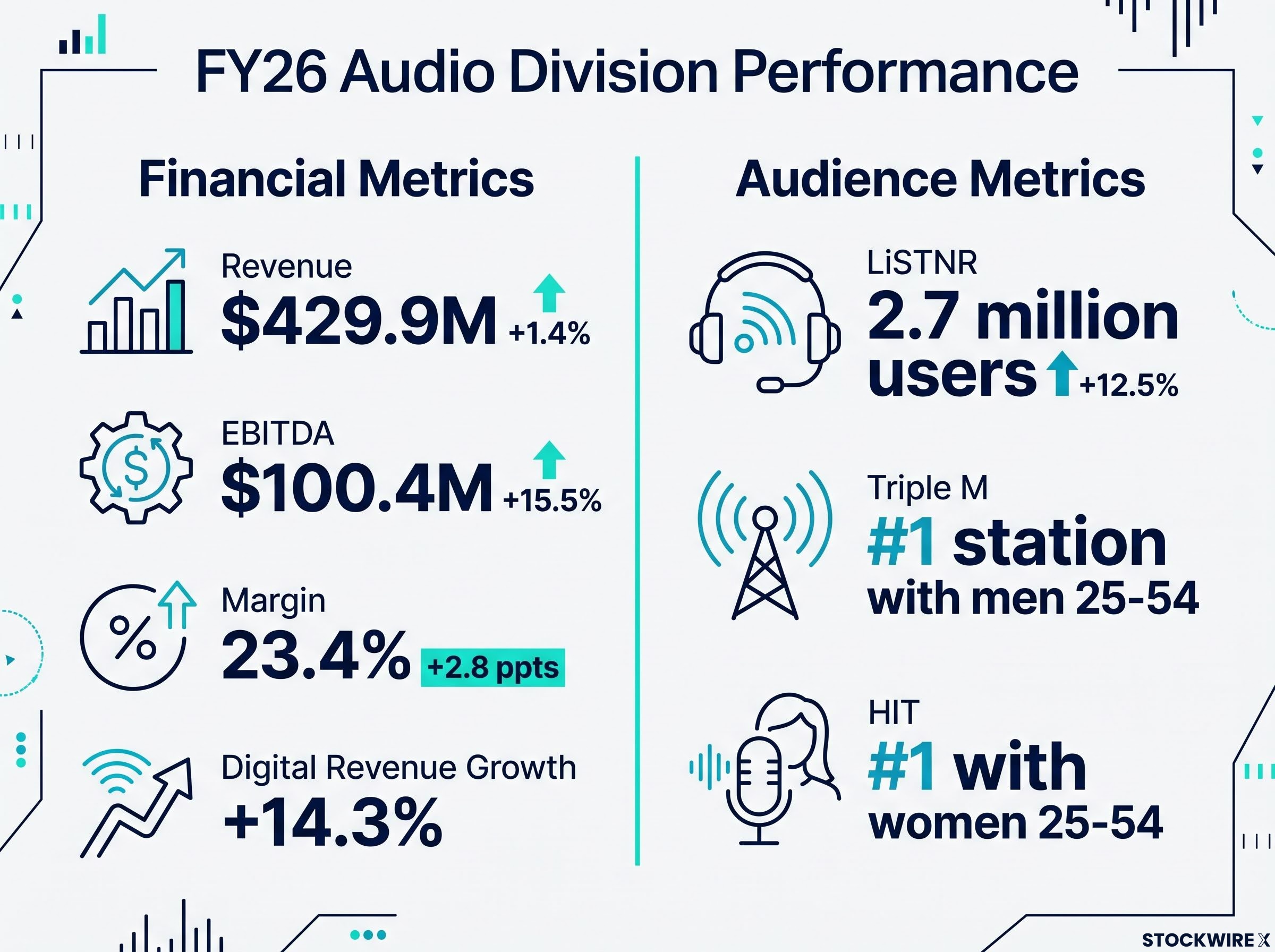
Audio revenue of $429.9M was up 1.4%, the standout result across the Group. Divisional EBITDA of $100.4M rose 15.5%, with margin up 2.8 ppts to 23.4%.
Seven merger integration was already yielding measurable audio gains at the half-year mark, with the division delivering 28% EBITDA growth to $40 million in H1 FY26 even as metro radio advertising markets contracted 7%.
Digital revenue grew 14.3%, more than offsetting the decline in broadcast. According to the company, it was the first year digital growth outpaced the broadcast decline. Key audience metrics included:
- LiSTNR reached 2.7 million registered users, up 12.5%
- Triple M ranked Australia’s #1 station with men 25-54
- HIT ranked #1 with women 25-54
Publishing: WA’s #1 digital news source
Publishing revenue of $187.0M was 3.1% lower, with EBITDA of $26.2M and digital revenue up 5.7%. The West brand group was WA’s #1 digital news source, with 40 million monthly page views. The Nightly, launched in 2024, is now a top-25 national news site, while The Game app registered users increased 16.5% following AFL expansion and an NRL soft launch.
Why the financial reset matters to investors
For readers less familiar with the terminology, merger synergies are the cost savings achieved by combining two businesses, such as removing duplicated functions. Onerous contracts are agreements where costs exceed the benefits, and annualised savings represent the full-year run-rate impact of cost actions.
The reset centred on two pillars. First, $30M of annualised merger synergies were delivered a year ahead of schedule, and an expanded program targeting $145M to $150M of annualised savings (inclusive of the $30M already achieved) started in Q4 FY26.
Second, the Group replaced the separate SCA and SWM debt facilities with a single $569M syndicated facility, arranged by ANZ, Commonwealth Bank and Westpac. Split across three- and four-year tranches, the facility has no syndicated maturities until July 2029, with first maturities in FY30, providing greater balance-sheet certainty.
The Ventures portfolio was wound down, and net debt was contained at $362.8M with leverage at 1.8x. Together, the cost-out program and refinancing are positioned to de-risk the merged entity as advertising conditions recover.
Rohan Lund, Managing Director & CEO
“Trading conditions were difficult, particularly in television through Q4, and revenue came in below where we expected. Share gains and cost discipline partially offset that, and EBITDA finished above our revised guidance. Digital kept growing while broadcast markets contracted. We delivered our merger synergies a year earlier than expected, expanded our cost program, and refinanced our debt.”
Cashflow and balance sheet position
Cashflow available for debt service was $41.0M, down 52.7%, an EBITDA cash conversion of 71% against 85% in FY25. The decline reflected working capital movements, primarily the unwinding of accrued leave on redundancies, and non-cash onerous contract items.
Capex of $27.5M, down 22.5%, was invested in digital assets and broadcast equipment. Net debt of $362.8M rose 1.6% after merger transaction costs of $22.0M and dividends of $9.6M, partly offset by $12.1M from the sale of Ventures interests.
Outlook: Building for growth and value
The Group’s Q1 FY27 trading update (covering July to September 2026) outlined three key trends:
- Television revenue tracking flat year-on-year, with share gains from the Commonwealth Games and AFL finals offsetting a market down mid-single digits.
- Audio revenue up low single digits.
- Publishing revenue stable year-on-year.
Management expects advertising conditions to remain short and volatile, with variable consumer and advertiser sentiment. Total operating expenses are expected to grow below inflation, and cost-out actions are tracking to plan for FY27 delivery. One-off costs are anticipated for major sport events, including the Commonwealth Games and Rugby League World Cup.
The company’s Annual General Meeting will be held on 5 November 2026, with the closing date for director nominations set at 17 September 2026.
Management reinforced the Group’s strategy of bringing Australians together through trusted content, converting that connection into audiences advertisers can buy across television, audio and publishing, and running the business with discipline as one team.
Don’t Miss the Next Media Sector Announcement
Big News Blast delivers FREE breaking ASX news directly to your inbox within minutes of release, complete with in-depth analysis. Join 20,000+ investors already staying ahead of media and communications sector moves. Click the “Free Alerts” button at StockWire X to get the next market-moving announcement the moment it drops.