
ARN Media resets cost base and strengthens balance sheet in 1HFY26
In its Half Year Results 2026 investor presentation, released on 21 August 2026, ARN Media outlined a transformation focused on cost discipline, a strengthened balance sheet and a clear digital growth strategy for the half year ended 30 June 2026.
Presented by Chief Executive Officer Michael Stephenson and Chief Financial Officer Alexis Poole, the update acknowledged revenue headwinds while emphasising capital discipline. Total revenue came in at $127.9m, down 14% on the prior corresponding period, with EBITDA of $18.2m and net debt reduced to $49.4m, a $28.1m improvement versus 1HFY25.
Net profit after tax (NPAT) before significant items landed at $4.2m. Management framed the result around three key takeaways: transformation, costs and revenue.
When big ASX news breaks, our subscribers know first
The 1HFY26 numbers at a glance
The headline result reflected a revenue decline partially offset by cost and capital discipline. On a normalised basis, excluding 1HFY25 federal election advertising revenue and the impact of ATN contract negotiations, revenue fell 10% for a like-for-like view.
Free cash generated reached $18.6m, representing a free cash conversion of 202%.
| Metric | 1HFY26 | 1HFY25 | Variance |
|---|---|---|---|
| Total Revenue | $127.9m | $149.5m | -14% |
| OpEx | $84.5m | $96.7m | -$11.8m |
| EBITDA | $18.2m | $24.9m | -$6.8m |
| NPAT | $4.2m | $8.4m | -51% |
| Net Debt | $49.4m | $77.5m | -$28.1m |
| Digital revenue share | 11% | 9% | – |
Cost discipline and a stronger balance sheet
Management detailed a continued cost-out programme, with $11.8m actioned in 1HFY26. This brought cumulative savings to $42.5m since FY24, keeping the company on track to deliver approximately $55m by the end of FY27.
The balance sheet was strengthened across several measures during the half:
- Cash up 72% to $17.6m, providing greater liquidity and headroom.
- Net debt down 23% to $49.4m, a $28.1m decrease versus 1HFY25.
- Refinanced debt facility extended to December 2028.
- Net Debt/EBITDA of 1.5x on a continuing operations basis, well below the target of less than 3x.
Two strategic items provided further clarity. The settlement with Kyle Sandilands, valued at $12.1m, is being paid over a three-year term ending in 2029, with ARN entitled to 19.9% of net revenue from the new venture for up to three years. Management noted this creates clarity and certainty for shareholders.
The company also entered into an agreement to sell Cody Hong Kong to DFI Retail Group, removing $30m of parent and bank guarantees and simplifying the portfolio (refer ASX release dated 30 June 2026).
The Cody HK divestment to DFI Retail Group is structured with 75% of consideration paid upfront and 25% deferred twelve months after completion, with the more significant balance sheet event being the release of A$30.5 million in bank guarantees that had been encumbering the group.
CEO Commentary (paraphrased)
Chief Executive Officer Michael Stephenson conveyed that the company has stabilised its core business and re-set its cost base, creating strong foundations to build on.
Why metro radio revenue share matters
A central theme of the presentation was the gap between what ARN’s audiences deliver and what those audiences convert into revenue. Audience share measures how many listeners a network attracts, while revenue share measures the proportion of advertising dollars it captures. When revenue share sits below audience share, it signals that existing listeners are not yet being fully monetised.
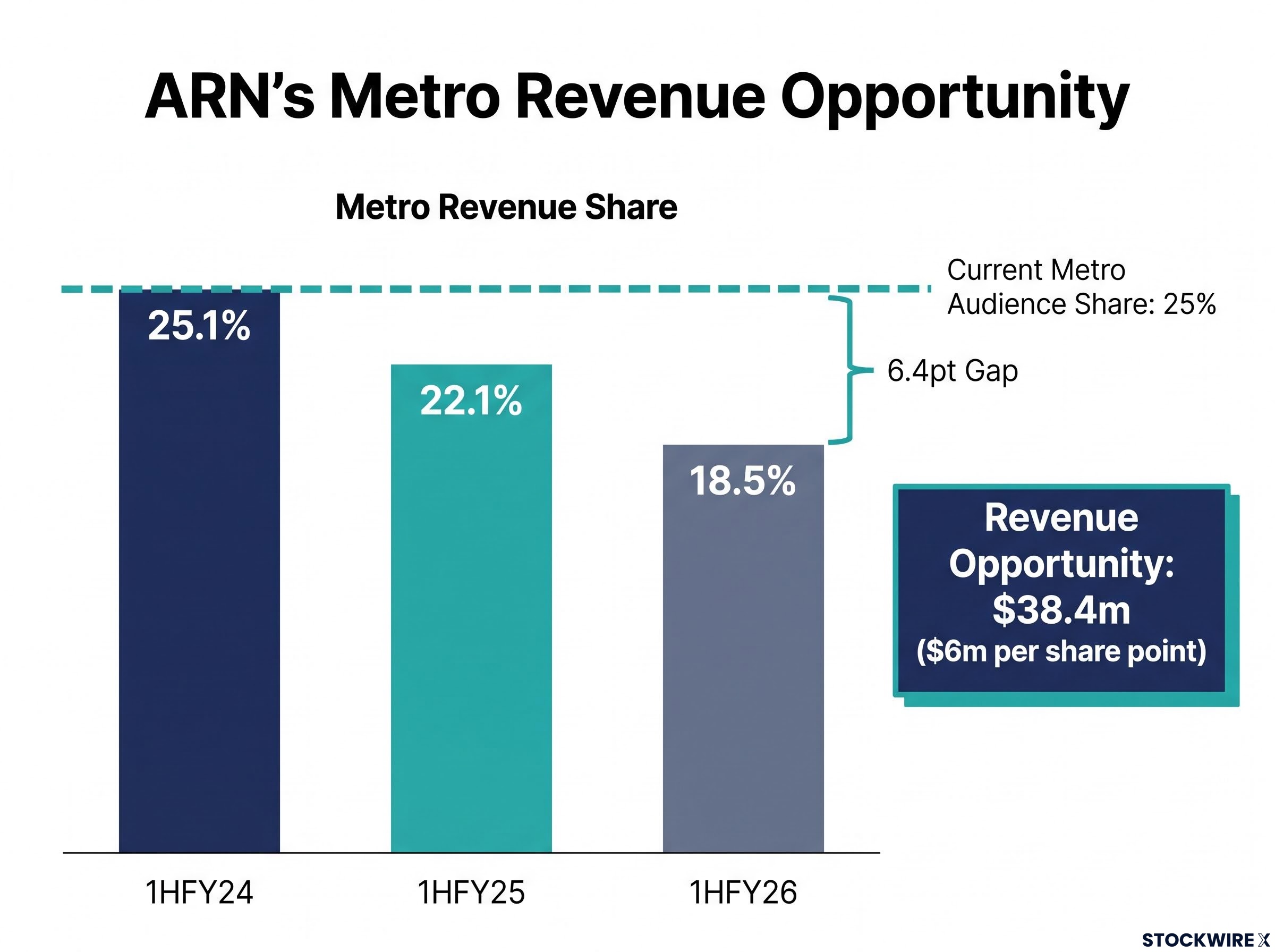
ARN reported a metro audience share of around 25% but a metro revenue share of just 18.5% in 1HFY26. That revenue share has declined from 22.1% in 1HFY25 and 25.1% in 1HFY24, a fall management attributed to brand safety issues.
According to the company, every metro share point equates to approximately $6m per year. The 6.4pt gap between audience and revenue share therefore represents a revenue opportunity of around $38.4m.
For investors, this sits at the centre of the turnaround thesis. The focus is on regaining lost share, meaning the pathway involves converting an existing audience base back into revenue.
Digital and video: the growth engine
Digital was positioned as the growth engine of the business, now contributing 11% of total revenue compared with 9% in the prior period. The presentation detailed a series of digital gains:
-
Digital EBITDA of $2.1m, up 55% on 1HFY25.
-
Live streaming revenue growing at +16%.
-
Data revenue growing at +70%.
-
50% of digital revenue now carries data attached, sold at a CPM premium.
The company highlighted its data infrastructure, comprising 5 million registered users and more than 800 audience segments, supported by partnerships with Westpac, Experian and Azira.
ARN also outlined a long-term licence agreement with iHeart carried out with no capital expenditure. The iHeart network reaches 7 million monthly listeners and holds a 33% share of commercial podcast downloads.
The iHeart licensing deal was renewed for a ten-year term at the 2026 AGM, with ARN framing the arrangement as the primary vehicle for entering the $5 billion Australian digital video advertising market without requiring material capital expenditure.
Looking ahead, management pointed to video as a material growth opportunity, with the company targeting entry into the $5bn digital video market through short-form video, video podcasts, catch-up radio and live-streamed shows.
Market position and outlook
The presentation positioned ARN as Australia’s number 2 radio network, with a 28% national commercial radio share compared with SCA at 37%, reaching 15.3 million Australians.
The total audio advertising market is forecast to be broadly flat in FY26, with growth in digital expected to offset low single-digit declines in the radio market.
Management set out a “Now, New, Next” roadmap:
- 2026: stabilise and protect the core radio business and regain lost metro radio revenue share.
- 2027: accelerate the digital and video transformation and operationalise key content, data and technology initiatives.
- 2026-2030: pursue strategic differentiation as an entertainment company, diversifying revenue and earnings.
On trading, metro revenue share is expected to improve in 2HFY26 versus 1HFY26, with regional share expected to remain stable and digital continuing to grow. The company reiterated it remains focused on delivering $55m of cost-out by FY27.
The investment case
The presentation set out a thesis built on a de-risked balance sheet, a disciplined cost base and a clear path to recover the roughly $38.4m metro revenue opportunity, alongside digital and video optionality.
The three takeaways framed the narrative: transformation, with the core stabilised; costs, with a $55m target; and revenue, where share sitting below audience share signals upside. Revenue is still declining, but the foundations are being built.
Don’t Miss the Next Media Sector Mover
Big News Blast delivers FREE breaking ASX news straight to your inbox within minutes of release, complete with in-depth analysis. Join 20,000+ subscribers already getting the edge on media and beyond. Click the “Free Alerts” button at StockWire X to start receiving alerts the moment market-moving announcements hit the ASX.