
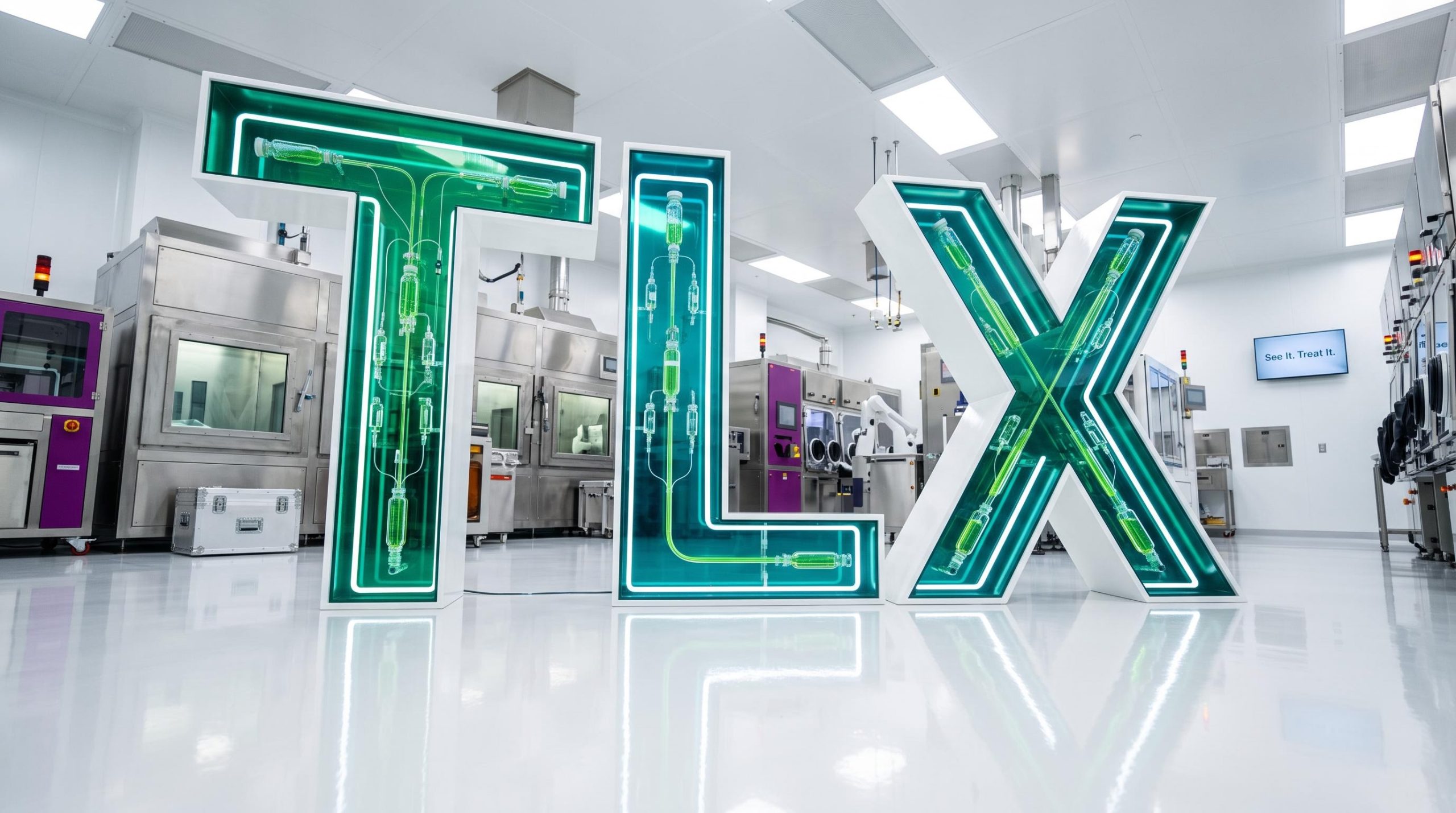
In its Capital Markets Day presentation on 4 November 2026 in Melbourne, Telix Pharmaceuticals outlined a strategy built on three growth engines. These are a scaled commercial business, a therapeutic and precision medicine pipeline, and best-in-class manufacturing and supply.
Management also covered the proposed ITM transaction and its capital allocation approach.
Telix outlines three growth engines at Capital Markets Day
Management described Telix as a diversified, vertically integrated radiopharmaceutical company built around an integrated theranostic approach, summarised as “See It. Treat It.” The presentation positioned commercial scale as the base that supports pipeline investment and strategic optionality, including M&A.
The headline figures, as of 30 October 2026, were 3 FDA-approved products (Illuccix, Gozellix and Pixclara), Illuccix commercially available in 22 countries, and 45 manufacturing and distribution sites globally. FY2026 revenue guidance stands at US$950M-$970M (AUD $1.36-1.39B).
The company highlighted financial strength as the source of choice. Management said a scaled commercial base enables investment across the late-stage pipeline, infrastructure and M&A.
| Metric | Detail |
|---|---|
| FY2026 revenue guidance | US$950M-$970M |
| Precision Medicine gross margin (H1 2026) | 65% |
| Net profit after tax (H1 2026) | US$38M |
| Cash balance (as of 30 June 2026) | US$252M |
When big ASX news breaks, our subscribers know first
Late-stage pipeline and 2027 data readouts
The presentation identified four therapeutic candidates in late-stage trials, with the ITM transaction expected to close in FY2026, subject to Telix Shareholder approval, regulatory approvals and other customary closing conditions. Management pointed to several data readouts in 2027.
Four late-stage therapeutics
The table below reproduces the pipeline figures presented. Total addressable market (TAM) figures use modelled pricing of $4,000 per scan for Precision Medicine and $250,000 per treatment for therapeutics. The company stated these price points do not reflect the actual price charged or the price Telix will charge in the future.
| Asset | Indication | Status | US TAM | Next milestone |
|---|---|---|---|---|
| TLX591-Tx | Prostate cancer (mAPMR) | Phase 3 | ~$5.6B | Interim futility analysis |
| TLX597-Tx | Prostate cancer (mAPMN/S) | Phase 2 | ~$4.2B | Optimal-PSMA data readout |
| TLX101-Tx | Brain cancer (glioblastoma) | Phase 3 | ~$1.2B | Enrolment progression |
| TLX250-Tx | Kidney cancer | Phase 2/3 | ~$1.1B | Enrolment progression |
Clinical highlights
Presenters shared study updates and early data. These are presenter-reported results and early data, not definitive outcomes.
- BiPASS: the Phase 3 study (n=350) has completed patient enrolment.
- PRIMARY2: the investigator-initiated study (n=660) reported a 49% biopsy reduction with Ga-PSMA-PET plus mpMRI.
- IPAX-2: the Phase 1 study in newly diagnosed glioblastoma met its primary endpoint, with a maximum tolerated dose of 5GBq x 2 cycles plus standard of care.
- TLX597-Tx dosimetry: early data (n=12) showed kidney dosimetry of 0.28 Gy/GBq, against 0.58 for PSMA-617.
- ProstACT Global: the Phase 3 study for TLX591-Tx is enrolling patients in Part 2 globally.
How radiopharmaceuticals work: why theranostics and supply matter
Theranostics pairs a diagnostic imaging agent with a therapeutic radioisotope directed at the same target. In the “See It. Treat It.” model, the scan identifies disease and the therapy treats it.
Supply chain control featured prominently because the sector is defined by time-critical delivery, specialist infrastructure, complex regulation and limited suppliers. The presentation noted, for example, that the physical half-life of 68Ga is 68 minutes, meaning the isotope decays continuously after production.
Management said vertical integration supports supply security, speed and economics. Telix capabilities cited were ARTMS (isotope production), Telix Manufacturing Solutions (manufacturing, quality control and clinical doses) and RLS Radiopharmacies (radiolabelling, dispensing and a distribution network).
Market context
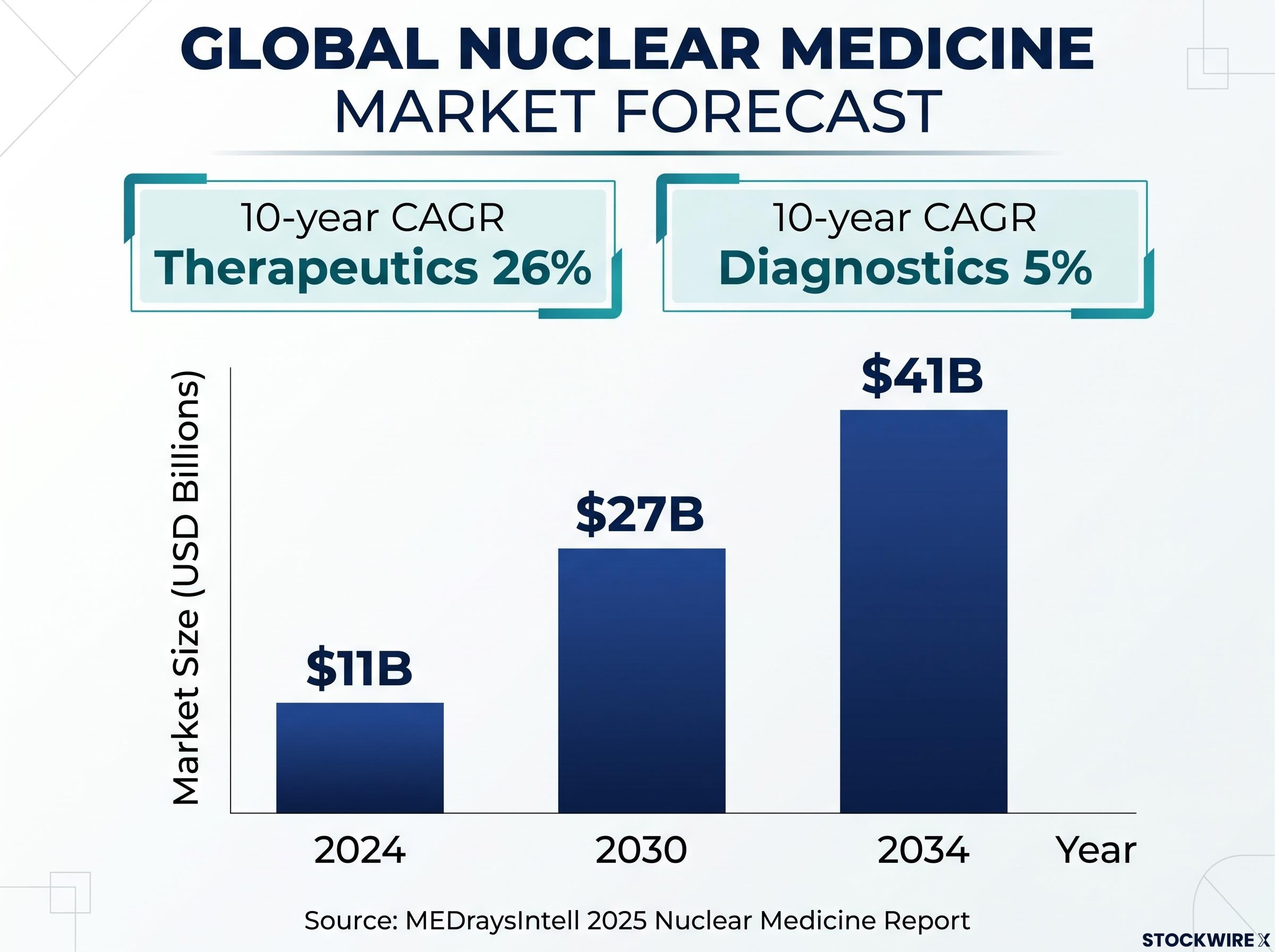
The presentation cited the MEDraysIntell 2025 Nuclear Medicine Report, which shows the global nuclear medicine market totalling 11, 27 and 41 (US$ billions) in 2024, 2030 and 2034 respectively. The report forecasts a 10-year CAGR of 26% for therapeutics and 5% for diagnostics. These are industry forecasts, not Telix guidance.
ITM transaction and capital discipline
The proposed ITM transaction is expected to close in FY2026, subject to Telix Shareholder approval, regulatory approvals and other customary closing conditions. Management presented it as reinforcing the three-engine strategy.
According to the presentation, ITM is the world’s largest supplier of 177Lu. ITM-11, a therapeutic for neuroendocrine tumours (GEP-NETs), carries a US TAM of ~$1.7B, included subject to closing of the ITM transaction.
On the financial side, the company cited the following, with the transaction expected to close in FY2026 subject to the same conditions:
- Positive EBITDA contribution from 2027 onwards.
- $50M targeted synergies in the first two years.
- Manufacturing gross margin above 40%.
Separately, the presentation referenced a co-development and co-commercialization agreement with Regeneron, covering 4 initial therapeutic programs with an option for 4 additional programs. The agreement includes up to US$2.1B in developmental and commercial milestone payments plus royalties for the initial programs.
The Regeneron partnership carries a 50/50 cost and profit-sharing structure, which lets Telix choose programme by programme whether to co-fund or opt out for milestones and royalties, and it came with US$40M upfront.
On spending, management pointed to R&D guidance of $240-260M for FY2026. The company stated that Telix’s R&D investment sits below the therapeutics peer average of 35% of revenue, which the presentation framed as disciplined investment supported by commercial scale.
For readers wanting the deal mechanics, our detailed coverage of the ITM acquisition terms sets out the upfront and deferred consideration, the pro forma group size, and the FDA Complete Response Letter issued on ITM-11 in August 2026.
What happens next for Telix
The presentation closed with a series of forward-looking items. All are subject to the conditions stated by the company, and the revenue bridge shown is illustrative only, with no FY2027 guidance implied.
- ITM transaction close: expected in FY2026, subject to Telix Shareholder approval, regulatory approvals and other customary closing conditions.
- 2027 data readouts: TLX591-Tx futility analysis, TLX597-Tx OPTIMAL-PSMA, TLX090-Tx (Part A) and BiPASS.
- Potential addition of three high-value commercial products in 2027 (Zircaix, BiPASS and ITM-11), subject to regulatory approvals.
- Potential launch of ITM-11 in late 2027 or 2028, subject to FDA approval.
- China and Japan: the Illuccix NDA is under review by the NMPA in China, and the Japan registration-enabling study has completed enrolment.
- IPAX BrIGHT: an IND has been filed to expand the study into the US and is under review.
Want the Next Healthcare Breakout in Your Inbox?
Join 20,000+ investors receiving FREE breaking ASX news within minutes of release, complete with in-depth analysis and the full announcement. Click the “Free Alerts” button at Big News Blast to get real-time healthcare alerts the moment market-moving news breaks, ahead of the wider market.